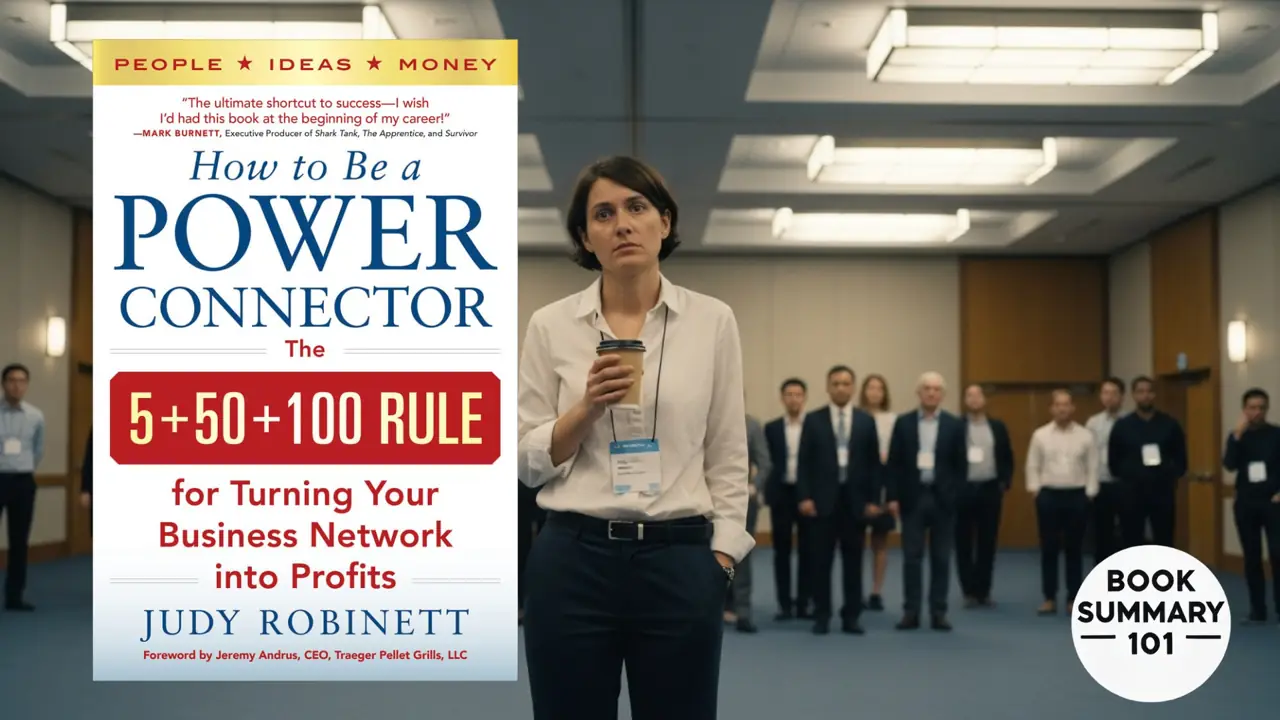
Let’s be honest for a second.
I used to absolutely dread networking events. You know the drill: you stand in a cold conference room, clutching a lukewarm coffee, awkwardly scanning nametags.
You spend two hours engaging in polite small talk, exchange a dozen business cards, and then go home.
And then? You put those cards in a drawer (or a rubber band stack) and never look at them again.
I always felt like I was doing it wrong. I thought networking was about volume—who had the most LinkedIn connections or the biggest stack of cards. It felt transactional. It felt fake. And frankly, it was exhausting.
That is, unti I picked up “How to Be a Power Connector” by Judy Robinett.
Reading this book felt like sitting down with a wise mentor who finally gave me permission to stop “schmoozing” and start actually building relationships. It wasn’t about being the loudest person in the room; it was about being the most strategic.
If you’ve ever felt like your professional network is a mile wide but an inch deep, this post is for you.
Why Should You Even Bother Reading It?
This isn’t just for salespeople or extroverted CEOs. Whether you are a shy creative, a mid-level manager, or an entrepreneur just starting out, this book solves the “overwhelm” problem.
We live in a hyper-connected world, yet we are lonelier and more disconnected than ever. Robinett argues that your “network” is actually your net worth—but only if you curate it properly.
If you are tired of wasted coffee chats and want a system that actually generates opportunities (and profit) without taking over your life, this methodology is the answer.
- Why Should You Even Bother Reading It?
- The Blueprint for Building a High-Value Ecosystem
- 1. The 5+50+100 Rule (The Magic Formula)
- 2. Become the Bridge (Connecting Different Worlds)
- 3. The “Give First” Mentality (Generosity as Currency)
- 4. No More Cold Calls (The Warm Intro Strategy)
- 5. Systematize or Fail (The “Power Grid”)
- My Final Thoughts
- Join the Conversation!
- Frequently Asked Questions (The stuff you’re probably wondering)
The Blueprint for Building a High-Value Ecosystem
Before we dive into the specific tactics, you have to understand the core philosophy here. Robinett teaches that you shouldn’t just build a list; you should build an ecosystem. Think of it less like collecting stamps and more like cultivating a garden. You need to know what you’re planting, where it goes, and how often to water it.
Here are the core principles that reshaped my thinking.
1. The 5+50+100 Rule (The Magic Formula)
This is the absolute heart of the book, and it solves the biggest problem we all have: Dunbar’s Number.
Dunbar’s Number is a cognitive limit that suggests humans can only maintain about 150 stable social relationships. Try to juggle more, and you’ll drop the ball. Robinett takes this limit and organizes it into three specific “Circles of Influence.”
Think of this like a solar system. You are the sun, and your contacts orbit around you at different distances.
- The Top 5 (Daily Contact): These are your closest allies. Your inner circle. They are the people you’d call in a crisis, your business partners, or your family. You are in touch with them almost every single day.
- The Key 50 (Weekly Contact): These are your critical value-adds. They are mentors, key clients, or collaborators who are vital to your current goals. You need to touch base with them roughly once a week.
- The Vital 100 (Monthly Contact): These are the people who keep you connected to the wider world. They might be industry peers, specialized experts, or friends you want to keep warm. You contact them once a month.
The Real-World Example:
Imagine you are launching a startup. Your co-founder and your spouse are in your Top 5. Your lead investor and your biggest beta-tester client are in your Key 50. That journalist you met once who covers your industry? She goes in the Vital 100.
If that journalist moves into a PR role for a massive firm, you might move her into your Key 50. It’s a fluid system, but it keeps you from ignoring important people.
📖 “There is no such thing as a ‘self-made’ man. We are made up of thousands of others. Everyone who has ever done a kind deed for us, or spoken one word of encouragement to us, has entered into the make-up of our character and of our thoughts, as well as our success.”
Simple Terms: Stop treating all contacts equally; rank them by intimacy and importance so you know who to call and when.
The Takeaway: You can only handle 155 relationships well, so choose them wisely and maintain them rigorously.
2. Become the Bridge (Connecting Different Worlds)
Most people network within their “silos.”
Tech people talk to tech people. Teachers talk to teachers. Bankers talk to bankers. Robinett calls this “incestuous networking.” It feels safe, but it rarely leads to breakthroughs because everyone in that room knows the same information and has the same connections.
To be a “Power Connector,” you need to act like a hub at an airport.
Think of a major hub like Chicago O’Hare. It connects a flight from tiny Des Moines to massive London. Without the hub, those two cities never meet.
You want to be the person who introduces the creative artist to the rigid financier. You want to introduce the software engineer to the non-profit director. When you link two people from different ecosystems, you create massive value because you are bridging a gap they couldn’t cross themselves.
The Real-World Example:
Let’s say you know a graphic designer who is looking for work (Person A). You also know a charity organizer who needs a logo but has no budget (Person B). You introduce them.
Person A gets a portfolio piece and a tax write-off. Person B gets a professional logo. You didn’t do the work, but you are the hero to both of them because you built the bridge.
Simple Terms: Don’t just hang out with people like you; connect people who are totally different from each other.
The Takeaway: The most valuable opportunities happen in the “white space” between different industries and groups.
3. The “Give First” Mentality (Generosity as Currency)
This concept changed my approach immediately. Many people view networking as hunting: What can I get from this person?
Robinett flips this. She suggests you view networking as farming. You have to put nutrients into the soil before you can harvest anything.
Power Connectors are obsessed with adding value. When they meet someone, their internal monologue isn’t, “Can this person hire me?” It is, “How can I help this person solve their current problem?”
The beauty of this is that it lowers defenses. When you approach someone with a genuine offer to help—without an immediate “ask” attached—you aren’t a nuisance; you’re a resource.
The Real-World Example:
You meet a potential client at a conference. Instead of pitching your service, you ask what they are struggling with. They mention they are having trouble finding a good venue for their company retreat.
Two days later, you email them: “Hey, nice meeting you. I remembered you mentioned needing a venue—my friend runs this great lodge upstate. Here’s the link. No pressure, just thought it might help!”
You just proved you listen, you care, and you have resources. That is worth more than any sales pitch.
📖 “The currency of real networking is not greed but generosity.”
Simple Terms: Stop asking for favors and start doing them; be useful to people and they will want to keep you around.
The Takeaway: If you focus on making other people successful, your own success becomes inevitable.
4. No More Cold Calls (The Warm Intro Strategy)
We all hate cold calling. We hate receiving them, and we hate making them. The good news? Judy Robinett says you never have to make a cold call again.
Think of trying to enter a medieval castle. You can try to scale the sheer rock wall (cold calling), or you can have someone on the inside lower the drawbridge for you (a warm intro).
Power Connectors use their existing network to reach new people. Because you have cultivated your 5+50+100 list, you likely know someone who knows someone.
The Real-World Example:
You want to pitch your product to the VP of Marketing at Nike. You don’t email her out of the blue.
Instead, you check LinkedIn. You see that your old college roommate (who is in your Vital 100) used to work at an agency with that VP. You call your roommate: “Hey, I see you know [Name]. Would you feel comfortable engaging in a quick email intro?”
When the VP sees an email from her old colleague, she opens it. The drawbridge is down.
Simple Terms: Never approach a stranger alone; always find a mutual friend to introduce you.
The Takeaway: Trust is transferable. If a friend trusts you, their friend will trust you, too.
5. Systematize or Fail (The “Power Grid”)
This is the “boring” part that makes the whole thing work. You cannot keep 155 relationships and their details in your head. You will forget birthdays. You will forget that their kid just started college. You will forget to follow up.
You need a “Power Grid”—a system to track this stuff.
Think of it like the dashboard of a car. You don’t guess how much gas you have; you look at the gauge. You need a gauge for your relationships.
Robinett suggests blocking out time specifically for this. It’s not something you do when you “have a moment.” It is a scheduled business activity.
The Real-World Example:
You don’t need expensive software. A simple Excel sheet or Google Sheet works wonders.
- Column A: Name
- Column B: Category (5, 50, or 100)
- Column C: Last Contact Date
- Column D: Notes (e.g., “Loves golf,” “Wife is named Sarah,” “Looking for a coder”).
Every Monday morning, you look at the list. Who in the “Key 50” haven’t I spoken to in 10 days? Send them a quick text. Systemizing it takes the anxiety out of it.
Simple Terms: Write it down and schedule it, because your brain isn’t reliable enough to remember 155 people’s needs.
The Takeaway: Consistency is key, and you can’t be consistent without a tracking system.
My Final Thoughts
What I loved most about How to Be a Power Connector is that it removed the “ick” factor from networking.
For years, I felt guilty asking for help because I hadn’t done the work to build the relationship first. Robinett’s 5+50+100 rule gave me a way to be consistent without being annoying. It empowered me to look at my contact list not as a database of names, but as a living community that I am responsible for nurturing.
It made me realize that I don’t need to know everyone. I just need to know the right people, and treat them with the respect and attention they deserve.
Join the Conversation!
I’d love to hear from you. If you had to pick just 5 people for your “Inner Circle” (your Top 5) right now—the people who would drop everything to help you—who would they be? (You don’t have to name names, just roles like “my boss” or “my college roommate”). Let me know in the comments!
Frequently Asked Questions (The stuff you’re probably wondering)
1. Is this book only for extroverts?
Absolutely not. In fact, the 5+50+100 system is perfect for introverts because it focuses on deep, high-quality relationships rather than working a room of 500 strangers. It limits the chaos.
2. Do I really need to contact 5 people every single day?
Not necessarily a phone call. A text, a quick email forward, or a 5-minute coffee chat counts. The “Top 5” are usually people you talk to naturally anyway (partners, key staff). The effort comes in maintaining the “50” and “100.”
3. Do I need expensive CRM software to do this?
Nope! Judy Robinett is very clear that the best system is the one you actually use. A notebook, a spreadsheet, or a simple contacts app is fine. It’s about the discipline, not the tool.
4. What if I don’t know 155 people yet?
That’s okay! Start where you are. Maybe you have a 2+10+20 right now. The goal is to fill those slots intentionally over time with high-value people, not just warm bodies.
5. Is this manipulative?
It can sound that way, but the core of the book is “generosity.” If you are only doing this to extract value, people will smell it a mile away. The system works because you are organizing yourself to give value more effectively.