I have a confession to make.
For the last couple of years, every time I opened a news app or scrolled through Twitter, I felt a creeping sense of dread. You know the feeling, right?
Headlines screaming about AI replacing writers, robots taking over factories, and algorithms deciding who gets a mortgage. I felt like I was standing on a train track, watching a high-speed locomotive called “The Future” barrel toward me. I felt helpless. I felt like the only options were to either get run over or jump out of the way and hide.
I assumed that technology just happens. I thought that if tech gets better, eventually, we all get richer and happier. That’s the deal, right?
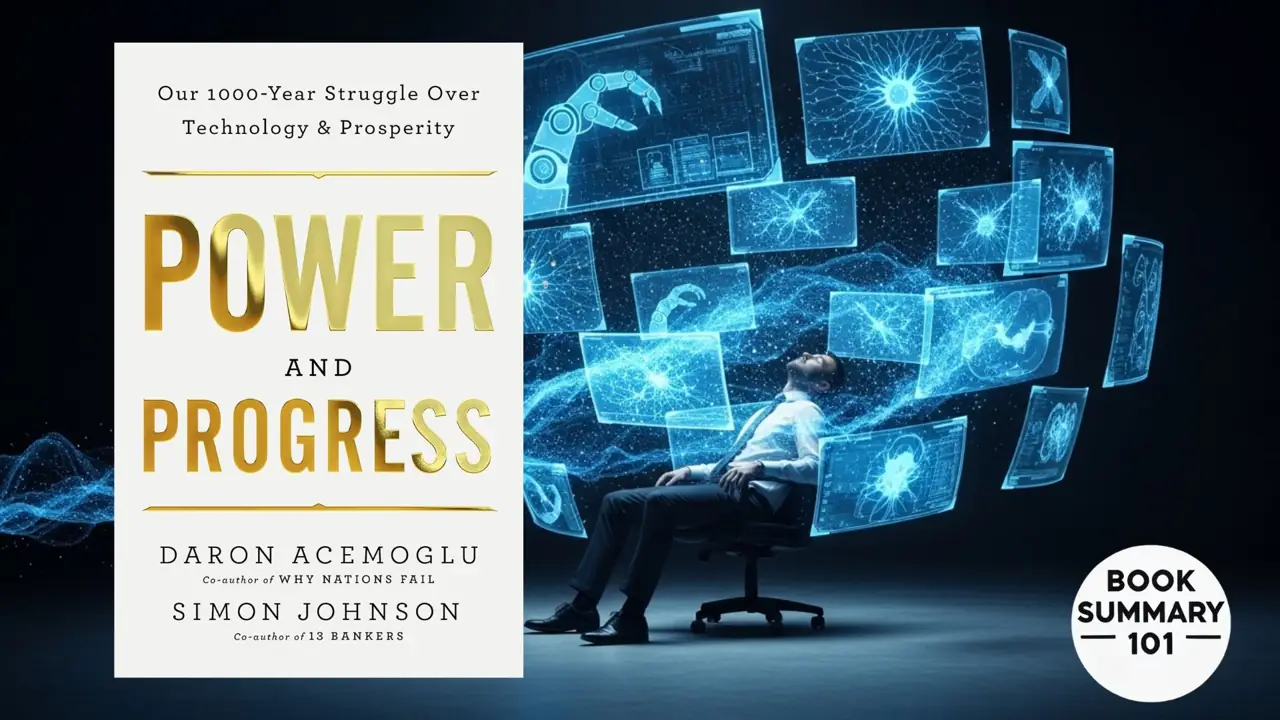
Then I picked up “Power and Progress” by Daron Acemoglu and Simon Johnson.
Reading this book felt like sitting down with two incredibly smart, history-savvy friends who gently took that fear away. They didn’t tell me technology was perfect. In fact, they validated my anxiety. But they also showed me that nothing about our future is written in stone.
They taught me that we aren’t helpless passengers. We are the ones who should be driving the train.
If you’ve ever worried that the “robot revolution” is leaving you behind, or if you’re just tired of the hype, grab a coffee. We need to talk about this book.
Why Should You Even Bother Reading It?
Honestly? Because your future career might depend on understanding the arguments in this book.
You don’t need to be an economist or a tech genius to get value from this. Whether you’re a creative professional worried about AI, a manager trying to implement new tools, or just a voter trying to make sense of the world, this book is essential.
It shatters the lazy idea that we should just “let tech rip” and hope for the best. It gives you the vocabulary to demand better tools—ones that help humans rather than just replacing them.
- Why Should You Even Bother Reading It?
- The Pillars of Prosperity (And Why We Don’t Have Them Yet)
- 1. The Myth of the “Productivity Bandwagon”
- 2. The Trap of “So-So Automation”
- 3. Machine Usefulness vs. Machine Intelligence
- 4. The “New Tasks” Requirement
- 5. The Power of the “Visionary”
- My Final Thoughts
- Join the Conversation!
- Frequently Asked Questions (The stuff you’re probably wondering)
The Pillars of Prosperity (And Why We Don’t Have Them Yet)
Acemoglu and Johnson take us on a thousand-year tour of history to prove one major point: Technology does not automatically improve our lives. It’s not magic. It’s a tool, and how that tool is used depends entirely on who is holding the handle.
Here are the five core concepts from the book that completely reshaped how I see the modern world.
1. The Myth of the “Productivity Bandwagon”
We’ve all been fed a very specific economic story. It goes like this: New technology makes businesses more efficient. When businesses are efficient, they save money and expand. When they expand, they hire more people and pay them better. Everyone wins!
The authors call this the Productivity Bandwagon. It’s the idea that if we just boost output, the benefits will naturally “trickle down” to everyone else.
The Analogy:
Imagine you’re waiting at a bus stop. You’re told that if the bus company buys faster, shinier buses (technology), you’ll get to your destination quicker.
But what if the company uses the faster buses to bypass your stop entirely? What if they use the extra speed to just drive past you?
The Reality:
History shows the bandwagon rarely works on its own. During the early Industrial Revolution in Britain, technology exploded. But for almost a hundred years, workers’ wages didn’t budge, and working conditions got worse. The money went straight to the factory owners.
Prosperity only became shared when people—through unions, regulations, and democracy—forced the bus to stop and pick them up.
Simple Terms: Just because a company makes more money using tech doesn’t mean they will share that money with you.
The Takeaway: Shared prosperity isn’t a natural law of economics; it’s a choice society makes.
2. The Trap of “So-So Automation”
This was my biggest “Aha!” moment. We tend to think all automation is impressive. But Acemoglu and Johnson argue that a lot of modern tech is actually just… “so-so.”
The Analogy:
Think about the self-checkout kiosk at your grocery store.
Does it make the line move significantly faster? Usually not (especially when there’s an “unexpected item in the bagging area”). Does it make the groceries cheaper? Nope.
It’s So-So Automation. It’s just good enough to replace a human cashier, saving the company a wage, but it’s not good enough to actually revolutionize the shopping experience or create huge value.
The Reality:
When companies invest in “so-so automation,” they displace workers without creating a massive productivity boom. This is the worst of both worlds: jobs disappear, but the economic pie doesn’t get big enough to create new jobs elsewhere. It’s cost-cutting disguised as innovation.
📖 Acemoglu & Johnson:
“The problem is not that there is too much automation, but that there is the wrong kind of automation… focusing on displacing workers rather than creating new tasks for them.”
Simple Terms: Technology that fires people but doesn’t actually improve the product or service is a trap.
The Takeaway: We should stop celebrating tech that merely mimics humans and start demanding tech that does things humans can’t do.
3. Machine Usefulness vs. Machine Intelligence
Right now, Silicon Valley is obsessed with “Machine Intelligence”—making AI that can pass the Turing test, write like a human, or paint like a human. The goal is autonomous machines.
The authors argue we need to pivot to Machine Usefulness.
The Analogy:
Imagine you are a carpenter.
- Machine Intelligence is a robot that walks into your shop, takes your hammer, and tries to build the cabinet for you (probably clumsily).
- Machine Usefulness is a power drill. It doesn’t replace you; it makes you ten times faster and allows you to do things you couldn’t do with a hand screwdriver.
The Reality:
The book highlights how Japan often utilizes robotics differently than the US. Instead of trying to fully automate a factory (lights-out manufacturing), they use “collaborative robots” (cobots) that handle the heavy lifting while the human does the intricate assembly.
The goal shouldn’t be to create a digital human. The goal should be to give actual humans superpowers.
Simple Terms: Don’t build robots to replace the worker; build robots to help the worker do a better job.
The Takeaway: The best technology increases the value of human labor rather than reducing it to zero.
4. The “New Tasks” Requirement
If you take away a job with automation, you must create a new one, or you get social collapse. This is the concept of New Tasks.
The Analogy:
Think about the transition from horses to cars.
Sure, the blacksmiths and stable boys lost their jobs. That was painful. But the automobile industry didn’t just replace the horse; it created entirely new categories of work that never existed before.
Mechanics. Road engineers. Motel operators. Drive-thru workers. Traffic controllers.
The Reality:
The authors argue that we are currently failing at this. We are very good at using AI to automate existing tasks (writing a basic email, sorting data), but we aren’t investing enough in using AI to invent new things for humans to do.
We need technology that expands human capabilities—like how complex software allowed for the creation of “Data Analysts” or “Cybersecurity Experts”—jobs that didn’t exist 30 years ago.
Simple Terms: You can’t just delete jobs; you have to copy-paste people into new, higher-value roles.
The Takeaway: True progress requires innovation that reinstates labor by giving us new problems to solve.
5. The Power of the “Visionary”
Why do we have the tech we have? Why is AI being used for surveillance and ad-targeting instead of solving climate change or curing diseases?
Because of the Vision.
The Analogy:
Imagine a group of friends deciding where to go for dinner. If the loudest, richest, most charismatic friend screams “Pizza!”, you’re probably getting pizza—even if everyone else wanted tacos.
The Reality:
Acemoglu and Johnson discuss how a small group of tech elites (the “visionaries”) currently set the menu for the entire world. They believe that data collection and automation are the only paths forward. Because they have the money and the microphone, we all just nod along.
The book uses the example of the Panama Canal. The first attempt to build it failed catastrophically because the visionary in charge (Ferdinand de Lesseps) insisted on a sea-level canal (like Suez) and ignored the reality of the jungle terrain and disease. He tried to force his “vision” on reality, and thousands died.
It wasn’t until a new approach focused on sanitation and locks (adapting to the environment) that it worked. We need to stop blindly following the “tech bro” vision and start asking if that vision actually serves us.
📖 Acemoglu & Johnson:
“Blindly following the path of least resistance—or the path advocated by a handful of tech leaders—is a recipe for inequality, not progress.”
Simple Terms: The direction of technology isn’t inevitable; it’s decided by the people with the most power.
The Takeaway: We need to democratize the conversation about what technology we actually want.
My Final Thoughts
When I finished the last page of Power and Progress, I didn’t feel fear anymore. I felt fired up.
The book makes it clear: Inequality is not a technology problem. It is a political problem.
If AI ends up destroying the middle class, it won’t be because “the algorithms were too smart.” It will be because we allowed companies to use algorithms to cut costs rather than improve services, and because we didn’t update our laws to protect workers.
It’s a heavy book, yes, but it’s essentially an empowering one. It reminds us that we have faced massive technological shifts before—from the steam engine to electricity—and we eventually made them work for us. But we had to fight for it.
We can do it again. But we have to stop waiting for the bus and start building the road.
Join the Conversation!
I’d love to hear your take on the “So-So Automation” idea. Can you think of a piece of technology at your job or in your life that was supposed to make things “better” but actually just made things more annoying or complicated?
Drop your horror stories in the comments below!
Frequently Asked Questions (The stuff you’re probably wondering)
1. Is this book really technical? Do I need a degree in economics?
Not at all. While the authors are heavyweight economists, they write for a general audience. If you can read the New York Times, you can read this. They explain everything clearly.
2. Is the book anti-technology?
No. The authors love technology. They cite how medical breakthroughs and agricultural tech saved billions of lives. They are “anti-misuse-of-technology,” not Luddites.
3. Is it a depressing read?
It starts a bit heavy because it dismantles the “everything will be fine” myth. However, the final chapters are full of specific solutions and policy ideas (like tax reform and directing research funds) that offer a hopeful path forward.
4. How long will it take to read?
It’s a substantial book (about 500 pages), but it moves fast because of the historical stories. If you’re a slow reader, focus on the first three chapters and the final two chapters to get the core argument.
5. Does it talk about ChatGPT and modern AI?
Yes! Since it was released recently, it directly addresses Generative AI, machine learning, and the current hype cycle, making it feel very relevant to right now.