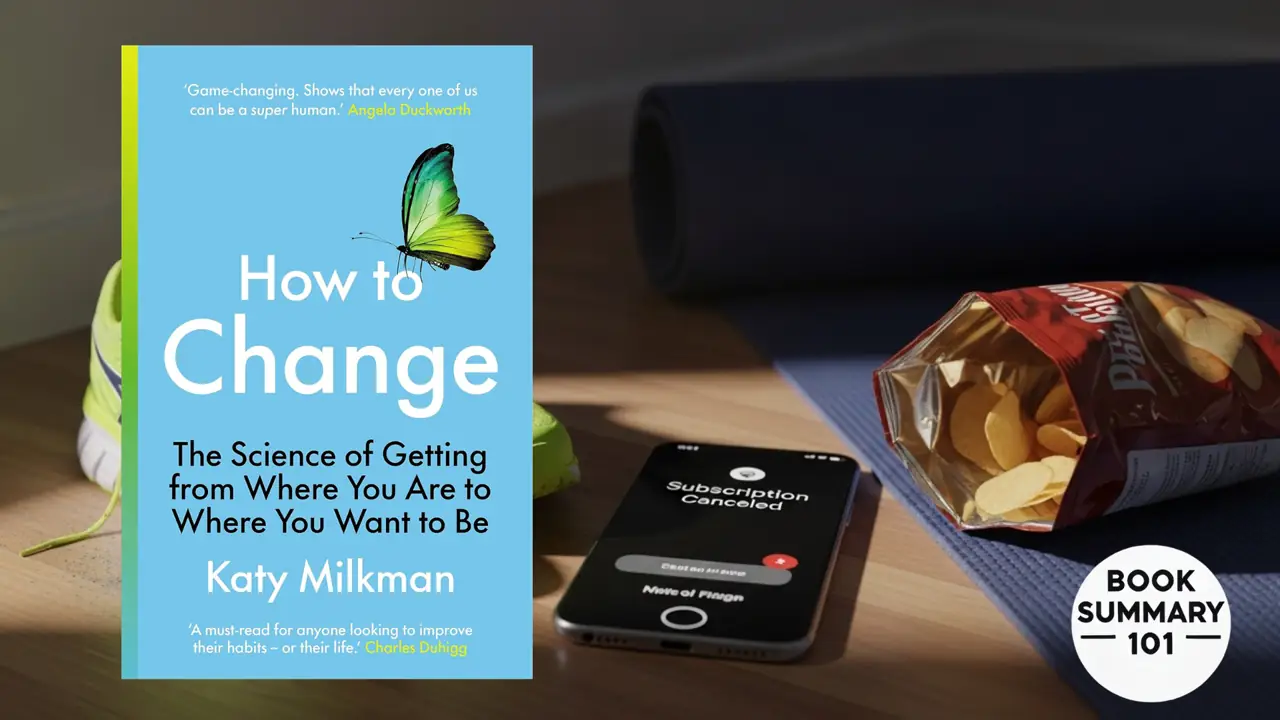
Stuck in a Rut? Here’s the Science of Finally Getting From Where You Are to Where You Want to Be
We’ve all been there.
It’s January 1st (or maybe a random Tuesday when you’re feeling ambitious). You buy the expensive running shoes. You download the meditation app. You throw out all the junk food in the pantry. You tell yourself, “This is it. This is the new me.”
Two weeks later? The shoes are gathering dust, the app subscription is canceled, and there’s a fresh bag of chips on the counter.
For years, I beat myself up about this cycle. I thought I was just weak. I thought I lacked “grit” or willpower.
Then I read “How to Change” by Katy Milkman.
It felt like sitting down with a brilliant friend who gently told me, “Hey, stop trying to power through a brick wall. Let’s just build a door instead.”
Katy Milkman is a behavioral scientist at Wharton, and she argues that we approach change all wrong. We treat it like a one-size-fits-all struggle. But actually, the barriers to change are specific, like different diseases. You wouldn’t treat a broken leg with antibiotics, right?
So why do we try to treat procrastination, forgetfulness, and laziness with the same generic “just try harder” advice?
This book changed how I view my own habits, and I think it will do the same for you.
- Why Should You Even Bother Reading It?
- Diagnosing Your Barriers: The Strategy of Behavioral Science
- 1. The Fresh Start Effect (Timing is Everything)
- 2. Temptation Bundling (Fighting Impulsivity)
- 3. Commitment Devices (Curing Procrastination)
- 4. Cue-Based Planning (Overcoming Forgetfulness)
- 5. The “Copy and Paste” Strategy (Using Social Norms)
- 6. The Advice Club (Building Confidence)
- My Final Thoughts
- Join the Conversation!
- Frequently Asked Questions (The stuff you’re probably wondering)
Why Should You Even Bother Reading It?
Honestly, this book is for anyone who has ever set a goal and failed—which is basically all of us.
If you are a chronic procrastinator, a manager trying to motivate a team, or just someone trying to save a little more money, this book is the blueprint.
It moves away from the “rah-rah” motivational speeches and dives into hard science. It explains why our brains resist change and gives you a toolkit of engineering hacks to outsmart your own nature. It’s practical, evidence-based, and thankfully, zero percent “woo-woo.”
Diagnosing Your Barriers: The Strategy of Behavioral Science
Before we get into the hacks, we have to change our mindset. Milkman explains that most of us fail because we don’t identify the specific “opponent” we are fighting.
Imagine you are a tennis player. You need to know if you’re playing against a massive server or a speedy baseline player. Your strategy has to change based on the opponent.
In the game of life, your opponents are internal barriers: impulsivity, forgetfulness, lack of confidence, or pure laziness. Once you identify the enemy, you can pick the right weapon.
Here are the biggest concepts from the book that will help you win that match.
1. The Fresh Start Effect (Timing is Everything)
We tend to think that time is a continuous stream, like a river. But our brains actually view time more like a series of episodes in a TV show.
Milkman introduces the concept of “The Fresh Start Effect.”
Think of it like a ledger in accounting. When you mess up your budget, it’s stressful to look at that messy page. But when you turn the page and start a fresh sheet, you feel a sense of optimism. You feel like the “Old You” (who ate the pizza) is separate from the “New You” (who is going to eat a salad).
We naturally feel this on New Year’s Day, but Milkman argues we can engineer these moments continuously. Birthdays, the start of a new week (Monday), or even the first day of a new month are all “temporal landmarks.”
Real-World Example:
Google wanted to encourage employees to save more for retirement. They found that if they invited employees to increase their savings rate specifically on their next birthday (a fresh start), the employees were far more likely to agree than if they were asked to do it immediately. The “birthday” signaled a new chapter where they could be a better, richer version of themselves.
Simple Terms:
Your motivation spikes whenever you feel like you are beginning a new chapter in your life.
The Takeaway:
Don’t just start “today.” Look at the calendar and pick a specific date that feels like a new beginning (like your birthday or next Monday) to launch your change.
2. Temptation Bundling (Fighting Impulsivity)
We all suffer from “present bias.” We want the donut now more than we want to be thin later. We want to binge-watch TV now more than we want to be educated later.
To fight this, Milkman suggests a strategy she calls “Temptation Bundling.”
Think of Mary Poppins. She didn’t just tell the kids to clean the room; she made it a game. She added a “spoonful of sugar” to help the medicine go down.
Temptation bundling works by taking something you love to do (the temptation) and tying it to something you have to do (the chore). But here is the catch: you are only allowed to do the fun thing while doing the hard thing.
📖 “We need to make the behavior we want to encourage more attractive in the moment… Temptation bundling allows us to do just that by combining a source of instant gratification with a chore.”
Real-World Example:
Milkman conducted a study where participants were given iPods loaded with addictive audiobooks (like The Hunger Games). One group was told they could listen whenever they wanted. The other group was told they could only listen to the audiobooks while they were exercising at the gym.
The result? The group that bundled the “temptation” (the book) with the “chore” (the gym) visited the gym significantly more often.
Simple Terms:
Link a “guilty pleasure” with a productive habit so you actually look forward to doing the work.
The Takeaway:
Only let yourself listen to your favorite true-crime podcast while you are folding laundry or doing dishes.
3. Commitment Devices (Curing Procrastination)
Sometimes, bundling isn’t enough. Sometimes, we need to be treated like toddlers. We need to be restricted for our own good.
This brings us to Commitment Devices.
The classic analogy here is Ulysses from Greek mythology. He knew he wouldn’t be able to resist the song of the Sirens, which would lure his ship to crash on the rocks. So, he ordered his men to tie him to the mast of the ship and fill their own ears with wax. He physically removed his ability to mess up.
We can do the same thing. We can create “hard commitments” (where we lose money or face a penalty) or “soft commitments” (psychological pledges).
Real-World Example:
There is a website called StickK.com (co-founded by a colleague of Milkman). You set a goal—say, “I will not smoke for a month”—and you put $100 on the line. You also appoint a referee. If you fail, the website automatically takes your money and donates it to a charity you hate.
It sounds extreme, but putting skin in the game forces you to act because the pain of losing the money is greater than the pain of doing the task.
Simple Terms:
Lock yourself into a choice now so that your future, lazy self can’t back out later.
The Takeaway:
If you want to save money, set up an automatic transfer that you can’t easily cancel. If you want to stop scrolling, use an app that locks your phone at 10 PM.
4. Cue-Based Planning (Overcoming Forgetfulness)
A huge barrier to change isn’t that we don’t want to do it; it’s that we simply flake out. We forget.
We treat our brains like perfect computers, assuming that if we think “I need to vote,” we will just do it. But our brains are more like disorganized file cabinets. We need a specific tag to find the file.
Milkman suggests using “Implementation Intentions.” This is essentially “If/Then” coding for humans.
Instead of a vague plan (“I will exercise”), you create a specific cue (“When the clock strikes 5 PM, I will put on my sneakers”).
Real-World Example:
In a massive study regarding flu shots, researchers found that sending people a generic reminder to get a shot was okay. But, when they asked people to write down the exact date and time they planned to get the shot, vaccination rates went up.
By linking the action to a specific time slot, the brain creates a mental “bookmark.” When that time arrives, the cue triggers the memory.
Simple Terms:
Don’t just make a plan; make a plan that is triggered by a specific time or place.
The Takeaway:
Fill in the blank: “When [Situation X] happens, I will do [Action Y].”
5. The “Copy and Paste” Strategy (Using Social Norms)
We like to think we are unique snowflakes, but we are actually herd animals. We look at what everyone else is doing to figure out how to behave.
Milkman suggests we can hack this by using the “Copy and Paste” method.
Imagine you are in a difficult math class. You’re struggling. You could try to figure it out on your own, or you could look at the student next to you who is acing the tests and see exactly how they take notes.
We often look for mentors who are “gurus”—people who are totally unlike us. Instead, we should look for peers who have already solved the problem we are facing and just copy their specific tactics.
Real-World Example:
Solar panels are contagious. Data shows that one of the best predictors of whether someone will install solar panels isn’t their income or political views—it’s whether their neighbor has them. When we see someone “like us” doing something, we believe we can do it too.
Simple Terms:
Find someone you relate to who is already achieving your goal and deliberately mimic their routine.
The Takeaway:
Don’t just admire successful friends; ask them specifically, “What is the very first thing you do when you get to the gym?” and copy it.
6. The Advice Club (Building Confidence)
This was the most surprising insight for me. Usually, when we are struggling, we seek advice.
But Milkman argues that if you lack confidence, giving advice is actually more powerful than receiving it.
Think of it like teaching. The best way to learn a subject is to have to teach it to someone else. When you are placed in the position of a mentor, two things happen:
- You are forced to articulate successful strategies (which reminds you that you actually know them).
- You feel hypocritical if you don’t follow your own advice.
📖 “Giving advice to others can actually help us achieve our own goals… it boosts our confidence and prompts us to reflect on what works.”
Real-World Example:
Milkman ran a study with high school students. One group received advice on how to study. The other group gave advice to younger students on how to study. The group that gave the advice actually ended up getting better grades. They stepped up to fit the role of the “wise mentor.”
Simple Terms:
Helping someone else solve your problem helps you solve it for yourself.
The Takeaway:
Form an “Advice Club” with friends where you swap tips. Being asked for your opinion will make you feel capable and motivated.
My Final Thoughts
What I love about How to Change is that it takes the guilt out of failure.
Reading this book made me realize that I wasn’t a “failure” for not sticking to my goals; I was just a bad strategist. I was trying to use willpower to fight structural problems.
Katy Milkman hands you the blueprints to rebuild your environment. It empowers you to stop fighting against your human nature and start working with it. It’s not about becoming a perfect person; it’s about tricking your imperfect self into doing the right thing.
And honestly? That’s a strategy I can live with.
Join the Conversation!
I’d love to hear from you. If you had to pick one “opponent” that stops you from reaching your goals—laziness, impulsivity, forgetfulness, or lack of confidence—which one is it?
Drop a comment below and let’s figure out which strategy fits your opponent!
Frequently Asked Questions (The stuff you’re probably wondering)
1. Is this book too academic or hard to read?
Not at all. While Katy Milkman is a scientist, she writes like a journalist. The book is filled with stories, interviews, and real-life examples. It’s very digestible, even if you hate science textbooks.
2. Is this just for people trying to lose weight?
No. While many examples involve health (because it’s easy to measure), the principles apply perfectly to saving money, finishing work projects, studying for degrees, or even being a more patient parent.
3. I have absolutely zero willpower. Will this still work?
Yes! That’s actually the whole point. This book teaches you how to build systems (like commitment devices and temptation bundling) that remove the need for willpower.
4. How is this different from Atomic Habits?
Great question. Atomic Habits is excellent for the “how” of daily repetition. How to Change focuses more on the “diagnosis” of why you get stuck and offers specific solutions for different barriers (like timing, confidence, and conformity) that go beyond just habit loops. They complement each other perfectly.
5. Can I use these ideas to manage my team at work?
Absolutely. Managers will find the sections on “Social Norms” and “Fresh Starts” incredibly useful for motivating employees and creating a culture of improvement without nagging.