I have a confession to make.
For years, I treated my body like a high-performance vehicle and my brain like… well, an afterthought.
I would meticulously track protein for my muscles and count calories for my waistline. But when 3:00 PM rolled around and my focus completely evaporated, or when I walked into a room and forgot why I was there, I just blamed it on “getting older” or “not enough coffee.”
I was feeding my body, but I was starving my brain.
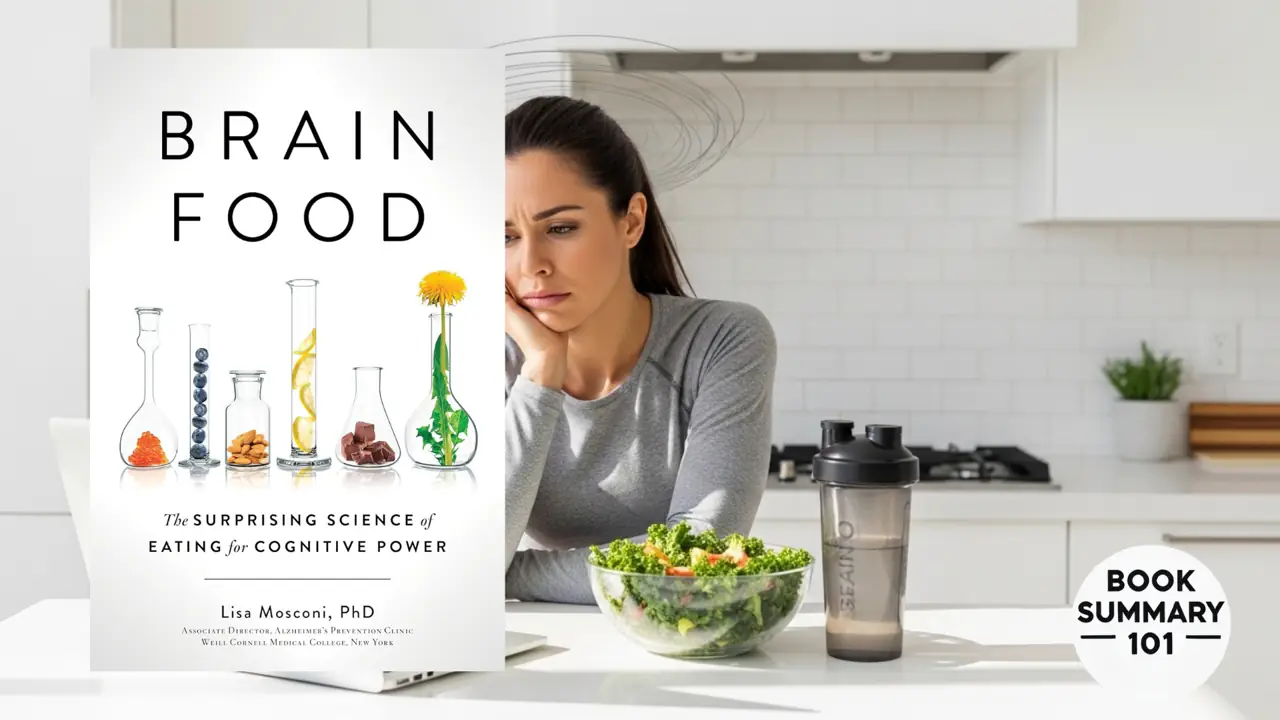
That changed when I picked up Brain Food: The Surprising Science of Eating for Cognitive Power by Dr. Lisa Mosconi. Reading this book felt like sitting down with a brilliant friend who happens to be a neuroscientist, grabbing a (hydrating) drink, and finally understanding the instruction manual for my own head.
It turns out, the brain is picky. It’s demanding. And it eats first.
If you’ve ever felt “brain fog,” anxiety, or just a general lack of mental sharpness, this post is for you.
Why Should You Even Bother Reading It?
This book isn’t just for bio-hackers or people terrified of Alzheimer’s (though if you are, this is mandatory reading). It’s for anyone who uses their brain for a living.
Whether you’re a coder trying to debug complex software, a writer staring at a blank page, or a parent juggling a thousand schedules, Dr. Mosconi explains that cognitive power isn’t just about willpower; it’s about biology.
The “Diet Culture” of the last 30 years focused on heart health and weight loss. Brain Food flips the script to focus on Neuro-Nutrition. It explains why the salad that’s “good for your hips” might not be doing much for your neurons.
- Why Should You Even Bother Reading It?
- The Pillars of Neuro-Nutrition: How to Build a Better Brain
- 1. The Blood-Brain Barrier: The VIP Club Bouncer
- 2. Water: The Brain is a Sponge
- 3. Fats: Building Material, Not Just Fuel
- 4. Glucose: The Fireplace vs. The Flash Fire
- 5. Antioxidants: Rust-Proofing Your Engine
- My Final Thoughts
- Join the Conversation!
- Frequently Asked Questions (The stuff you’re probably wondering)
The Pillars of Neuro-Nutrition: How to Build a Better Brain
Dr. Mosconi doesn’t just throw a list of “superfoods” at you; she explains the mechanics of why the brain needs what it needs. Before we look at what to put on your plate, we have to understand the fundamental rules of how your brain accepts—and rejects—nutrition.
1. The Blood-Brain Barrier: The VIP Club Bouncer
Imagine your brain is the most exclusive VIP club in the city. It’s where all the important decisions are made, and it can’t afford to let just anyone in.
To protect itself, the brain has a security system called the Blood-Brain Barrier (BBB). Think of the BBB as a strict bouncer standing at the door.
Your bloodstream is the street outside the club. It’s full of all kinds of characters—bacteria, viruses, toxins, but also nutrients and drugs. The bouncer’s job is to stop the bad guys from getting into the VIP section (your brain neurons).
Here is the problem: The bouncer is extremely picky. Just because something is in your blood doesn’t mean it gets into your brain.
Dr. Mosconi explains that the brain has specific “gates” for specific nutrients. If you eat something that doesn’t have a matching “ID card” or transport system, the bouncer turns it away.
Real-World Example:
This is why you can’t just take a “Serotonin” pill to feel happier. The serotonin molecule is too big and lacks the right credentials to pass the bouncer. It gets stuck outside.
However, if you eat foods rich in Tryptophan (like eggs or chia seeds), the bouncer recognizes it, opens the velvet rope, and lets it in. Once inside the club, your brain uses that Tryptophan to build its own serotonin.
📖 “The brain is the only organ that selects its own supply. It has a barrier that separates it from the rest of the body… This means that not everything you eat will find its way into your brain.”
Simple Terms:
Your brain has a filter that blocks most things, so you have to eat the specific ingredients it allows inside.
The Takeaway:
Don’t rely on random supplements; eat whole foods that contain the precursor ingredients your brain is programmed to welcome in.
2. Water: The Brain is a Sponge
We all know we should drink water, but we usually do it for our skin or our kidneys. Mosconi argues that water is arguably the most critical nutrient for the brain.
Picture a beautiful, bright yellow household sponge. When it’s wet, it’s squishy, flexible, and useful. Now, imagine leaving that sponge on the counter in the sun for two days. It becomes hard, shriveled, and brittle.
Your brain is roughly 80% water. It is essentially a squishy sponge floating in fluid.
When you are even mildly dehydrated (we’re talking 2-4% water loss), your brain physically shrinks. It loses that “squishiness.” This disrupts the chemical reactions needed for thinking, causing headaches, fatigue, and poor concentration.
Real-World Example:
Think about the “3:00 PM Slump.” You feel tired, so you reach for a coffee or a sugary snack.
Dr. Mosconi suggests that most of the time, this isn’t hunger or caffeine withdrawal—it’s just a dry sponge. Your brain is thirsty. Before you grab the espresso, chug a large glass of water. You might find the fog clears up in 20 minutes without the jitters.
Simple Terms:
Your brain needs water to maintain its shape and electrical conductivity; without it, you literally can’t think straight.
The Takeaway:
Hydration is the cheapest and fastest cognitive enhancer you have available.
3. Fats: Building Material, Not Just Fuel
In the rest of the body, we often think of fat as stored energy—the stuff we want to burn off on the treadmill.
But inside the brain? Fat is structural.
Imagine building a house. You have wood for the fire (energy) and bricks for the walls (structure). In the brain, fat acts like the bricks. The brain is the fattiest organ in the body (excluding adipose tissue itself). It uses specific types of fat to build the membranes that protect your neurons.
Mosconi distinguishes between “good” fats (Polyunsaturated, specifically Omega-3s) and “bad” fats (Saturated/Trans fats) using the analogy of flexibility.
If you build your neuron walls out of saturated fats (bacon, butter), the walls become rigid and hard. Signals struggle to pass through them.
If you build your walls out of Omega-3s (fatty fish, flax seeds, walnuts), the walls are flexible and fluid. Information zips through them at lightning speed.
Real-World Example:
Consider the Inuit diet vs. a standard Western diet. The Inuit historically consumed massive amounts of fat from whales and seals (high Omega-3), yet had low rates of heart disease and dementia.
Conversely, a diet high in cheese and red meat creates “stiff” neurons. Mosconi emphasizes getting DHA and EPA (types of Omega-3s) because the brain essentially hoards these specific fats to maintain its wiring.
Simple Terms:
You need to eat high-quality fats to keep your brain cells flexible so they can talk to each other quickly.
The Takeaway:
Fear bad fats, but embrace the good ones—your brain is literally made of them.
4. Glucose: The Fireplace vs. The Flash Fire
The brain is an energy hog. It accounts for only 2% of your body weight but consumes 20% of your energy. And its favorite fuel? Glucose (sugar).
Wait, isn’t sugar bad?
Here is the nuance. Think of your brain’s energy supply like heating a cabin with a wood stove.
Complex Carbohydrates (Bran, Oats, Quinoa, Sweet Potatoes):
These are like big, dense oak logs. You put them in the stove, and they burn slowly and steadily for hours. They provide a consistent, warm energy that keeps the brain happy.
Refined Sugars (Donuts, Soda, White Bread):
These are like dousing the stove in gasoline and throwing in a newspaper. WHOOSH. You get a massive explosion of heat (a sugar high), followed immediately by the fire dying out (the crash).
The brain hates these explosions. High sugar spikes force the body to release insulin. Over time, if you keep causing these flash fires, the brain becomes insulin resistant. Mosconi points out that scientists are starting to call Alzheimer’s “Type 3 Diabetes” because it involves the brain losing the ability to process glucose efficiently.
📖 “It’s not just about fueling the brain, but about how that fuel is delivered. The brain needs a steady supply of energy, not a rollercoaster of spikes and crashes.”
Simple Terms:
Your brain needs sugar, but it needs the kind that comes wrapped in fiber (complex carbs), not the white powdery kind.
The Takeaway:
To avoid the afternoon crash and long-term damage, swap the bagel for oatmeal and the candy for berries.
5. Antioxidants: Rust-Proofing Your Engine
Because the brain uses so much energy (oxygen), it produces a lot of waste products called “free radicals.”
If left unchecked, these free radicals cause oxidative stress. The best analogy here is rust. Just like a bike left out in the rain will eventually rust and seize up, a brain under high oxidative stress accumulates damage. This “brain rust” is a major driver of aging and cognitive decline.
So, how do we rust-proof the engine? Antioxidants.
Vitamins C and E, and beta-carotene act as the protective coating. They neutralize the free radicals before they can damage your neurons.
Real-World Example:
Mosconi champions the “Blue Zones” (places like Okinawa and Sardinia where people live the longest). Their diets are packed with plants.
Think of a bowl of dark berries (blueberries, blackberries). The dark pigment in the skin is actually where the antioxidants live. Eating them is like spraying WD-40 on your brain cells to keep them running smoothly without grinding gears.
Simple Terms:
Thinking creates chemical waste; antioxidants are the cleaning crew that removes the waste before it causes permanent damage.
The Takeaway:
Eat the rainbow—specifically the dark, rich colors in fruits and vegetables—to stop your brain from “rusting.”
My Final Thoughts
Reading Brain Food was a massive shift for me. I stopped looking at food as “calories” and started seeing it as “information.”
Every time I eat, I’m sending a message to my DNA and my neurons. Am I sending them the building blocks they need to repair themselves? Or am I sending them junk that gums up the works?
The most empowering part of Mosconi’s work is that it’s not about perfection. It’s not about a grueling detox. It’s about adding the good stuff—more water, more fatty fish, more dark berries. It turns the act of eating into an act of self-respect for your future self.
You have the power to change how your brain ages, one meal at a time.
Join the Conversation!
I’m curious – we all have that one “guilty pleasure” snack that we know kills our focus. What’s yours, and what “brain food” swap are you willing to try this week? Let me know in the comments!
Frequently Asked Questions (The stuff you’re probably wondering)
1. Is this just another low-carb or Keto book?
Actually, no. Dr. Mosconi is quite skeptical of the Keto diet for long-term brain health. While Keto can have benefits for specific conditions (like epilepsy), she argues that the brain prefers glucose from complex carbohydrates for sustained energy. She leans much closer to a Mediterranean-style diet.
2. Do I need to buy expensive supplements to follow this?
Dr. Mosconi is a “food first” scientist. She explains that supplements are often not absorbed well because they lack the “synergy” of whole foods. She recommends getting your nutrients from the grocery store, not the pharmacy aisle, whenever possible.
3. Is the science too technical for a layperson?
Not at all. While she is a neuroscientist, the writing is incredibly accessible. She uses great metaphors (like the ones I shared above) to explain complex biological processes. You won’t need a biology degree to understand it.
4. Does this book help with weight loss too?
It’s not the primary goal, but it is a happy side effect. By cutting out processed sugars and bad fats while increasing fiber and water, most people will naturally lose weight. But the focus here is on gaining focus, memory, and longevity.
5. I’m young. Do I really need to worry about Alzheimer’s now?
Yes! Dr. Mosconi presents compelling evidence that Alzheimer’s doesn’t just “start” when you’re 70. It is a slow progression that begins decades earlier. The dietary choices you make in your 30s and 40s are laying the foundation for your brain health in your 70s and 80s.