Have you ever spent five full minutes staring at a text message from a younger coworker, trying to decipher if they are actually mad at you or just being… efficient?
I have.
A few months ago, I sent a perfectly normal email to a colleague. Their reply was a simple “Sure.” with a period at the end. I immediately panicked.
Why the period? Are they angry? Was my request stupid? Did I ruin the project?
I spent the rest of the afternoon spiraling, convinced I had offended them. Later, I realized that for them, it was just punctuation. For me, it was passive-aggressive warfare.
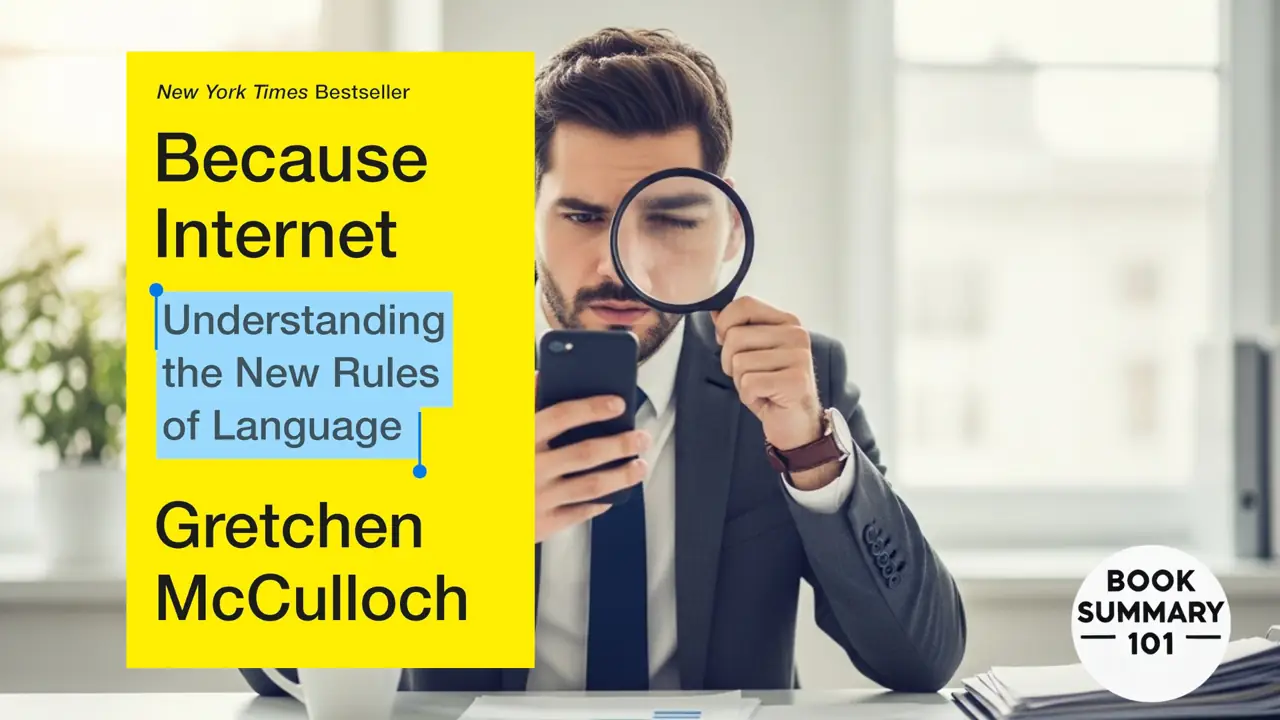
If you’ve ever felt this specific type of digital anxiety, or if you’ve ever wondered why your kids laugh at memes that look like nonsense to you, I found the manual we’ve all been waiting for. It’s called Because Internet by Gretchen McCulloch.
Reading this book felt like sitting down with a brilliant, funny friend who finally explained why I text the way I do—and why everyone else texts differently. It turns out, we aren’t ruining the English language. We’re just reinventing it.
- Why Should You Even Bother Reading It?
- Decoding the Digital Dialect
- 1. Writing is Now “Fingered Speech”
- 2. The Typographical Tone of Voice
- 3. Emojis Are Gestures, Not Pictures
- 4. The Five Generations of Internet People
- 5. The Evolution of the “Keysmash”
- My Final Thoughts
- Join the Conversation!
- Frequently Asked Questions (The stuff you’re probably wondering)
Why Should You Even Bother Reading It?
Honest answer? Because you live on the internet.
Whether you are a “digital native” who grew up with a smartphone in hand, or someone who still remembers the screeching sound of a dial-up modem, this book bridges the gap.
It is essential reading for parents trying to understand their teenagers, managers trying to communicate with Gen Z teams, and anyone who loves language. It replaces the judgment of “kids these days can’t spell” with the fascination of “look how clever this new communication style is.”
Decoding the Digital Dialect
The internet didn’t break English; it just gave it a new playground. To understand why we communicate the way we do, we have to stop looking at tweets and texts as “bad writing” and start seeing them as a completely new form of human connection.
Here are the five most mind-blowing concepts from the book that completely reshaped how I look at my phone screen.
1. Writing is Now “Fingered Speech”
For centuries, humanity had two distinct boxes for language.
Box one was Speech. It was informal, fleeting, and full of emotion. You said it, the air vibrated, and then it was gone.
Box two was Writing. This was formal, permanent, and slow. You wrote a letter or a book, edited it, and it stayed around forever.
McCulloch argues that the internet crashed these two boxes together. We are now doing something she calls “fingered speech.”
Imagine you are at a noisy bar with your friends. You’re shouting over the music, laughing, cutting sentences short, and using slang. That is speech. Now, imagine you are texting those same friends the next day. You aren’t writing a formal letter; you are typing out that “bar chat.”
We are writing with the informality and speed of talking.
When people complain that texting lacks proper grammar, they are judging a casual conversation by the rules of a formal essay. It’s like wearing a tuxedo to a beach party—technically “correct” attire, but totally wrong for the vibe.
Simple Terms: Texting isn’t “writing” in the traditional sense; it’s talking with your fingers.
The Takeaway: Don’t obsess over formal grammar in texts; focus on the conversational flow, because that is the new standard of polite communication.
2. The Typographical Tone of Voice
If I’m talking to you in person, I can use my pitch, volume, and pauses to show you how I feel. If I say “I’m fine” with a smile, it means one thing. If I say it with a sigh and an eye-roll, it means the opposite.
But how do you do that in ASCII code?
McCulloch introduces the brilliant concept of “Typographical Tone of Voice.” Since we can’t use our vocal cords online, we have weaponized punctuation and capitalization to do the heavy lifting for us.
Think about the difference between these three messages:
- happy birthday (Casual, chill, low stakes)
- Happy Birthday! (Standard, polite, enthusiastic)
- HAPPY BIRTHDAY (Shouting, extreme excitement)
And then, there is the infamous period.
In formal writing, a period just marks the end of a sentence. But in a text message (which is usually short), the end of the message is the end of the sentence. Adding a period where one isn’t needed adds a tone of finality.
📖 “The period is the typographical equivalent of a full stop in the middle of a sentence. It implies that the conversation is over. It’s the difference between ‘fine’ and ‘fine.’ One is an answer; the other is a weapon.”
If you send “Okay.” to a Gen Zer, they think you’re mad. Why? Because you took the extra time to add a “stop” signal. It feels falling-off-a-cliff abrupt.
Simple Terms: We use caps, spacing, and punctuation to replace the volume and tone of our actual voices.
The Takeaway: Be mindful of your punctuation in texts; a simple period can change a friendly agreement into a passive-aggressive shutdown.
3. Emojis Are Gestures, Not Pictures
This was the biggest “Aha!” moment of the entire book for me.
I used to think emojis were just digital stickers or decorations. Like, if I’m talking about a cat, I put a cat emoji.
McCulloch corrects this. She argues that emojis are actually digital hand gestures.
Think about how you talk. You wave your hands, you shrug, you point, you make faces. These are “illustrators” and “emblems” that add context to your words.
If you text, “Great job,” it could be sarcastic.
If you text, “Great job 🎉,” the confetti acts like a high-five or a smile. It confirms the sincerity.
This is why it feels weird to use emojis in the middle of a sentence (e.g., “I am going to drive my 🚗 to the store”). We don’t usually mime “driving” while saying the word “car” in the middle of a sentence. We usually gesture after we speak or while we speak to set the mood.
That’s why we usually put emojis at the end of the message. They are the smile you give after you finish your sentence.
Simple Terms: Emojis aren’t words you read; they are body language you see.
The Takeaway: Use emojis to clarify the emotional intent of your message, just like you would use a smile or a hand wave in person.
4. The Five Generations of Internet People
Why do you and your boss use the internet so differently? It’s not just about how old you are; it’s about when you moved online.
McCulloch categorizes us into different waves, similar to how immigrants adopt the language of a new country:
- Old Internet People: These are the pioneers who were online before the web was social. They are the coders and the geeks. They learned to talk to machines first, so they value technical proficiency.
- Full Internet People: These people (mostly Millennials) came of age as the social web (AIM, MySpace) was being built. For them, the internet is a place to project an identity.
- Semi-Internet People: These folks joined later, usually for work or to keep up with family (often Boomers/Gen X). They bring their “formal writing” habits with them. This is why your dad signs his text messages like a letter: “Love, Dad.”
- Post-Internet People: These are the Zoomers (Gen Z). The internet has always been there, like electricity or running water. They don’t “go online”; they are online. They play with language the most because they are the native speakers.
📖 “For Post-Internet People, the internet isn’t a place you go. It’s a layer on top of the real world. Asking them when they first went online is like asking them when they first used electricity.”
Simple Terms: Your “internet accent” depends on whether you were born in the digital world or if you immigrated there later in life.
The Takeaway: Stop judging other generations for their digital habits; they are simply speaking a different dialect based on when they arrived.
5. The Evolution of the “Keysmash”
Nothing illustrates the evolution of internet linguistics better than the “keysmash.”
You know what I mean—when something is so funny or frustrating that you just mash your fingers on the keyboard. But did you know even chaos has rules?
- The QWERTY Mash: If you are on a physical keyboard (like a computer), a keysmash usually looks like
asdfghjkl. You are rolling your fingers across the home row. It looks balanced. - The Smartphone Mash: If you are on a phone, you type with your thumbs.
asdfis hard to do. So, the keysmash evolved intoskksksksksorgdhjdjs.
McCulloch points out that if you see someone type asdfghjkl on Instagram, they are signaling a “vintage” internet vibe. If you see sksksks, they are likely younger or on mobile.
Even when we think we are being random, we are following social patterns constrained by our technology. We are tribal creatures, and we mimic the “noise” of the people around us to show we belong.
Simple Terms: Even the random gibberish we type follows hidden patterns based on the technology we are holding.
The Takeaway: Language changes as our tools change, and even our “random” expressions tell a story about who we are and what device we use.
My Final Thoughts
I used to be a bit of a grammar snob. I would roll my eyes at lowercase tweets and cringe at the overuse of “lol.”
But Because Internet completely cured me of that snobbery. It replaced my judgment with wonder. It made me realize that we are living through the greatest explosion of language creativity in history. We aren’t getting dumber; we are getting more expressive.
The internet has given us the ability to write with the warmth, nuance, and speed of a face-to-face conversation. And that is a beautiful thing.
This book gave me permission to stop worrying about the “rules” I learned in 5th grade and start embracing the “rules” of connection.
Join the Conversation!
I’d love to hear from you. What is one slang term or text abbreviation that absolutely confuses you (or that you refuse to use)? Drop a comment below and let’s decode it together!
Frequently Asked Questions (The stuff you’re probably wondering)
1. Is this book too academic or technical?
Not at all. While Gretchen McCulloch is a linguist, she writes like a normal person. It reads like a pop-culture history book, not a textbook. It’s very funny and accessible.
2. Will this help me communicate better with my kids/employees?
100%. It explains the why behind their communication style. You’ll understand why they don’t use periods, why they use certain emojis, and how to bridge the gap without sounding like you’re “trying too hard.”
3. Do I need to be a “tech person” to understand it?
No coding knowledge required. If you have ever sent a text message or used Facebook, you have all the background knowledge you need.
4. Is the English language actually dying?
The book argues the exact opposite. English is thriving and evolving. The internet has made us write more than any generation in history. We are just writing differently.
5. I’ve heard the audiobook is good, should I listen to that instead?
Yes! The audiobook is fantastic because the author narrates it herself. However, the visual aspects (like the placement of emojis or specific capitalization) are sometimes easier to grasp in the print or Kindle version.