I have a confession to make: I used to be a massive germophobe. For years, I viewed my body as a pristine, sacred temple that was constantly under attack by invisible, malicious invaders.
Every time someone sneezed on the train, or I had to grab a sticky public door handle, I imagined an army of evil bacteria storming my gates. I slathered on hand sanitizer like it was expensive lotion. I thought all microbes were the enemy.
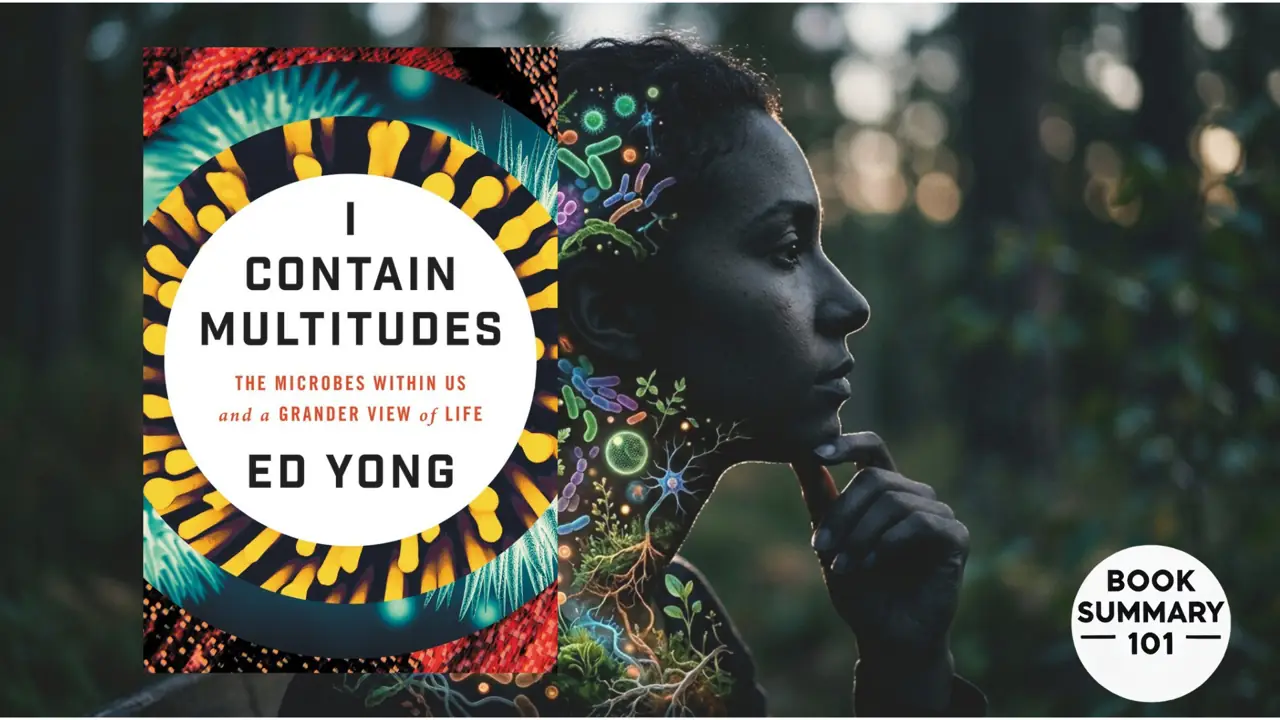
Then, a friend recommended a book that entirely shattered my perspective. The book was I Contain Multitudes: The Microbes Within Us and a Grander View of Life by Ed Yong.
Reading it felt less like studying a biology textbook and more like sitting in a cozy coffee shop with an incredibly passionate friend who couldn’t wait to reveal the secret magic of the universe to me. It completely changed my worldview. Instead of seeing my body as a battlefield, I learned to see it as a thriving, beautiful, cooperative ecosystem.
Why Should You Even Bother Reading It?
You might be thinking, “I’m not a scientist; why should I care about bacteria?” Well, if you have a body, this book is essentially your user manual.
It is a must-read for the naturally curious, health and wellness enthusiasts, and anyone who wants to understand the absolute cutting edge of how biology actually works. We live in an era where we are obsessed with diets, immune health, and mental well-being. This book pulls back the curtain to reveal that the secret to all of those things isn’t just human cells—it’s the trillions of microscopic passengers coming along for the ride. It cures your fear of the microscopic world and replaces it with pure, unadulterated awe.
- Why Should You Even Bother Reading It?
- The Hidden Microscopic Universe Inside You
- The Zoo Inside You (We Are Ecosystems)
- The Ultimate Evolutionary Partnership (Symbiosis)
- The Immune System as a Park Ranger
- The Puppet Masters (Microbes and the Mind)
- Reseeding the Forest (The Future of Medicine)
- My Final Thoughts
- Join the Conversation!
- Frequently Asked Questions (The stuff you’re probably wondering)
The Hidden Microscopic Universe Inside You
Below are five foundational concepts from the book that completely reshaped how I view the biological world, moving away from a war against germs and toward a beautiful, collaborative partnership. Let’s dive into the fascinating ways these unseen entities steer the ship of our lives.
The Zoo Inside You (We Are Ecosystems)
When you look in the mirror, you think you are looking at a single individual. But the mind-blowing truth is that you are more like a walking, talking coral reef.
Think of your body as a bustling, infinitely complex metropolis like New York City. You are the infrastructure—the buildings, the roads, the bridges. But your microbes? They are the millions of citizens walking the streets. They are the trash collectors managing waste, the chefs cooking up nutrients, and the factory workers building vital chemicals. Without the citizens, the city is just an empty, dead shell of concrete.
The numbers are simply staggering. By the most current estimates, roughly half of the cells in your body aren’t actually human cells. They are bacterial, fungal, and viral.
Every single inch of your body is a unique, specialized habitat. The crook of your elbow is a lush, humid rainforest for specific microbes. Your dry forearm is an arid desert housing entirely different species. Your gut is a densely packed, oxygen-free metropolis.
Yong brilliantly points out that even from the moment of birth, mothers are feeding this microscopic city. When a mother produces breast milk, it contains complex sugars called human milk oligosaccharides (HMOs).
Here is the crazy part: human babies cannot digest these sugars. So why does the mother spend precious energy making them? Because those sugars aren’t for the baby at all. They are specifically designed to feed Bifidobacterium infantis, a crucial, beneficial bacteria in the infant’s gut. The mother is literally feeding the baby’s microbial ecosystem to build a foundation for lifelong health.
📖 “Every one of us is a zoo in our own right—a colony enclosed within a single body. A multi-species collective. An entire world.”
Simple Terms: You are not an individual; you are a massive, thriving community composed of trillions of microscopic creatures.
The Takeaway: Stop viewing yourself as a single biological entity. You are a super-organism, and taking care of your health means taking care of the entire microscopic ecosystem that lives inside you.
The Ultimate Evolutionary Partnership (Symbiosis)
When we learn about evolution in school, it’s usually framed as a brutal, bloodthirsty competition. We picture animals growing sharper claws, running faster, or fighting to the death to survive.
But Yong introduces a completely different evolutionary strategy: the power of alliances. To understand this, imagine you are building your dream house. You wouldn’t try to do the roofing, the plumbing, and the electrical work all by yourself, right? That would be inefficient and exhausting.
Instead, you act as the general contractor. You outsource the specialized jobs to expert plumbers and electricians. Throughout evolutionary history, animals have done the exact same thing. Instead of spending millions of years evolving complex new organs to solve problems, animals simply outsourced the work to expert microbes.
The absolute coolest example of this in the real world is the Hawaiian bobtail squid. This tiny, adorable squid hunts at night in shallow waters.
Normally, a squid swimming under the bright moonlight would cast a dark shadow on the ocean floor, making it an easy target for predators looking up from below. But the bobtail squid has a built-in “invisibility cloak.” It emits a soft, downward glow from its belly that perfectly matches the moonlight, erasing its shadow entirely.
But the squid doesn’t actually produce this light! It houses glowing bacteria called Vibrio fischeri inside a specialized organ. The squid provides the bacteria with food and a safe home, and in return, the bacteria act as the squid’s personal lighting crew. It’s a flawless, life-saving business transaction.
Simple Terms: Animals and microbes frequently team up to survive, trading safe habitats for specialized biological superpowers.
The Takeaway: Evolution isn’t always about vicious competition and survival of the fittest. More often than not, it is driven by profound, collaborative partnerships between vastly different species.
The Immune System as a Park Ranger
If you ask the average person what their immune system does, they will likely describe a heavily armed military force. We picture our white blood cells as ruthless soldiers on the front lines, shooting down any foreign invader that dares to breach our borders.
But this military analogy is fundamentally flawed. If your immune system simply attacked every microbe it found, you would be incredibly sick, because you need your good microbes to survive.
Instead, Yong asks us to imagine the immune system as a highly skilled park ranger managing a vast national park. The ranger’s job isn’t to kill all the wildlife. The ranger’s job is to maintain balance.
A good park ranger actively protects the endangered, beneficial species (like wolves that keep the deer population in check). They carefully monitor the borders, check IDs at the gate, and only eliminate the invasive pests that threaten to destroy the ecosystem’s harmony.
This “park ranger” needs extensive training to know the difference between a good tourist and a destructive poacher. Where does it get this training? From the microbes themselves!
During early childhood, our beneficial gut bacteria actually communicate with our developing immune system. They act like veteran rangers, training the new recruits on who to trust and who to attack.
If a child grows up in an overly sterilized environment without exposure to these microbes, the “park ranger” never gets properly trained. It becomes paranoid and trigger-happy. This is why scientists believe allergies and autoimmune diseases are skyrocketing in the modern world. An untrained immune system starts attacking harmless things like peanut dust, pollen, or even the body’s own cells.
Simple Terms: Your immune system isn’t an army meant to kill all germs; it’s a manager meant to maintain a peaceful balance of good microbes.
The Takeaway: Exposure to a diverse range of microbes, especially early in life, is critical. It trains your immune system to be smart, tolerant, and precise, rather than panicked and reactive.
The Puppet Masters (Microbes and the Mind)
This is the concept that will absolutely blow your mind. We like to think that we are the conscious captains of our own ships. We believe our moods, our behaviors, and our decisions come entirely from our human brains.
But what if you aren’t the only one holding the steering wheel? Imagine you are driving a car, but there is a microscopic backseat driver constantly whispering directions into your ear, subtly changing your route without you even realizing it.
This is the reality of the “gut-brain axis.” The millions of microbes in your gut are constantly producing chemicals, hormones, and neurotransmitters. These chemicals seep into your bloodstream and travel directly to your brain via the vagus nerve, which acts like a superhighway connecting your stomach to your mind.
Our microscopic passengers can actually alter our behavior. The book explores incredible, almost sci-fi levels of mind control in the animal kingdom.
Consider the terrifying parasite Toxoplasma gondii. It can only reproduce inside the gut of a cat. But what happens if it finds itself inside a mouse? The parasite actually rewires the mouse’s brain, eliminating its natural fear of feline predators. The mouse becomes bold, wanders out into the open, and gets eaten by a cat—exactly as the parasite planned.
While humans aren’t being mind-controlled to get eaten by cats, our microbes heavily influence our mental health. In highly controlled laboratory studies, scientists took gut bacteria from anxious, stressed-out humans and transplanted them into the guts of completely calm, germ-free mice. Shockingly, the mice immediately began displaying signs of deep anxiety. The anxiety wasn’t in their heads; it was in their guts.
📖 “We are not individuals; we are ecosystems. We are a collective, and our fate is inextricably linked to the unseen companions we carry with us.”
Simple Terms: The bacteria in your digestive system produce chemicals that can directly alter your brain chemistry, mood, and behavior.
The Takeaway: Mental health isn’t purely a neurological issue confined to your skull. Taking care of your psychological well-being may be deeply tied to cultivating a healthy, diverse microbiome in your gut.
Reseeding the Forest (The Future of Medicine)
For the last century, our primary weapon in medicine has been the antibiotic. Antibiotics are undeniably miraculous, saving millions of lives from lethal infections.
But antibiotics are incredibly blunt instruments. Taking a broad-spectrum antibiotic is like dropping a bomb on a forest to get rid of a few invasive weeds. Yes, you kill the weeds, but you also burn down the ancient, beautiful trees and completely destroy the local wildlife.
When the fire is over, the land is barren. Without the good trees there to protect the soil, dangerous new weeds can easily take over. This is exactly what happens in our guts when we overuse antibiotics.
The future of medicine, as Yong outlines, isn’t just about bombing the forest. It’s about expertly reseeding the soil. This involves intentionally introducing beneficial microbes back into the body to restore ecological balance.
The most dramatic, real-world example of this is the Fecal Microbiota Transplant (FMT). It sounds incredibly gross, but it is saving lives. Clostridium difficile (C. diff) is a horrific, often lethal gut infection that takes over when antibiotics wipe out a patient’s good bacteria. Standard antibiotics often fail to cure it.
So, doctors began taking the stool (poop) from a healthy donor, processing it, and transplanting it into the sick patient’s gut. The results are miraculous. The diverse army of healthy microbes sets up camp, outcompetes the deadly C. diff bacteria, and cures the patient within days. We are finally learning how to practice ecological restoration inside the human body!
Simple Terms: Instead of just killing bad bugs with antibiotics, modern medicine is learning to heal diseases by planting communities of good bacteria.
The Takeaway: Health is about cultivating biodiversity. The next great frontier in medical science involves acting like microscopic gardeners, planting and nourishing the right microbes to heal the body naturally.
My Final Thoughts
Reading I Contain Multitudes: The Microbes Within Us and a Grander View of Life completely altered my reality. It shifted my perspective from one of fear to one of profound wonder.
I no longer look at my body as an isolated, lonely island fighting off the dirty outside world. Instead, I see myself as a vibrant, breathing galaxy, teeming with life and deeply connected to the natural world around me.
Ed Yong’s masterpiece reminds us that we are never truly alone. We carry vast, cooperative multitudes within us everywhere we go. It makes you want to treat your body with a little more grace, knowing you are responsible for trillions of tiny lives that are working tirelessly, around the clock, just to keep you going.
Join the Conversation!
Which of these microscopic superpowers surprised you the most? Could you ever see yourself getting a fecal transplant to cure a stubborn disease, or does the “ick factor” still hold you back? Drop a comment below and let’s talk about our invisible passengers!
Frequently Asked Questions (The stuff you’re probably wondering)
Do I need a biology degree or a science background to understand this book?
Not at all! Ed Yong is an absolute master of science communication. He uses brilliant, relatable analogies (like cities, zoos, and contractors) to make deeply complex biological processes incredibly easy and fun to read for the average person.
Is the book just going to gross me out?
While there is definitely some talk about bodily fluids and fecal transplants, it is framed through a lens of fascinating medical science. The overwhelming tone of the book is awe-inspiring and wondrous, not disgusting.
Who is the perfect reader for this book?
This book is perfect for anyone curious about biology, nature, or human health. If you are interested in wellness, gut health, or just want a non-fiction book that will completely change how you view the world around you, this is for you.
Will this book tell me which probiotics to buy at the grocery store?
No. This is an exploration of the science of the microbiome, not a dietary self-help book. In fact, Yong spends some time debunking the hype around commercial probiotics, explaining that the microscopic world is far more complex than eating a cup of commercial yogurt.
What is the single most important message of the book?
The main message is that we must stop viewing humans and microbes as natural enemies. Microbes are our evolutionary partners. To fully understand human biology, health, and evolution, we have to look at the entire ecosystem working together.