Have you ever watched the evening news, stared at the endless bickering between politicians, and thought to yourself, “Why does it feel like nobody is actually steering the ship?”
I used to feel incredibly frustrated by this. I’d watch our national debt climb, see infrastructure crumble, and read about massive shifts in the global economy, yet the people in charge only seemed to care about winning their next election. It felt like we were all trapped in a wildly dysfunctional group project where everyone was fighting over the font size on the title page while the deadline flew by.
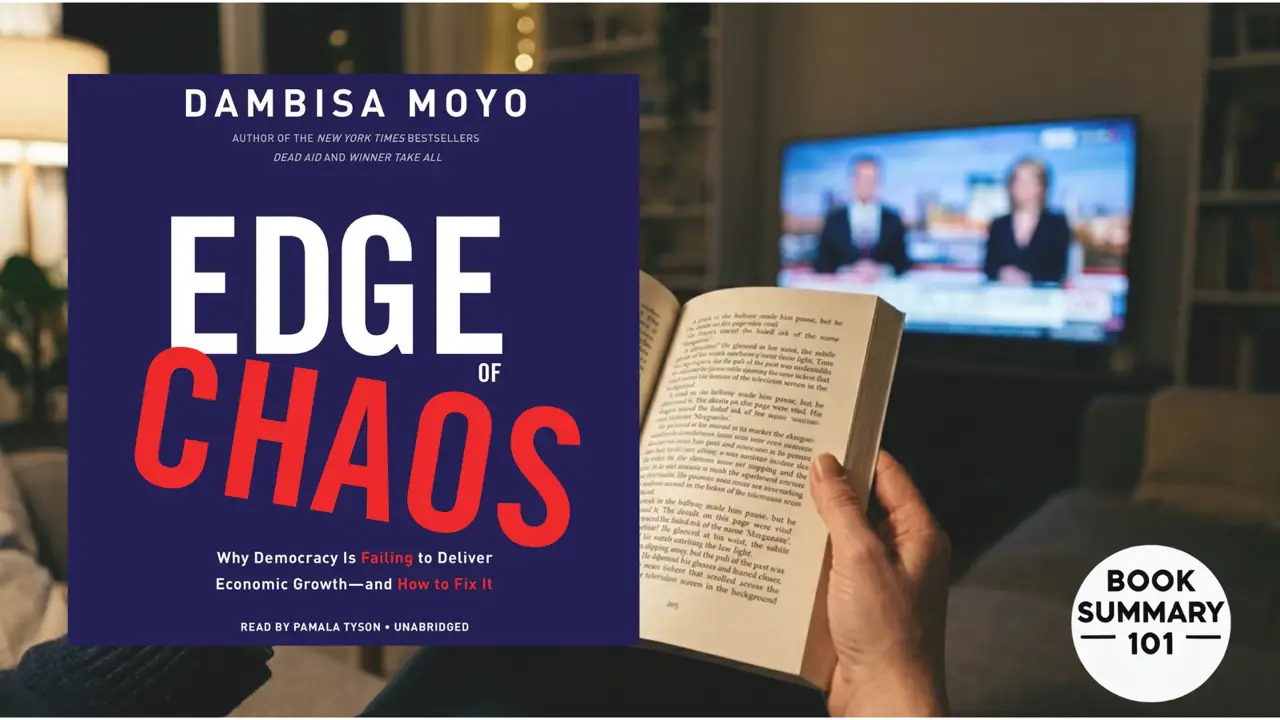
Then, I picked up Edge of Chaos: Why Democracy Is Failing to Deliver Economic Growth-and How to Fix It by Dambisa Moyo.
Reading this book felt like sitting down for coffee with a brilliant, brutally honest economist friend who finally explained why our system feels so broken. She didn’t just complain about the problem; she diagnosed it with laser precision and offered solutions that made my jaw drop. It completely shifted how I view politics, voting, and the future of our economy.
Why Should You Even Bother Reading It?
You might be thinking, “I’m not a political scientist or a Wall Street banker. Why should I care?” You should care because this book is about the money in your pocket, the security of your job, and the world your children will inherit.
This book is for anyone who feels disillusioned with modern politics. Whether you are a curious voter, a business leader trying to forecast the next ten years, or just someone who wants to understand why global superpowers are shifting, Moyo’s insights are vital. She dares to ask the taboo questions about democracy, proving that if we want to save our system, we have to be willing to radically upgrade it.
- Why Should You Even Bother Reading It?
- The 6 Pillars of the Democratic Crisis (And the Radical Blueprint to Save Us)
- 1. The Six Headwinds (The Economic Perfect Storm)
- 2. The Curse of Short-Termism (The Myopic Politician)
- 3. The Threat of State Capitalism (The China Conundrum)
- 4. Radical Fix #1: Elongating Political Terms
- 5. Radical Fix #2: Weighted Voting (The Most Controversial Idea)
- 6. Radical Fix #3: Mandatory Voting and Minimum Standards
- My Final Thoughts
- Join the Conversation!
- Frequently Asked Questions (The stuff you’re probably wondering)
The 6 Pillars of the Democratic Crisis (And the Radical Blueprint to Save Us)
Let’s peel back the curtain on why our political system keeps dropping the economic ball, and explore Moyo’s incredibly bold, controversial solutions to rewire it for long-term success.
1. The Six Headwinds (The Economic Perfect Storm)
Imagine trying to keep a leaky rowboat afloat in the middle of the ocean. Now, imagine you are also juggling flaming torches, a storm is rolling in, and you’ve run out of drinking water. If you drop a torch, you burn the boat. If you stop bailing water, you sink.
This is exactly how Dambisa Moyo describes the current state of the global economy. We aren’t just facing one problem; we are facing a convergence of massive, structural crises that she calls the “Six Headwinds.” These headwinds are heavy, relentless, and completely immune to quick political fixes.
What are they? They include staggering demographic shifts (like aging populations), massive income inequality, severe resource scarcity, mounting national debts, declining workplace productivity, and the rapid technological displacement of jobs due to automation and AI. Every single one of these problems requires decades of careful, painful planning to solve.
Think about the real-world example of Japan, or even the United States’ looming Social Security crisis. People are living much longer, and birth rates are dropping. This means fewer young workers are paying taxes to support a growing number of retirees. A politician can’t just pass a bill to make people younger. Fixing this requires overhauling immigration, taxation, and retirement ages—all of which are wildly unpopular moves that politicians avoid like the plague.
When these six headwinds combine, they create an environment where economic growth stalls out. And without economic growth, democracies become angry, polarized, and unstable.
Simple Terms: The world is facing six massive, interconnected economic crises that are too big for quick political band-aids.
The Takeaway: We can no longer afford to ignore the deep, structural problems like debt and demographics; our survival depends on facing this perfect storm head-on.
2. The Curse of Short-Termism (The Myopic Politician)
Think about training a brand-new puppy. If you want the puppy to love you immediately, you feed it endless treats and let it sleep on the kitchen table. You get instant affection! But jump forward three years: the dog is terribly unhealthy, has horrible behavioral problems, and destroys your house.
Our democratic politicians are treating the economy exactly like that puppy. Moyo calls this the curse of “Short-Termism.” Because politicians in a democracy are locked into two-to-four-year election cycles, their ultimate goal is never long-term economic stability. Their ultimate goal is simply getting re-elected.
Therefore, they are heavily incentivized to hand out “treats” right before an election. These treats look like tax cuts we can’t afford, stimulus checks that drive up inflation, or massive subsidies for loud, angry industries. Meanwhile, the long-term “health” of the nation—like paying down a multi-trillion dollar national debt or rebuilding a crumbling electrical grid—is completely ignored. Why? Because the painful sacrifices required to fix those things will get a politician voted out of office long before they see the positive results.
Consider a real-world example: American infrastructure. Everyone knows bridges are collapsing and roads need fixing. But no politician wants to raise taxes today to fund a ten-year bridge project. By the time the ribbon is cut on that new bridge, some other politician will be in office taking the credit. So, they just kick the can down the road.
📖 “Democracy is not delivering the economic growth it once did, and the short-termism inherent in the political cycle is a fundamental reason why.”
Simple Terms: Politicians only care about the next election, so they ignore long-term problems to offer short-term bribes to voters.
The Takeaway: Our election cycles actively punish leaders who try to make the difficult, responsible decisions needed for our future.
3. The Threat of State Capitalism (The China Conundrum)
Imagine a family of ten trying to decide where to go for dinner. Everyone is arguing, people are storming out of the room, and an hour later, they still haven’t left the house. Meanwhile, a single guy in a sports car decided what he wanted, drove to the restaurant, and is already eating dessert.
In the global economic race, democracy is the bickering family, and authoritarian state capitalism—specifically China—is the guy in the sports car. Moyo points out a highly uncomfortable truth: when it comes to long-term economic planning, authoritarian regimes currently have a massive structural advantage over democracies.
Because leaders in state capitalist systems don’t have to worry about the next election, they can plan fifty years into the future. They can direct billions of dollars into emerging technologies, build massive infrastructure projects overnight, and absorb short-term economic pain without fear of being voted out.
Look at a real-world example like China’s Belt and Road Initiative, or their high-speed rail network. While democratic nations like the US and the UK spend fifteen years locked in committee hearings, environmental reviews, and partisan gridlock just to lay a few miles of track, China laid down thousands of miles of high-speed rail across their entire country. Moyo warns that if democracies don’t find a way to become more agile, state capitalism will simply outcompete us on the global stage.
Simple Terms: Authoritarian governments can make fast, long-term economic plans because they don’t have to worry about winning elections.
The Takeaway: Democracies must find a way to overcome their internal gridlock, or they risk losing global economic dominance to more decisive, state-run economies.
4. Radical Fix #1: Elongating Political Terms
Imagine a farmer who only rents a piece of land for a single year at a time. Is that farmer going to plant a beautiful apple orchard that takes ten years to bear fruit? Absolutely not. He is going to plant the fastest-growing cash crop he can find, drain the soil of all its nutrients, and move on.
To fix the short-termism of politicians, Moyo suggests we need to turn them from “renters” into “owners” of the long-term outcome. Her first radical fix is to significantly elongate political term limits. Instead of a President or a Representative constantly running for re-election every two to four years, what if they served a single, seven-to-ten-year term?
By removing the constant pressure of the campaign trail, politicians wouldn’t have to spend 70% of their time fundraising and pandering to wealthy donors. They could actually sit down and tackle the complex, multi-year issues like the Six Headwinds. They could plant the “apple orchard.”
We actually already use this concept in the real world with great success. Look at the Federal Reserve in the United States. The Governors of the Federal Reserve are appointed to 14-year terms. This is done entirely on purpose so they can make tough, unpopular economic decisions (like raising interest rates to fight inflation) without worrying about a looming election. Moyo asks: why not apply this logic to our elected officials?
Simple Terms: Giving politicians longer, single terms removes the pressure of constant campaigning and allows them to focus on long-term problems.
The Takeaway: If we want leaders to act with long-term vision, we have to give them the time and job security to actually execute that vision.
5. Radical Fix #2: Weighted Voting (The Most Controversial Idea)
Imagine you are on a commercial flight, and suddenly the pilot passes out. The flight attendants ask if anyone knows how to fly the plane. A retired Air Force pilot raises her hand. But then, a guy who has played a lot of Microsoft Flight Simulator also raises his hand. Should the passengers take a majority vote to decide who lands the plane? Of course not. You defer to the person with the actual qualifications.
This brings us to Moyo’s most shocking and controversial proposal: weighted voting. She argues that in a highly complex, technologically advanced global economy, treating every single vote as exactly equal might be a fatal flaw.
Currently, a voter who has spent hundreds of hours studying macroeconomic policy has the exact same voting power as someone who flips a coin in the voting booth. Moyo suggests exploring an “epistocracy”—a system where your voting power is tied to your knowledge.
How would this work in the real world? It wouldn’t be based on wealth or race. Instead, you might take a standardized civic and economic test. If you pass, your vote gets weighted heavier. We do this in the corporate world all the time; a shareholder with a deeper investment in the company gets more voting power. Moyo argues that if we require people to pass a test just to drive a car, we might need a minimum standard of knowledge to steer the fate of a nuclear-armed economy.
📖 “In a world of deep complexity, we can no longer rely on a system where ignorance is given the exact same weight as hard-earned expertise.”
Simple Terms: Giving more voting power to citizens who demonstrate a solid understanding of civics and economics.
The Takeaway: While highly controversial, treating voting as a responsibility that requires a baseline of knowledge could drastically improve the quality of our leaders.
6. Radical Fix #3: Mandatory Voting and Minimum Standards
Think about those awful group projects in high school. Usually, two people did all the work, two people completely checked out, and one person just complained the whole time. But imagine if the teacher instituted a strict rule: if everyone doesn’t actively participate and present a part of the project, the entire group fails. Suddenly, the quiet people speak up, and the loud complainers get drowned out by the sensible middle.
Moyo’s final radical fixes involve forcing participation and raising the bar for entry. First, she advocates for mandatory voting. In many democracies, voter turnout is abysmal. Because only the most angry, hyper-partisan fringes show up to vote, politicians pander to those extremes. If voting were legally mandatory, politicians would be forced to appeal to the rational, moderate middle of the country.
Look at a real-world example like Australia. They have had compulsory voting for a century. If you don’t vote, you get a fine. As a result, voter turnout is consistently in the 90% range, and their political landscape tends to be less hijacked by extreme, fringe candidates compared to the United States.
Furthermore, Moyo suggests minimum standards for politicians. Just as doctors and lawyers must pass rigorous board exams to practice, politicians should have to pass standardized tests in economics, foreign policy, and law before they are even allowed to put their names on a ballot. We shouldn’t let popularity contests mask a total lack of competence.
Simple Terms: Making voting required by law to dilute extreme voices, and forcing politicians to pass exams to prove they are qualified for the job.
The Takeaway: By forcing everyone to the polls and demanding baseline competence from candidates, we can pull politics back to a sane, functional center.
My Final Thoughts
Reading Edge of Chaos: Why Democracy Is Failing to Deliver Economic Growth-and How to Fix It was a deeply jarring, yet profoundly empowering experience. Moyo doesn’t pull any punches.
Some of her ideas—especially weighted voting—made me uncomfortable at first. It feels deeply counterintuitive to the democratic ideals we are taught in grade school. But that is exactly the point of this book. We cannot afford to cling to romanticized, 18th-century notions of democracy while 21st-century economic crises threaten to sink the ship.
Moyo gives us permission to think outside the box. She reminds us that democracy isn’t a magical, flawless system; it’s a piece of human software. And right now, that software has a lot of bugs. It is up to us to have the courage to download the upgrade.
Join the Conversation!
I’d love to hear your thoughts on this. Of all of Moyo’s radical fixes, which one do you think is the most brilliant, and which one do you think would cause a riot? Let me know in the comments below!
Frequently Asked Questions (The stuff you’re probably wondering)
1. Is this book anti-democracy?
Not at all! Actually, it’s the exact opposite. Dambisa Moyo is fiercely protective of democracy. She points out its flaws because she wants to save it from collapsing under the weight of economic stagnation. It’s tough love.
2. I don’t know anything about economics. Will I be lost?
Nope! Moyo is a brilliant communicator. While she deals with heavy macroeconomic concepts, she breaks them down in a way that makes sense to the average reader. If you can understand the concept of a household budget, you will follow along just fine.
3. Aren’t her ideas about weighted voting inherently elitist?
This is the most common criticism of the book. Moyo addresses this head-on, arguing that it’s not about rich vs. poor, but about informed vs. uninformed. She argues that bad economic policy hurts the poorest citizens the most, so we need informed voters to protect them.
4. Does she offer any solutions for the “Six Headwinds” themselves?
Yes, but she makes it clear that the policies aren’t the missing piece—the political will is. We know how to fix debt and infrastructure. Her book focuses on fixing the political machine so it actually has the courage to pass those known solutions.
5. Who absolutely needs to read this book?
Anyone interested in finance, political science, or leadership should grab a copy immediately. It’s also a fantastic read for anyone who is sick of partisan yelling and wants a logical, data-driven look at how we can actually fix our country.