You know that feeling. It’s the “Blank Page of Doom.”
A few years ago, I was trying to name a new side project. I sat in a coffee shop, staring at my laptop, waiting for a bolt of lightning to strike. I wanted something cool. Something iconic. Something like Apple or Nike.
Instead, my brain offered up gems like “Quali-Solutions” and “Fast-Track Systems.”
I spent hours on GoDaddy, typing in variations of terrible names, only to find out even the bad ones were taken. I felt like I was trying to solve a Rubik’s cube in the dark. I wasn’t just stuck; I was boring myself to tears.
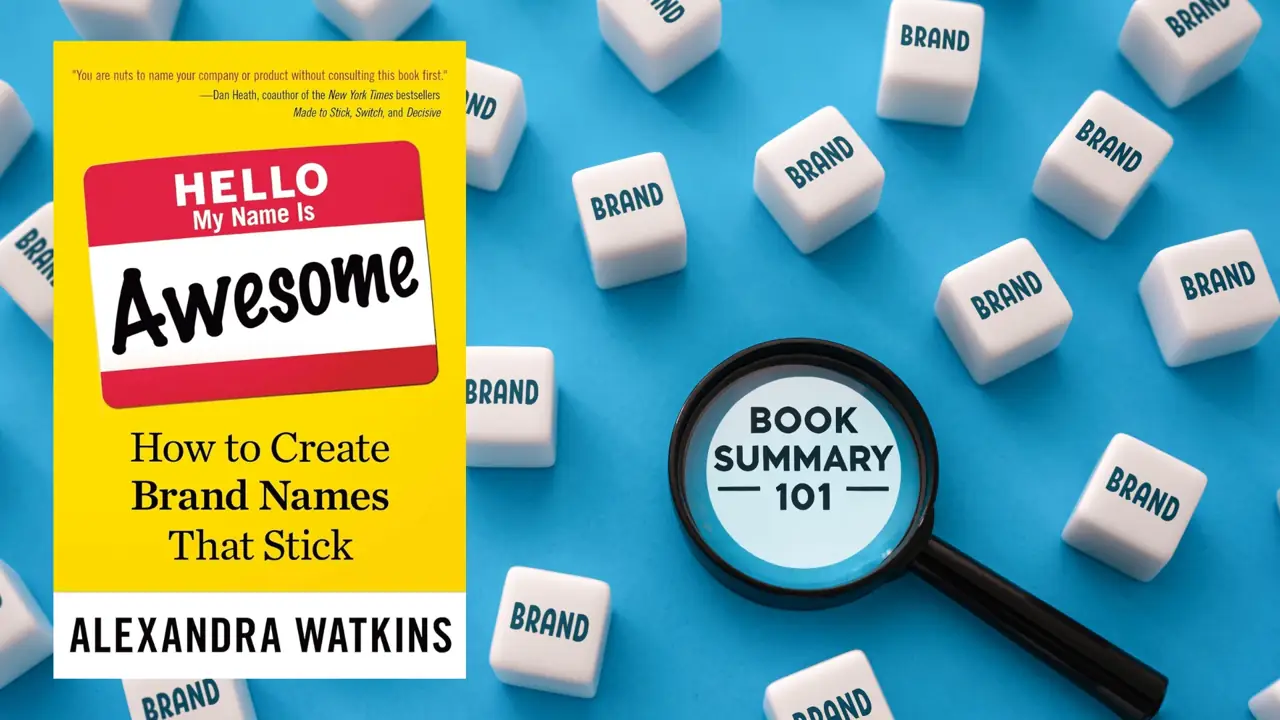
Then I picked up Hello, My Name Is Awesome by Alexandra Watkins.
It wasn’t a dry, academic textbook on linguistics. It felt like sitting down with a sassy, incredibly smart friend who took one look at my list of “professional” names, laughed, and tossed them in the trash. This book didn’t just teach me how to name things; it completely rewired how I think about creativity and branding.
If you are tired of names that sound like prescription drugs or bad sci-fi villains, you’re in the right place.
- Why Should You Even Bother Reading It?
- The SMILE and SCRATCH Framework: A New Way to See Words
- 1. The SMILE Test: The 5 Qualities of a Super Sticky Name
- 2. The SCRATCH Test: The 7 Deadly Sins to Avoid
- 3. The “Bar Test” (The Ultimate Reality Check)
- 4. The Domain Name Myth (Don’t Buy the House for the Mailbox)
- 5. Brainstorming is for Amateurs (Eat Your Own Words)
- My Final Thoughts
- Join the Conversation!
- Frequently Asked Questions (The stuff you’re probably wondering)
Why Should You Even Bother Reading It?
Honestly? Because the world is noisy, and a boring name is a death sentence for a brand.
Whether you are a solopreneur launching your first freelance business, a startup founder looking for the next unicorn title, or just someone trying to name a podcast, this book is your lifeline.
Most people think naming requires magic or a million-dollar agency budget. Alexandra Watkins proves that all you need is a sense of humor, an internet connection, and a set of rules to keep you from embarrassing yourself. It’s relevant today because, in a sea of “Spotify-wannabes” and “Tech-startups-dropping-vowels,” having a name that makes people smile is a competitive advantage.
The SMILE and SCRATCH Framework: A New Way to See Words
Before we dive into the nitty-gritty, we need to set the stage. Watkins doesn’t believe in staring at the wall until inspiration hits. She believes in systems.
The core of this book revolves around two powerful checklists: SMILE (the qualities of a sticky name) and SCRATCH (the seven deadly sins of naming). Think of this like sorting LEGOs. You want to keep the bright, useful pieces that you can build with, and you want to throw away the broken, jagged pieces that are just going to hurt your feet when you step on them.
Here are the 5 core concepts that will turn you into a naming genius.
1. The SMILE Test: The 5 Qualities of a Super Sticky Name
Imagine you are at a crowded party. Who do you remember the next day? Do you remember the guy in the grey suit who talked about the weather? Or do you remember the person with the bright jacket who told a hilarious story?
Your brand name is that person at the party. To be memorable, Watkins argues your name needs to pass the SMILE test.
- Suggestive: It implies a positive brand experience. (e.g., Amazon suggests massiveness).
- Meaningful: Your customers “get it” instantly. (e.g., Rep Squad).
- Imagery: It paints a picture in your head. (e.g., Timberland).
- Legs: It lends itself to a theme for your marketing. (e.g., Ben & Jerry’s creates fun flavor names).
- Emotional: It engages people on a human level. (e.g., Obsession for perfume).
The Concept in Action:
Let’s look at the cleaning service, “Geeks on a Beach.” Just kidding, that’s a tech conference. But consider the cleaning brand “Merry Maids.”
It passes the test. It suggests happiness (Suggestive), tells you they clean (Meaningful), and makes you feel good (Emotional).
Compare that to something like “Global Cleaning Solutions Inc.” That name has zero imagery. It’s a grey suit. Watkins pushes us to find names that create a visual spark in the brain immediately.
📖 “The most powerful names are those that make a connection with the people you are trying to reach.”
Simple Terms: A good name must evoke a feeling or picture, not just describe what you do.
The Takeaway: If your name doesn’t make someone smile or visualize something, keep brainstorming.
2. The SCRATCH Test: The 7 Deadly Sins to Avoid
This is my favorite part of the book because it is ruthlessly practical. If the SMILE test is the accelerator, the SCRATCH test is the brakes. It stops you from driving off a cliff.
Watkins warns us against names that are:
- Spelling challenged (dropping vowels like Flickr or Raizr).
- Copycat (trying to sound like Apple or Google).
- Restrictive (naming yourself “24 Hour Tacos” when you might want to sell burgers later).
- Annoying (names that try too hard to be cool).
- Tame (boring, descriptive names).
- Curse of Knowledge (insider terms only you understand).
- Hard to pronounce.
The Concept in Action:
Remember the trend of dropping vowels? Think of a name like “Xobni.”
It looks like a typo. It’s actually “Inbox” spelled backward. The founders thought it was clever. Watkins would put this squarely on the SCRATCH list. It looks like a prescription drug for a rash, and nobody knows how to say it.
If you have to explain how to spell your name every time you say it, you are wasting marketing dollars. You are putting a barrier between you and your customer.
Simple Terms: Don’t try to be too clever, too cute, or too similar to everyone else.
The Takeaway: If people stumble when reading your name or roll their eyes when hearing it, scratch it off the list.
3. The “Bar Test” (The Ultimate Reality Check)
This is the most practical tool in the entire book. Watkins suggests that before you fall in love with a name, you need to subject it to the Bar Test.
Here is the scenario: You are in a noisy bar (or a crowded coffee shop). It’s loud. There is music playing. You bump into a friend and they ask, “Hey, what’s the name of your new company?”
If you say the name and they look confused, squint, or ask “Did you say…?” — you failed.
If you have to say, “It’s like the word ‘Blue,’ but spelled B-L-E-W,” — you failed.
The Concept in Action:
Imagine you named your company “Quik-Fix.”
In a noisy bar, you say, “I started Quik-Fix.”
Your friend asks, “Quick… what? Like the chocolate milk?”
You: “No, Q-U-I-K fix.”
Friend: “Oh.”
The energy is dead. Compare that to saying, “I started the Geek Squad.”
Your friend hears it. They get it. They probably smile. No spelling required. The Bar Test ensures your name is audibly clear and easy to share.
Simple Terms: If you have to spell it, explain it, or apologize for it in a loud room, it’s a bad name.
The Takeaway: Clarity beats cleverness every single time.
4. The Domain Name Myth (Don’t Buy the House for the Mailbox)
This section was a massive relief for me. We all obsess over getting the matching .com. We think if we can’t get OurName.com, the business is doomed.
Watkins smashes this myth with a sledgehammer. She compares obsessing over a domain name to refusing to buy your dream house because it has an ugly mailbox. You can change the mailbox! Or, in this case, you can add a modifier.
She argues that having a great brand name with a slightly modified URL is better than a terrible brand name with a perfect URL.
The Concept in Action:
Look at Tesla.
When Elon Musk started, he didn’t own Tesla.com. He used TeslaMotors.com. Did it stop him from building an empire? No.
Dropbox started as getdropbox.com.
If you come up with a brilliant name like “Big Spoon” for a yogurt shop, but bigspoon.com is taken by a construction company in 1998, don’t panic. Use EatBigSpoon.com or BigSpoonYogurt.com.
📖 “Don’t let a domain name dictate your brand name. A domain is just an address; your brand name is your identity.”
Simple Terms: A perfect .com is nice, but a memorable brand name is essential.
The Takeaway: Add a verb (like “get” or “try”) or a noun (like your industry) to your URL and keep the awesome name.
5. Brainstorming is for Amateurs (Eat Your Own Words)
We’ve all been taught that the best way to get ideas is to get a group of people in a room, buy some pizza, and write on a whiteboard. Watkins says this is actually the worst way to name something.
Group brainstorming usually leads to “groupthink,” where everyone settles on the safest, most boring option (the Tame category of SCRATCH) because they don’t want to look stupid.
Instead, she advocates for solitary creative dives using the internet as a tool—but not in the way you think. Don’t look for available domains. Look for words.
The Concept in Action:
Watkins suggests using sites like freedictionary.com (specifically the Idioms section) or Google Images.
If you are naming a fast IT service, don’t just stare at the wall.
- Go to an idiom dictionary and search for “fast.”
- You’ll find phrases like “lickety-split,” “full tilt,” or “double time.”
- Go to Google Images and search for “speed.” You might see a picture of a cheetah, a rocket, or a bolt of lightning.
This method allows you to make connections (like “Rocket IT” or “Double Time Tech”) that you never would have found by just staring at a whiteboard with your coworkers.
Simple Terms: Stop brainstorming in groups; start researching idioms and imagery alone.
The Takeaway: The internet is a goldmine of associations and metaphors waiting to be connected to your brand.
My Final Thoughts
Reading Hello, My Name Is Awesome felt like someone finally gave me permission to have fun with business.
For so long, I thought “professional” meant “boring.” I thought if a name sounded corporate, it was safe. Alexandra Watkins taught me that safe is risky. In a world where everyone is fighting for attention, being the “safe” choice just makes you invisible.
This book empowers you. It takes the mystery out of the creative process. You realize you don’t need to be a poetic genius to name a company; you just need to follow the SMILE and SCRATCH rules, do your research, and trust your gut (after you’ve passed the Bar Test, of course).
It’s a quick read, but the tools inside will stick with you forever. I’ll never look at a “Quali-Tech” sign the same way again.
Join the Conversation!
I’d love to hear from you. What is the funniest or worst business name you’ve ever seen in the wild? Or, be brave—what was a terrible name you almost gave your own business? Drop a comment below!
Frequently Asked Questions (The stuff you’re probably wondering)
1. Do I need to be a creative writer to use this book?
Not at all. The book is designed for non-creatives. Watkins provides lists, resources, and step-by-step guides on how to use online tools (like thesauruses and image searches) to find words. It’s more about research and connection than pure invention.
2. Does this book cover the legal side of naming?
Yes, it touches on it. While it’s not a law textbook, Watkins explains the basics of trademarks and why descriptive names (like “Fast Plumbers”) are much harder to protect legally than creative names (like “Laser Leaks”).
3. Is this book relevant for B2B (Business to Business) companies?
Absolutely. There is a misconception that B2B names need to be serious and dry. Watkins argues that B2B buyers are humans too, and they appreciate names that are easy to remember and spell just as much as consumers do.
4. Can I use these techniques for naming products or newsletters, not just companies?
Yes! The SMILE and SCRATCH principles apply to anything that needs a name—podcasts, blog series, specific products, conference themes, or even your Wi-Fi network.
5. Is the advice outdated?
The core principles are timeless. While some specific tech trends mentioned might age, the psychology of what makes a human being remember a word (imagery, emotion, simplicity) hasn’t changed in thousands of years.