I have a confession to make. I can still remember the whirring sound of my old computer’s CD burner working overtime. I remember the thrill of watching a progress bar on Napster, Kazaa, or LimeWire, waiting for that one song to finish downloading. For years, I just assumed “free music” kind of… happened. It felt like magic, a sudden digital flood that appeared out of nowhere.
I never once stopped to think about how. Who actually invented the file that made it all possible? Who was the first person to leak an album? And how on earth did the most powerful entertainment industry on the planet just let it happen?
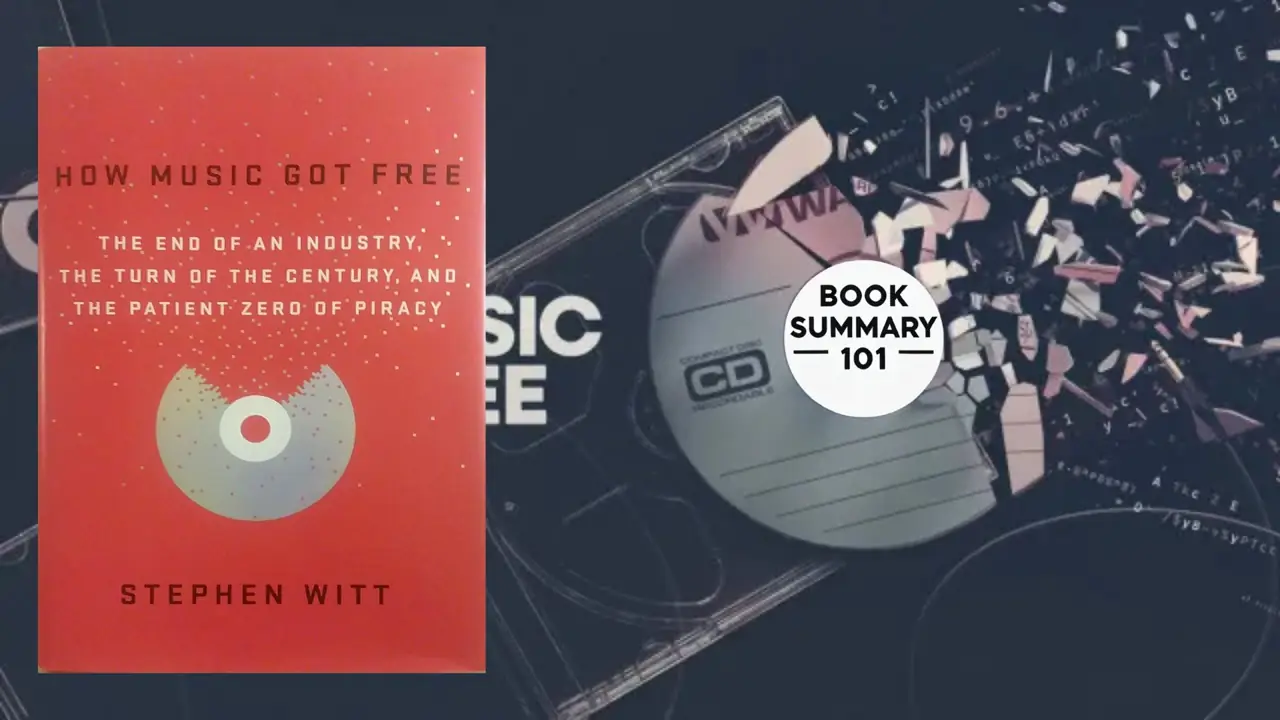
That’s where Stephen Witt’s masterpiece, How Music Got Free, comes in. I picked it up expecting a dry, technical history lesson, but what I got was a fast-paced thriller. It felt less like a business book and more like a secret history of the world I grew up in, told through the eyes of the people who lived it.
It’s like having a brilliant friend sit you down and say, “You see that world-changing event? Let me tell you the real story.”
Why Should You Even Bother Reading It?
Honestly, this book is for anyone who has ever clicked “play” on a digital song. It’s for you if you’re fascinated by how technology can completely upend a powerful industry overnight. It’s for you if you love a good true story with incredible characters—from geniuses and corporate titans to thieves.
You don’t need to be a techie or a music industry insider. Witt makes the complex simple and the history personal. This book isn’t just about music; it’s a blueprint for understanding digital disruption that’s more relevant today than ever.
- Why Should You Even Bother Reading It?
- The Three Men Who Accidentally Started a Revolution
- The Sound No One Could Hear: Inventing the MP3
- The King in the Ivory Tower: Doug Morris and the CD Empire
- Patient Zero: Dell Glover, The Man with the Plastic Buckle
- The Race to Zero: The Pirates of Rabid Neurosis (RNS)
- The Floodgates Open: Napster Changes Everything
- My Final Thoughts
- Join the Conversation!
- Frequently Asked Questions (The stuff you’re probably wondering)
The Three Men Who Accidentally Started a Revolution
The magic of How Music Got Free is that it’s not one story, but three completely separate stories that slowly, fatefully, begin to collide. Witt masterfully weaves together the tales of an inventor, a CEO, and a factory worker who, without ever meeting, conspired to change the world.
The Sound No One Could Hear: Inventing the MP3
Let’s start with the science. For years, digital audio files were massive. Think of a perfect, life-sized marble statue—beautiful, but way too heavy to email to a friend. A German audio engineer named Karlheinz Brandenburg and his team were obsessed with a single problem: how do you shrink that statue without anyone noticing it got smaller?
Their solution was a brilliant piece of psychoacoustics. The analogy is like being a master art forger who realizes you don’t need to replicate a painting perfectly, you just need to replicate what the human eye can see. Brandenburg’s team studied the biology of the human ear to discover which sounds we can’t perceive. If a loud drum hits at the same time as a quiet cymbal, your brain often just doesn’t register the cymbal. So, why waste digital space on it?
The MP3 algorithm was designed to intelligently throw away all the “inaudible” data. The team’s benchmark for perfection was Suzanne Vega’s a cappella song, “Tom’s Diner.” Her warm, nuanced voice was notoriously difficult to compress without it sounding tinny and robotic.
They tweaked and tweaked their algorithm for years until, finally, they could compress her voice down to a tiny fraction of its original size, and it sounded perfect. They had created a smaller, lighter statue that, to the human ear, was indistinguishable from the original.
Simple Terms: The MP3 is a “lossy” audio file that shrinks music by deleting the sounds your ears can’t process anyway.
The Takeaway: This wasn’t just a new file type; it was a technological key capable of unlocking music from its physical prison, the CD.
The King in the Ivory Tower: Doug Morris and the CD Empire
Now, let’s meet the king. In the 1990s, Doug Morris was one of the most powerful executives in the world, the CEO of Universal Music Group. His kingdom was built on a single, perfect product: the compact disc.
Imagine you’re selling water. For decades, you sold it in a cheap cup. Suddenly, you invent a beautiful, high-tech, patented bottle that people are willing to pay $18 for, even though the water inside is the same. That was the CD. The profit margins were astronomical. The industry had total control over manufacturing, shipping, and pricing. From Morris’s perspective, they had built an unbreakable fortress.
When the internet and the MP3 started bubbling up, Morris and his peers saw it not as a revolutionary new delivery system, but as a low-quality toy for geeks. They couldn’t imagine why anyone would trade the pristine, profitable CD for a hissy, intangible file. Their entire response was defensive. Instead of innovating, they chose to litigate. They built bigger walls around the fortress, completely oblivious to the fact that their enemy wasn’t at the gates—it was about to fly right over the top.
📖 “The CD was the most profitable consumer product in the history of modern capitalism. And no one in the major-label music industry had any incentive to change that.”
This quote perfectly captures the hubris. They weren’t just resistant to change; they were financially and psychologically incapable of even conceiving of it. Their greatest strength—the CD—had become their greatest vulnerability.
Simple Terms: The music industry was making so much money from CDs that they ignored the internet until it was too late.
The Takeaway: Success can create a dangerous blindness, making you protect what you have rather than invent what comes next.
Patient Zero: Dell Glover, The Man with the Plastic Buckle
This is where the story gets wild. All the technology in the world doesn’t matter without the product. So, how did brand-new albums from Eminem and Mariah Carey end up online weeks before they were in stores? The answer is a guy named Bennie Lydell “Dell” Glover, a worker at a Polygram CD pressing plant in North Carolina.
Think of Dell as a single, trusted guard inside the world’s most secure diamond vault. The music industry had spent millions securing their digital files, but they never thought the leak would come from the physical factory. Dell was on the assembly line, surrounded by thousands of finished, shrink-wrapped CDs every single day.
He wasn’t a criminal mastermind. He just figured out a simple, brilliant system. He would smuggle a CD out of the factory by tucking it behind his oversized belt buckle, confident that it wouldn’t set off the metal detectors. He’d take it home, “rip” it into an MP3 using his computer, and upload it to a private server for an elite piracy group. Within minutes, a CD that wasn’t due for release for another month was being shared by a secret network all over the globe. He was Patient Zero of the piracy epidemic.
Simple Terms: The biggest music pirate in history was a regular factory worker who smuggled CDs out of the plant one at a time.
The Takeaway: The most sophisticated security systems can be defeated by the simplest, most overlooked human element.
The Race to Zero: The Pirates of Rabid Neurosis (RNS)
Dell wasn’t just leaking music for fun. He was a supplier for an elite, underground group known as Rabid Neurosis (RNS). This is a crucial piece of the puzzle that most of us never knew about.
RNS wasn’t like Napster, where everyone shared everything. Imagine an exclusive club of the world’s best art thieves who competed not for money, but for the sheer thrill and reputation of being the first to steal a masterpiece. That was “The Scene.” They had strict rules, hierarchies, and an obsession with “0-day” releases—getting a work online the very same day it was finished.
These weren’t casual music fans; they were digital purists, racing against rival groups to leak an album, movie, or game first. Dell Glover was their secret weapon. His leaks gave RNS an unbeatable advantage, cementing their status as legends within The Scene. They weren’t trying to destroy the music industry. For them, it was a high-stakes competitive game, and the global economy of music was just the playing field.
📖 “For the pirates of the Scene, infringement was a competitive sport. The goal was to be first. Monetary profit was forbidden. The only reward was status.”
This changes everything. It shows that the initial wave of piracy wasn’t driven by a desire for free stuff, but by a subculture of competition and glory.
Simple Terms: Before piracy was mainstream, it was a competitive sport run by elite, secret groups who raced to leak things first.
The Takeaway: The motivations behind major technological shifts are often far more complex and human than they appear on the surface.
The Floodgates Open: Napster Changes Everything
So you have the technology (MP3), the product (leaked by Dell), and the secret distribution network (RNS). But the final piece of the puzzle was making it easy for normal people. That was Napster.
The analogy here is simple. RNS and The Scene were like a small group of gourmet chefs secretly trading rare ingredients. Napster came along and built a global, all-you-can-eat buffet and gave everyone a free pass.
Shawn Fanning’s simple software took the obscure, geeky world of FTP servers and IRC channels and turned it into a user-friendly search box. Suddenly, my mom, your cousin, and your English teacher could get any song they wanted, for free, in seconds. It took the elite game played by RNS and turned it into a worldwide phenomenon. The music industry’s fortress didn’t just have a breach; the floodgates were blown completely off their hinges.
Simple Terms: Napster created an easy-to-use app that let millions of normal people access the music leaked by the elite pirate groups.
The Takeaway: A disruptive technology only truly changes the world when it becomes simple enough for everyone to use.
My Final Thoughts
Reading How Music Got Free feels like finding a secret map to the modern world. It’s not a story of good guys versus bad guys. Brandenburg just wanted to solve a technical puzzle. Dell Glover just wanted to make a few extra bucks. Doug Morris just wanted to protect his business. And the pirates just wanted to win their game.
Yet, when you put them all together, they accidentally set off a bomb that reshaped media, culture, and technology forever. It’s a powerful, thrilling reminder that history isn’t usually made by grand plans, but by a messy, unpredictable collision of human ingenuity, ambition, and blindness. It left me feeling not just informed, but with a much deeper appreciation for the chaotic forces that shape our digital lives.
Join the Conversation!
This book brought back so many memories for me. I have to ask: What was the first song or album you remember downloading, and what did it feel like to have all that music at your fingertips? Share your story in the comments below!
Frequently Asked Questions (The stuff you’re probably wondering)
1. Is this book super technical? Do I need to be a computer expert?
Not at all. Stephen Witt does an incredible job of explaining complex ideas—like psychoacoustics and data compression—through simple analogies and character-driven stories. It’s built for a general audience.
2. Is it just about the technology?
No, that’s what makes it so great. The technology is just one part of the story. It’s really about the people: the obsessed German engineer, the powerful New York executive, and the humble North Carolina factory worker. It’s a human story first, a tech story second.
3. Who is this book really for?
It’s for anyone who lived through the digital music revolution, anyone working in an industry facing disruption (which is pretty much every industry), or anyone who just loves a fantastic, fast-paced nonfiction thriller.
4. Does the book take a side between the pirates and the industry?
It’s remarkably balanced. Witt presents the motivations and flaws of everyone involved. You understand why the executives were so blind, and you also understand the code of ethics and the thrill that drove the pirates. You’re left to draw your own conclusions.
5. What’s the most shocking thing I’ll learn from this book?
For most people, it’s the Dell Glover story. The realization that the entire piracy epidemic was fueled not by some shadowy hacker in a basement, but by an ordinary guy with a clever trick and access to the physical supply chain is absolutely mind-blowing.