Let me be honest with you for a second.
For years, I was stuck in the “self-improvement” trap. You know the drill. I read all the books on how to be happier, how to optimize my morning routine, and how to “find my passion.” I treated my life like a software project that just needed one more update to run perfectly.
But here’s the thing: despite all that focus on me, I didn’t feel more fulfilled. In fact, I felt anxious. I felt like I was constantly checking my emotional temperature, asking, “Am I happy yet?”
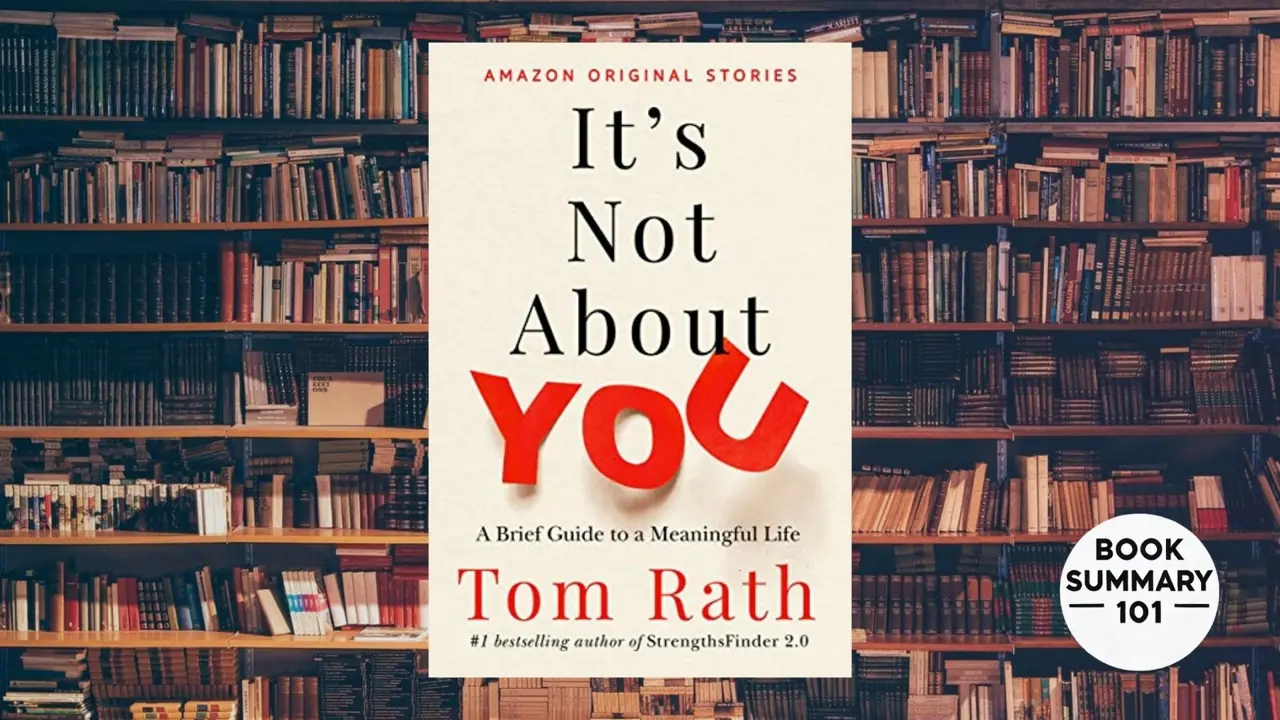
Then I picked up a slim little book by Tom Rath called It’s Not About You.
I expected another lecture on productivity. What I got instead was a gentle, friendly wake-up call. It was like a friend grabbing me by the shoulders and saying, “Hey, you’re looking in the wrong direction.”
Rath’s message is simple but radical: The pursuit of personal happiness often leads to misery. Meaning is found not in what you get, but in what you give.
If you’ve ever felt burned out by the pressure to “live your best life,” grab a coffee. We need to talk about this book.
- Why Should You Even Bother Reading It?
- The Blueprint for a Contribution-Centric Life
- 1. The Paradox of the Butterfly
- 2. The Toolkit Analogy (Reframing Your Strengths)
- 3. The Solar System Shift
- 4. Daily Interaction as a “Charging Station”
- 5. Planting Trees for Shade You Won’t Sit In
- My Final Thoughts
- Join the Conversation!
- Frequently Asked Questions (The stuff you’re probably wondering)
Why Should You Even Bother Reading It?
This isn’t a complex philosophical treatise. It is short, punchy, and designed for the modern, busy person.
You should read this (or this summary) if you are a professional feeling unfulfilled in your career, a student wondering what path to take, or just someone who feels like the modern obsession with “self-care” has morphed into “selfishness.”
It is relevant today because we live in a selfie culture. We are told to curate our lives for applause. This book offers an antidote: a way to find deep satisfaction by turning your focus outward.
The Blueprint for a Contribution-Centric Life
Tom Rath doesn’t just tell us to “be nice.” He breaks down exactly how to shift your mindset from consumption to contribution. This isn’t about becoming a martyr; it’s about realizing that life flows better when you stop trying to be the reservoir and start being the river.
Here are the core concepts from the book that completely reshaped my thinking.
1. The Paradox of the Butterfly
Imagine you are running through a field, frantically trying to catch a butterfly with your bare hands. The faster you run, the more erratic the butterfly flies. You end up exhausted, sweaty, and empty-handed.
This is how Rath describes the pursuit of happiness.
When we wake up asking, “How can I be happy today?”, we are chasing the butterfly. We focus on our own mood, our own needs, and our own satisfaction. Ironically, this hyper-focus on self usually highlights what we lack, leading to anxiety and dissatisfaction.
Rath argues that happiness is a byproduct, not a goal. It’s like the butterfly that lands on your shoulder when you sit still and focus on something else. That “something else” is meaningful work and contribution to others.
Real-World Example:
Think about the last time you were “in the zone” helping a friend move house or working late with a team to solve a crisis. You probably weren’t thinking, “Am I happy right now?” You were too busy being useful. Yet, looking back, you likely feel a deep sense of satisfaction about that day. That is meaning in action.
Simple Terms:
Stop trying to make yourself happy and start trying to make yourself useful.
The Takeaway:
Happiness is not a destination you run toward; it is a side effect of doing things that matter for other people.
2. The Toolkit Analogy (Reframing Your Strengths)
If you know Tom Rath, you know he is famous for StrengthsFinder. But in this book, he adds a crucial twist.
Imagine you have a magnificent, high-tech toolkit. It has the best drills, the sharpest saws, and the most durable hammers. Most self-help advises you to polish your tools, admire them, and maybe display them on a shelf.
Rath says: The tools aren’t for you.
Your talents—whether you are good at math, empathy, coding, or public speaking—are not designed to bring you accolades. They are designed to fix things for other people. A hammer is useless if it never drives a nail. Similarly, your talent is wasted if it’s only used to advance your own career rather than improve the lives of those around you.
📖”Life is not about you. It is about what you do for others.”
Real-World Example:
Let’s say you are a brilliant graphic designer.
- Self-Focus: You use your skills only to build a flashy portfolio to get a raise.
- Contribution-Focus: You use your skills to help a local non-profit communicate their mission clearly, or you mentor a junior designer who is struggling.
- The Result: In the second scenario, your skill actually does something.
Simple Terms:
Your talents are not trophies to be displayed; they are tools to be used for the benefit of others.
The Takeaway:
Don’t just ask “What am I good at?” Ask “How can I apply what I’m good at to help someone else right now?”
3. The Solar System Shift
Most of us grow up believing we are the sun. We think the world, our friends, and our workplace orbit around us. We get annoyed when traffic makes us late, or when a coworker’s bad mood ruins our day.
Rath suggests a Copernican shift in our social lives. You are not the sun. You are a planet. The “sun” is the collective well-being of the group (your family, your team, your community).
When you stop thinking you are the center of the universe, the pressure drops. You don’t have to shine the brightest; you just have to maintain your orbit and support the gravity of the whole system. This removes the ego from your interactions.
Real-World Example:
Think about a meeting at work.
- The “Sun” Mindset: “I need to speak up so I look smart. I hope they like my idea.” (High pressure, high anxiety).
- The “Planet” Mindset: “Does the team have what they need to succeed? How can I support the current speaker?” (Low pressure, high value).
Simple Terms:
Stop acting like the main character in a movie and start acting like a vital team member in a mission.
The Takeaway:
Removing yourself from the center of the narrative makes you less anxious and more effective at connecting with others.
4. Daily Interaction as a “Charging Station”
This is my favorite concept in the book because it is so actionable.
Imagine every person you meet has a battery icon floating above their head. Every time you interact with them—whether it’s a 30-minute meeting or a 5-second glance in the hallway—you are doing one of two things:
- Draining their battery.
- Charging their battery.
There is no neutral ground. Rath argues that we underestimate the power of brief interactions. You don’t need to save someone’s life to make a difference. A genuine smile, a “thank you,” or active listening charges people up. Ignoring them or complaining drains them.
Real-World Example:
The barista at your coffee shop. You can stand there looking at your phone, grunt your order, and grab the cup (Neutral/Draining). Or, you can look them in the eye, smile, and say, “Thanks, I really needed this today.”
That three-second interaction might be the only time that barista feels “seen” all morning. You just charged their battery.
📖 “You cannot be anything if you want to be everything.”
Simple Terms:
Every single time you talk to someone, leave them a little bit better than you found them.
The Takeaway:
Your legacy is built in micro-interactions, not just grand gestures.
5. Planting Trees for Shade You Won’t Sit In
This is the ultimate long-term view. Rath closes the loop by discussing legacy.
If you are only working for your own resume, your work dies when you retire. But if you are working to build something that lasts, you are thinking generationally.
The analogy here is the classic proverb: “A society grows great when old men plant trees in whose shade they know they shall never sit.”
Rath challenges us to engage in work where the full benefit might not be realized until after we are gone. This is the ultimate act of “it’s not about you.” It requires setting aside the need for immediate credit.
Real-World Example:
Wikipedia. Thousands of people contribute knowledge, edit articles, and verify facts for free. They don’t get bylines. They don’t get royalties. They are planting trees of knowledge so that a student ten years from now can sit in the shade and learn.
Simple Terms:
Do work that will outlast you, even if you don’t get the credit for it.
The Takeaway:
True meaning comes from contributing to a future that is bigger than your own lifespan.
My Final Thoughts
Reading It’s Not About You felt like a weight being lifted off my shoulders.
We put so much pressure on ourselves to be perfect, to be happy, and to be “successful.” Rath’s book taught me that I can stop obsessing over my own reflection.
It is incredibly empowering to realize that my value isn’t based on how I feel, but on what I do for others. It turns a bad day into a good one simply by asking, “Who can I help right now?”
If you are feeling lost, stop looking inward. Look outward. That’s where the magic is.
Join the Conversation!
I’d love to hear from you. What is one tiny, specific way you could “charge someone’s battery” today at work or at home? Drop a comment below!
Frequently Asked Questions (The stuff you’re probably wondering)
1. Is this a religious book?
No. While the concepts of service and humility align with many spiritual traditions, the book is secular, practical, and based on behavioral science and Rath’s research.
2. How long does it take to read?
It is very short. You can easily read it in one sitting—probably in about an hour or less. It’s designed to be a quick, impactful guide.
3. Is this similar to StrengthsFinder 2.0?
It is written by the same author and shares the philosophy of using your strengths, but the focus is different. StrengthsFinder is about identifying talent; It’s Not About You is about applying talent for the sake of others.
4. I’m an introvert. Is this book telling me I have to socialize constantly?
Not at all. Contribution doesn’t mean being the life of the party. It means doing work—even solitary work—that benefits others. It’s about the intent of your actions, not just social volume.
5. Will this book actually help me feel happier?
Paradoxically, yes. By taking the focus off your own happiness, you lower your anxiety and increase your sense of purpose. Most readers find that “contribution” is a much more reliable path to well-being than “happiness.”