Let’s be honest for a second. Have you ever caught yourself groaning when you get out of a chair? Or maybe you’ve looked in the mirror, seen a new wrinkle, and thought, “Well, it’s all downhill from here.”
I’ve been there.
A few months ago, I felt like I was prematurely aging. I found myself saying things like, “I’m too old to learn that software,” or “My bad back is just something I have to live with.” I was accepting limits that nobody had actually set for me.
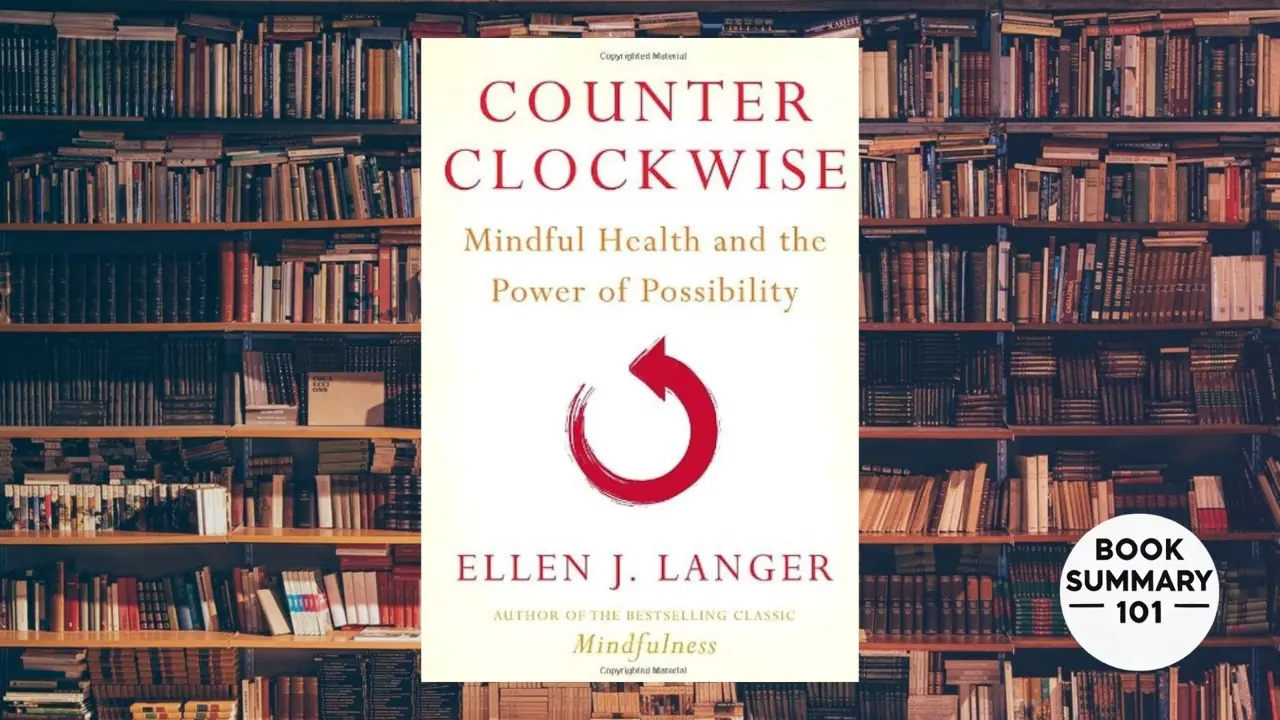
Then I stumbled upon Counterclockwise: Mindful Health and the Power of Possibility by Dr. Ellen J. Langer.
I’ll admit, I was skeptical. It sounded a bit too “woo-woo” for me. But then I realized Langer isn’t a guru; she’s a Harvard psychologist.
Reading this book felt like sitting down with a brilliant friend who gently takes the heavy backpack of “inevitable aging” off your shoulders and shows you that it was empty all along.
If you’ve ever felt trapped by a diagnosis, a number on a birthday cake, or just the feeling that your best days are behind you, this post is for you.
Let’s grab a coffee and break down how your mind might just be the most potent medicine you have.
- Why Should You Even Bother Reading It?
- The Psychology of Possibility: Rewiring How We Age
- 1. The Counterclockwise Study (The Time Travel Experiment)
- 2. Mindlessness vs. Mindfulness (The Autopilot Problem)
- 3. The Tyranny of Diagnoses (Don’t Be a Statistic)
- 4. The Placebo Effect is Real Medicine (The Internal Pharmacy)
- 5. Asymmetry of Control (Taking Credit vs. Blaming Luck)
- My Final Thoughts
- Join the Conversation!
- Frequently Asked Questions (The stuff you’re probably wondering)
Why Should You Even Bother Reading It?
This book isn’t just for the elderly or those facing health crises. It is essential reading for anyone who feels stuck.
If you are a caregiver, it will change how you treat your loved ones.
If you are health-conscious, it adds a critical mental component to your diet and exercise routine.
If you are a skeptic, it provides the hard science to back up the mind-body connection.
In a world obsessed with anti-aging creams and supplements, Langer argues that the fountain of youth isn’t in a bottle—it’s in your perspective.
The Psychology of Possibility: Rewiring How We Age
Most of us view our health like a car engine: eventually, parts wear out, things break, and there’s nothing you can do about it. Langer flips this script entirely. She presents a framework where our physical bodies are deeply intertwined with our social environment and our mental state.
Here are the core principles from the book that completely reshaped my thinking.
1. The Counterclockwise Study (The Time Travel Experiment)
This is the crown jewel of the book, and honestly, it sounds like the plot of a sci-fi movie.
The Analogy:
Imagine method acting. When an actor truly inhabits a role—let’s say, acting like a boxer—their posture changes, their adrenaline spikes, and they physically become stronger during the performance. Langer asked: What if we “method acted” being younger?
The Concept:
In 1979, Langer conducted a radical experiment. She took a group of elderly men (mostly in their late 70s and 80s) to a retreat that had been retrofitted to look exactly like 1959.
There were no mirrors (to remind them of their age). They listened to 1959 radio shows on vintage radios. They watched Ed Sullivan. But here was the kicker: They weren’t asked to reminisce about the past. They were told to live as if it were currently 1959. They had to speak in the present tense about events from twenty years prior.
Real-World Example:
The results were staggering. After just one week, the men didn’t just feel better; they were biologically younger.
Their hearing improved. Their vision sharpened. Their grip strength increased. Arthritis diminished so much that men who arrived with canes were playing touch football by the end of the week.
Simple Terms:
When you change the context and demand that your mind accept a different reality, your body follows suit.
The Takeaway:
Aging is not just a biological process; it is a social and psychological one. If you stop acting “old,” your body may stop feeling “old.”
2. Mindlessness vs. Mindfulness (The Autopilot Problem)
We hear the word “mindfulness” and usually think of someone sitting cross-legged on a yoga mat, burning incense. Langer’s definition is much more practical and active.
The Analogy:
Think about driving home from work. You’ve done it a thousand times. Suddenly, you’re in your driveway, and you don’t remember the drive at all. That is mindlessness. You were on autopilot.
Now, imagine driving that same route during a snowstorm. You are hyper-aware of every turn, every skid, every other car. That is mindfulness.
The Concept:
Langer argues that we live most of our healthy lives on autopilot. We blindly accept “facts” about our health.
For example, if you believe “eyesight inevitably worsens with age,” you won’t bother trying to focus when things get blurry—you’ll just reach for glasses. This creates a self-fulfilling prophecy.
Mindfulness, in Langer’s view, is the act of actively noticing new things. It’s noticing that your chronic pain actually fluctuates—it’s not constant. It’s noticing that you feel energetic at 3 PM, even though you’re “supposed” to be tired.
📖 “Mindfulness is the simple process of noticing new things. It puts us in the present. It makes us more sensitive to context and perspective. It is the essence of engagement.”
Simple Terms:
Stop living life on autopilot; pay attention to the subtle changes in your body and environment to regain control.
The Takeaway:
When we notice change, we realize we have choices. When we are mindless, we are victims of our habits.
3. The Tyranny of Diagnoses (Don’t Be a Statistic)
This section hit me hard. We tend to treat medical labels as absolute truths rather than helpful descriptions.
The Analogy:
Imagine you are given a LEGO set. If the box says “Spaceship,” you will only build a spaceship. You won’t look at the bricks and see a castle or a boat. The label on the box limits what you think is possible with the pieces.
The Concept:
Langer discusses how medical labels trap us. If a doctor says you have “chronic back pain,” you accept the word “chronic” (meaning forever) and stop looking for ways to heal.
She points out that medical science is based on statistics—averages of large groups. But you are not an average. You are an individual.
If a study says “60% of people with this condition don’t recover,” we usually hear “I won’t recover.” But Langer asks: Why not focus on the 40% who do? What did they do differently? By accepting the diagnosis as a rigid destiny, we shut down the body’s potential to heal.
Real-World Example:
Langer cites studies involving vision. When people are asked to read an eye chart, the letters get smaller as they go down. We expect not to be able to read the bottom lines.
However, when the chart is inverted (small letters at top, big at bottom), people can often read much smaller print than they thought. Why? Because the expectation of failure was removed.
Simple Terms:
A diagnosis is a label, not a life sentence; don’t let a name prevent you from seeking a cure or improvement.
The Takeaway:
Question the certainty of medical labels. Science deals in probabilities, but your life is a single, unique instance where anything is possible.
4. The Placebo Effect is Real Medicine (The Internal Pharmacy)
We usually use the word “placebo” to mean “fake” or “it didn’t work.” Langer argues that the placebo effect is actually the most powerful proof of the mind’s ability to control the body.
The Analogy:
Think of the feather in the movie Dumbo. Dumbo the elephant thought he needed the magic feather to fly. When he held it, he soared. When he dropped it, he panicked.
But the magic wasn’t in the feather. The feather was just the key that unlocked the ability Dumbo already had.
The Concept:
Langer suggests we should stop dismissing the placebo effect and start harnessing it. If a sugar pill can lower blood pressure because you believe it will, that means your body has the chemical ability to lower blood pressure on its own.
She details the famous “Chambermaid Study.” She took a group of hotel maids who spent all day scrubbing, lifting, and pushing carts. They didn’t view this as exercise; they viewed it as work. Consequently, their health metrics were poor.
Langer simply told them: “Your work satisfies the Surgeon General’s recommendations for an active lifestyle.” She pointed out how bed-making is like weightlifting, vacuuming is cardio, etc.
Real-World Example:
A month later—without changing their work routine or diet—the maids had lost weight, lowered their blood pressure, and decreased their waist-to-hip ratio. Just believing their work was exercise changed how their bodies metabolized the effort.
📖 “The placebo effect is not a trick. It is a demonstration of the power of the mind to heal the body.”
Simple Terms:
Your beliefs can trigger real chemical and biological changes in your body.
The Takeaway:
You don’t always need a “pill” to activate healing; you need to change how you perceive your activities and environment.
5. Asymmetry of Control (Taking Credit vs. Blaming Luck)
We have a funny way of looking at success and failure when it comes to our health.
The Analogy:
Imagine a gambler at a slot machine. When they win, they think, “I have a system! I’m skilled!” When they lose, they say, “Bad luck. The machine is rigged.”
The Concept:
Langer points out that when we recover from an illness, we rarely say, “My mind healed me.” We credit the medicine or the doctor.
However, when we get sick, we blame genetics or bad luck.
We externalize the cause of our health issues, which makes us feel helpless. Langer encourages us to recognize the role our own choices and mindset play in both sickness and health. This isn’t about blaming yourself for getting sick; it’s about empowering yourself to participate in getting better.
Real-World Example:
Think about stress. If you get a headache after a stressful meeting, do you say, “I gave myself a headache”? Probably not. But if you realized that your reaction to the stress caused the headache, you suddenly have the power to change your reaction next time.
Simple Terms:
If you take responsibility for your health, you gain the power to change it.
The Takeaway:
Recognize your agency. You are the captain of the ship, not just a passenger along for the ride.
My Final Thoughts
Reading Counterclockwise was, quite literally, a mind-opening experience for me.
It’s easy to feel like our bodies are machines destined to break down. We treat aging like a slow leak in a tire that we just have to accept. Ellen Langer challenges us to look at the tire and realize we might be the ones holding the pin.
This book didn’t make me stop going to the doctor or throw away my vitamins. But it did change how I wake up in the morning.
It taught me that if I wake up stiff, it might be because I expect to be stiff. It taught me that “learning” is possible at any age if I drop the fear of looking foolish.
Ultimately, Counterclockwise is about hope. But not blind, foolish hope. It’s a grounded, scientific hope that says we have far more control over our health and happiness than we ever dared to imagine.
Join the Conversation!
I’d love to hear from you. What is one “age-appropriate” limit you’ve placed on yourself that you might be willing to challenge this week? Let me know in the comments below!
Frequently Asked Questions (The stuff you’re probably wondering)
1. Is this book anti-science or anti-medicine?
Not at all. Ellen Langer is a respected Harvard professor. She argues for a partnership between medicine and mindfulness. She suggests we should question the certainty of medical data, not the data itself.
2. Can I really “think” away a serious illness?
No, and the book doesn’t claim you can magic away disease. However, it presents evidence that your mindset can significantly influence the outcome and severity of an illness, and that a positive, mindful approach can boost the body’s natural healing mechanisms.
3. Is this book difficult to read?
It is very accessible. While it is based on academic research, Langer writes for a general audience. She uses plenty of stories and examples, making it a smooth read for non-scientists.
4. What is the main thing I have to do to apply this?
The main action is “active noticing.” It requires you to stop running on autopilot and start paying attention to the variability in your health, your environment, and your behavior.
5. I’m young. Is this book relevant to me?
Absolutely. The “mindless” habits we form in our 20s and 30s become the health problems of our 60s and 70s. Learning to be mindful now can prevent the “inevitable decline” later.