Have you ever watched the news during a financial crisis, listened to the pundits talk about “derivatives,” “liquidity,” and “short-selling,” and just felt… stupid?
I know I have. For years, I treated the finance industry like a black box. I knew I put money in one end (my savings account or pension), and I hoped more money would eventually come out the other end. But what happened in the middle? That was a mystery wrapped in jargon I was too afraid to ask about.
I assumed that if I didn’t understand it, the problem was me. I wasn’t smart enough. I wasn’t “mathy” enough.
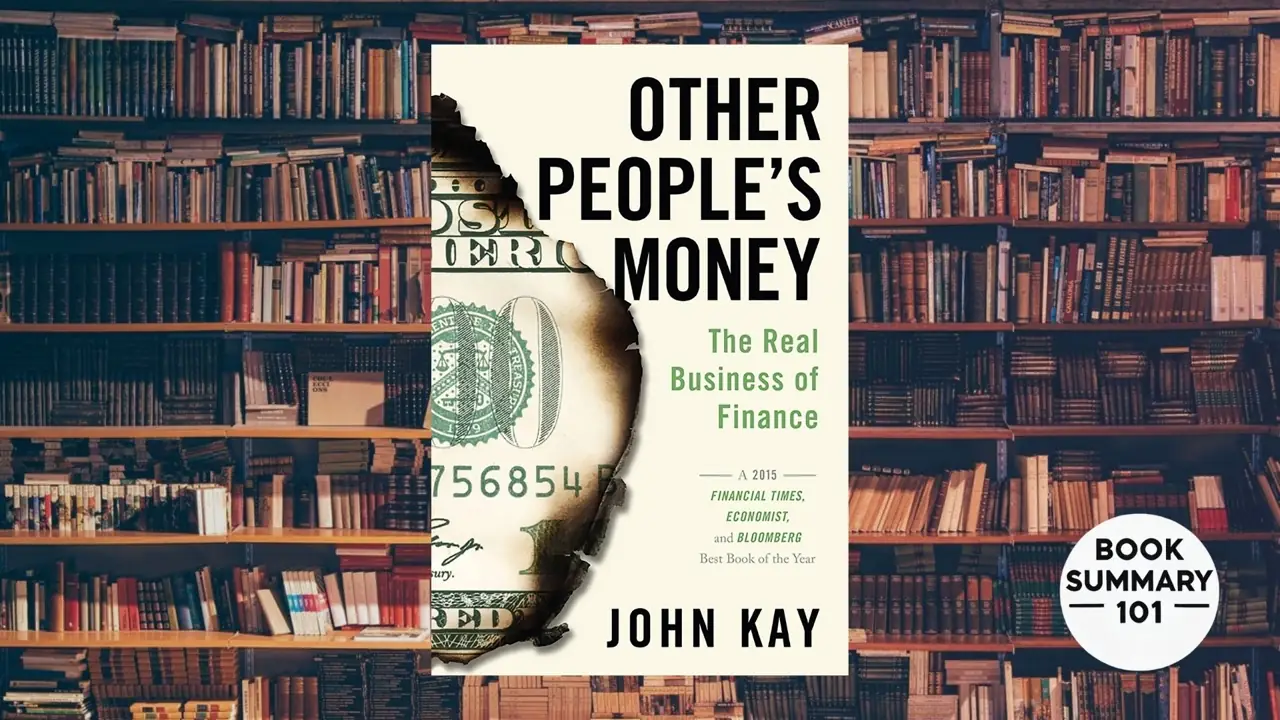
Then I picked up Other People’s Money by John Kay. And suddenly, it felt like someone turned the lights on in a dark room.
Kay isn’t an outsider throwing stones; he’s a distinguished economist. But reading this book felt less like a lecture and more like sitting down with a rebellious insider who finally decided to spill the beans. He confirms a suspicion many of us have had but couldn’t articulate: The finance industry isn’t just complicated; it has stopped serving the purpose it was built for.
If you’ve ever felt like the financial game is rigged or just unnecessarily confusing, this post is for you. Let’s unpack why the “masters of the universe” might actually be wearing no clothes.
- Why Should You Even Bother Reading It?
- The Great Disconnect – How Finance Lost Its Way
- 1. The Tail Wagging the Dog (Financialization)
- 2. The Intermediation Chain (The Bucket Brigade)
- 3. The Casino vs. The Utility
- 4. The “Other People’s Money” Problem
- 5. Complexity is Not Innovation
- My Final Thoughts
- Join the Conversation!
- Frequently Asked Questions (The stuff you’re probably wondering)
Why Should You Even Bother Reading It?
You might be thinking, “I’m not a banker, and I don’t day trade. Why do I care?”
You should care because this is about your money. Whether you have a 401(k), a pension, an insurance policy, or just a checking account, you are part of this system.
This book is perfect for:
- The Curious Skeptic: If you want to know why bankers get massive bonuses even when they lose money.
- The Non-Expert: You don’t need a degree in economics. Kay writes in plain English.
- The Future-Proofer: Understanding how the system is fragile helps you make better decisions about where you put your trust (and your cash).
It’s a wake-up call that explains why the finance sector has become a master at generating profit for itself, while doing very little for the rest of us.
The Great Disconnect – How Finance Lost Its Way
The central thesis of Kay’s book is shocking in its simplicity: The finance industry has largely stopped doing its job. Its primary role is to take capital from people who have it (savers) and give it to people who need it to build things (businesses). But somewhere along the way, finance became an industry obsessed with trading with itself.
Let’s break down the five core concepts that explain how this happened.
1. The Tail Wagging the Dog (Financialization)
Imagine you own a house, and you hire a plumber to fix a leak. The plumber is essential, but they are a service provider. They exist to support the house.
Now, imagine a world where the plumber becomes the most powerful person in the neighborhood. They start dictating how big your house should be, they take 40% of your household budget, and they spend all day trading pipes with other plumbers rather than actually fixing your leak.
This is what Kay calls “Financialization.”
Ideally, finance is a service industry. It’s the “plumber” of the economy, moving money to where it’s useful. But over the last 40 years, the finance sector has grown massively out of proportion to the “real” economy (factories, shops, services, technology).
Kay points out that a tiny fraction of the activity in the finance sector actually goes toward funding new businesses or infrastructure. The vast majority is just the financial sector trading existing assets with itself.
Real-World Example:
Think about the stock market. When you buy a share of Apple on an app like Robinhood, you aren’t giving money to Apple to build a new iPhone factory. You are buying that share from another trader. Apple doesn’t see a dime of that transaction. The “secondary market” (trading used shares) has eclipsed the “primary market” (funding companies).
Simple Terms: Finance used to be a utility like electricity; now it’s become the main event, sucking talent and money away from industries that actually make things.
The Takeaway: The finance sector has become a parasite that is now larger than the host it was meant to feed.
2. The Intermediation Chain (The Bucket Brigade)
We tend to think that when we save for retirement, our money goes into a vault and stays there. Or, we think we are “investing in the economy.”
Kay uses a brilliant conceptual framework to show us the reality: The Intermediation Chain.
Picture a bucket brigade trying to put out a fire. In an efficient system, you pass the water bucket, and it gets to the fire. In the modern financial system, the line of people passing the bucket is miles long.
- You give your money to a pension fund.
- The pension fund hires an investment consultant.
- The consultant hires an asset manager.
- The asset manager hires a fund manager.
- The fund manager hires a broker.
- The broker buys a stock.
Here is the kicker: Every single person in that line takes a “sip” of water from the bucket in the form of fees, commissions, and bonuses. By the time the bucket reaches the “fire” (the actual investment), a significant portion of the water is gone.
📖 “The finance sector today is not a servant of the real economy, but a master of it. The tail wags the dog.”
Real-World Example:
Look at your pension or 401(k) statement. You might see a “management fee” of 1%. That sounds small. But over 30 years, thanks to compound interest working against you, that 1% fee can eat up nearly one-third of your total potential returns. That’s the cost of the long chain.
Simple Terms: There are too many middlemen standing between your savings and the actual investment, and they all want a cut.
The Takeaway: The complexity of the system isn’t there to help you; it’s there to hide the fees being extracted by the middlemen.
3. The Casino vs. The Utility
Kay draws a sharp distinction between two activities that look the same but are fundamentally different: Investment vs. Trading.
Imagine you go to a horse track.
- Activity A: You buy a horse, pay for its training, and feed it so it can win races. This is Investment. You are contributing to the creation of value.
- Activity B: You stand in the stands and bet $50 that the horse will win. This is Trading.
The finance industry loves to conflate these two. They tell us they are “investing,” but Kay argues that the vast majority of modern finance is just Activity B. It is a giant casino where traders bet on price movements—whether the price of oil, gold, or Apple stock will go up or down in the next ten seconds.
This trading is a “zero-sum game.” For every winner, there is a loser. It creates no new wealth for society; it just shuffles money from one pocket to another, usually taking a fee in the process.
Real-World Example:
High-Frequency Trading (HFT). These are supercomputers that buy and sell stocks in microseconds to exploit tiny price differences. They don’t care about the company’s long-term health; they are just betting on the direction of the numbers. This adds zero value to the real economy but generates billions in profits for the traders.
Simple Terms: Much of Wall Street is just gambling on price changes rather than helping companies build better products.
The Takeaway: We need to stop treating speculators like essential economic guardians; they are just bettors in a very expensive casino.
4. The “Other People’s Money” Problem
This is the concept that gives the book its title, and it is the psychological root of the crisis.
Have you ever driven a rental car? Be honest—did you treat it as carefully as you treat your own car? Probably not. You might have hit a speed bump a little too fast or braked a little too hard. Why? Because you don’t bear the full cost of the wear and tear.
In finance, the managers are playing with Other People’s Money (OPM)—specifically, yours and mine.
Kay argues that the incentive structures are totally broken. If a banker takes a massive risk and it pays off, they get a multimillion-dollar bonus. If the risk blows up and the bank fails (like in 2008), the banker doesn’t pay back the bonus. The shareholders lose, or the taxpayers bail them out.
📖 “If you are playing with other people’s money, you are likely to take risks you would not take with your own.”
Real-World Example:
The 2008 Mortgage Crisis. Bankers were incentivized to sell as many mortgages as possible to people who couldn’t afford them. Why? because they got paid a bonus for every loan sold. They didn’t care if the loan eventually defaulted years later, because by then, they had already cashed their checks.
Simple Terms: When you gamble with someone else’s wallet, you take risks you’d never take with your own cash.
The Takeaway: Until bankers are personally liable for their losses, they will continue to take dangerous risks with our savings.
5. Complexity is Not Innovation
We are often told that financial products are complex because “modern markets are sophisticated.” Kay calls bluff on this.
Think of a Rube Goldberg machine—those cartoons where a ball rolls down a ramp, hits a fan, which blows a sail, which tips a bucket… just to wipe a napkin across a face. It’s complex, sure. But is it efficient? No.
Kay argues that complexity in finance is often designed intentionally to confuse regulators and customers. If a product is simple, it’s easy to compare prices, which drives fees down. If a product is complex (like a “Collateralized Debt Obligation”), nobody can tell what it’s truly worth, so the bank can charge higher fees.
Kay advocates for “robustness” over complexity. A simple suspension bridge is robust. A bridge held together by thousands of rubber bands and complex counter-weights might look fancy, but it’s prone to catastrophic failure.
Real-World Example:
Think about your credit card agreement. It is pages and pages of fine print. Is that there to help you? No. It’s there to hide the “gotchas.” In the same way, complex financial derivatives are often designed to hide risk rather than manage it.
Simple Terms: If a financial product is too hard to explain in a sentence, it’s probably designed to rip you off.
The Takeaway: We should demand simplicity. If a bank can’t explain it simply, we shouldn’t buy it.
My Final Thoughts
Reading Other People’s Money left me feeling two things: angry and empowered.
I was angry because it exposes just how much wealth is siphoned off by a system that has forgotten its purpose. But I felt empowered because the “fog” was lifted. John Kay strips away the intimidation factor. He makes you realize that finance isn’t a dark art; it’s just a business that needs to be brought back down to earth.
The book doesn’t suggest we burn the banks down. We need banks. We need a way to pay for groceries and fund new ideas. But we need a boring, reliable financial system—not a high-stakes casino.
Join the Conversation!
I’d love to hear your take. Do you trust your bank or pension manager to act in your best interest, or do you feel like just another source of fees? Drop a comment below and let’s talk about it.
Frequently Asked Questions (The stuff you’re probably wondering)
1. Is this book too technical for me?
Not at all. John Kay is a master of analogy. If you understood the “bucket brigade” or “rental car” examples in this blog post, you will understand the book perfectly.
2. Is the author anti-capitalist?
No. Kay is very much pro-market. He believes in the power of markets to solve problems. His critique is that the current finance sector actually hinders true capitalism by misallocating capital.
3. Will this book teach me how to invest?
It won’t give you stock tips or tell you to buy Bitcoin. However, it will teach you how to think about investing. It advocates for simple, low-fee, passive investing over chasing “hot” trends.
4. Is it just about the 2008 crash?
While it discusses the crash, the book is really about the structural design of the industry today. The problems that caused 2008—complexity, OPM, and trading-over-investing—are still very much with us.
5. What is the one thing I should change after reading this?
Focus on fees. Realize that every layer of intermediation costs you money. Look for simple, direct investment vehicles with the lowest possible costs.Simplicity is your friend.