I have a confession to make.
For years, I approached strategy the same way I approached cleaning my garage.
I would stand in the middle of the mess, look at what was right in front of me—a box of old cables here, a broken rake there—and I would just try to make it slightly better than it was yesterday.
I was reacting. I was incremental. I was trapped in the “now.”
In business, we call this the “quarterly grind.” You hit your numbers, you tweak the product, you try to grow by 4% next year. It feels safe. It feels responsible.
But deep down? It felt like I was rearranging deck chairs on the Titanic. I wasn’t building anything new; I was just maintaining what already existed.
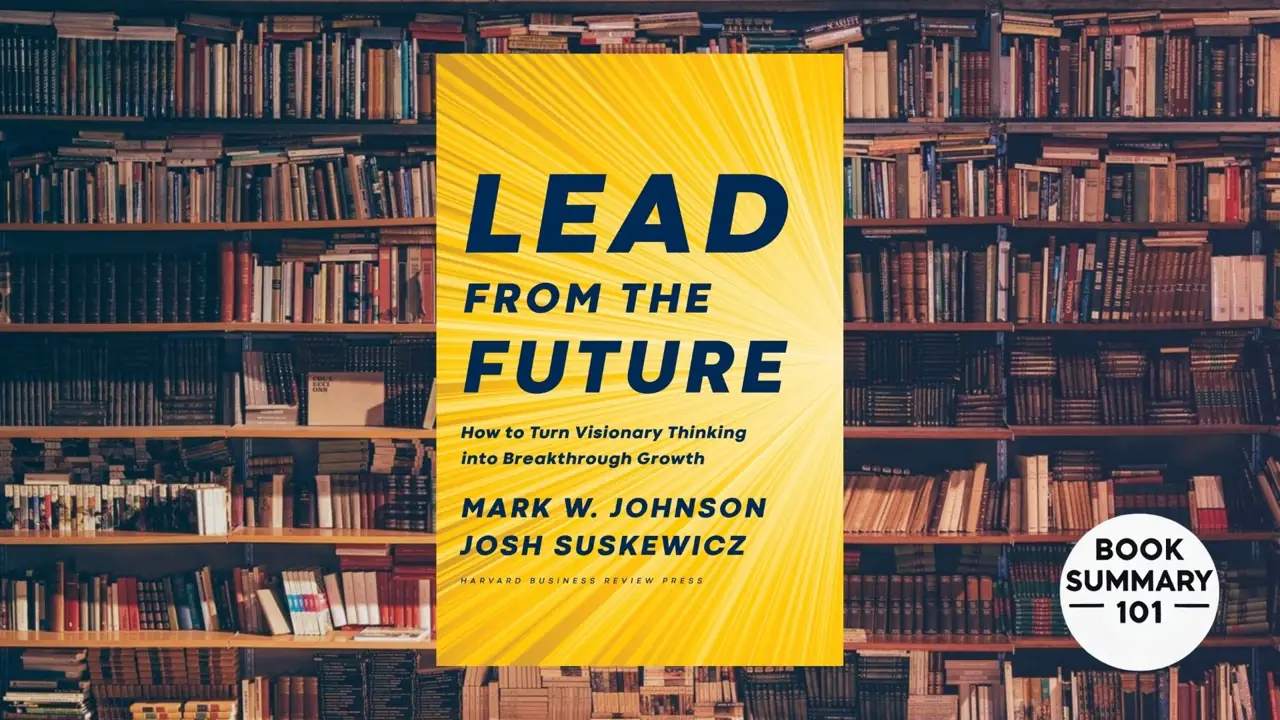
Then I picked up Lead from the Future by Mark W. Johnson and Josh Suskewicz.
It wasn’t just another dry business book. It felt like a friendly intervention.
It was the conversation I desperately needed to hear. It showed me that the reason I felt stuck wasn’t because I wasn’t working hard enough. It was because I was looking in the wrong direction.
If you’ve ever felt like you’re just spinning your wheels, trying to squeeze a little more juice out of a drying lemon, this post is for you.
Let’s dive into how to change your timeline.
- Why Should You Even Bother Reading It?
- Escaping the Trap of Incrementalism
- 1. The Present-Forward Trap
- 2. Future-Back Thinking (The Moonshot)
- 3. The Three Horizons (Your Innovation Garden)
- 4. The Clean Sheet (Unlearning the Rules)
- 5. Walking the Vision Back (The Bridge)
- My Final Thoughts
- Join the Conversation!
- I’d love to hear from you.
- Frequently Asked Questions (The stuff you’re probably wondering)
Why Should You Even Bother Reading It?
Honestly? Because the world is moving too fast for you to stay still.
If you are a manager, a startup founder, or just someone who wants to take control of their career, Lead from the Future is essential.
It is for anyone who is tired of “short-termism”—that pressure to only care about next month’s results.
This book bridges the gap between the “blue sky” dreamers and the “keep the lights on” operators. It teaches you how to have a vision without having your head in the clouds.
Escaping the Trap of Incrementalism
Here is the hard truth: doing what you did yesterday, but slightly better, is a recipe for irrelevance. To break out of that cycle, we need to install a completely new operating system for how we make decisions.
Here are the 5 core principles from the book that completely reshaped my thinking.
1. The Present-Forward Trap
The authors identify a specific disease that kills companies: “Present-Forward” thinking.
Imagine you are trying to reach a mountain peak.
Present-forward thinking is like looking strictly at your boots. You take a step, then you look for the next safe place to put your foot. You are making progress, sure. But because you’re only looking down, you might be walking in circles—or worse, walking right off a cliff.
Most organizations operate this way. They look at their current products and ask, “How do we sell 10% more of these?”
They are anchored in today’s data and today’s problems.
Real-World Example:
Think about Blockbuster. Their strategy was entirely present-forward. They looked at their stores and asked, “How do we get more late fees?” They were optimizing the now. Meanwhile, Netflix wasn’t looking at stores; they were looking at the future of digital consumption. Blockbuster perfected a dying model while Netflix built a new world.
📖 “You can’t discover a new land with an old map.”
Simple Terms:
Don’t let your current limitations dictate your future possibilities.
The Takeaway:
If you only plan based on what you have today, you will never create what you need for tomorrow.
2. Future-Back Thinking (The Moonshot)
This is the antidote. This is the “secret sauce” of the book.
Future-Back thinking flips the timeline. Instead of starting today and pushing forward, you travel 5 to 10 years into the future.
Think of it like President JFK’s “Moonshot” speech.
He didn’t ask NASA, “What is our current rocket capacity, and how much higher can we go next year?”
No. He went to the future first. He said, “By the end of this decade, we will land a man on the moon.”
He set a fixed point in the future that was theoretically impossible at the time. Then, he worked backward from that point to figure out what needed to happen today to make it real.
Real-World Example:
Steve Jobs was a master of this. When he created the iPhone, he didn’t look at the iPod and ask, “How do we add a phone dialer to this?”
He envisioned a future where a single device handled your music, your calls, and the internet. He imagined the experience first, then walked backward to invent the technology (like multitouch screens) required to deliver it.
Simple Terms:
Pick a destination first, then build the road to get there.
The Takeaway:
True innovation comes from imagining the future state first, unconstrained by today’s problems.
3. The Three Horizons (Your Innovation Garden)
The authors use a great framework to help you balance your time. You can’t just dream all day; you still have bills to pay.
Think of your business strategy like a garden.
- Horizon 1 (The Core): These are your annuals. They bloom fast, provide immediate food, and keep you alive today. This is your core business.
- Horizon 2 (The Adjacent): These are slow-growing bushes. They are extensions of what you already do, branching into new markets.
- Horizon 3 (The Transformational): These are the oak trees. You plant them now, knowing they won’t pay off for years, but they will eventually define the landscape.
The problem? Most leaders spend 99% of their time weeding the annuals (Horizon 1) and zero time planting trees.
Real-World Example:
Amazon is the king of this.
- Horizon 1: Selling books and goods online (Retail).
- Horizon 2: Amazon Prime (stickiness/membership).
- Horizon 3: AWS (Cloud Computing).
When Amazon started working on AWS, it seemed insane. It had nothing to do with selling books. But because they invested in Horizon 3 early, it now generates the bulk of their profit.
Simple Terms:
You need to manage today’s business while simultaneously inventing tomorrow’s.
The Takeaway:
Allocate specific resources to “Horizon 3” ideas and protect them from the demands of the core business.
4. The Clean Sheet (Unlearning the Rules)
When you are doing your “Future-Back” visioning, you have to fight the urge to be realistic.
The authors suggest using a “Clean Sheet.”
Imagine you are designing your house, but you aren’t allowed to look at the existing walls, plumbing, or foundation. You have to design the ideal house for your lifestyle 10 years from now.
If you focus on the existing plumbing, you’ll just renovate the bathroom. If you focus on the ideal life, you might realize you need to move to a totally different city.
In business, this means forgetting your current profit margins, your current supply chain, and your current customers.
Real-World Example:
Consider the transition from horses to cars.
If a carriage company tried to innovate using their “current walls,” they would have just bred faster horses. To build a car, they had to start with a clean sheet: “We want to move people faster. How?” The answer (internal combustion) had nothing to do with their current assets (hay and stables).
📖 “Vision isn’t about predicting the future with perfect accuracy; it’s about making a choice to shape it.”
Simple Terms:
Pretend your company doesn’t exist yet, and design the perfect solution for the future customer.
The Takeaway:
Assumption is the enemy of invention. Strip away “how we do things” to discover “what we should do.”
5. Walking the Vision Back (The Bridge)
This is where the rubber meets the road.
Having a vision is great, but without a plan, it’s a hallucination.
Once you have that “Moonshot” vision for 10 years out, you have to walk it back.
- 10 Years Out: We dominate the solar energy market.
- 7 Years Out: We have a fully functional distribution network.
- 5 Years Out: We have a working prototype and pilot program.
- 2 Years Out: We have hired the key engineers and secured patents.
- Next Monday: I need to post a job listing for a Chief Scientist.
See what happened there? We connected a sci-fi dream directly to a task for next Monday.
Real-World Example:
The US Military uses this for defense strategy. They don’t just buy tanks for today. They envision the battlefield of 2040 (cyber warfare, drones), and then they walk back to today to decide which research grants to fund now.
Simple Terms:
Reverse-engineer your dream until you have a to-do list for today.
The Takeaway:
A vision is useless unless you can translate it into immediate, actionable first steps.
My Final Thoughts
Reading Lead from the Future felt like taking a deep breath after holding it for a long time.
It empowers you. It reminds you that you aren’t a victim of the market or your industry trends. You don’t have to just sit there and wait for disruption to hit you in the face.
You can be the architect.
The most comforting part of the book is the realization that you don’t need to be a prophetic genius like Steve Jobs or Elon Musk to do this. You just need a process. And this book gives you that process.
It turns “vision” from a buzzword into a practical, repeatable skill.
Join the Conversation!
I’d love to hear from you.
When you look at your to-do list for this week, what percentage of it is “Present-Forward” (fixing today’s problems) versus “Future-Back” (building tomorrow’s growth)? Drop a comment below!
Frequently Asked Questions (The stuff you’re probably wondering)
1. Is this book only for CEOs of massive companies?
No, not at all. While the examples often cite big companies (like Apple or Johnson & Johnson), the mindset applies to anyone leading a team, a small business, or even managing their own career path.
2. Is it really technical and dry?
Surprisingly, no. It’s very readable. The authors use great storytelling and analogies. It feels more like a strategy workshop than a textbook.
3. Do I need to be a creative “visionary” type to use this?
That’s the best part—you don’t. The book argues that vision is a process, not a magical talent. If you can follow a series of logical steps, you can develop a visionary strategy.
4. How is this different from regular strategic planning?
Regular planning usually starts with “last year’s results plus 5%.” This method starts with the future environment and works backward, which often leads to radically different (and better) ideas.
5. Can I use this for my personal life?
Absolutely. I actually used the “Future-Back” method to plan my own five-year career goals. It works for anything where you want to change your trajectory, not just your speed.