I remember the first time I tried to write a “proper” business plan. It was a nightmare.
I sat in a coffee shop, staring at a blinking cursor, trying to fluff up paragraphs about “market synergy” and “projected financials” for a business that didn’t even exist yet. It felt like I was writing a fantasy novel that no one—least of all a busy investor—would ever want to read. I felt stuck, overwhelmed, and frankly, a bit like a fraud.
I wanted to build something great, but I was drowning in paperwork before I even started.
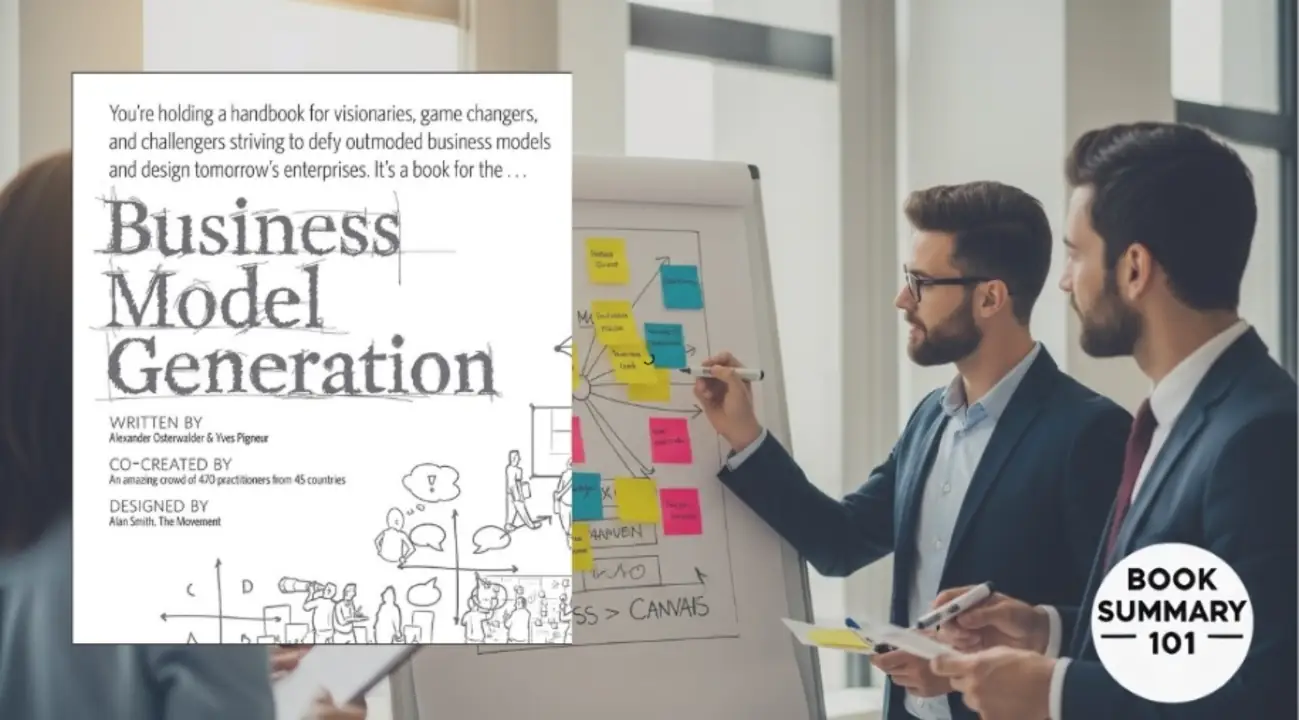
Then, a mentor slid a rectangular, visually stunning book across the table: Business Model Generation.
It wasn’t a textbook. It didn’t look like homework. It was colorful, filled with drawings, and promised me that I could map out an entire business strategy on a single sheet of paper.
Reading it felt less like studying and more like unlocking a cheat code for entrepreneurship. It took the scary, nebulous idea of “business strategy” and turned it into something I could touch, move, and play with.
If you’ve ever felt paralyzed by the complexity of starting or pivoting a business, grab a coffee. We need to talk about this book.
- Why Should You Even Bother Reading It?
- The Blueprint for Building a Business That Actually Works
- 1. The Business Model Canvas (The 9 Building Blocks)
- 2. The Value Proposition (The “Painkiller” Principle)
- 3. Multi-Sided Platforms (The Chicken and Egg Pattern)
- 4. Freemium (The “Free Lunch” Strategy)
- 5. Prototyping (Thinking With Your Hands)
- My Final Thoughts
- Join the Conversation!
- Frequently Asked Questions (The stuff you’re probably wondering)
Why Should You Even Bother Reading It?
You might be thinking, “I’m not a CEO, and I don’t have an MBA. Is this for me?”
Absolutely. In fact, it’s better if you don’t have an MBA mindset.
This book is for the visionaries, the “game changers,” and the challengers. It is essential reading for:
- Entrepreneurs who want to test an idea without wasting six months writing a document nobody reads.
- Corporate Intrapreneurs trying to launch a new product within a stiff, old-school company.
- Freelancers and Creatives who need to figure out how to actually make money from their art.
In a world where technology changes overnight, the old way of planning is dead. This book gives you the tools to be agile, visual, and fast.
The Blueprint for Building a Business That Actually Works
The genius of this book lies in its simplicity. It doesn’t ask you to write long essays; it asks you to draw a map. Before we dive into the specific mechanics, understand that the core philosophy here is about designing a business, not just managing one. It’s about seeing the whole picture at once.
1. The Business Model Canvas (The 9 Building Blocks)
This is the crown jewel of the book. The authors introduce the “Business Model Canvas,” a visual template that breaks every business down into nine essential components.
Think of your business like a car engine. A traditional business plan is a 50-page user manual describing the engine. The Business Model Canvas is a 3D schematic drawing that shows you exactly how the fuel gets to the pistons and makes the wheels turn.
If you remove one piece, the car stops.
The authors argue that you can sketch any company, from Microsoft to a local lemonade stand, using these nine blocks:
- Customer Segments: Who are we serving?
- Value Propositions: What problem are we solving?
- Channels: How do we reach them?
- Customer Relationships: How do we interact with them?
- Revenue Streams: How do we make money?
- Key Resources: What assets do we need?
- Key Activities: What do we actually do?
- Key Partnerships: Who helps us?
- Cost Structure: What do we pay for?
Real-World Example:
Think about Uber. Their Value Proposition is fast, on-demand transportation. Their Key Resources are the app and the brand (they don’t own the cars!). Their Revenue Stream is a percentage of every ride. By mapping this out, you can see instantly that their model relies heavily on Channels (the app) and Partnerships (the drivers).
Simple Terms: A one-page visual map that shows how your business creates, delivers, and captures value.
The Takeaway: Stop writing text. Start mapping your business on one page to see the gaps and opportunities instantly.
2. The Value Proposition (The “Painkiller” Principle)
Most businesses fail because they build something nobody wants. They fall in love with their product, not the customer’s problem.
The authors urge you to think of the Value Proposition not as “what you sell,” but as the relief you offer.
Imagine you have a splitting headache. You walk into a pharmacy. You don’t care about the chemical composition of the pills or the color of the box. You just want the pain to stop. Your business must be the painkiller.
It’s about “jobs to be done.” What “job” is the customer hiring your product to do? Is it to look wealthy? To save time? To feel safe?
Real-World Example:
Consider Nespresso. They don’t just sell coffee machines. Their value proposition is “restaurant-quality espresso in the comfort of your home with zero mess.” They aren’t selling caffeine; they are selling convenience and luxury.
Simple Terms: The specific problem you solve or the benefit you provide that makes a customer choose you over a competitor.
The Takeaway: Your product features don’t matter; the problem you solve for the customer is the only thing that counts.
3. Multi-Sided Platforms (The Chicken and Egg Pattern)
One of the most fascinating sections of the book deals with “Patterns”—standard business models that repeat across industries. The Multi-Sided Platform is the most dominant one in the tech world today.
Think of a nightclub. A nightclub needs two distinct groups of people to work: “Guys who want to meet girls” and “Girls who want to dance (and maybe meet guys).” If the club has only guys, the girls won’t come. If it has only girls, the guys won’t come. The club owner has to keep both sides happy simultaneously.
In business, this brings distinct groups together. The platform is the intermediary that creates value by facilitating interaction between these groups.
📖 “Multi-sided platforms are of value to one group of customers only if the other groups of customers are also present. The platform creates value by facilitating interactions between the different groups.”
Real-World Example:
Google is the ultimate example. On one side, they have searchers (us) who want free information. On the other side, they have advertisers who want to reach us. Google gives the search product away for free to attract the first group, which makes the platform valuable to the second group (who pays the bills).
Simple Terms: A business that connects two or more independent groups of customers (like buyers and sellers).
The Takeaway: You often have to subsidize one group (give them free stuff) to attract the other group that actually pays.
4. Freemium (The “Free Lunch” Strategy)
We’ve all used a service for free, only to be asked to upgrade later. This is the Freemium pattern, and the book explains the math behind why it works.
Imagine throwing a party and offering free pizza to everyone who walks by. 90% of people will eat a slice and leave. But 10% will love the pizza so much they’ll hire you to cater their wedding.
In the digital world, the cost of that “free slice” (serving a digital user) is almost zero. So, you can afford to have thousands of freeloaders just to find that small percentage of “whales” who will pay for the premium service.
Real-World Example:
Dropbox or Spotify. You can use Spotify for free forever if you tolerate ads (the cost is your attention). But if you want to skip songs and download music, you pay a monthly fee. The free users fuel the virality and scale of the platform, while the premium users fund the operation.
Simple Terms: Offering a basic service for free to everyone, while charging a premium for advanced features.
The Takeaway: “Free” is a powerful marketing tool, but you must ensure the paid version offers irresistible value to cover the costs of the free users.
5. Prototyping (Thinking With Your Hands)
If an architect wants to design a building, they don’t just think about it. They build a small foam model. They look at it from different angles. They smash it and build another one.
Business people rarely do this. We obsess over the “perfect” idea in our heads.
The authors insist that you must bring a “design attitude” to business. This means prototyping your business model. You shouldn’t just draw one canvas; you should draw ten. Ask “What if?”
- What if we gave the product away for free? (Draw that canvas).
- What if we only sold to high-end luxury clients? (Draw that canvas).
- What if we eliminated our sales team entirely? (Draw that canvas).
📖 “Business Model Prototyping is about a mindset called design attitude. It stands for an explorative spirit… [it] is not about predicting the future. It is about creating future possible directions that could be taken.”
Real-World Example:
The authors actually prototyped this book. Before publishing, they shared early drafts and visualizations with an online community of 470 practitioners in 45 countries. They iterated based on feedback, treating the book itself like a startup product.
Simple Terms: Creating quick, rough versions of your business model to test different strategies before spending real money.
The Takeaway: Don’t fall in love with your first idea. Sketch out five different ways your business could work and pick the best one.
My Final Thoughts
Honestly, Business Model Generation is one of those rare business books that respects your time and your intelligence. It doesn’t hide behind buzzwords. It hands you a sharpie and a blank sheet of paper and says, “Go create.”
It empowered me to stop worrying about the “format” of business and start focusing on the “mechanics” of value. Whether you are launching the next Facebook or just trying to organize a freelance career, the Canvas brings clarity to the chaos. It turns the scary monster of “Business Strategy” into a solvable puzzle.
Join the Conversation!
I’d love to hear from you. If you could sketch out your current career or business on the Canvas, which of the 9 blocks is your biggest struggle right now? Is it finding the right customers? Or maybe figuring out the revenue stream? Drop a comment below!
Frequently Asked Questions (The stuff you’re probably wondering)
1. Do I need to be a designer to use the visual canvas?
Not at all. If you can draw a stick figure and write on a sticky note, you are overqualified. The visual aspect is about organization, not art.
2. Is this book only for tech startups?
No. While it uses many tech examples, the principles apply to bakeries, consulting firms, non-profits, and even personal career planning.
3. Is the Business Model Canvas better than a traditional business plan?
For the early stages, yes. A traditional plan is for executing a known strategy. The Canvas is for searching for a strategy that works. You do the Canvas first; you write the plan later (if you need a loan).
4. How long does it take to read?
Because of its visual format, you can skim the core concepts in an hour. However, it’s designed as a handbook, so you’ll likely keep coming back to it as a reference.
5. I’m an employee, not an owner. Can I use this?
Yes! Look up “Business Model You” (a spin-off book). You can use the Canvas to map your own value to your employer, helping you negotiate raises or change career paths.