Have you ever sat in a meeting, staring at a slide deck that you knew—just knew—contained a massive error?
Your heart starts thumping against your ribs. You look around the room. Everyone else is nodding sagely. The boss is smiling. You open your mouth to speak, but then a little voice in your head whispers, “Don’t do it. Remember what happened to Greg when he questioned the timeline last month? Just stay quiet.”
So, you stay quiet. The project launches. The error blows up. And the company loses money.
I have been there more times than I care to admit. For years, I thought this was just “office politics” or a lack of courage on my part. I thought I just needed to be braver.
But then I picked up The 4 Stages of Psychological Safety: Defining the Path to Inclusion and Innovation by Timothy R. Clark.
It felt less like reading a business book and more like having a therapy session for my professional life. Clark explains that that “thumping heart” feeling isn’t a personality flaw; it’s a lack of psychological safety.
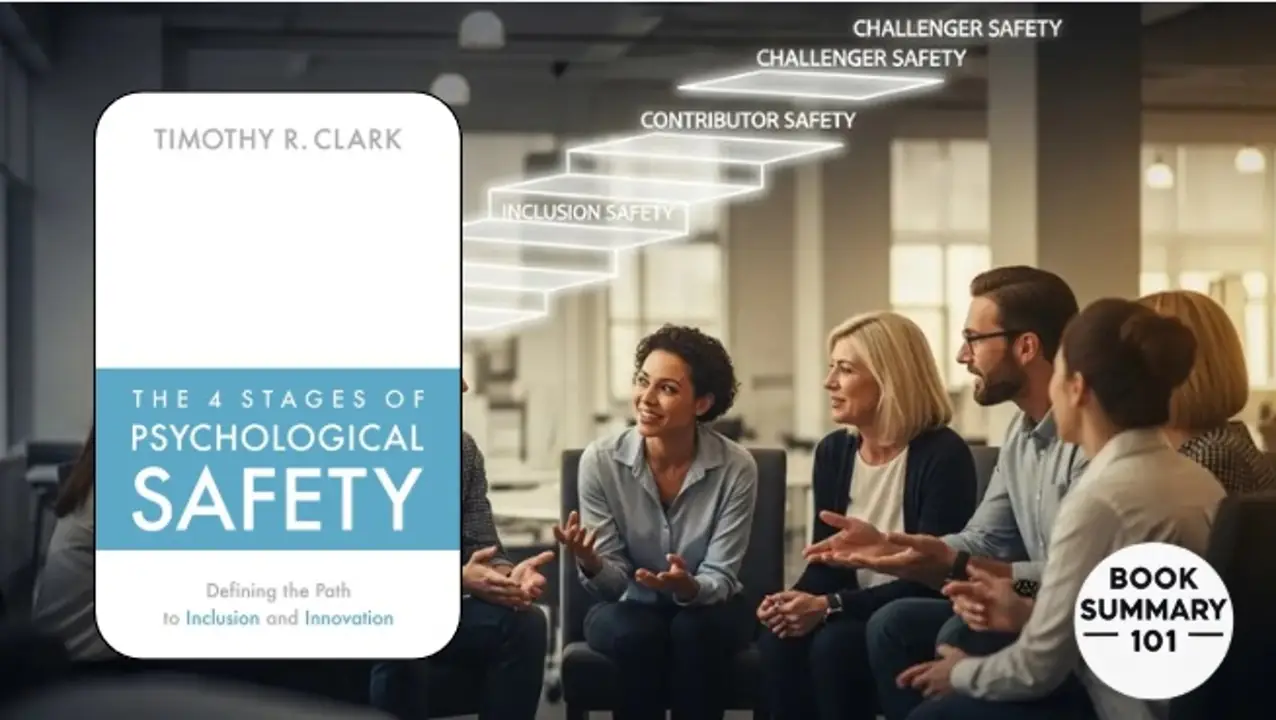
But here is the kicker: safety isn’t a binary switch. You aren’t just “safe” or “unsafe.” It’s a journey. It’s a ladder. And if you miss the bottom rungs, you will never reach the top where the magic happens.
If you have ever felt silenced, ignored, or afraid to experiment at work, this summary is for you. Let’s break down exactly how to fix it.
- Why Should You Even Bother Reading It?
- Climbing the Ladder of Trust and Innovation
- 1. Inclusion Safety: The “Human” Right
- 2. Learner Safety: The License to Ask “Stupid” Questions
- 3. Contributor Safety: The “Earned” Right
- 4. Challenger Safety: The Innovation Zone
- 5. The 50% Rule (Why You Are Responsible)
- My Final Thoughts
- Join the Conversation!
- Frequently Asked Questions (The stuff you’re probably wondering)
Why Should You Even Bother Reading It?
Honestly? Because the old way of managing—leading through fear—is dead.
Whether you are a CEO, a middle manager, or a junior developer, this book is essential. In the modern economy, we aren’t paid to move widgets from pile A to pile B. We are paid to think. We are paid to solve problems.
But the human brain literally shuts down its creative centers when it feels threatened.
If you are a leader, this book explains why your team might be silent during brainstorming sessions. If you are an employee, it validates your feelings and gives you a vocabulary to ask for what you need. It is the missing manual for human interaction in the workplace.
Climbing the Ladder of Trust and Innovation
One of the biggest misconceptions about psychological safety is that it’s just about “being nice” or lowering standards so everyone feels good. Clark shatters this idea immediately.
He frames psychological safety as a hierarchy of needs, almost like a video game where you have to unlock Level 1 before you can even think about Level 2. You can’t just demand innovation (Level 4) if people are terrified they’ll be fired for asking a question (Level 2).
Here are the core principles that structure this ascent.
1. Inclusion Safety: The “Human” Right
Imagine you are at a crowded party. You are standing on the periphery, holding your drink, watching a circle of people laughing. You want to join them, but you are terrified of that awkward moment where you walk up and nobody makes space for you.
That is the absence of Inclusion Safety.
Inclusion Safety is the very first rung of the ladder. It satisfies the basic human need to connect and belong. Clark argues that in a social unit, this stage is a human right, not something you have to “earn” through skill.
If you have a pulse and you are on the team, you deserve to be treated with dignity. You deserve a seat at the table.
Real-World Example:
Think about onboarding at a great company. When you arrive, your desk is set up. You have a “buddy” assigned to take you to lunch. You are added to the Slack channels immediately. You are signaled, “You are one of us.”
Compare that to a company where you show up, IT hasn’t set up your email, and you eat lunch alone in your car. Without Inclusion Safety, the brain spends all its energy on survival and social anxiety, leaving zero energy for work.
📖 “Inclusion safety is the specific form of psychological safety that satisfies the basic human need to be included, accepted, and belong. It’s the entry point.”
Simple Terms: Everyone gets a seat at the dinner table simply because they are part of the family.
The Takeaway: You cannot expect someone to perform if they don’t even feel like they belong in the room.
2. Learner Safety: The License to Ask “Stupid” Questions
Once you feel like you belong, the next natural urge is to grow. But growth requires learning, and learning is messy.
Think about a toddler learning to walk. They stumble, they fall, they grab the coffee table. Do we scream at them? Do we put them on a Performance Improvement Plan? No. We clap when they wobble.
Learner Safety is the stage where you feel safe to ask questions, admit you don’t know something, and make small mistakes without fear of punishment.
If a team lacks this, everyone pretends to know everything. This is dangerous. This is how you end up with “The Emperor’s New Clothes” scenarios where no one admits they don’t understand the strategy until it’s too late.
Real-World Example:
Look at Pixar. They are famous for their “post-mortems” after a movie is finished. They dissect what went wrong, not to blame anyone, but to learn. Or consider a junior developer who feels safe saying, “I don’t understand this legacy code,” rather than guessing, breaking the build, and hiding it.
Simple Terms: It’s safe to say “I don’t know” or “I messed up” without being shamed.
The Takeaway: To encourage rapid learning, you must decouple fear from mistakes.
3. Contributor Safety: The “Earned” Right
Here is where the dynamic shifts.
Clark makes a crucial distinction here that I absolutely love. While Inclusion Safety is a human right (owed to everyone), Contributor Safety is an earned right based on competence.
You don’t let the medical student perform open-heart surgery on their first day just to be “inclusive.” They have to learn first (Stage 2). Once they have demonstrated the skill, they unlock Contributor Safety.
This is the stage where you are given autonomy. The training wheels come off. You are trusted to execute and deliver value. It’s the feeling of being a full-fledged player on the field, not just a rookie on the bench.
Real-World Example:
Think of the Zillow “Zestimate” algorithm team. A data scientist on that team isn’t micromanaged on every line of code. They have proven their skills. They are given a goal (“Improve accuracy by 1%”) and the autonomy to figure out how to do it. They feel safe to contribute their skills to move the needle.
Simple Terms: You have proven you know your stuff, so the team trusts you to do your job your way.
The Takeaway: Autonomy isn’t a gift; it’s an exchange for demonstrated competence.
4. Challenger Safety: The Innovation Zone
This is the summit. This is the hardest stage to reach and the easiest to destroy.
Challenger Safety is the ability to challenge the status quo, disagree with authority, and suggest radical changes without fear of retaliation.
Most leaders say they want innovation. But innovation is, by definition, destructive. It destroys the old way of doing things. If you have a thin-skinned boss who takes every suggestion as a personal attack, you will never reach this stage.
Clark uses the analogy of “Social Friction” vs. “Intellectual Friction.” In a toxic team, social friction is high (people hate each other), so intellectual friction is low (nobody debates ideas).
In a high-performing team, social friction is low (we trust each other), so intellectual friction can be high (we argue passionately about ideas because we know it’s not personal).
Real-World Example:
The Toyota Production System relies on the “Andon Cord.” Any worker on the assembly line, no matter how junior, has the authority to pull a cord and stop the entire production line if they see a problem. They are challenging the process to improve it. In most companies, stopping the line would get you fired. At Toyota, it gets you thanked.
📖 “Challenger safety is the support you need to make things better. It allows you to challenge the status quo without retribution… It’s the highest level of psychological safety.”
Simple Terms: You can tell the boss their idea is bad, and they will thank you for saving the team from a mistake.
The Takeaway: True innovation only happens when people are not afraid to break the current model.
5. The 50% Rule (Why You Are Responsible)
It is easy to read this book and think, “Well, my boss needs to read this because he is a tyrant.”
But Clark throws a curveball. He argues that psychological safety is a 50/50 proposition.
Yes, the leader sets the tone. But the team members are responsible for the other 50%. We are responsible for how we treat our peers. Do we roll our eyes when a colleague asks a “dumb” question? Do we gossip when someone fails?
If we do, we are the ones destroying Learner Safety.
Clark uses the concept of “Patrolling the Boundaries.” In a safe team, if someone acts like a jerk or bullies someone, the team shuts it down, not just the manager. The team creates the culture, the leader just facilitates it.
Real-World Example:
Imagine a brainstorming meeting. A shy colleague suggests an idea. Someone interrupts and laughs, “That’ll never work.”
- Unsafe Culture: Everyone stays silent.
- The 50% Rule in Action: You speak up and say, “Hey, let’s hear her out. I think there is something to that idea.” You have just patrolled the boundary and re-established safety.
Simple Terms: You don’t have to be the boss to protect your teammates.
The Takeaway: We are all architects of the culture we live in; safety is everyone’s job.
My Final Thoughts
Reading The 4 Stages of Psychological Safety was a massive “Aha!” moment for me.
It made me realize that trying to force a team to be “innovative” without first making them feel included and safe to learn is like trying to build a roof on a house that has no foundation. It will inevitably collapse.
This book empowers you because it gives you a map. If your team feels stagnant, you can look at the four stages and diagnose exactly where you are stuck. Are people quiet? Maybe you lack Inclusion Safety. Are people hiding mistakes? You lack Learner Safety.
It turns a “soft skill” into a hard science. And that is powerful stuff.
Join the Conversation!
I’d love to hear from you. Which of the 4 Stages do you think is the hardest for modern companies to achieve, and why? Drop a comment below—let’s discuss!
Frequently Asked Questions (The stuff you’re probably wondering)
1. Is this book only for CEOs and managers?
Not at all. While it’s crucial for leaders, it’s incredibly helpful for individual contributors. It helps you understand your own needs and gives you the language to advocate for a better team environment.
2. Can you skip stages? Can I go straight to Challenger Safety?
No. It’s a ladder. If you try to challenge the status quo (Stage 4) before you’ve established that you belong (Stage 1) or know what you’re doing (Stage 3), you will likely be rejected or ignored. You need the foundation of the previous stages.
3. Is psychological safety just about being “nice”?
Definitely not. It’s about being effective. In fact, Stage 4 (Challenger Safety) involves a lot of debate and disagreement (intellectual friction). The difference is that the conflict is about ideas, not personalities.
4. How do I build safety if my boss is toxic?
This is the tough one. Clark acknowledges that leaders hold the “faucet” of safety. However, you can still build a “pocket” of safety with your immediate peers by practicing the 50% rule—supporting each other even if the boss doesn’t.
5. Is this a long read?
It is very manageable. It’s concise, well-structured, and full of examples. You can get through the core concepts relatively quickly, but applying them takes a lifetime.