Do you remember sitting in an English class, staring at a chalkboard covered in sentence diagrams?
I certainly do.
I remember sweating over “participles” and “gerunds,” feeling like language was this impossible fortress I had to siege. I felt clumsy. I felt like I was constantly breaking rules I didn’t understand. For the longest time, I thought language was a cultural invention—like driving a car or baking a soufflé—that I just wasn’t very good at.
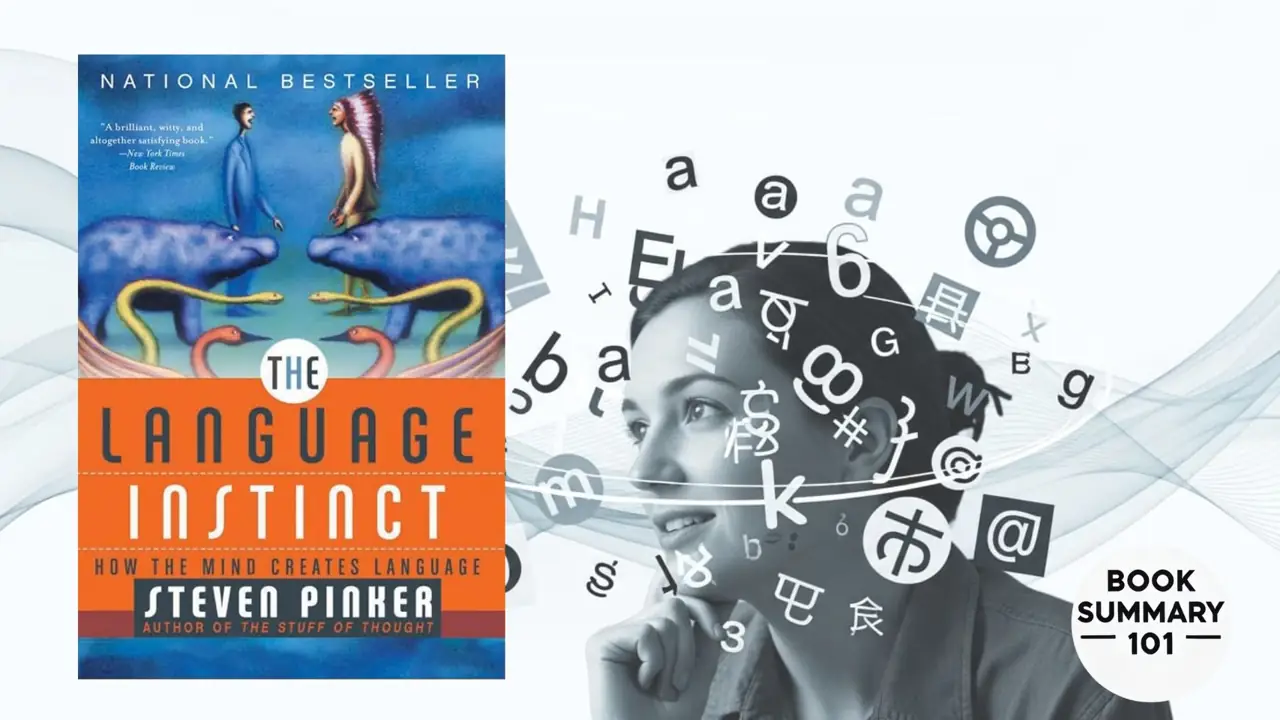
Then I picked up The Language Instinct.
Reading this book felt like Steven Pinker sat me down, handed me a warm cup of coffee, and said, “Relax. You’re already a master.”
It turns out, the anxiety we feel about “proper grammar” has nothing to do with the miracle of language itself. Pinker flips the script entirely. He argues that language isn’t an artifact we invented; it’s a biological instinct, as natural to us as spinning a web is to a spider.
If you’ve ever wondered why you can speak without thinking, or how a toddler learns to talk without a textbook, this post is for you.
Let’s unravel the mystery of your own mind.
- Why Should You Even Bother Reading It?
- The Biological Blueprint Behind Every Sentence You Speak
- 1. The Spider’s Web: Language as an Instinct, Not an Invention
- 2. Mentalese: The Silent Language of Thought
- 3. The Infinite Lego Set: The Discrete Combinatorial System
- 4. The Poverty of the Stimulus: How Kids Are Magic Learners
- 5. Universal Grammar: The Software Pre-installed in Your Brain
- My Final Thoughts
- Join the Conversation!
- Frequently Asked Questions (The stuff you’re probably wondering)
Why Should You Even Bother Reading It?
You might be thinking, “I’m not a linguist, and I’m definitely not a scientist. Is this for me?”
Absolutely.
This book is for anyone who has ever marveled at a child’s first words or struggled to learn a second language. It’s for the writers, the parents, and the curious minds who want to know what separates humans from every other animal on the planet.
In an age where we are obsessed with Artificial Intelligence and Large Language Models (like ChatGPT), understanding the biological hardware of human language is more relevant than ever.
The Language Instinct doesn’t just teach you about nouns and verbs; it teaches you what it means to be human. It liberates you from the tyranny of “grammar Nazis” and shows you the elegant machinery humming away inside your brain right now.
The Biological Blueprint Behind Every Sentence You Speak
We tend to think of language as a tool we built, like the wheel or the iPhone. But Pinker challenges us to look deeper, suggesting that language is actually a specific, biological adaptation shaped by natural selection. Before we get into the nitty-gritty, let’s look at the five pillars that support this revolutionary idea.
1. The Spider’s Web: Language as an Instinct, Not an Invention
The central metaphor Pinker uses to shatter our preconceptions is that of a spider and its web.
Imagine a spider. It doesn’t need to go to “weaving school.” It doesn’t need its mother to diagram a web on a leaf to understand tension and structure. The knowledge of how to spin that web is hardwired into the spider’s brain. It is an instinct.
Pinker argues that human language is exactly the same.
We treat language like it’s a cultural skill, similar to telling time or reading. But reading is an invention; that’s why it’s hard to learn and requires years of schooling. Speaking, however, happens automatically.
Pinker points out that there is no tribe of mute humans anywhere on Earth. Every society, no matter how isolated or technologically “primitive,” possesses a language of immense grammatical complexity.
If language were an invention, we’d expect to find some groups who were “better” at it than others, or some who hadn’t “invented” it yet. But we don’t. A remote tribe in Papua New Guinea has verb conjugations just as complex—often more so—than English or Latin.
This suggests that language is part of our standard biological equipment. We don’t “learn” it in the traditional sense; we “grow” it, just like we grow teeth or hair.
Simple Terms: You don’t learn to speak like you learn to drive; you develop speech like a spider develops the ability to spin a web.
The Takeaway: Language is a biological imperative, universal to our species and distinct from general intelligence or cultural habits.
2. Mentalese: The Silent Language of Thought
Have you ever had a brilliant idea, but you couldn’t find the words to explain it? You knew exactly what you meant, but the English language seemed to fail you.
That frustration is proof of something Pinker calls “Mentalese.”
Think of Mentalese as the Operating System of your brain, while English, French, or Spanish are just the apps you use to share data.
Many people believe the old sci-fi trope that “we think in words.” But if that were true, how could you ever struggle to find a word? If thoughts were words, the word would always be there.
Pinker uses the analogy of a computer. When a computer processes information, it isn’t using the icons and folders you see on the screen; it’s using binary code (0s and 1s) and deep electrical impulses.
Similarly, our brains process abstract concepts, images, and relationships (Mentalese). We only translate those concepts into English (or any other language) when we need to broadcast them to someone else.
📖 “People don’t think in English or Chinese or Apache; they think in a language of thought. This language of thought probably looks a bit like all these languages… but compared with any given language, mentalese must be richer in some ways and simpler in others.”
This explains why translation is so difficult. You aren’t just swapping a French word for an English word; you are trying to decode the French word back into Mentalese (the abstract concept), and then re-encode it into English.
Simple Terms: We don’t think in English; we think in abstract concepts and then translate them into words to speak.
The Takeaway: Our thoughts are far faster, more complex, and more abstract than the spoken language we use to express them.
3. The Infinite Lego Set: The Discrete Combinatorial System
Here is a mind-bending fact: You are likely to say a sentence today that has never been spoken before in the history of the human race.
How is that possible?
Pinker explains this using the concept of a “Discrete Combinatorial System.” It sounds technical, but it’s actually just like a bucket of Lego bricks.
If you have a set of sound descriptions (phonemes) and a set of rules (grammar), you have a finite number of pieces. However, because you can combine those pieces in endless variations, the output is infinite.
Think of a puppy. You can say:
“The puppy walked.”
“The puppy walked to the store.”
“The sad puppy walked to the store to buy a bone.”
“The sad puppy walked to the store to buy a bone because he was hungry.”
You can keep adding clauses forever. This is called “recursion.”
Unlike a dog’s bark, which usually has a fixed meaning (Bark A = Danger, Bark B = Food), human language allows us to combine a limited number of sounds into an unlimited number of sentences.
This is the engine of human creativity. It’s why we can describe a dream we had, explain quantum physics, or write a poem about a flying toaster. Our brain is a machine designed to generate infinite novelty from a finite list of words.
Simple Terms: With a limited list of words and a few rules, we can create an infinite number of unique sentences.
The Takeaway: Human language is unique because it is “digital” and infinite, allowing us to express thoughts that have never existed before.
4. The Poverty of the Stimulus: How Kids Are Magic Learners
If you’ve ever listened to a three-year-old talk, you know they say some hilarious things.
“I goed to the park.”
“He hurted me.”
We usually laugh and correct them: “No, honey, you went to the park.”
But Pinker argues that these “mistakes” are actually proof of genius.
This concept is often called “The Poverty of the Stimulus.” It basically means that children produce complex grammar that they have never heard before.
Think about the “I goed” example. The child has likely never heard an adult say “goed.” So, they aren’t imitating you. Instead, they have intuitively figured out the rule: To make something past tense, add -ed.
They are applying a logic rule to an irregular verb. They are acting like little linguists, analyzing the data and building a system.
Pinker discusses the famous “Wug Test.” A child is shown a picture of a made-up bird and told, “This is a Wug.” Then they are shown two of them. “Now there are two…”
Without hesitation, the child says, “Wugs.”
They’ve never heard that word before. They applied the rule of pluralization automatically.
This proves that parents don’t “teach” children grammar. We don’t sit toddlers down and explain subject-verb agreement. We just talk to them. And from that messy, noisy input, their brains automatically extract the perfect mathematical rules of the language.
📖 “A three-year-old is a grammatical genius… The child has intuitively grasped the logic of the language structure that has eluded logicians for millennia.”
Simple Terms: Kids don’t just parrot what they hear; they are born with a brain mechanism that hunts for and applies grammar rules automatically.
The Takeaway: We are born with a “language acquisition device” that allows us to construct complex grammar systems from the messy speech we hear around us.
5. Universal Grammar: The Software Pre-installed in Your Brain
If language is an instinct, and kids learn it automatically, does that mean all languages are basically the same?
According to Pinker (and the famous linguist Noam Chomsky), the answer is yes.
Imagine you walk into a computer store. You see a Dell, a MacBook, and a gaming PC. On the surface, they look different. They have different screens, different keyboards, and different case colors.
But deep down? They all run on binary code. They all have a processor. They all have memory.
Pinker argues that every language on Earth—from English to Swahili to Japanese—is built on the same “Universal Grammar.”
This doesn’t mean the words are the same. It means the structure is the same. All languages have nouns and verbs. All languages have ways to make things negative. All languages have ways to ask questions.
The differences between languages are just “parameter settings.” It’s like flipping a switch in the settings menu of a video game.
- Switch A: Does the verb come before the object (Eat the apple) or after (The apple eat)?
- Switch B: Do we put prepositions before the noun (in the house) or after (the house in)?
When a baby is born, their brain is open to all possibilities. As they hear English, they unknowingly flip the switches: “Okay, in this language, the verb comes first.”
This is why learning a second language is so hard for adults. Our switches are already set and rusted in place. But for a child, the Universal Grammar software is fresh and ready to be configured.
Simple Terms: All human languages share the same underlying “operating system,” just with different settings toggled on or off.
The Takeaway: Despite how different they sound, every language on Earth follows the same deep, biological laws of structure.
My Final Thoughts
Reading The Language Instinct shifted my perspective from feeling like a clumsy user of language to feeling like the owner of a biological miracle.
It forces you to stop and appreciate the sheer complexity of what you are doing right now: decoding black squiggles on a screen, translating them into Mentalese concepts, and reconstructing my thoughts inside your own head.
Pinker shows us that we are all linguistic geniuses. We possess a power that no supercomputer has yet fully mastered, and we use it to crack jokes, order coffee, and say “I love you.” It is the defining trait of our species, and it is magnificent.
Join the Conversation!
I’d love to hear from you. What is the funniest “grammatical error” (like “I goed”) you’ve ever heard a child make that proves they were actually using logic? Drop a comment below!
Frequently Asked Questions (The stuff you’re probably wondering)
1. Is this book too academic or hard to read?
Not at all. While the concepts are deep, Steven Pinker is famous for his wit and pop-culture references. He explains complex linguistics using analogies from Woody Allen, Star Trek, and everyday life. It’s challenging but very rewarding.
2. Do I need to be a linguist or know multiple languages to enjoy this?
No. The book focuses heavily on English examples to make its points. You don’t need to speak another language or know what a “syntax tree” is before you start. Pinker teaches you everything you need to know along the way.
3. Does this book help me learn a new language?
Not directly. It won’t teach you French or Spanish vocabulary. However, understanding how the brain learns language (and why adults struggle compared to kids) can give you a lot of grace and patience with your own learning process.
4. Is the science in this book still accurate today?
Mostly, yes. While the book was published in 1994, the core concepts of Universal Grammar and language as an evolutionary adaptation remain the foundation of modern linguistics. Some specifics about genetics have advanced, but the “instinct” argument stands strong.
5. What does Pinker say about “Grammar Nazis”?
He is not a fan! Pinker distinguishes between “Descriptive Grammar” (how people actually speak) and “Prescriptive Grammar” (stuffy rules like “don’t split an infinitive”). He argues that many schoolhouse rules are arbitrary and have nothing to do with how the brain actually works.