If you turn on the financial news or scroll through Twitter, you’re bombarded with a very specific, anxiety-inducing narrative. It goes something like this: The economy is sluggish. We’ve lost our edge. We aren’t growing like we used to in the “Golden Age” of the 20th century.
It feels like we’re failing, doesn’t it?
I used to feel this way constantly. I looked at the charts showing GDP growth slowing down over the last few decades and assumed something was broken. Was it bad government policy? Lack of innovation? Laziness? I felt like I was living in the sequel to a great movie that just didn’t live up to the original.
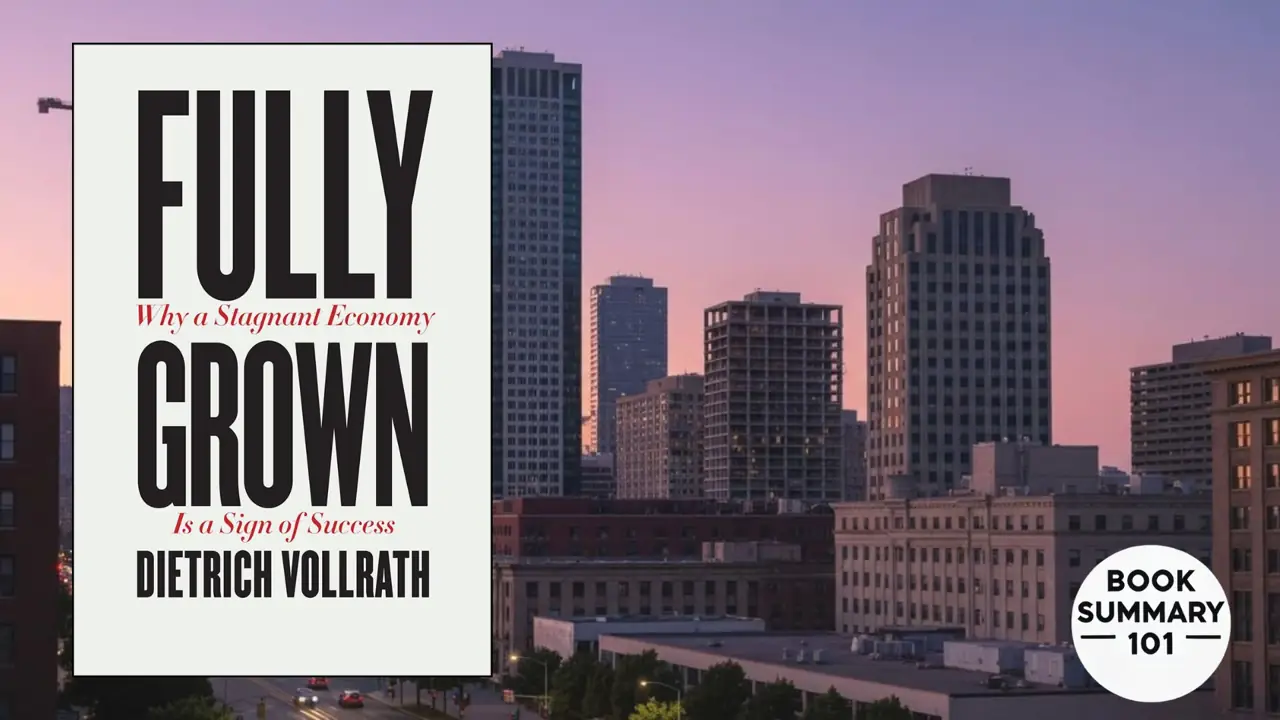
Then I picked up Fully Grown: Why a Stagnant Economy Is a Sign of Success by Dietrich Vollrath.
And honestly? It felt like someone finally turned the lights on. Vollrath, a growth economist, sat me down (figuratively speaking) and explained that I was looking at the data all wrong. He argues that the slowdown isn’t a symptom of sickness; it’s a symptom of maturity. It’s the economic equivalent of growing up.
It was such a relief to read a book that wasn’t screaming about the apocalypse. Instead, it was a calm, data-driven conversation about why we should actually be celebrating our “sluggish” numbers.
Why Should You Even Bother Reading It?
You might be thinking, “I’m not an economist, why do I care about growth rates?” You should care because this narrative shapes everything—politics, your job security, and your general outlook on the future.
This book is perfect for anyone who is tired of the “doom and gloom” news cycle. Whether you are a business owner trying to understand market trends, a student confused by macroeconomics, or just a curious person wondering why your parents seem to think the 1960s were an economic miracle, this book provides a refreshing, optimistic mental model. It flips the script from “We Failed” to “We Succeeded.”
- Why Should You Even Bother Reading It?
- The Real Reasons We’ve Slowed Down (And Why That’s Okay)
- 1. The “Adult Phase” Analogy (Understanding Diminishing Returns)
- 2. The Human Capital Plateau
- 3. The Fertility Drop (Smaller Families = Richer Lives)
- 4. The “String Quartet” Problem (Baumol’s Cost Disease)
- 5. Net Output vs. Gross Output (The Stuff We Don’t Count)
- My Final Thoughts
- Join the Conversation!
- Frequently Asked Questions (The stuff you’re probably wondering)
The Real Reasons We’ve Slowed Down (And Why That’s Okay)
Vollrath breaks down the economy not by pointing fingers at politicians or taxes, but by looking at the fundamental mechanics of how societies evolve. Before we dive in, know this: The central thesis here is that the causes of our slow growth are actually things we fought hard to achieve.
1. The “Adult Phase” Analogy (Understanding Diminishing Returns)
Imagine a human being’s life cycle. When you are a toddler, you grow at an astonishing rate. You double your weight and height in a very short time. But by the time you hit twenty-five, you stop getting taller.
Does this mean your body has failed? Are you “stagnant” because you aren’t growing two inches a year anymore? Of course not. You are simply Fully Grown.
Vollrath uses this concept to explain the overall economy. In the mid-20th century, the U.S. economy was like a teenager hitting a growth spurt. We were adopting basic technologies, electrifying the country, and moving people from farms to factories.
However, once you have electricity in every home and a car in every driveway, you can’t do it again. You can’t upgrade from “no electricity” to “electricity” twice.
Real-World Example:
Think about the washing machine. The jump from scrubbing clothes on a washboard to using an electric washing machine was a massive explosion in productivity. It saved hours of labor every single week. But upgrading from an iPhone 13 to an iPhone 14? That’s a marginal improvement. It doesn’t radically change how much work we can get done. We are currently living in the “iPhone upgrade” era of the economy, not the “invention of the washing machine” era.
Simple Terms: You can only industrialize a country once; after that, growth naturally slows down.
The Takeaway: Slow growth is the natural state of a mature, successful economy, just as maintaining height is the natural state of a healthy adult.
2. The Human Capital Plateau
One of the biggest engines of economic growth in the 20th century was education. We call this “Human Capital.”
Think of the economy as a massive construction site. If you suddenly train all the workers to read blueprints and use power tools, the building goes up much faster. That is exactly what happened in the 1900s. We went from a population with very little formal schooling to a nation of high school and college graduates.
But here is the catch: Education has a physical limit.
Vollrath explains that we have essentially picked all the “low-hanging fruit” of education. In 1900, the average person might have had 5 years of schooling. By 2000, it was 13 or 14 years. That increase drove massive economic growth.
But we can’t repeat that trick. We can’t ask the average person to go to school for 25 years. We can’t keep doubling the time spent in the classroom because people eventually need to enter the workforce. The massive boost we got from educating the masses was a one-time windfall.
📖 “It is a sign of success that we have educated our population to such a high level, but it also means that the growth boost from rising education levels is largely behind us.”
Real-World Example:
The GI Bill after World War II sent millions of men to college who never would have gone otherwise. This created a massive spike in skilled labor. Today, most people who are capable of going to college already go. We can improve the quality of education, sure, but we can’t double the quantity of educated workers like we did back then.
Simple Terms: We already sent everyone to school, so we can’t use that strategy to boost the economy anymore.
The Takeaway: The slowdown in “educational growth” isn’t a failure of our schools; it’s a sign that we successfully educated our population.
3. The Fertility Drop (Smaller Families = Richer Lives)
This is perhaps the most controversial but fascinating point in the book. Economic growth is often just a numbers game: more workers = more stuff produced.
For decades, the workforce grew rapidly because the population was exploding. But recently, birth rates across the developed world have plummeted. A shrinking or flat workforce drags down GDP growth stats significantly.
The usual reaction to this is panic. “Who will pay for Social Security?!” “We are dying out!”
Vollrath flips this. He argues that the drop in fertility is a direct result of our immense success. Why do people have fewer kids?
- Because we are wealthy enough that we don’t need large families to work the farm.
- Because women have rights, careers, and access to contraception.
- Because the opportunity cost of having children is high (we want to travel, work, and enjoy leisure).
We have chosen smaller families as a luxury of our success.
Real-World Example:
Look at Japan or South Korea. Their economies are “slowing” massively because their populations are aging. But if you walk around Tokyo, it doesn’t look like a dystopia. It looks like a highly advanced, wealthy, safe society where people are choosing lifestyle over raising six children.
Simple Terms: We aren’t running out of workers because of a plague; we have fewer workers because we are rich enough to choose smaller families.
The Takeaway: Lower birth rates are a trophy of women’s rights and economic autonomy, even if they make the GDP charts look “bad.”
4. The “String Quartet” Problem (Baumol’s Cost Disease)
This concept is my absolute favorite mental model from the book. It explains why TVs are cheap but healthcare is expensive.
It’s called “Baumol’s Cost Disease.”
Here is the analogy: Imagine a string quartet playing Beethoven in the year 1800. It takes four people about 20 minutes to play a specific piece. Now, fast forward to 2024. It still takes four people 20 minutes to play that same piece. There has been zero productivity growth in playing live classical music. You can’t automate the cellist.
Now compare that to making a car. In 1800, it was impossible. In 1950, it took many workers. Today, robots do most of it. Manufacturing has massive productivity growth.
Here is the kicker: As we get richer, we spend less money on goods (cars, TVs, clothes) and more money on services (healthcare, education, elderly care, personal training).
The problem? Services are like the string quartet. They are really hard to make more efficient. You can’t make a nurse care for patients 10x faster without ruining the care. As our economy shifts from “Making Stuff” to “Doing Things for People,” our overall growth rate must slow down mathematically.
📖 “We have shifted our spending from goods, where productivity growth is fast, to services, where it is slow. This shift is a result of our wealth, not our poverty.”
Real-World Example:
Think about how cheap a 65-inch 4K TV is today compared to 10 years ago. Now think about the cost of college tuition or childcare. We are pouring our money into the “slow growth” sectors (services) because we already have all the TVs we need.
Simple Terms: We spend our money on services (which are hard to automate) rather than goods (which are easy to automate), dragging down the average growth.
The Takeaway: Shifting to a service economy is a luxury of a wealthy society, even if it makes the productivity numbers look sluggish.
5. Net Output vs. Gross Output (The Stuff We Don’t Count)
Finally, Vollrath touches on how we measure success. GDP measures “stuff produced.” It’s a very crude tool.
It does not measure:
- The value of a clean environment.
- The value of leisure time.
- The value of safety.
In the mid-20th century, we grew fast, but we also polluted rivers, worked dangerous jobs, and filled the air with smog. We have since decided to “spend” some of our potential growth on regulations that make the air breathable and cars safer.
Regulating a factory to reduce pollution might slow down its production (lowering GDP growth), but it increases the quality of life. Vollrath argues that this trade-off is intentional. We are “paying” for clean air with slightly lower growth rates. And that is a good trade!
Real-World Example:
In the 1960s, a car didn’t need seatbelts, airbags, or catalytic converters. It was cheaper and faster to make. Today, a car is a complex safety capsule. It takes more resources to build these safety features, which doesn’t necessarily show up as “more cars produced,” but it definitely shows up as “fewer people dying in accidents.”
Simple Terms: We are trading maximum speed for a safer, cleaner ride.
The Takeaway: Slower growth is the price we happily pay for a cleaner environment and safer workplaces.
My Final Thoughts
Reading Fully Grown: Why a Stagnant Economy Is a Sign of Success was genuinely therapeutic. It stripped away the nostalgia I had for the “boom times” of the past and helped me appreciate the stability of the present.
We are not a dying empire. We are not a failed state. We are simply a civilization that has graduated from the frantic growth spurt of childhood into the stable, comfortable phase of adulthood. We have conquered the basics—food, shelter, electricity, literacy—and now we are spending our resources on the harder, slower, but more rewarding things: health, leisure, and experiences.
If you are tired of the economic fear-mongering, this book is the antidote you need.
Join the Conversation!
I’d love to hear your take. Do you feel like the economy is “stagnant” in a bad way, or do you agree with Vollrath that our quality of life is better despite the slower numbers? Drop a comment below!
Frequently Asked Questions (The stuff you’re probably wondering)
1. Is this book incredibly technical and full of math?
Not really. While Vollrath is an economist, he writes for a general audience. There are some charts and graphs, but he explains every concept with clear logic. You don’t need a degree in economics to follow along.
2. Does the author blame any specific political party?
No, and that’s the best part. He explicitly moves away from the “Republicans did X” or “Democrats did Y” arguments. He shows that these trends (demographics, shift to services) would have happened regardless of who was in the White House.
3. Is he saying we should just stop trying to innovate?
Definitely not. He supports innovation. He just wants us to have realistic expectations. We should keep trying to invent new things, but we shouldn’t panic if those inventions don’t double our GDP overnight like electricity did.
4. Who is the ideal reader for this book?
Anyone who follows the news and feels anxious about the future. It’s also great for people in tech or business who want to understand why “disruption” is getting harder to achieve than it used to be.
5. If the economy is a sign of success, why does it feel like inequality is rising?
Great question. Vollrath acknowledges that while the aggregate economy is a success story, the distribution of that wealth is a separate issue. The pie is fully baked, but how we slice it is still a major political challenge. He focuses mostly on the size of the pie, but acknowledges the slicing problem.