Have you ever had that sinking feeling right after a meeting? You know the one.
You had a brilliant idea. The logic was sound. The data was undeniable. You walked in there ready to change the world (or at least the department policy). But when you finished talking, all you got were blank stares and a polite, “We’ll get back to you.”
Meanwhile, Steve from accounting pitched a half-baked concept five minutes later, and everyone applauded.
I used to lose sleep over this. I thought I just wasn’t charismatic enough. I thought influence was a magical gene you were born with, like blue eyes or the ability to roll your tongue.
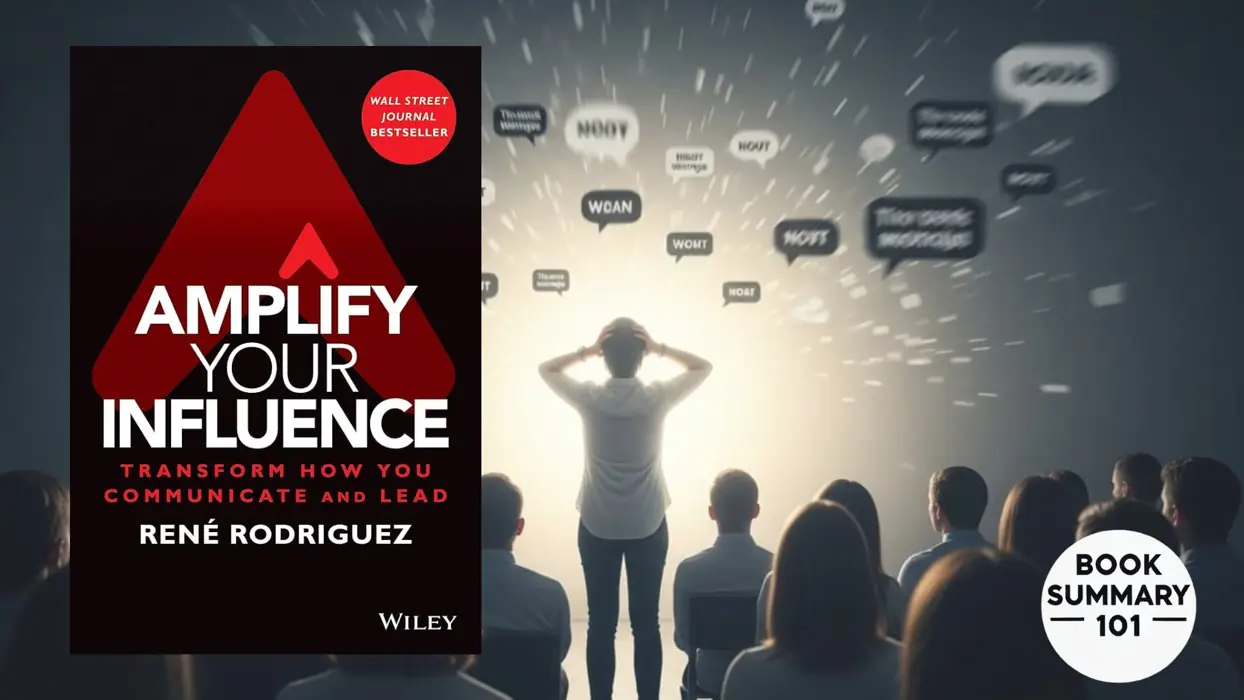
Then I picked up Amplify Your Influence: Transform How You Communicate and Lead by Rene Rodriguez.
Reading this book felt less like a lecture and more like a friendly intervention. It turns out, I wasn’t unlikable; I was just doing things in the wrong order. Rene Rodriguez breaks down the neuroscience of communication in a way that is so simple, it’s almost embarrassing that we aren’t taught this in school.
If you’ve ever felt unheard, misunderstood, or just plain invisible, this post is for you.
- Why Should You Even Bother Reading It?
- The Core Principles That Reshaped My Thinking
- 1. The Power of Sequence: Context Before Content
- 2. Framing: Controlling the Lens
- 3. The Origin Story: Why They Buy You
- 4. The Tie-Down: Landing the Plane
- 5. Managing the “Limbic” Reaction
- My Final Thoughts
- Join the Conversation!
- Frequently Asked Questions (The stuff you’re probably wondering)
Why Should You Even Bother Reading It?
This book isn’t just for slick salespeople or CEOs giving TED Talks. It is for anyone who needs to get a point across to another human being.
Whether you are a parent trying to get a toddler to eat broccoli, a manager trying to motivate a burnt-out team, or a spouse trying to decide on a movie without an argument, this book matters.
We live in the “Attention Economy.” We are bombarded with noise every second of the day. If you can’t cut through that noise and connect with people on a biological level, your message is dead on arrival. This book gives you the scalpel to cut through the noise.
The Core Principles That Reshaped My Thinking
Rodriguez argues that most of us focus 90% of our energy on what we want to say (the content) and almost zero energy on how the other person’s brain receives it (the context). He introduces the “AMP” philosophy, which relies heavily on sequence.
It’s not magic; it’s biology. Here are the main concepts from the book that completely changed how I operate.
1. The Power of Sequence: Context Before Content
Imagine I handed you a delicious, gourmet steak dinner. The best cut of meat, perfectly seasoned.
Now, imagine I served it to you on the lid of a dirty trash can.
Would you eat it? Absolutely not. The “content” (the steak) is perfect. But the “context” (the trash can lid) ruins it. You can’t separate the two.
Rodriguez teaches that this is exactly what we do with our ideas. We have great content, but we serve it on a trash can lid of bad timing, poor body language, or zero context.
The brain needs to know how to process information before it receives the information. If you dive straight into data without setting the stage, the brain rejects it.
The Real-World Example:
Think about a manager announcing a budget cut.
- Bad Sequence: “We are cutting the marketing budget by 20% effective immediately.” (Panic ensues).
- Good Sequence (Framing): “Our goal this year is to protect every single job in this department while remaining profitable. To ensure we don’t have to let anyone go, we need to tighten up spending in other areas. Therefore, we are reducing the marketing budget by 20%.”
See the difference? The bad news didn’t change, but the reaction changed from panic to cooperation because the context was set first.
Simple Terms: Never deliver a message without first explaining the lens through which it should be viewed.
The Takeaway: Structure matters more than raw data; always set the stage before you perform the play.
2. Framing: Controlling the Lens
Let’s stick with the photography analogy. When you take a picture, you choose what to include in the frame and what to leave out.
If you zoom in on a crying child, the story is “sadness.” If you zoom out and show that the child is crying because they dropped their ice cream at Disney World, the story is “a minor mishap in a happy place.”
Rodriguez emphasizes that if you don’t frame your message, the listener’s brain will frame it for you—usually based on their own biases, fears, or bad moods. Framing is the act of creating the “lens” the audience looks through.
📖 “The frame is the psychological context that dictates the meaning of your message.”
The Real-World Example:
Consider how companies like Apple frame their products. They don’t just say, “Here is a phone with a better camera.” They frame it as, “This is for the creators. This is for the people who want to capture cinema-quality memories of their children.”
They aren’t selling megapixels; they are framing the device as a tool for emotional connection. By the time they tell you the price, you aren’t thinking about money; you’re thinking about your kid’s birthday party.
Simple Terms: Tell people what something means before you tell them what it is.
The Takeaway: Whoever controls the frame controls the conversation.
3. The Origin Story: Why They Buy You
Why do we love superhero movies? It’s not just the fight scenes. It’s the origin story. We need to know why Batman is so angry. We need to know why Spider-Man feels responsible.
Rodriguez points out that in business, we often try to be robots. We hide our struggles and only show our successes. But humans don’t connect with perfection; we connect with struggle.
To amplify your influence, you must share your “Signature Story.” This isn’t a long autobiography. It’s a specific story from your past that explains why you value what you value today. It bridges the gap between you and the listener.
The Real-World Example:
Imagine a financial advisor.
- Advisor A: “I have a degree in finance and 20 years of experience. Invest with me.” (Boring).
- Advisor B: “When I was 12, my parents lost our home because of bad financial advice. I watched the stress destroy their marriage. I promised myself I would learn how money works so I could protect families from ever feeling that pain. That is why I am so conservative with my risk management.” (Powerful).
You trust Advisor B not because of their degree, but because of their story.
Simple Terms: People don’t buy your product; they buy the reason you sell it.
The Takeaway: Vulnerability is a hook; use your past to validate your present values.
4. The Tie-Down: Landing the Plane
Have you ever listened to someone talk and talk, and you just wanted to scream, “So what? What do you want me to do?”
That speaker failed to “land the plane.”
Rodriguez introduces the concept of the “Tie-Down.” This is a technique used to check for agreement and pull the listener toward a conclusion. It’s a way of saying, “Are we on the same page?” without being annoying.
It involves asking questions at the end of statements that trigger a “yes” response in the listener’s brain. The more “yeses” you get, the more influence you have.
The Real-World Example:
Instead of just stating a benefit, turn it into a question.
- Statement: “This software will save you time.”
- Tie-Down: “This software automates the data entry, which is going to save you about ten hours a week. And I imagine getting ten hours of your life back would be pretty valuable, wouldn’t it?”
By adding “wouldn’t it?”, you force the brain to agree.
📖 “Tie-downs are the guardrails that keep the conversation on the road to agreement.”
Simple Terms: Don’t just make statements; ask small questions that get the other person nodding.
The Takeaway: Influence is interactive; if they aren’t nodding, you aren’t leading.
5. Managing the “Limbic” Reaction
Our brains are built for survival, not for PowerPoint presentations. Rodriguez spends time explaining the difference between the “Old Brain” (the Limbic system, responsible for fight-or-flight) and the “New Brain” (the Neocortex, responsible for logic).
The problem? The Old Brain is the bouncer at the club. It sees everything first. If the Old Brain senses a threat, arrogance, or confusion, it slams the door shut. The New Brain (logic) never even gets the message.
Most people try to use logic to open a door that is emotionally locked. You have to lower the threat level first.
The Real-World Example:
Think about a difficult performance review. If a boss walks in with a stern face and crossed arms, the employee’s Limbic system screams “THREAT!” Their heart rate goes up, and their IQ effectively drops. They literally cannot process the logical feedback the boss is giving.
To succeed, the boss must first signal safety (warm tone, open body language, clear “framing” of support) to get past the bouncer.
Simple Terms: You cannot reason with a scared or defensive brain.
The Takeaway: Make them feel safe first, then make them think.
My Final Thoughts
Reading Amplify Your Influence was a massive wake-up call for me. It made me realize that “being right” is only 10% of the battle. The other 90% is packaging that truth in a way that the human brain can actually accept.
The best part? This isn’t manipulation. It’s actually the highest form of empathy. By framing your message and respecting the other person’s brain chemistry, you are making it easier for them to understand you. You are removing the friction from communication.
It empowered me to stop blaming others for “not getting it” and start taking responsibility for how I was sending the signal.
Join the Conversation!
I’d love to hear from you. What is one “good idea” you had that failed because you didn’t frame it correctly? Drop a comment below—let’s learn from our awkward moments together!
Frequently Asked Questions (The stuff you’re probably wondering)
1. Is this book just for salespeople?
Not at all. While the examples often touch on business or sales, the principles apply to anyone. If you are a teacher, a parent, or a partner in a relationship, you are constantly “selling” your ideas.
2. Is the “Tie-Down” method manipulative?
It can be if you use it to trick people. But Rodriguez teaches it as a tool for clarity. It’s about ensuring the other person is following along and agrees with the logic, rather than forcing them into a corner.
3. Do I need a background in psychology to understand it?
No. Rodriguez explains the brain science (neuroscience) in incredibly simple terms. He uses plain English to explain complex biological reactions.
4. How long does it take to learn these skills?
The concepts are easy to grasp immediately, but mastering them takes practice. You can start using “framing” in your very next email, but perfecting your “Signature Story” might take some reflection.
5. Does the book cover body language?
Yes! A significant portion is dedicated to “congruency”—ensuring your face and body match the words coming out of your mouth. If they don’t match, people will always believe the body language over the words.