Have you ever sat on your couch, scrolling through your news feed or watching the evening broadcast, and felt a weird sense of déjà vu?
You know that feeling. It seems like every channel is covering the exact same story, using the exact same angle, and ignoring everything else. Or maybe you’ve felt that nagging suspicion that you aren’t getting the full picture, but you can’t quite put your finger on why.
I used to feel like this all the time. I’d get angry at the TV. “Why aren’t they talking about this?” I’d shout. I felt like I was being manipulated, but I assumed it was some shadowy conspiracy involving guys in a smoke-filled room plotting to lie to me.
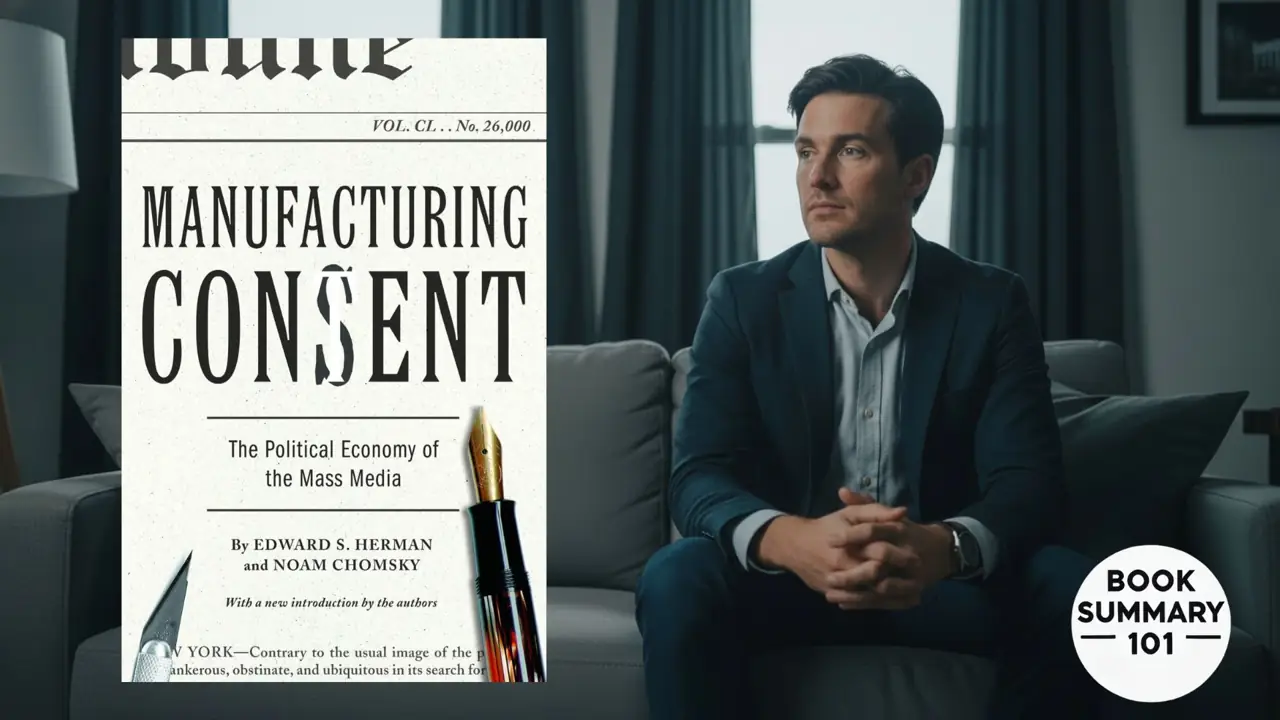
Then I picked up Manufacturing Consent: The Political Economy of the Mass Media by Edward Herman and Noam Chomsky.
Honest to goodness, it was like someone turned on the lights in a dark room.
I realized I was wrong. It wasn’t a conspiracy. It was something much more boring, and much more powerful: it was just business.
This book completely rewired my brain. It took the chaos of the media landscape and gave me a map to navigate it. And today, I want to share that map with you.
Why Should You Even Bother Reading It?
If you consume news—whether it’s via TikTok, the New York Times, or cable TV—you need this framework.
This book isn’t just for political science majors or journalists. It’s for anyone who wants to stop being a passive consumer of information.
If you’ve ever felt overwhelmed by the narrative or wondered why the world seems to care deeply about some tragedies while completely ignoring others, this book explains the mechanics behind it. It teaches you how to “read between the lines” of the nightly news.
- Why Should You Even Bother Reading It?
- The Propaganda Model: How the Machine Works
- 1. The First Filter: Size, Ownership, and Profit
- 2. The Second Filter: The Advertising License to Do Business
- 3. The Third Filter: Sourcing Mass-Media News
- 4. The Fourth Filter: Flak and the Enforcers
- 5. The Fifth Filter: The Common Enemy (Fear)
- The Result: Worthy vs. Unworthy Victims
- My Final Thoughts
- Join the Conversation!
- Frequently Asked Questions (The stuff you’re probably wondering)
The Propaganda Model: How the Machine Works
Herman and Chomsky don’t believe that journalists are bad people or that they are all secretly meeting to coordinate lies. Instead, they introduce something called the Propaganda Model.
Think of the news not as a mirror reflecting reality, but as a raw material that has to pass through a series of aggressive sieves before it reaches your screen. Only the stuff that fits through the holes makes it to your living room.
Here are the five filters that shape every single story you see.
1. The First Filter: Size, Ownership, and Profit
Imagine you want to start a newsletter for your neighborhood. It costs you maybe $50 for paper and ink. You can print whatever you want.
Now, imagine you want to start a cable news network or a national newspaper.
The barrier to entry is astronomical. You need billions of dollars. This means that the “media” isn’t a public service; it represents huge, tiered corporations.
The analogy here is The Exclusive Country Club.
To get into the club of “Major Media,” you have to be incredibly wealthy. Because these outlets are corporations, their primary duty is to their shareholders, not to the truth. They are profit-seeking machines.
Naturally, a massive corporation isn’t going to publish stories that hurt the financial interests of massive corporations. They aren’t going to dismantle the system that made them rich.
Real-World Example:
Think about when Jeff Bezos bought The Washington Post. While journalists there still do great work, are they likely to run a relentless, year-long crusade exposing the working conditions in Amazon warehouses? The ownership structure creates an inherent conflict of interest.
Simple Terms:
News outlets are big businesses run by wealthy people who want to stay wealthy.
The Takeaway:
The owners of the media shape the news to fit their own corporate interests and exclude voices that threaten their bottom line.
2. The Second Filter: The Advertising License to Do Business
Here is the most important shift in thinking I had while reading this book.
We usually think that we (the readers or viewers) are the customers of the news. We think we “buy” the paper or “pay” for the cable subscription.
Herman and Chomsky argue that this is backward.
The Analogy: The Rancher and the Cattle.
In the media model, the news outlet is the rancher. The advertisers are the buyers. You are the cattle.
The product being sold isn’t the news; the product is your attention. The media sells your eyeballs to other businesses (advertisers).
📖 “The media are not a solid monolith on all issues, but they are unified on one: they are profit-seeking corporations, funded by other profit-seeking corporations, selling audiences to yet other profit-seeking corporations.”
If a TV station runs a documentary that attacks the fossil fuel industry, and their biggest commercial breaks are bought by oil companies and car manufacturers, that station is going to lose money. Therefore, the news is filtered to create a “buying mood” and to avoid offending the sponsors who actually pay the bills.
Real-World Example:
Have you ever noticed how lifestyle magazines rarely criticize the beauty industry? If a magazine’s revenue comes from selling ads for anti-aging cream, they aren’t going to run an article saying “Aging is natural and you don’t need creams.” They would go bankrupt.
Simple Terms:
Advertisers pay for the news, so the news won’t report on things that make advertisers look bad.
The Takeaway:
Media outlets will naturally kill stories that interfere with the “buying mood” or attack the industries that fund them.
3. The Third Filter: Sourcing Mass-Media News
News is a 24/7 beast. It is hungry, and it needs to be fed constantly.
Investigative journalism—where you send a reporter to a foreign country for six months to dig up dirt—is incredibly expensive. It costs money, time, and resources.
The Analogy: The Lazy Student.
Imagine a student who needs to write a daily essay. They could go out, interview people, and do original research. Or, they could just copy down exactly what the teacher writes on the board.
The media does the latter. They rely on “official sources”—the White House, the Pentagon, police departments, and corporate PR firms—to provide them with a steady stream of content. It’s free, it’s easy, and it looks “credible.”
Because the media relies on these powerful institutions for their daily content, they cannot afford to offend them. If a reporter annoys the White House Press Secretary, they lose their access. They get cut off from the “feed.”
Real-World Example:
Look at how crime reporting works. You often see headlines that say, “Officer involved shooting occurred,” or “Suspect died after medical emergency.” The news simply reprints the police press release word-for-word because it’s the path of least resistance.
Simple Terms:
The media relies on government and corporate officials for cheap content, so they rarely challenge those officials.
The Takeaway:
By relying on “official sources,” the media becomes a megaphone for the powerful rather than a check on them.
4. The Fourth Filter: Flak and the Enforcers
What happens if a journalist actually does break the rules and reports something that upsets the powerful?
They get hit with Flak.
The Analogy: The Electric Shock Collar.
Flak is the negative response to a media statement. It’s the shock the dog gets when it strays too far from the yard.
This can take the form of angry letters, phone calls from the White House to the editor, lawsuits, or aggressive campaigns by “think tanks” designed to discredit the journalist.
If a news organization produces a documentary exposing a powerful industry, that industry might threaten to pull millions of dollars in advertising (see Filter #2) or sue them into oblivion. It becomes too expensive and too much of a hassle to tell the truth. So, editors learn to avoid “trouble.”
Real-World Example:
When 60 Minutes tried to expose the tobacco industry (dramatized in the movie The Insider), the corporate pushback and threat of lawsuits were so intense that the network killed the interview. That is Flak in action.
Simple Terms:
When the media reports something the powerful don’t like, they get punished until they stop.
The Takeaway:
Flak makes it expensive and risky to challenge power, causing the media to self-censor to stay safe.
5. The Fifth Filter: The Common Enemy (Fear)
To keep the population together and distracted, you need a boogeyman.
When the book was written, this filter was explicitly “Anti-Communism.” Today, scholars (and even Chomsky himself) argue this has evolved into “The War on Terror” or vague concepts like “immigrants” or “radicals.”
The Analogy: The Monster Under the Bed.
If you can convince a child there is a monster under the bed, they will run to their parents for protection and do exactly what they are told.
By creating a constant state of fear against a common enemy, the media encourages the population to support the government and the military. It frames the world as “Us vs. Them.” If you question the government, you are accused of siding with “Them.”
📖 “The smart way to keep people passive and obedient is to strictly limit the spectrum of acceptable opinion, but allow very lively debate within that spectrum.”
Real-World Example:
Think about the coverage leading up to the invasion of Iraq. The media drumbeat was almost entirely focused on the fear of WMDs (Weapons of Mass Destruction). Dissenting voices were labeled as unpatriotic or soft on terror.
Simple Terms:
The media uses fear of a common enemy to unite the public behind the government and silence critics.
The Takeaway:
Fear is the ultimate control mechanism that shuts down critical thinking and nuances.
The Result: Worthy vs. Unworthy Victims
So, what happens when you run reality through these five filters? You get a skewed view of the world, particularly regarding human suffering.
Herman and Chomsky illustrate this with the concept of Worthy vs. Unworthy Victims.
The Analogy: The Teacher’s Pet vs. The Outcast.
If the Teacher’s Pet scrapes their knee, the teacher stops the class, gets the nurse, and everyone cries. If the Outcast breaks their arm, the teacher says, “Stop whining and sit down.”
- Worthy Victims: People abused or killed by “enemy” states (e.g., a dissident killed in Russia or Iran). The media screams about these to show how bad the “enemy” is.
- Unworthy Victims: People abused or killed by our government or our allies. The media ignores these because acknowledging them would make “us” look bad.
Real-World Example:
The book compares the media coverage of one priest killed in a communist country (massive coverage) versus 100 religious leaders killed by US-backed regimes in Latin America (zero coverage). The value of a human life depends entirely on whose side killed them.
Simple Terms:
We cry for victims killed by our enemies, but we ignore victims killed by our friends.
The Takeaway:
The media manipulates our empathy to serve political goals.
My Final Thoughts
Reading Manufacturing Consent didn’t make me cynical; it made me empowered.
I don’t look at the news and get confused anymore. I look at it like a puzzle. I ask myself: Who owns this station? Who are the advertisers? Why is this official source saying this right now?
It’s a heavy book, but the feeling of clarity you get on the other side is worth every page. You realize that you aren’t crazy for thinking the game is rigged. It is rigged—but now you know the rules.
Join the Conversation!
I’d love to hear your take. Can you think of a recent news story that seemed to disappear overnight, or one that was blown out of proportion? Drop a comment below and let’s break it down through the 5 Filters!
Frequently Asked Questions (The stuff you’re probably wondering)
1. Is this book a conspiracy theory?
No. The authors explicitly state that this isn’t a conspiracy. It’s a “market analysis.” They argue that media companies act this way not because they are evil, but because they are businesses responding to market forces like profit, advertising, and cost-cutting.
2. The book was written in 1988. Is it still relevant in the age of the Internet?
Yes, arguably even more so. While the “Anti-Communism” filter has changed to “Anti-Terrorism,” the other filters (Ownership, Advertising, Flak) are even stronger now. Algorithms on social media platforms are the ultimate “Advertising Filter”—they show you what keeps you clicking, not what is true.
3. Is it hard to read?
I’ll be honest—it can be dry. It’s an academic text filled with data tables and detailed historical examples. That’s why I wrote this summary! However, the introduction and the first chapter are very readable and contain the core of the theory.
4. Do the authors think all journalists are liars?
Not at all. They acknowledge that many journalists are honest, hardworking people trying to find the truth. But those journalists operate within a system that limits what they can do. If they push too hard against the filters, they simply don’t get promoted or their stories get cut.
5. What’s the solution? Should I stop watching the news?
Don’t stop watching, but watch critically. Diversify your sources. Support independent journalism that is funded by readers (like Substack or listener-supported podcasts) rather than advertisers. The solution is to be aware of the filters so you can mentally remove them.