We’ve all been there. It’s 5:30 PM on a Tuesday. You’ve been sitting at your desk for nine hours, typing furiously, clicking between tabs, and responding to Slack messages. You feel exhausted, like you’ve run a mental marathon.
But when you look at your to-do list… you realize you didn’t actually finish anything important.
I used to live in this state of perpetual motion. I called it “hustling.” In reality, I was just drowning in admin tasks—copying data from emails to spreadsheets, scheduling meetings, and sorting files. I was a highly paid data entry clerk in my own life.
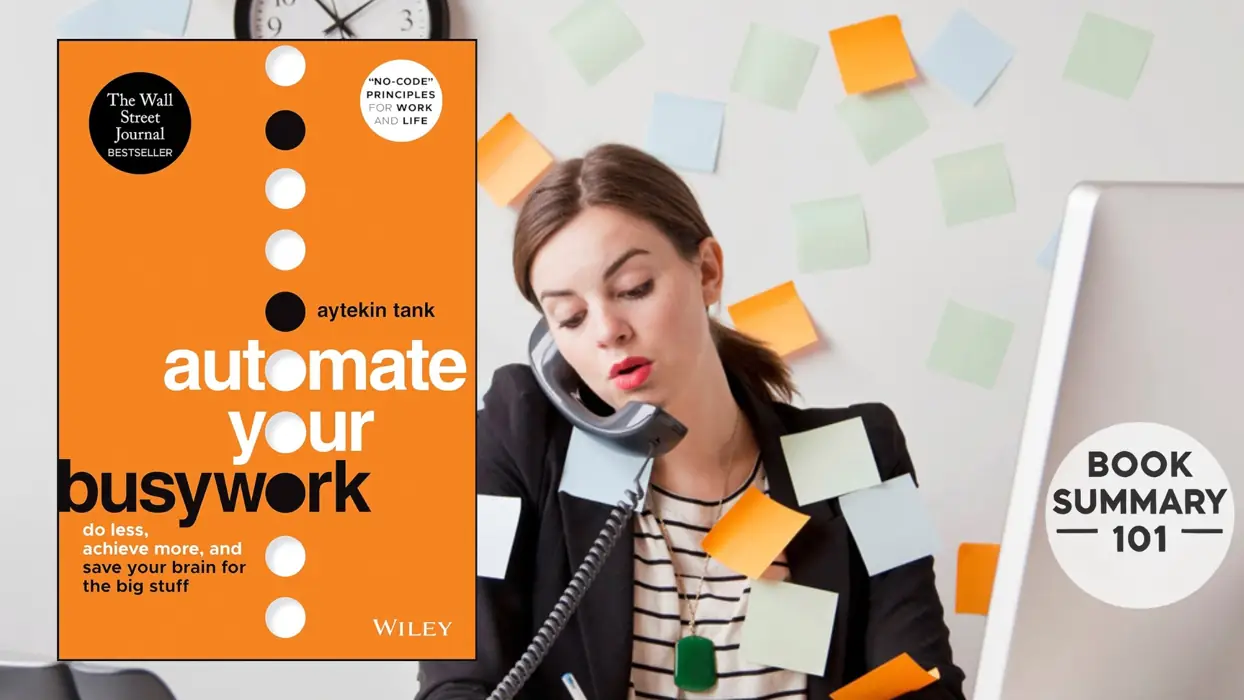
Then I picked up “Automate Your Busywork: Do Less, Achieve More, and Save Your Brain for the Big Stuff” by Aytekin Tank.
I was skeptical. I’m not a coder. I don’t know Python. But reading this book felt less like a technical manual and more like a coffee chat with a calm, organized friend who gently explains, “Hey, you know you don’t have to live like this, right?”
It changed how I view my workday. And I think it can change yours, too.
3. Why Should You Even Bother Reading It?
Who is this book for? Honestly, it’s for anyone who has ever uttered the phrase, “I just don’t have enough time.”
Whether you are a freelancer juggling five clients, a small business owner wearing every hat, or a corporate manager buried in reports, this book is your lifeline.
The core message is vital for the modern era: Busyness is not a badge of honor. In a world where we are constantly bombarded by digital noise, the ability to automate the boring stuff isn’t just a “hack”—it’s a survival skill. And the best part? Aytekin Tank, the founder of JotForm, proves you don’t need to be a tech wizard to do it.
- The Blueprint for Reclaiming Your Life
- 1. The Automation Flywheel (The Engine of Efficiency)
- 2. Distinguishing “Busywork” from “Meaningful Work”
- 3. The “No-Code” Revolution (Legos for Adults)
- 4. “Divide and Conquer” (The Russian Doll Strategy)
- 5. Saving Your Brain (The RAM Analogy)
- My Final Thoughts
- Join the Conversation!
- Frequently Asked Questions (The stuff you’re probably wondering)
The Blueprint for Reclaiming Your Life
Tank doesn’t just throw a bunch of app recommendations at you and wish you luck. Instead, he provides a philosophical framework and a practical system for rethinking how work gets done. It’s about shifting from a “doer” mindset to an “architect” mindset.
Here are the core principles from the book that completely reshaped my thinking.
1. The Automation Flywheel (The Engine of Efficiency)
Imagine you are trying to push a heavy boulder up a hill. That is manual work. You have to exert force every single day just to stay in the same place. If you stop pushing, the boulder rolls back down.
Tank introduces the concept of the Automation Flywheel.
A flywheel is different. It takes some effort to get it spinning, but once it’s moving, it carries its own momentum. The more it spins, the faster and smoother it gets.
The book breaks this down into three distinct phases:
- Divide and Conquer: Breaking tasks down.
- Design and Implement: Building the solution.
- Refine and Iterate: Polishing the process.
Most people stop at step 2. But the Flywheel concept reminds us that automation is a cycle, not a one-time fix.
Real-World Example:
Think about Spotify’s “Discover Weekly” playlist. Spotify doesn’t have a human DJ manually picking songs for millions of users every Monday. They built a flywheel (an algorithm) that analyzes your listening habits, compares them to others, and serves you a playlist. They built it once, and now it runs forever, getting better (iterating) the more you listen.
Simple Terms: stop doing things that don’t scale; build systems that run themselves.
The Takeaway: Put in the heavy lifting upfront to build the machine, so the machine can do the heavy lifting forever after.
2. Distinguishing “Busywork” from “Meaningful Work”
The author uses a great analogy that really stuck with me: The difference between being a Gardener and being a Weed.
Busywork is the weed. It’s persistent, it chokes out growth, and it comes back if you don’t pull it out by the root. Meaningful work is the flower or the vegetable—the thing that actually bears fruit.
Tank argues that we often confuse the two. We think checking email is “work.” We think organizing files is “work.” But usually, these are just weeds disguised as productivity. They make us feel busy, but they don’t move the needle on our long-term goals.
📖 “Time is the one asset you can’t buy more of. But you can save it. You can spend it more wisely. And you can protect it with everything you’ve got.”
Real-World Example:
Consider a real estate agent.
- Busywork: Manually emailing a client to confirm a viewing time, then texting them the address, then putting it in the calendar.
- Meaningful Work: The actual face-to-face conversation where they negotiate the sale.
- Automation: Using a tool like Calendly. The client picks a time, the calendar updates automatically, and the zoom link/address is sent without the agent lifting a finger.
Simple Terms: If a robot could do it, a human shouldn’t do it.
The Takeaway: Audit your day ruthlessly. If a task is repetitive and requires zero creativity, it is the enemy.
3. The “No-Code” Revolution (Legos for Adults)
This is the most encouraging part of the book. Years ago, if you wanted to automate a workflow, you needed to hire a developer or learn to write code.
Tank compares the modern software landscape to Legos.
Today, we have “No-Code” tools. These are pre-built blocks that snap together. You don’t need to know how to manufacture the plastic (write the code); you just need to know how to snap the blue block onto the red block.
Tools like Zapier, Make, and (naturally) JotForm act as the glue between your different apps.
Real-World Example:
Let’s say you run a newsletter.
- The Old Way: Someone fills out a form on your site. You get an email. You open the email. You copy their name. You open Mailchimp. You paste their name. You hit save.
- The Lego Way: You use Zapier. You tell it: “When a new entry hits my website form (Block A), automatically add it to Mailchimp (Block B).” You snap them together once, and it never fails.
Simple Terms: You don’t need to be a computer genius; you just need to be a good connector of blocks.
The Takeaway: Technology has been democratized. The barrier to entry for automation is now zero.
4. “Divide and Conquer” (The Russian Doll Strategy)
When people try to automate, they often fail because they try to automate a massive, vague task like “Manage Project Marketing.”
Tank suggests a method similar to unpacking Russian Nesting Dolls. You have to open the big doll to find the smaller one, and open that one to find an even smaller one, until you reach the solid, tiny doll at the center that can’t be opened anymore.
You can’t automate “Project Marketing.” But you can automate the tiny doll at the center: “Post a tweet when a new blog is published.”
You have to break workflows down into their atomic steps. If you can’t write the steps down on a napkin, you can’t automate them.
Real-World Example:
Think about the Roomba vacuum. It doesn’t just “clean the house” in one vague motion. It operates on a series of tiny, binary decisions: Is there a wall? Turn left. Is there dirt? Suck it up. is battery low? Go home. Complex behavior is just a stack of very simple automated steps.
Simple Terms: Don’t try to automate a whole job; automate the tiny tasks that make up the job.
The Takeaway: Specificity is the secret sauce. Break it down until it can’t be broken down any further.
5. Saving Your Brain (The RAM Analogy)
Your brain is like a computer. You have limited RAM (Random Access Memory).
Every time you have to remember to send a follow-up email, or remember where you saved that file, you are keeping a “tab” open in your brain. Eventually, if you have too many tabs open, your operating system slows to a crawl. You get “brain fog.”
Tank emphasizes that automation isn’t just about saving time; it’s about saving energy. By offloading the remembering and the sorting to a machine, you close those mental tabs.
📖 “Creativity requires space. If your mind is cluttered with to-dos and reminders, there’s no room for the big ideas to land.”
Real-World Example:
1Password or LastPass. Before password managers, your brain had to hold dozens of complex combinations (or you used “Password123” everywhere, which is bad). By automating the storage and entry of passwords, you free up that mental RAM for creative problem solving, rather than rote memorization.
Simple Terms: Your brain is for having ideas, not for holding data.
The Takeaway: Automate to protect your mental health and creativity, not just to speed up your typing.
My Final Thoughts
I’ll be honest: I went into Automate Your Busywork expecting a dry manual on software integration. I came out of it feeling empowered.
Aytekin Tank manages to make automation feel human. He reframes the conversation. It’s not about robots taking our jobs; it’s about robots taking the drudgery out of our jobs so we can be more human.
After reading this, I spent a Sunday afternoon “building my flywheel.” I set up filters for my email, automated my invoicing, and connected my calendar to my to-do list. The result? I felt lighter. I wasn’t just working faster; I was working calmer.
If you feel like you’re running on a treadmill that never stops, this book is the “Stop” button you’ve been looking for.
Join the Conversation!
I’d love to hear from you. What is the one task in your daily life that makes you want to pull your hair out—the one you would pay anything to never have to do again? Drop it in the comments below, and let’s see if we can figure out a way to automate it!
Frequently Asked Questions (The stuff you’re probably wondering)
1. Do I need to know how to code to use this book?
Absolutely not. That is the main selling point. The book focuses on the “No-Code” movement, utilizing tools that use drag-and-drop interfaces. If you can use a smartphone, you can use these techniques.
2. Is this book only for tech startup founders?
No. Whether you are a teacher organizing grades, a lawyer managing cases, or a creative freelancer, the principles of the “Automation Flywheel” apply to any workflow that involves repetitive steps.
3. Won’t automating everything make my work feel robotic?
Ironically, no. By automating the robotic parts of your job (data entry, scheduling), you free up more time for the human parts (strategy, creativity, connection). It actually allows you to be more personal where it counts.
4. Does this require buying expensive software?
Not necessarily. Many of the tools mentioned (like Zapier, Trello, or Google’s built-in features) have robust free versions. The book focuses on the mindset of automation, which you can apply using whatever tools you have.
5. How long does it take to see results?
It requires an upfront investment of time. You might spend 2 hours setting up an automation that only saves you 5 minutes a day. But over a year, that 5 minutes adds up to 30 hours of saved time. It’s a long-term play.