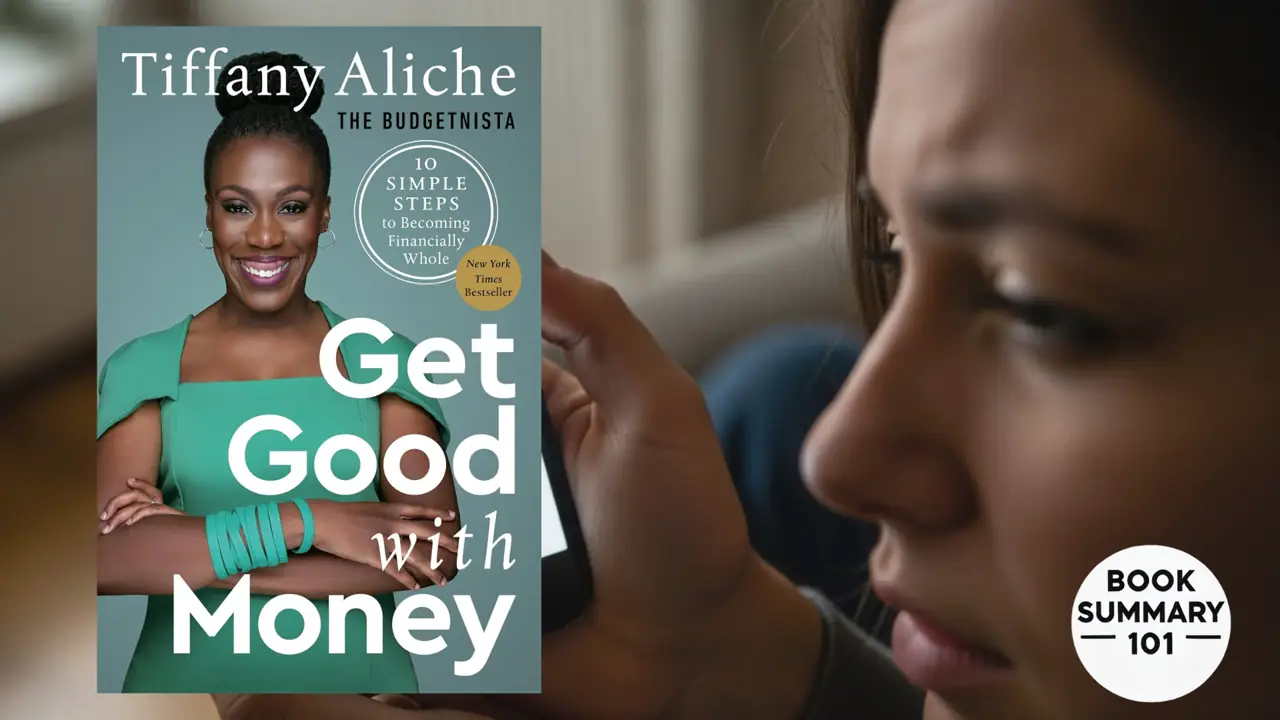
I used to treat my banking app like a horror movie. You know the feeling?
I’d squint one eye, hold the phone at arm’s length, and tap the icon, praying the number on the screen wasn’t in red. I was earning decent money, but I felt like I was constantly treading water with heavy boots on. I wasn’t broke, but I certainly wasn’t broken in.
I tried reading the “classic” finance books, but they felt like being yelled at by a stern accountant in a dusty suit.
Then I picked up “Get Good with Money” by Tiffany Aliche (aka The Budgetnista).
Reading this book didn’t feel like a lecture; it felt like sitting on a comfortable couch with a wise, non-judgmental big sister who genuinely wants you to win. Tiffany isn’t just a finance expert; she was a preschool teacher who lost her job and her home during the recession and rebuilt her life from a negative bank balance.
She gets it. And she breaks down the scary monster of “Personal Finance” into a friendly, manageable puppy that you can actually train.
If you’ve been looking for a sign to finally get your financial house in order, this is it.
- Why Should You Even Bother Reading It?
- The Roadmap to Financial Wholeness: Breaking Down the 100% Plan
- 1. Financial Wholeness vs. Being Rich
- 2. The “Noodle Budget” and The Money List
- 3. The Squirrel Strategy (Automating Your Savings)
- 4. Digging Out: The Debt Avalanche vs. Snowball
- 5. Investing: Planting Your Garden
- 6. Protection: The Fence Around Your House
- My Final Thoughts
- Join the Conversation!
- Frequently Asked Questions (The stuff you’re probably wondering)
Why Should You Even Bother Reading It?
Honestly? Because you’re probably tired of the low-level anxiety humming in the background of your life.
This book isn’t for the day-trader looking to short stocks or the crypto-bro looking for the next moonshot. It is for the person who wants to sleep well at night.
Whether you are drowning in student loans, terrified of the stock market, or just feeling like you should be “further ahead” by now, this book is for you. Tiffany’s core message is relevant today because she shifts the goalpost from being “Rich” (which feels impossible) to being “Financially Whole” (which is completely achievable).
The Roadmap to Financial Wholeness: Breaking Down the 100% Plan
Tiffany structures the entire book around ten distinct steps that, when completed, make you 100% “Financially Whole.” It’s not about doing everything at once; it’s about ticking off one box at a time until you’ve built a fortress around your life.
1. Financial Wholeness vs. Being Rich
The first thing we need to do is change the destination on your GPS. Most of us are driving toward “Rich,” but we don’t even know what that looks like. Is it a million dollars? A yacht? It’s vague, and vague goals are hard to hit.
Tiffany introduces the concept of Financial Wholeness.
Imagine your financial life is a house. “Rich” is just a fresh coat of expensive paint on the outside. It looks good to the neighbors, but if the foundation is cracked and the roof is leaking, the paint doesn’t matter.
Financial Wholeness is the structure itself. It’s having a solid foundation (budgeting), strong walls (savings), a roof (insurance), and a garden out back (investing).
When you are financially whole, you can survive a storm. You might lose your job or face a medical emergency, but because your house is solid, you won’t collapse. This shift in thinking is massive. It stops you from comparing your “behind the scenes” to everyone else’s “highlight reel” on Instagram. You aren’t trying to look wealthy; you are trying to be secure.
Simple Terms: Stop trying to look rich and start building a life that can survive a crisis.
The Takeaway: Financial Wholeness is a concrete checklist of ten achievable steps, whereas “being rich” is a moving target that never feels like enough.
2. The “Noodle Budget” and The Money List
Budgeting usually feels like going on a crash diet. We tell ourselves, “I will spend $0 on fun forever,” and then binge-spend three days later.
Tiffany replaces the restrictive diet with the “Noodle Budget.”
Think of the Noodle Budget as your survival kit. If everything went wrong tomorrow—you lost your job, the economy tanked, and a pandemic hit (sound familiar?)—what is the absolute bare minimum you need to survive? We’re talking rent, lights, and literal Ramen noodles.
Knowing this number is a superpower. It strips away the fear.
For example, let’s say you spend $4,000 a month comfortably. But after doing the math, you realize your Noodle Budget is only $2,200. Suddenly, the idea of losing your income is slightly less terrifying because you know the baseline you need to hit to keep the lights on.
She pairs this with “The Money List,” which is just a categorization of your expenses. It’s like sorting laundry. You don’t throw the red socks in with the white sheets. You separate your “Needs” (bills), “Loves” (Netflix, dining out), and “Likes” (extra clothes). When you see it on paper, you regain control.
📖 “Budgeting isn’t about restricting your freedom; it’s about finding it. A budget is a plan for your money, and if you don’t have a plan for your money, someone else does.”
Simple Terms: Calculate the bare minimum amount of money you need to survive if everything goes wrong.
The Takeaway: Your Noodle Budget is your safety net; once you know that number, you can spend the rest of your money with less guilt and more intention.
3. The Squirrel Strategy (Automating Your Savings)
We all know we should save, but relying on willpower to move money into savings at the end of the month is a losing game. By the end of the month, the money is usually gone.
Tiffany uses the analogy of a Squirrel.
Squirrels don’t wander around the forest hoping they stumble upon a pile of acorns in the dead of winter. They aggressively hide nuts away before the snow falls. But humans are forgetful squirrels. We need a robot to hide the nuts for us.
This is the concept of splitting your direct deposit.
Imagine you get paid $2,000. Instead of all of it hitting your checking account (where you will inevitably spend it), you tell your HR department or bank to split it before you even see it.
- $1,500 goes to Checking (for bills).
- $200 goes to a “Emergency” savings account (at a totally different bank so you can’t see it).
- $300 goes to a “Goals” account (for that vacation).
This is exactly how I finally saved for my car repairs. I set up a transfer of $75 a paycheck to an online bank I didn’t have a debit card for. Six months later, when my brakes needed replacing, the money was just there. It felt like magic, but it was just automation.
Simple Terms: Make your savings automatic and invisible so you can’t accidentally spend it.
The Takeaway: If you have to manually transfer money to save it, you probably won’t; set up split deposits so the money is saved before it ever hits your spending account.
4. Digging Out: The Debt Avalanche vs. Snowball
Debt feels like a heavy backpack you can never take off. Tiffany approaches debt not with shame, but with strategy. She acknowledges the emotional weight of owing money.
She breaks down the two main ways to attack this, much like choosing a workout plan.
The Debt Snowball: This is for the person who needs quick wins to stay motivated. You list your debts from smallest balance to largest. You attack the little gnat of a $500 credit card bill first. When you pay it off, you get a hit of dopamine. You feel like a winner. Then you roll that payment into the next smallest debt.
The Debt Avalanche: This is for the math nerds who hate wasting money on interest. You list debts from highest interest rate to lowest. You attack the toxic 24% APR credit card first, regardless of the balance.
Tiffany doesn’t force you to pick one. She asks, “What kind of person are you?”
If you get discouraged easily, do the Snowball. If you are disciplined and hate inefficiency, do the Avalanche.
Real-world application: I had a friend with three credit cards. The math said “Avalanche,” but she was so depressed about her finances she couldn’t start. She switched to the Snowball, paid off a small $300 retail card in one month, and that single victory gave her the energy to tackle the $5,000 card next.
Simple Terms: Pick a debt payoff strategy that matches your personality type, not just the math.
The Takeaway: The “best” way to pay off debt is the one you will actually stick to; momentum is often more important than interest rates.
5. Investing: Planting Your Garden
This is the section that usually makes people sweat. We think investing requires six monitors, a shouting addiction, and a degree in economics.
Tiffany simplifies this beautifully: Investing is just growing a garden.
Your savings account is a basket of apples. It’s safe, but eventually, the apples might rot (inflation). Investing is taking the seeds from those apples and planting them in the ground. You have to water them, and you have to wait. You cannot dig up the seed every Tuesday to see if it’s a tree yet.
She advocates for boring, simple investing. She talks about the power of compound interest—which is basically your money having babies, and then those babies having babies.
She strongly suggests retirement accounts (like 401ks and IRAs) and index funds. Think of an index fund like a fruit salad. Instead of trying to pick the one perfect apple (buying a single stock like Tesla), you buy a giant bowl of fruit (an index fund that holds 500 companies). If one apple is rotten, you still have 499 other pieces of fruit, so you don’t starve.
📖 “Compound interest is the eighth wonder of the world. He who understands it, earns it… he who doesn’t… pays it.”
Simple Terms: Don’t try to pick winning stocks; buy a little bit of everything (index funds) and let time do the work.
The Takeaway: Investing doesn’t have to be complicated or risky; consistent contributions to boring funds will build wealth over decades.
6. Protection: The Fence Around Your House
This is the step everyone skips because it’s not sexy. It’s about Insurance and Estate Planning.
If you’ve built this beautiful financial house—budget, savings, investments—but you don’t have insurance, you have no fence. A single storm (lawsuit, car accident, disability) can wash the whole house away.
Tiffany explains that insurance isn’t a scam; it’s a transfer of risk. You are paying a monthly fee to ensure that if a catastrophe happens, a multi-billion dollar corporation pays for it, not you.
She breaks down the “must-haves”:
- Health Insurance.
- Life Insurance (specifically Term Life, which is cheap and effective).
- Disability Insurance (to protect your income).
She also touches on the “W” word: Wills. It feels morbid, but she frames it as an act of love. Writing a will is the final way you say “I love you” to your family, ensuring they aren’t fighting over your stuff or struggling to access accounts while they are grieving.
Simple Terms: Insurance is the defensive team that protects the wealth you are building.
The Takeaway: You aren’t truly financially whole until you have protected your assets and your income against the worst-case scenarios.
My Final Thoughts
Reading Get Good with Money felt less like a financial overhaul and more like a therapy session for my wallet.
The true power of this book isn’t the math. The math of finance is actually simple (spend less than you earn). The hard part is the behavior and the emotion. Tiffany Aliche masters the emotional side. She removes the shame of past mistakes and replaces it with a simple, numbered list of things to do next.
By the time I finished the book, I didn’t just have a budget; I had a sense of calm. I knew my “Noodle” number. I had my “Squirrel” accounts set up. And for the first time, I looked at my banking app with both eyes open.
Join the Conversation!
I’d love to hear from you. Which step of the “Financial Wholeness” journey scares you the most? Is it finally looking at your debt numbers, or is it the confusing world of investing? Let me know in the comments below!
Frequently Asked Questions (The stuff you’re probably wondering)
1. Is this book only for people who are bad with money?
Not at all. While it’s a lifesaver for beginners, the sections on investing, estate planning, and insurance are incredibly useful even for people who think they have it “figured out.”
2. Do I need to make a lot of money for this to work?
No. Tiffany started these principles when she was unemployed and in debt. The strategies scale with your income. The “Noodle Budget” concept is actually most helpful when money is tight.
3. Is it too technical? Will I need a calculator?
It is zero percent technical. Tiffany writes like she’s talking to you over brunch. There is some math involved (calculating your net worth), but she guides you through it step-by-step.
4. I’m not in the US. Is this book still relevant?
mostly, yes. The principles of budgeting, mindset, debt strategy, and saving are universal. However, specific chapters on 401ks, credit scores (FICO), and US-specific insurance types might need to be adapted to your local laws.
5. How long does it take to become “Financially Whole”?
It’s not an overnight fix. Some steps (like budgeting) can be done in an afternoon. Others (like paying off debt or reaching full investment goals) take years. The book is designed to be a companion for the long haul.