I distinctly remember the moment I hit the “management wall.”
I was sitting in a fluorescent-lit conference room, looking at a strategy plan that was failing. My team was exhausted. The numbers weren’t moving. And my instinct? My instinct was to tell everyone to just “work harder.”
I thought the plan was perfect, so the problem had to be the execution, right?
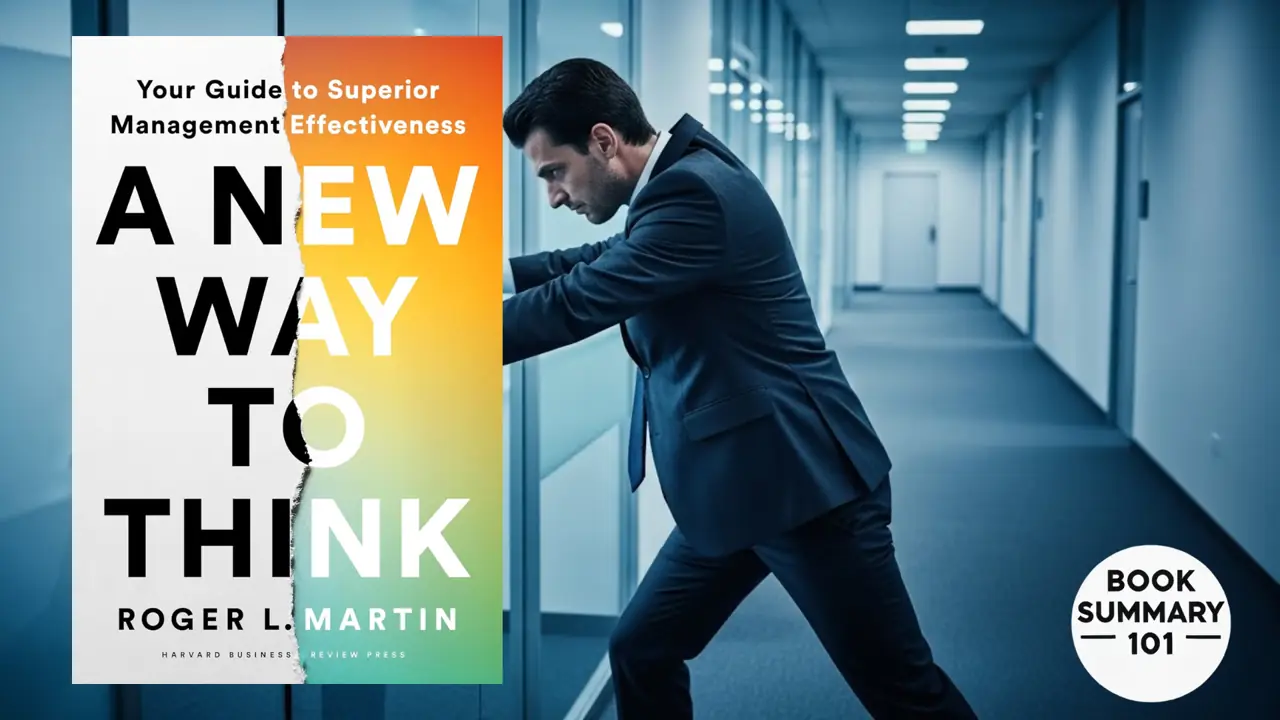
I was stuck in a loop. I felt like I was trying to open a door by pushing on the side that said “PULL.” No matter how much muscle I used, the door wasn’t budging.
That is exactly where Roger Martin meets us in his brilliant book, A New Way to Think: Your Guide to Superior Management Effectiveness.
Reading this book felt less like a lecture and more like a late-night intervention with a wise mentor. Martin, the former Dean of the Rotman School of Management, essentially told me, “You aren’t a bad manager. You’re just using a broken map.”
If you’ve ever felt like the standard business advice just isn’t working anymore, this book is the fresh air you’ve been gasping for.
- Why Should You Even Bother Reading It?
- The Mental Models That Are Holding You Back
- 1. Strategy is Not Planning (The Grocery List Trap)
- 2. Execution is Just More Strategy (The “Brain vs. Body” Myth)
- 3. Data is Not the Answer to Everything (The Rearview Mirror)
- 4. Culture is Not “Values on a Wall” (The Proxy Trap)
- 5. Competition is Not War (The Unique Value Mindset)
- My Final Thoughts
- Join the Conversation!
- Frequently Asked Questions (The stuff you’re probably wondering)
Why Should You Even Bother Reading It?
You might be thinking, “Great, another management book. Let me guess: optimize, synergize, and leverage?”
Not this time. This book is for the frustrated manager, the overwhelmed entrepreneur, and the aspiring leader who suspects the “old ways” are obsolete.
Whether you are a CEO or running a small creative team, this book matters because it dismantles the dominant models of business that have ruled for forty years. Martin argues that when things don’t work, we usually double down on the model.
Instead, he teaches us how to swap the model entirely. It’s not about doing the wrong thing better; it’s about starting to do the right thing.
The Mental Models That Are Holding You Back
Martin structures the book as a series of specific “models” to swap out—trading an old, broken way of thinking for a new, effective one. Before we try to fix our businesses, we have to fix the lens through which we view them.
1. Strategy is Not Planning (The Grocery List Trap)
The biggest headache in corporate life is the “Strategic Planning” season. You know the drill. You create a five-year plan with budget forecasts, revenue goals, and lists of projects.
Martin drops a bomb here: That isn’t strategy. That is planning.
Think of it like going to the grocery store.
When you make a grocery list, you control everything. You pick the milk, you buy the bread, you pay the cashier. It is a cost-side exercise. You control the costs and the actions. That is planning.
Strategy, however, is like betting on a horse race. You can analyze the horses, you can train the jockey, and you can buy the best equipment. But once the gate opens? You don’t control the outcome. The result depends on what the other horses do and what the track conditions are.
Martin argues that most managers hate true strategy because it forces them to admit they aren’t in control.
In the old model, we build massive plans to feel safe. In the new model, strategy is simply a set of choices that positions you on a playing field where you have a better chance of winning.
Real-World Example:
Look at Southwest Airlines. If they were just “planning,” they would try to be everything to everyone to maximize revenue. Instead, they had a strategy: to be the low-cost, point-to-point carrier.
This meant making hard choices not to offer meals, not to assign seats, and not to use multiple types of aircraft. Those choices made them terrifyingly efficient and unique. They didn’t plan to be the best; they chose to be different.
Simple Terms: Planning is managing what you control (costs); Strategy is betting on what you don’t control (customers).
The Takeaway: Stop writing 100-page planning documents and start making clear, hard choices about what you will—and will not—do to win.
2. Execution is Just More Strategy (The “Brain vs. Body” Myth)
I used to believe there were “Thinkers” (Strategy) and “Doers” (Execution). The CEO sets the vision, and the frontline workers are just the hands that build it.
Martin calls this the “Chopped Chef” fallacy.
Imagine a chef on a cooking show. Does the head chef write a recipe (strategy) and then turn into a robot to chop the onions (execution)? No.
Every time the chef chops an onion, they are making a micro-choice. How fine? How fast? Which knife?
If the “execution” goes wrong, it’s usually because the “strategy” didn’t account for reality.
Martin argues that execution is actually just strategy happening at a lower level. The CEO chooses the market. The VP chooses the product features. The store manager chooses how to display them. Everyone is making strategic choices; the scope just gets smaller as you go down the chain.
📖 “In the new model, we recognize that strategy and execution are the same thing: making choices under uncertainty and competition. The only difference is the scope of the choice.”
Real-World Example:
Think about Four Seasons Hotels. They don’t just have a strategy of “luxury.” They empower their frontline staff (the execution layer) to make strategic choices.
If a guest mentions they have a headache, the housekeeper has the authority to request peppermint tea for the room. The “execution” staff is making a strategic choice to increase customer loyalty. If they were just “doers” following a rigid script, that magic wouldn’t happen.
Simple Terms: Everyone in your company, from the CEO to the intern, is a strategist making choices for their specific area.
The Takeaway: Stop blaming “bad execution” for your failures; realize that your strategy needs to be clear enough for frontline employees to make their own smart choices.
3. Data is Not the Answer to Everything (The Rearview Mirror)
We live in the age of Big Data. The common wisdom is: “Show me the data to prove this new idea will work.”
Martin points out a massive logical flaw here using a philosophical analogy: Aristotle vs. Plato.
Aristotle argued that truth is found in observing the world (data). Plato argued truth is found in logic and imagination.
Here is the problem: Data is arguably 100% from the past. You cannot have data on the future.
If you require “proof” (data) that a new innovation will work, you will kill every innovative idea before it starts. Why? Because if it’s truly new, there is no data for it yet!
Driving your business using only data is like driving a car down the highway while looking exclusively in the rearview mirror. It tells you exactly where you’ve been, but it won’t show you the cliff you’re about to drive off.
Real-World Example:
Consider the Blackberry. They had mountains of data proving that business people loved physical keyboards. The data said, “Don’t change a thing; people type emails.”
Then Steve Jobs released the iPhone. He didn’t have data proving people wanted to type on glass. He had logic and empathy. He knew that a screen that could morph into anything (a keyboard, a video player, a map) was logically superior. If Apple had waited for the data, Blackberry would still be king (and we know how that ended).
Simple Terms: Use data to analyze the past, but use logic and imagination to design the future.
The Takeaway: Don’t let the lack of data kill a great idea; if you are doing something truly new, the data hasn’t been born yet.
4. Culture is Not “Values on a Wall” (The Proxy Trap)
How many times have you walked into a lobby and seen words like “Integrity,” “Innovation,” and “Teamwork” etched into glass?
And how many times has that same company been a toxic place to work?
Martin introduces the concept of Proxies.
We can’t easily measure “culture,” so we create proxies for it, like employee surveys, mission statements, and HR perks. We try to “fix” culture by launching campaigns or holding seminars.
Martin compares this to trying to change the weather by changing the thermometer.
Culture is not what you say it is. Culture is the accumulated result of how people behave when no one is looking. It is determined by the systems you put in place.
If you say you value “Teamwork,” but you only give bonuses to the top individual sales performer, your culture is “Every Man for Himself.” The system overrides the slogan every single time.
Real-World Example:
A classic example is Microsoft in the early 2000s vs. today. Under the “stack ranking” system (a forced bell curve where someone had to be rated poorly), the culture was cutthroat. Employees would sabotage each other to avoid being the bottom 10%.
When Satya Nadella took over, he didn’t just put up new posters. He changed the system. He changed how people were evaluated, focusing on collaboration. The behavior changed, and the culture followed.
Simple Terms: You don’t fix culture by talking about it; you fix it by changing the rewards, rules, and processes that drive behavior.
The Takeaway: If you want to change your culture, ignore the mission statement and audit your bonus structure.
5. Competition is Not War (The Unique Value Mindset)
Business language is obsessed with war. We want to “crush” the competition. We capture “territory.” We have “front lines.”
Martin argues that viewing business as war is a disastrous model.
In war, there is only one way to win: destroy the enemy. The battlefield is zero-sum. If I have the hill, you don’t.
But in business, you don’t need to kill your competitor to succeed. You just need to be better for a specific customer.
When you focus on “crushing” the competition, you end up looking exactly like them. You copy their features, you match their prices, and you eventually become a commodity. It’s a race to the bottom.
📖 “The goal of strategy is not to crush your competitors; it is to make your competitors irrelevant.”
Real-World Example:
Look at Cirque du Soleil. In the 1990s, the circus business was dying. Ringling Bros. was fighting a war on costs and animal acts.
Cirque du Soleil didn’t try to “beat” Ringling Bros. by having more elephants. They changed the game entirely. They removed the animals (high cost), added theater and music (high value), and targeted adults, not kids.
They didn’t fight the war; they left the battlefield and created a new one.
Simple Terms: Stop obsessing over what your competitors are doing and obsess over what your customers need.
The Takeaway: Real success comes from being unique, not just being a slightly better version of your rival.
My Final Thoughts
Reading A New Way to Think was, honestly, a relief.
It removed the guilt I felt about standard management techniques not working. It wasn’t that I wasn’t trying hard enough; it was that I was using tools designed for a world that doesn’t exist anymore.
Roger Martin gives you permission to stop pretending you can predict the future. He empowers you to act on logic, to treat your employees like human decision-makers, and to stop viewing business as a cage match.
If you feel stuck, don’t push harder. Stop. Think. And maybe, just maybe, change your model.
Join the Conversation!
I’d love to hear from you. What is one “old school” management rule (like strict 9-to-5s or annual performance reviews) that you think needs to die immediately? Drop a comment below!
Frequently Asked Questions (The stuff you’re probably wondering)
1. Is this book too academic/boring?
Not at all. Roger Martin is an academic, but he writes like a normal human being. The chapters are short, punchy, and filled with stories from his time consulting with major companies like P&G and Lego.
2. Do I need to be a CEO to get value from this?
No. While some chapters discuss high-level strategy, the concepts about decision-making, data, and working with people apply to freelancers, team leads, and project managers equally.
3. Is it very technical or math-heavy?
Zero math. This is a book about thinking and logic, not about formulas or complex economic theories.
4. Can I just read one chapter, or do I need to read the whole thing?
The book is actually a compilation of his best essays, so it is highly modular. You can jump to the chapter on “Talent” or “M&A” without reading the rest. It’s perfect for picking up and putting down.
5. What is the single biggest lesson?
The biggest lesson is that there is no “one right way” to manage. There are only models. If the model you are using isn’t solving your problem, you have the power to choose a new one.