I used to have a very specific mental image of how my brain worked.
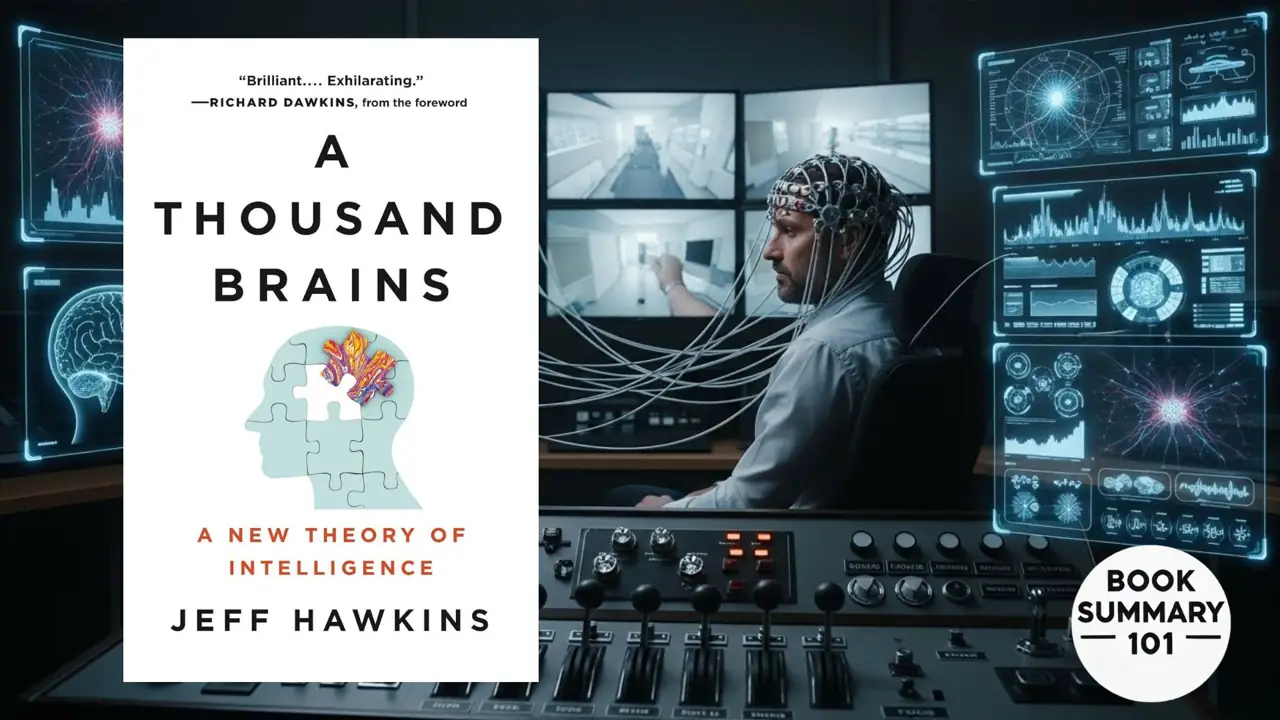
I pictured a CEO sitting in a control room behind my eyes. I thought my eyes were like cameras sending video feeds to the CEO, and my ears were microphones sending audio. The CEO would process this data, make a decision, and then pull levers to make my arms and legs move.
It felt logical. It felt organized.
But after reading “A Thousand Brains: A New Theory of Intelligence“ by Jeff Hawkins, I realized that my mental image wasn’t just slightly off—it was completely wrong.
For years, I’ve struggled to wrap my head around the concept of “intelligence.” Is it just processing power? Is it magic?
Jeff Hawkins, the inventor of the PalmPilot turned neuroscientist, breaks it down in a way that feels less like a textbook and more like a late-night conversation with a genius friend. He argues that our brains don’t have one central processor. Instead, we have thousands of little processors working at the same time.
If you’ve ever felt overwhelmed by the jargon of neuroscience or artificial intelligence, this book is the antidote. It changed the way I look at the world, and honestly, it changed the way I look at myself.
- Why Should You Even Bother Reading It?
- The Blueprint of Thought: How We Map the World
- 1. The Cortical Column (The Uniform Army)
- 2. Reference Frames (The Map in Your Head)
- 3. Sensory-Motor Learning (The Straw View)
- 4. The Voting Mechanism (The Democracy of the Mind)
- 5. The “Old Brain” vs. The “New Brain” (Why AI Won’t Kill Us)
- My Final Thoughts
- Join the Conversation!
- Frequently Asked Questions (The stuff you’re probably wondering)
Why Should You Even Bother Reading It?
You might be thinking, “I’m not a neuroscientist, and I don’t code AI. Why is this for me?”
You should read this because it answers the ultimate human question: What makes us intelligent?
This book is perfect for:
- The Naturally Curious: If you’ve ever wondered how you can instantly recognize your dog from a tail wag, this explains it.
- Tech Enthusiasts: If you want to know why ChatGPT is impressive but (according to Hawkins) not yet “truly intelligent.”
- Skeptics: If you are afraid of the “Terminator” scenario where robots take over the world, this book will help you sleep better at night.
It’s a handbook for understanding the machinery inside your own head.
The Blueprint of Thought: How We Map the World
Hawkins doesn’t just throw random facts at you. He presents a unified theory—the “Thousand Brains Theory of Intelligence.” It sounds intimidating, but the logic is beautifully simple once you see the pieces.
Here are the core principles from the book that completely reshaped my thinking.
1. The Cortical Column (The Uniform Army)
The star of the show is the Neocortex. That’s the wrinkly outer layer of the brain responsible for everything we call “intelligence”—language, math, art, and planning.
Hawkins explains that the neocortex looks remarkably the same everywhere. The part that handles vision looks just like the part that handles touch.
The Analogy:
Imagine a stadium filled with 150,000 people. Every person in that stadium is identical. They are all holding the same notebook and following the same set of instructions.
In your brain, these people are “Cortical Columns.”
For decades, scientists thought the brain had specialized “hardware” for different tasks—like a dedicated video card for sight and a sound card for hearing. Hawkins argues the opposite. The “hardware” is generic. Every column runs the exact same algorithm. The only difference is what data is plugged into it (light from eyes, or pressure from skin).
Real-World Example:
Think of a computer. The same USB port can read a mouse, a keyboard, or a printer. The port doesn’t change; the input does. Your brain is a massive collection of universal USB ports learning whatever you plug into them.
📖 Quote: “The brain is not a computer, but a memory system. It records everything you experience and plays it back to you.”
Simple Terms: Your brain isn’t a collection of specialized tools; it’s a collection of thousands of identical learning machines.
The Takeaway: Intelligence isn’t about complex, custom machinery; it’s about a single, powerful algorithm repeated thousands of times.
2. Reference Frames (The Map in Your Head)
This is arguably the most important concept in the book. Hawkins claims that the brain doesn’t just record inputs; it builds Reference Frames.
The Analogy:
Imagine you are walking through your house in the pitch dark. You reach out and touch a cold, smooth surface.
How do you know if it’s the fridge or the window?
You know because you have a mental map of your kitchen. You know where you are standing relative to the room. You have a “reference frame” for the kitchen.
Hawkins argues that the brain creates these maps for everything, not just locations. You have a “map” for a coffee cup. You know where the handle is located relative to the rim. If you didn’t have this map, the cup would just be a confusing blob of colors.
Real-World Example:
Consider a Zillow 3D Home Tour. It’s not just a pile of photos; the software stitches them together so you understand the spatial relationship between the kitchen and the living room. Your brain does this instantly for every object you see.
Simple Terms: Your brain organizes information by placing it on a mental map, just like dropping a pin on Google Maps.
The Takeaway: We don’t just “see” things; we understand where they are in space and time relative to everything else.
3. Sensory-Motor Learning (The Straw View)
We tend to think that we see a whole picture at once, like a camera snapping a photo. Hawkins says: False.
The Analogy:
Imagine looking at the world through a thin drinking straw. You can only see a tiny circle of reality at a time. To understand what you are looking at, you have to move the straw around.
Your eyes are constantly moving (saccades) about three times a second. Your brain stitches these tiny “straw views” together to create the illusion of a stable image.
You cannot learn the structure of a coffee cup just by staring at it motionless. You have to move your eyes over the edges, or move your fingers over the handle.
Real-World Example:
Think about a Roomba. A Roomba cannot learn the layout of your living room by sitting in the corner. It has to bump into the couch, turn, move, and bump into the table. Movement is essential for learning.
Simple Terms: You cannot be intelligent without moving; you learn by interacting with the world.
The Takeaway: Intelligence is an active process. We learn the model of the world by moving through it.
4. The Voting Mechanism (The Democracy of the Mind)
So, if we have thousands of cortical columns all looking at the world through a straw, how do we agree on what we are seeing?
The Analogy:
Imagine a jury of 1,000 people trying to identify an object inside a black box.
- Juror #1 feels something smooth.
- Juror #2 feels a curved edge.
- Juror #3 sees a flash of white.
Individually, they are confused. Juror #1 thinks “It’s a ball.” Juror #2 thinks “It’s a vase.”
But then they communicate. They “vote.”
Juror #2 says, “I feel a handle.”
Suddenly, all the jurors realize: “A smooth object with a handle and white color? It’s a coffee cup!”
This happens in your brain milliseconds after you look at something. Thousands of columns vote, and once they reach a consensus, pop—you perceive a coffee cup.
Real-World Example:
This is similar to Blockchain consensus. One node might have weird data, but the network validates the truth by checking if the majority agrees.
📖 Quote: “We have a singular perception of the world because the columns vote. The voting mechanism resolves the ambiguity.”
Simple Terms: Your brain cells argue with each other until they agree on what they are looking at.
The Takeaway: Our reality is actually a “consensus vote” taking place across thousands of mini-brains inside our skull.
5. The “Old Brain” vs. The “New Brain” (Why AI Won’t Kill Us)
This section relieved a lot of my anxiety about AI.
The neocortex (New Brain) is the smart part. It learns maps and models.
The limbic system (Old Brain) is the ancient part. It controls emotions, survival instincts, and drives (fear, hunger, desire to reproduce).
Hawkins explains that the Neocortex is just a prediction machine. It has no desires. It doesn’t want to take over the world. It only does what the Old Brain tells it to do.
The Analogy:
Think of the Neocortex as a super-advanced GPS system, and the Old Brain as the Driver.
The GPS is incredibly smart. It knows every road and traffic jam. But if you turn it on and sit there, the GPS will do nothing. It has no desire to go to the beach. The Driver (Old Brain) has to punch in the destination.
Real-World Example:
The “Terminator” scenario assumes that once a computer gets smart (GPS), it will suddenly develop a desire to kill humans (Driver). Hawkins argues this is a biological fallacy. Intelligence and “The Will to Dominate” are two totally different brain functions.
Simple Terms: Intelligence is the ability to accomplish a goal; it does not choose the goal itself.
The Takeaway: Future AI will likely be a tool that does exactly what we ask, without the biological baggage of ego or survival instincts.
My Final Thoughts
Reading A Thousand Brains left me feeling incredibly empowered.
For a long time, we’ve treated the brain like a mystical black box. Hawkins opens the lid and shows us the gears. It turns out, we aren’t running on magic. We are running on a beautiful, scalable algorithm of reference frames and voting.
There is a section at the end of the book where Hawkins talks about “Estate Planning for Humanity.” He suggests that our intelligence—our knowledge—is the most precious thing in the universe. Even if humanity doesn’t last forever, understanding how our brains work allows us to create machines that can preserve our knowledge for the cosmos.
It’s a heavy thought, but a hopeful one. We are the universe’s way of understanding itself.
Join the Conversation!
I’d love to hear your take. Do you agree with Hawkins that AI won’t become dangerous on its own, or do you think “intelligence” naturally leads to a desire for control? Drop a comment below!
Frequently Asked Questions (The stuff you’re probably wondering)
1. Is this book too technical for a non-scientist?
Not at all. Hawkins is a rare breed: a scientist who writes like a human. He avoids dense academic jargon and relies heavily on analogies (like the coffee cup and the map) to make complex ideas stick.
2. Do I need to know how to code to understand the AI sections?
No. He discusses the philosophy and architecture of AI, not the code. If you know what a computer is, you’ll be fine.
3. Does this book explain how to build a brain?
In theory, yes. Hawkins offers a blueprint for “Machine Intelligence.” He argues that current AI (Deep Learning) is hitting a wall and that to get to true AI, we need to mimic the reference frames of the brain.
4. How long is the book?
It’s about 250-300 pages depending on the edition. It’s a brisk read because the chapters are short and focused.
5. What is the single biggest thing I’ll learn?
You will learn that your perception of reality isn’t a passive camera feed—it’s an active construction created by thousands of independent voters inside your head.