Let’s be real for a second.
How many times have you heard the term “AI” in the last month? Probably enough to make your eyes glaze over.
For a long time, I felt the exact same way. Every time I opened LinkedIn or attended a generic L&D conference, someone was shouting about algorithms, neural networks, and the impending technological singularity.
To be honest? It made me want to hide under my desk.
I felt a mix of “imposter syndrome” (because I don’t know how to code) and existential dread (because I worried a piece of software was about to steal my job). I just wanted to help people learn and grow, not become a data scientist.
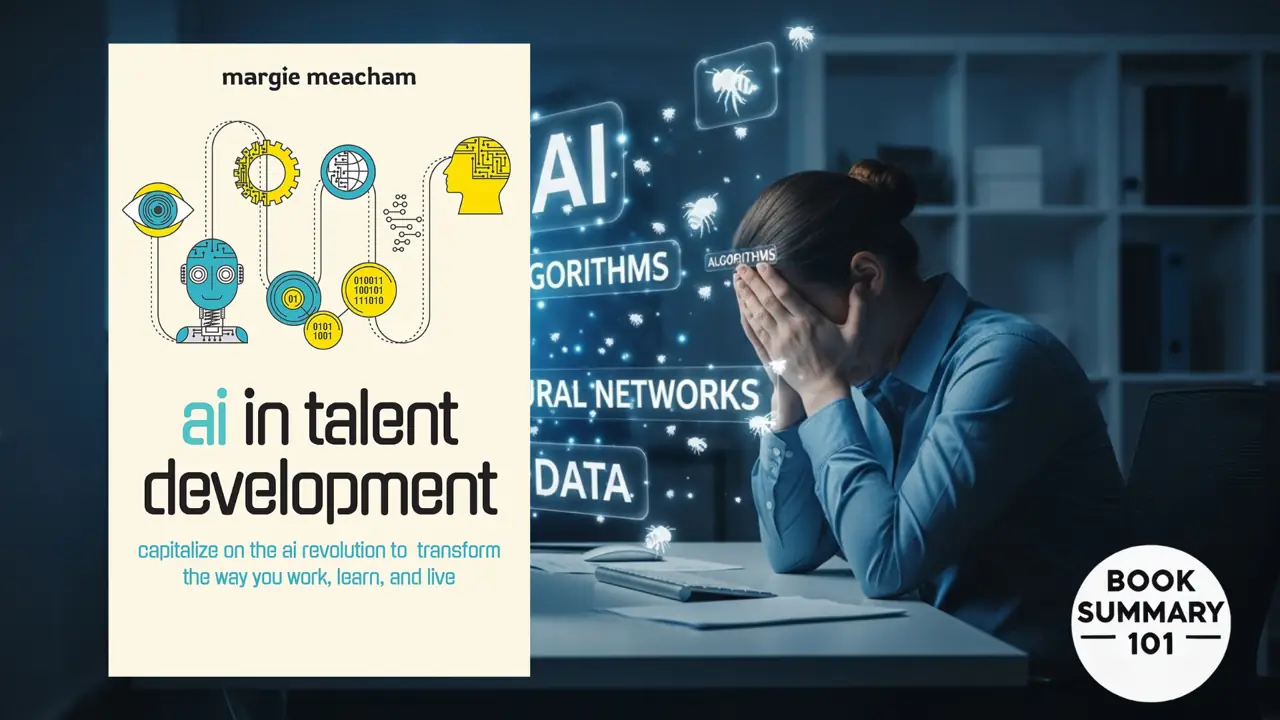
Then I picked up Margie Meacham’s AI in Talent Development.
It wasn’t dense. It wasn’t scary. It felt like sitting down with a really smart, empathetic friend who happens to know everything about neuroscience and technology. She didn’t throw jargon at me; she threw lifelines.
If you’ve been feeling overwhelmed by the AI revolution, this summary is for you.
- Why Should You Even Bother Reading It?
- The Blueprint for the Human-AI Partnership
- 1. The Brain and The Bot: Understanding Neural Networks
- 2. The Move from “Just-in-Case” to “Just-in-Time” with Chatbots
- 3. Hyper-Personalization: The “Netflix” of Learning
- 4. Curation: AI as the Ultimate Librarian
- 5. Ethics and Bias: The “Black Box” Warning
- My Final Thoughts
- Join the Conversation!
- Frequently Asked Questions (The stuff you’re probably wondering)
Why Should You Even Bother Reading It?
This book isn’t for computer engineers. It is specifically written for Talent Development (TD) professionals, HR leaders, instructional designers, and corporate trainers.
If you are in the business of people, you need this book.
Why? Because Margie Meacham—known in the industry as “The Brain Lady”—connects the dots between how the human brain functions and how Artificial Intelligence mimics it. She argues that ignoring AI isn’t an option anymore.
But the good news is: you don’t need to be a tech wizard to use it. You just need to be curious. This book is the bridge between the “human” side of HR and the “technical” side of the future.
The Blueprint for the Human-AI Partnership
Meacham doesn’t present AI as a magic wand that fixes everything, nor as a monster that destroys everything. Instead, she outlines a partnership where AI handles the heavy lifting of data, freeing us up to do the creative, empathetic work humans are best at. Here are the core principles from the book that completely reshaped my thinking.
1. The Brain and The Bot: Understanding Neural Networks
To understand AI, Meacham takes us back to biology class. She explains that “Deep Learning” in computers is actually modeled after the biological neural networks inside your own skull.
The Analogy:
Imagine a toddler trying to learn what a “cat” is.
The first time she sees a cat, you say, “Cat!” The neurons in her brain fire and connect that fuzzy image with the sound of the word.
Later, she sees a dog and says, “Cat!”
You gently correct her: “No, that’s a dog.”
Her brain adjusts the connection. It weakens the link between “dog shape” and the word “cat” and builds a new one.
AI works the exact same way.
An artificial neural network is just layers of digital “neurons.” You feed it data (images, text, numbers), it makes a guess, and you tell it if it was right or wrong. Over millions of repetitions, it “learns” to recognize patterns, just like the toddler.
Real-World Example:
Think about Google Photos. When you search your photo library for “Beach,” it pulls up every vacation photo you’ve ever taken near the ocean.
Nobody at Google sat down and tagged your photos manually. The AI has “seen” millions of beach photos and learned the pattern of sand + water + blue sky.
Simple Terms: AI isn’t magic; it’s just a computer system that learns from mistakes and patterns, exactly like a human brain does.
The Takeaway: Since we are experts in how humans learn, L&D professionals are actually the best suited people to train AI systems.
2. The Move from “Just-in-Case” to “Just-in-Time” with Chatbots
We’ve all been there. You create a massive, 45-minute eLearning course on “Company Travel Policies.”
Everyone clicks through it as fast as possible, passes the quiz, and forgets everything ten minutes later.
That is “Just-in-Case” learning. And Meacham argues it’s dying.
The Analogy:
Imagine you are lost in a foreign city.
“Just-in-Case” learning is like memorizing a map of the entire city three weeks before your trip. You’ll forget it by the time you arrive.
“Just-in-Time” learning is having GPS on your phone. You ask, “Where is the hotel?” and it tells you exactly where to go, right when you need it.
Meacham highlights how AI-driven Chatbots serve as that GPS. They provide performance support at the moment of need.
📖 “The chatbot is the new performance support tool. It is available 24/7, never gets tired or cranky, and can access the entire database of organizational knowledge in a split second.”
Real-World Example:
Consider a sales rep who is about to walk into a client meeting. They don’t have time to take a course on the new product line.
Instead, they text the company’s internal AI bot: “What are the top three specs for the X-200 model?”
The bot pulls the answer instantly. The rep gets the sale. The learning happened exactly when it mattered.
Simple Terms: Stop forcing people to memorize things they don’t need yet; use AI bots to answer their questions the moment they have them.
The Takeaway: AI shifts the focus from “training events” to “performance support,” making learning invisible and seamless.
3. Hyper-Personalization: The “Netflix” of Learning
Meacham hits hard on the fact that the “one-size-fits-all” model of corporate training is obsolete. Assigning the same leadership course to a veteran manager and a brand-new hire is a waste of time for both.
The Analogy:
Imagine walking into a shoe store, and the clerk hands everyone a size 9 shoe.
It doesn’t matter if your foot is a size 6 or a size 12—you get the size 9.
That is traditional corporate training.
Now, imagine walking in, and a 3D scanner measures your foot perfectly and 3D prints a shoe that fits only you.
That is AI-enabled adaptive learning.
AI algorithms track a learner’s behavior, their role, their past performance, and their gaps in knowledge. It then serves up content specifically for them.
Real-World Example:
Spotify’s “Discover Weekly” playlist.
Spotify doesn’t give every user the same playlist. It looks at what you skipped, what you played on repeat, and what genre you listen to in the morning vs. the evening. It creates a custom playlist just for you.
L&D platforms are now doing this—suggesting a short video on “conflict resolution” because the AI noticed you struggled with that module last year.
Simple Terms: AI treats every employee like an individual, customizing their learning path based on what they actually need to know.
The Takeaway: Adaptive learning saves money and time by not forcing employees to learn things they have already mastered.
4. Curation: AI as the Ultimate Librarian
We are living in an age of information overload. Meacham points out that we are drowning in content but starving for wisdom. A big role of AI in Talent Development is “Curation.”
The Analogy:
Imagine you are panning for gold in a muddy river.
There is a lot of mud (bad information, outdated articles, irrelevant data).
You could spend hours sifting through it by hand to find one flake of gold.
AI is like a high-powered, automated sluice box. It washes away the mud instantly and leaves you with a pile of gold nuggets.
Meacham explains that AI tools can scan the internet or your company’s internal servers, analyze millions of articles, and present the best five articles on a specific topic to your learners.
Real-World Example:
Think of Amazon. When you buy a coffee maker, Amazon says, “People who bought this also bought these coffee filters.”
It is curating the vast inventory to show you what is relevant.
In L&D, an AI tool like Anders Pink or EdCast can scour the web for the latest industry news and deliver a daily briefing to your team, saving you hours of Googling.
Simple Terms: Humans can’t read everything; AI can read the entire internet in seconds and find the best stuff for you.
The Takeaway: The role of the L&D professional is shifting from “Creator of Content” to “Curator of Content,” facilitated by AI.
5. Ethics and Bias: The “Black Box” Warning
This is perhaps the most serious section of the book. Meacham warns that AI is not neutral. Because AI learns from human data, it picks up human prejudices.
The Analogy:
Think of AI like a parrot.
If a parrot lives in a house where people use polite language, the parrot will be polite.
If the parrot lives in a house where people shout insults, the parrot will shout insults.
The parrot isn’t “mean”—it’s just repeating what it heard.
If we feed an AI historical hiring data to help us recruit new talent, and our company has historically only hired men for leadership roles, the AI will “learn” that men make better leaders. It will start rejecting female resumes.
📖 “We must be the conscience in the machine. AI will scale our biases just as efficiently as it scales our successes.”
Real-World Example:
Amazon actually had to scrap an AI recruiting tool a few years ago because the system taught itself that the word “women’s” (as in “women’s chess club captain”) was a negative attribute on a resume. The data it trained on was male-dominated, so the AI maximized for that pattern.
Simple Terms: If you put garbage data in, you get garbage results out—and sometimes those results are discriminatory.
The Takeaway: TD professionals must constantly audit AI systems to ensure they are fair, inclusive, and ethical.
My Final Thoughts
Reading AI in Talent Development gave me a profound sense of relief.
Margie Meacham stripped away the sci-fi fear and replaced it with practical excitement. I walked away realizing that AI is not here to replace the trainer; it is here to replace the administrative drudgery.
It can handle the scheduling, the grading, the content tagging, and the basic Q&A. This leaves us with the freedom to do what we do best: mentor, coach, empathize, and build strategy.
This book didn’t just teach me about technology; it empowered me to take my seat at the table and help shape how that technology is used.
Join the Conversation!
I’d love to hear your take on this.
If you could hand off one boring, repetitive part of your job to an AI “assistant” tomorrow, what would it be?
Let me know in the comments below!
Frequently Asked Questions (The stuff you’re probably wondering)
1. Do I need to know how to code to understand this book?
Absolutely not. Margie writes in plain English. If you can use a smartphone, you can understand the concepts in this book.
2. Is this book only for big Fortune 500 companies?
No. While some examples involve big data, the principles of personalization and using chatbots apply to small businesses and even solo consultants.
3. Will AI really replace L&D professionals?
The book argues “No.” It will replace tasks, not jobs. Specifically, it will replace the repetitive, administrative tasks, allowing L&D pros to focus on strategy and human connection.
4. Is the book too technical or dry?
Not at all. The neuroscience angle makes it fascinating because it’s about people, not just machines. It’s very readable.
5. What is the biggest takeaway for a beginner?
Start small. You don’t need to overhaul your entire ecosystem. Start with a simple chatbot or a data analysis tool and grow from there.