I used to have this nagging fear at my old job.
Maybe you know the feeling.
It was the sense that we were moving through molasses. Every new idea required three meetings, a slide deck, and a signature in triplicate. By the time we actually did anything, the market had moved on, or worse, a competitor had already launched a better version.
We were busy, sure. But were we actually innovating? Or were we just… existing?
I felt like I was watching a slow-motion car crash of irrelevance. I knew we needed to change, but I didn’t have the vocabulary to explain why or how.
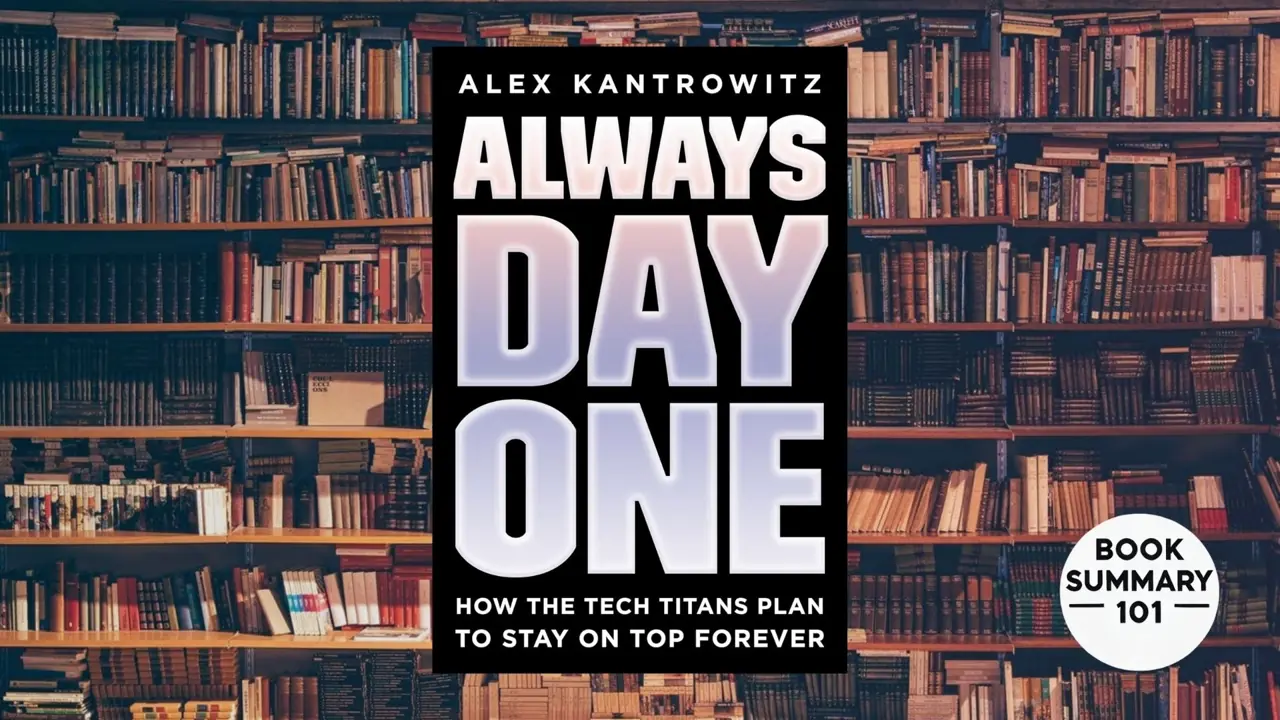
Then I picked up “Always Day One“ by Alex Kantrowitz.
Reading this book felt like someone finally turned on the lights in a dark room. It wasn’t just a book about “tech stuff”; it was a survival guide for the modern era. It explained exactly why some companies (and people) stay young, hungry, and dominant forever, while others get slow, fat, and happy before fading away.
If you’ve ever worried about your skills, your business, or your career becoming obsolete, grab a cup of coffee. We need to talk about this book.
- Why Should You Even Bother Reading It?
- The Blueprint for Eternal Youth in Business
- 1. The Day One vs. Day Two Mental Model
- 2. The Engineer’s Mindset (Demoting the Manager)
- 3. Automating the Hierarchy (Feedback Loops)
- 4. Cannibalize Yourself Before Someone Else Does
- 5. The Culture of Written Communication
- 6. The “Apple” Exception
- My Final Thoughts
- Join the Conversation!
- Frequently Asked Questions (The stuff you’re probably wondering)
Why Should You Even Bother Reading It?
You might think, “I’m not a tech CEO, and I don’t work at Amazon, so why does this matter?”
Here is the truth: The rules of the game have changed for everyone.
This book is essential reading for:
- Entrepreneurs who want to build a culture that doesn’t stagnate.
- Employees who want to understand how to make themselves indispensable in an AI-driven world.
- Creatives looking to understand how to foster constant reinvention.
The core message isn’t about code; it’s about mindset. It explains how the world’s most valuable companies have hacked human nature to stay at the top, and how you can apply those same principles to your own life to stay ahead of the curve.
The Blueprint for Eternal Youth in Business
What is the secret sauce that keeps Amazon, Facebook, Google, and Microsoft growing when most companies their size collapse under their own weight?
It turns out, they all operate under a specific set of psychological and structural laws. They refuse to enter “Day Two”—the phase of stasis and decline. Instead, they have engineered their entire existence to remain in “Day One.”
Here are the core principles from the book that completely reshaped my thinking on innovation.
1. The Day One vs. Day Two Mental Model
The foundational concept of the book comes from Jeff Bezos’s famous shareholder letters. Kantrowitz breaks this down brilliantly.
Imagine a shark. We all know the biological myth (which is actually true for some species) that if a shark stops swimming, it dies. It creates water flow over its gills by moving forward. Movement is life. Stasis is death.
“Day One” is the startup phase. It is full of vitality, speed, risk-taking, and customer obsession. It is the shark swimming.
“Day Two,” according to Bezos, is stasis. Followed by irrelevance. Followed by excruciating, painful decline. Followed by death. Day Two happens when a company focuses more on processes and proxies (like following the rules for the sake of the rules) rather than the actual outcome.
Most companies work hard to become successful so they can relax. They want to reach Day Two because it feels safe. But Kantrowitz argues that in the tech world, safety is an illusion. The Titans (Amazon, Google, Facebook, Microsoft) are terrified of Day Two. They structure their companies to remain in a perpetual state of anxiety and invention, never allowing themselves to feel “finished.”
📖 “Day 2 is stasis. Followed by irrelevance. Followed by excruciating, painful decline. Followed by death. And that is why it is always Day 1.”
Simple Terms: You must treat every day like it’s the first day of your startup, no matter how big or successful you become.
The Takeaway: Never rely on yesterday’s success to guarantee tomorrow’s survival; constant reinvention is the only safety net.
2. The Engineer’s Mindset (Demoting the Manager)
This was a huge “Aha!” moment for me. In traditional companies, ideas flow from the top down. The CEO has a vision, the managers break it into tasks, and the workers execute.
Kantrowitz explains that this model is too slow for the modern world.
Think of a traditional company like a classical orchestra. The conductor (CEO) waves the baton, and everyone plays the notes exactly as written on the sheet music. It’s beautiful, but it can’t react to a fire in the building or a change in the audience’s mood.
The Tech Titans operate more like a jazz improv group, or better yet, a biological ecosystem.
In these companies, the “Engineer’s Mindset” reigns supreme. Decision-making power is pushed down to the people actually building the product. Engineers aren’t just bricklayers; they are architects.
At Facebook and Google, managers often don’t tell engineers what to build. Instead, engineers identify problems, build prototypes, and then show them to leadership. The hierarchy is flipped. The manager’s job isn’t to command; it’s to remove obstacles so the engineer can build.
Real-World Example:
Look at Gmail. It wasn’t ordered by a CEO. It was created by a Google developer, Paul Buchheit, as a side project. In a traditional “Day Two” company, a middle manager would have killed it immediately because it wasn’t part of the “strategic plan.” At Google, the culture allowed the engineer to lead the innovation.
Simple Terms: Stop telling smart people what to do; give them the tools and data, and let them tell you what needs to be done.
The Takeaway: Innovation dies in hierarchies; it thrives when the people closest to the work have the power to make decisions.
3. Automating the Hierarchy (Feedback Loops)
If you get rid of managers telling people what to do, how do you keep chaos from taking over?
The answer is feedback loops.
Imagine trying to learn to shoot a basketball, but you’re blindfolded. You throw the ball, but you never see if it goes in. You’d never improve, right?
Now, imagine you take the blindfold off. You throw, you see you missed left, you adjust right. You improve instantly.
Kantrowitz explains that Tech Titans use technology to remove the blindfold. They don’t rely on a manager’s opinion (“I think this design looks good”). They rely on immediate data.
They build internal tools that allow employees to launch ideas, test them on a small percentage of users, and get immediate feedback on whether it works.
At Amazon, this is extreme. They use software to manage the mundane parts of the hierarchy—assigning resources, tracking inventory, and even predicting what to buy. This frees up the humans to do the creative thinking. They call this “Hands off the Wheel.” By automating the boring management stuff, the humans are free to invent.
Simple Terms: Use data and software to manage the routine work so humans can focus on creative problem-solving.
The Takeaway: Don’t use technology just to make products; use technology to manage your company so you can move faster than humanly possible.
4. Cannibalize Yourself Before Someone Else Does
This is the most painful lesson in the book, and the one most companies fail at.
To stay “Day One,” you must be willing to kill your own golden goose.
Think of a gardener. To get the most beautiful roses, they have to aggressively prune the bush. sometimes cutting off healthy branches that are crowding out new growth. It feels counterintuitive to cut something that is alive, but it’s necessary for the plant’s long-term health.
“Day Two” companies protect their cash cows at all costs. “Day One” companies attack them.
Kantrowitz highlights how Facebook (now Meta) is the master of this. When Snapchat Stories started blowing up, Mark Zuckerberg didn’t just ignore it. He realized the “News Feed” (his golden goose) might be dying. He aggressively pivoted the entire company to “Stories,” effectively cloning Snapchat and risking the stability of his main product.
He was willing to make his current product worse or less relevant in the short term to ensure the company survived in the long term.
📖 “If you don’t cannibalize yourself, someone else will.”
Real-World Example:
Netflix is another classic example (though not the main focus of this book, the principle fits). They killed their DVD business to build streaming. If they had protected the DVD business, they would be Blockbuster today.
Simple Terms: If you have a successful product, you should be the one to build the thing that replaces it.
The Takeaway: Loyalty to your past success is the quickest way to destroy your future success.
5. The Culture of Written Communication
This might sound boring compared to AI and algorithms, but Kantrowitz argues it’s a secret weapon.
Amazon bans PowerPoint.
Why? Because PowerPoint is a sales pitch. It’s easy to hide weak ideas behind flashy graphics and charisma. It’s like a magician using smoke and mirrors.
Instead, Amazon requires “Six-Page Memos.” Before a meeting, everyone sits in silence for 30 minutes and reads a dense, narratively written document detailing the idea.
Writing requires logic. You can’t hide a logical gap in a sentence the way you can on a bullet point. This forces deep thinking. It levels the playing field. It doesn’t matter if you are a nervous speaker or a charismatic extrovert; if your writing is good and your logic is sound, your idea wins.
This creates an “Idea Meritocracy.” The best idea wins, not the loudest voice.
Simple Terms: Stop doing presentations; start writing detailed narratives to force clear thinking and remove bias.
The Takeaway: Clear writing leads to clear thinking, and clear thinking leads to better decisions.
6. The “Apple” Exception
I found this section fascinating because it challenges the whole premise of the book.
Kantrowitz points out that while Amazon, Google, Facebook, and Microsoft are all open, data-driven, and engineer-led… Apple is different.
Apple is secretive. Apple is hierarchical. Apple is design-led, not data-led.
Apple is the Master Watchmaker. They work in secret for years, perfecting every gear and spring, and then unveil the masterpiece to the world. They don’t A/B test the iPhone button color on 1% of users. They decide what is cool, and they tell us.
However, Kantrowitz argues that Apple is the exception that proves the rule. Apple succeeds because of a unique brand cachet and hardware dominance that is almost impossible to replicate. Trying to copy Apple’s “Day Two-ish” secretive culture is suicide for almost any other company. Unless you are Apple, you need to act like Amazon.
Simple Terms: Apple breaks all the rules because they are a luxury brand disguised as a tech company; don’t try to be them.
The Takeaway: Unless you have a monopoly on “cool,” you can’t afford to be secretive and slow; you must be open and fast.
My Final Thoughts
Honestly, reading Always Day One was a bit of a kick in the pants.
It made me realize that “comfort” is a dangerous place to be. Whether you are running a giant corporation or just managing your own career, the moment you stop learning, stop testing new ideas, and stop trying to disrupt yourself, you have entered “Day Two.”
The book doesn’t leave you feeling hopeless, though. It feels empowering. It democratizes the secrets of the billionaires. You don’t need a billion dollars to write a six-page memo. You don’t need a massive server farm to adopt an “engineer’s mindset” of solving problems rather than following orders.
It convinced me that in the 21st century, agility isn’t just a nice-to-have skill. It’s the only skill that matters.
Join the Conversation!
I’d love to hear from you. Does your current workplace feel like it’s in “Day One” (innovative, fast, risky) or “Day Two” (bureaucratic, slow, safe)? Drop a comment below and let’s vent (or celebrate)!
Frequently Asked Questions (The stuff you’re probably wondering)
1. Is this book only for tech people?
Not at all. While the examples are about tech giants, the lessons on leadership, management, and adaptability apply to anyone. Whether you run a bakery or a marketing agency, the “Day One” mindset is relevant.
2. Do I need to understand coding to read it?
No. Kantrowitz writes like a journalist (which he is). The book is focused on culture, psychology, and management strategy, not technical code. It’s very accessible.
3. Is the book just praising these companies?
It gives them credit for their success, but it’s not a love letter. It acknowledges the controversies and the ruthlessness required to maintain this culture. It’s an analysis of effectiveness, not necessarily morality.
4. How long does it take to read?
It’s a breezy read. It comes in at around 250-300 pages. Because it’s full of stories and interviews, you can easily finish it in a weekend.
5. What is the single biggest lesson I can apply immediately?
The “Six-Page Memo” or the general shift to written culture. Try replacing your next slide deck presentation with a well-written 2-page document and see how much more productive the meeting becomes.