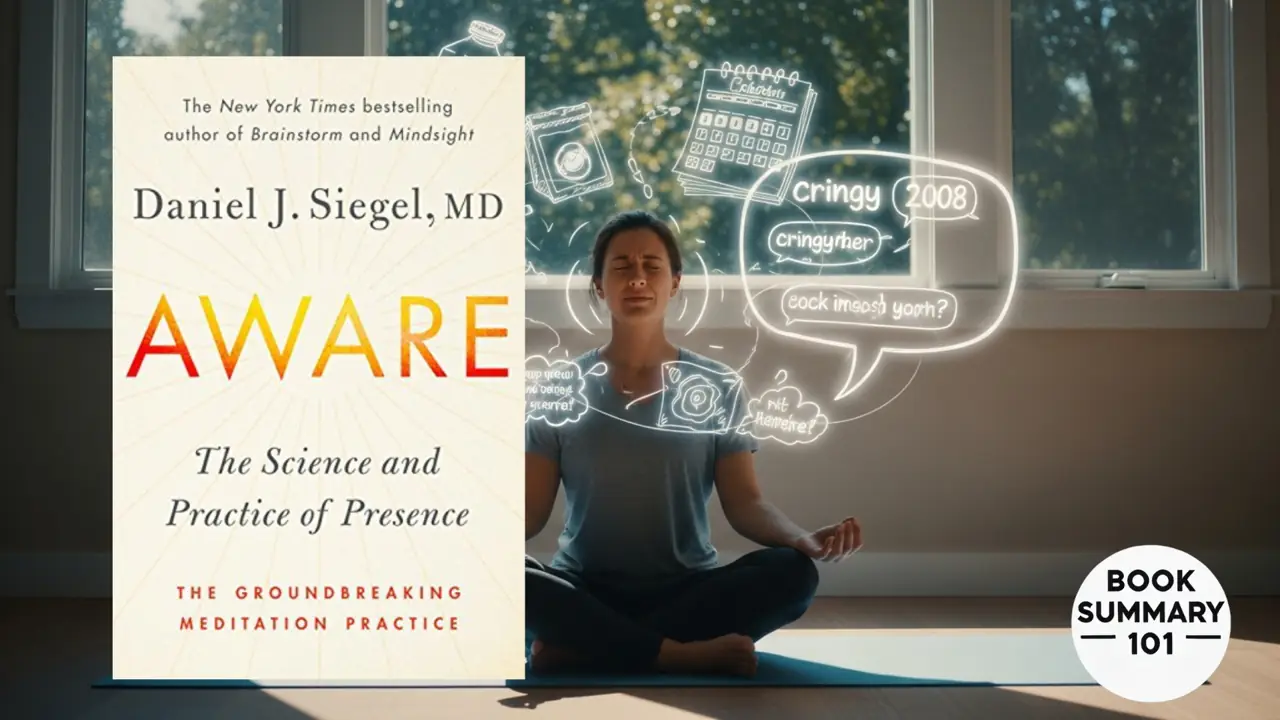
Let’s be honest for a second. How many times have you tried to meditate, only to spend twenty minutes making a mental grocery list or replaying an embarrassing conversation from 2008?
I’ve been there. For years, I thought “presence” meant I had to stop thinking. I treated my brain like a wild dog I was trying to muzzle. It was exhausting, frustrating, and frankly, it didn’t work. I felt like a failure every time I opened my eyes.
Then I picked up Aware by Dr. Daniel Siegel.
I expected another dry, scientific textbook or a vague book of aphorisms. What I got instead felt like a friendly conversation with a brilliant neuroscientist who finally handed me the user manual for my own mind.
Siegel doesn’t ask you to stop thinking. He teaches you how to change where you’re standing when you think.
If you’ve ever felt overwhelmed by the chaos in your head, grab a cup of coffee. We need to talk about the “Wheel of Awareness.”
- Why Should You Even Bother Reading It?
- The Blueprint of a Resilient Mind
- 1. The Hub vs. The Rim (The Core Mechanism)
- 2. The First Quadrant: Grounding in the Five Senses
- 3. The Sixth Sense: Interoception (The Body’s Dashboard)
- 4. Mental Activities: Watching the Trains Go By
- 5. Bending the Spoke: Awareness of Awareness
- 6. Integration: The River of Health
- My Final Thoughts
- Join the Conversation!
- I’d love to hear from you.
- Frequently Asked Questions (The stuff you’re probably wondering)
Why Should You Even Bother Reading It?
This book isn’t just for yogis or people who have hours to spare sitting on a cushion. It is specifically designed for the skeptics, the busy professionals, and the “over-thinkers.”
If you rely on your brain for your job—whether you’re a coder, a writer, a parent, or a manager—this book explains the neuroscience of why you feel scattered.
Siegel uses hard science to prove that training your attention isn’t just “relaxing”; it actually changes the physical structure of your brain, making you more resilient, focused, and healthy. It’s not magic; it’s biology.
The Blueprint of a Resilient Mind
Before we dive into the specific steps, we need to look at the big picture. Siegel introduces a visual metaphor that anchors the entire book: The Wheel of Awareness.
Imagine your mind isn’t a nebulous cloud, but a physical wheel—like a bicycle wheel. This simple image is the key to unlocking everything else.
1. The Hub vs. The Rim (The Core Mechanism)
This is the most critical concept in the book. Siegel asks us to visualize a wheel with a central Hub, an outer Rim, and a Spoke connecting the two.
Here is the breakdown:
- The Hub: This represents the experience of being aware. It is the “knower.” It is that quiet, open space of pure consciousness.
- The Rim: This is where we place the “knowns.” This includes your thoughts, feelings, physical sensations, and memories.
- The Spoke: This is your attention. It’s the mechanism you use to connect the Hub to the Rim.
Most of us live our entire lives stuck on the Rim. We are strapped to the tire, spinning around in the mud of our anxieties and to-do lists. When you are on the Rim, you don’t just feel sad; you are sadness. You don’t just have a worry; you become the worry.
The practice of Aware is about learning to retract that spoke and hang out in the Hub.
Think of it like Zillow. When you’re inside a house (The Rim), looking at the clutter and the leaky faucet, you’re stressed. But when you zoom out to the map view (The Hub), you see the house as just one data point in a whole neighborhood. You haven’t left the world, but you have a completely different perspective on it.
Simple Terms: The Hub is the “you” that watches; the Rim is the stuff you are watching.
The Takeaway: You are not your thoughts; you are the space in which your thoughts happen.
2. The First Quadrant: Grounding in the Five Senses
Siegel breaks the Rim into four distinct “quadrants.” The first step of the meditation travels through the first quadrant: our five physical senses.
This sounds basic, but it’s actually a neurological reset button. By sending your “spoke” of attention out to hear sounds, see light behind your eyelids, or feel the texture of the chair, you are physically shifting your brain state.
Think of this like an anchor on a boat. When the storm of anxiety hits, your thoughts (the wind) try to blow you out to sea. Your five senses are the heavy iron anchor that keeps you tethered to the present moment.
Siegel explains that we often ignore raw data in favor of our “constructs” (what we think we see). Doing this practice forces you to interact with reality as it is, not as you fear it might be.
📖 “Where attention goes, neural firing flows, and neural connection grows.”
Simple Terms: Getting out of your head and coming to your senses—literally.
The Takeaway: Focusing on physical sensation is the fastest way to stop a mental spiral.
3. The Sixth Sense: Interoception (The Body’s Dashboard)
After the five senses, Siegel guides the spoke of attention to the second quadrant: the interior of the body. This is the realm of muscles, bones, and organs.
Scientists call this “interoception.” I like to call it checking the dashboard.
We often treat our bodies like nothing more than a vehicle to carry our heads to meetings. But the body is constantly sending signals—a tight stomach, a heavy chest, a relaxed jaw. These are data points.
If you’ve ever had a “gut feeling” that something was wrong, that was interoception. The problem is, most of us ignore the check engine light until the car breaks down (i.e., we have a panic attack or get sick).
By running your attention through your body—scanning from your toes to your head—you aren’t just relaxing. You are integrating the body’s wisdom with the brain’s logic. You’re making sure the driver (your brain) is actually listening to the engine (your body).
Simple Terms: Listening to what your guts, lungs, and muscles are trying to tell you.
The Takeaway: Your body usually knows how you feel before your brain does; you just have to learn to listen.
4. Mental Activities: Watching the Trains Go By
Now we get to the tricky part: The third quadrant. This is where your thoughts, emotions, and memories live.
Usually, when we try to meditate, this is where we fight. We try to shove thoughts away. Siegel suggests a different approach. He invites us to send the spoke of attention to this quadrant and just… watch.
Imagine you are standing on a platform at a busy train station.
- A thought (“I forgot to email my boss”) pulls into the station.
- You see it. You acknowledge it.
- Then, you let it leave the station.
Most of us don’t do this. When the “I forgot to email” train arrives, we jump on board. Suddenly, we’re five stops away at “I’m going to get fired” and “I’m a terrible person.”
Siegel teaches us to observe mental activities as events rather than facts. You look at the thought, determine if it’s useful, and if it’s not, you watch it chug away down the track.
Simple Terms: Treating your thoughts like passing traffic rather than jumping into the cars.
The Takeaway: You can invite a thought in for tea without asking it to move in permanently.
5. Bending the Spoke: Awareness of Awareness
This is the “Inception” moment of the book. It’s the part that feels the most trippy but offers the most relief.
After exploring the Rim (senses, body, thoughts), Siegel asks you to do something strange: Bend the spoke of attention back toward the Hub itself.
Instead of being aware of a sound or a thought, you simply rest in the feeling of being aware.
It’s like the difference between looking at the furniture in a room (the Rim) and suddenly noticing the space and light that holds the furniture (the Hub).
Siegel describes this Hub state as “open, peaceful, and receptive.” It is a sanctuary. When you access this state, even for a few seconds, you realize that the chaos of your life is just surface noise. Deep down, the ocean is calm.
📖 “Awareness itself is the container of all experience, and that container is not the content it holds.”
Simple Terms: Resting in the quiet “I am” feeling, rather than the “I am busy” feeling.
The Takeaway: You have a portable sanctuary inside you that is always calm, no matter how crazy your external life gets.
6. Integration: The River of Health
Why do we do all this? Why spin the wheel?
Siegel argues that mental health is defined by Integration. He uses the analogy of a river.
- One bank of the river is Chaos (feeling out of control, anxious, overwhelmed).
- The other bank is Rigidity (feeling stuck, stubborn, depressed, shut down).
Health is floating down the middle of the river, flexible and flowing.
When we are stuck on the Rim, we bounce between chaos and rigidity. We scream at our kids (chaos) or we stone-wall our partner (rigidity).
By practicing the Wheel of Awareness, we integrate the differentiate parts of our brain. We link the Hub to the Rim. This allows us to experience strong emotions without drowning in them. We become the conductor of the orchestra, ensuring the drums (anger) and the violins (sadness) play a harmony rather than a cacophony.
Simple Terms: Finding the balance between being totally out of control and completely shut down.
The Takeaway: A healthy mind isn’t empty; it’s a mind where all the parts are talking to each other.
My Final Thoughts
Aware changed my relationship with my own head.
It stopped the war. I stopped trying to “kill” my ego or “delete” my anxiety. Instead, I learned to just retract the spoke. I learned that I can feel anxious in my stomach (Rim) while simultaneously feeling completely safe and expansive in my awareness (Hub).
It’s empowering because it gives you a tool you can use anywhere. You can do a mini-version of this while waiting in line at the DMV or right before a massive presentation. It turns “mindfulness” from a buzzword into a practical, mechanical skill.
Join the Conversation!
I’d love to hear from you.
When you try to meditate or just sit quietly, what is the biggest obstacle that usually stops you? Is it physical restlessness, or does your brain instantly start planning your tomorrow? Let me know in the comments!
Frequently Asked Questions (The stuff you’re probably wondering)
1. Do I need to be a pro at meditation to read this?
Absolutely not. Siegel writes for beginners and skeptics. He explains the science first, which actually makes the practice easier because you understand why you’re doing it.
2. Is this book religious?
No. While Siegel respects wisdom traditions, Aware is rooted in interpersonal neurobiology. It’s about brain structure, neural integration, and mental health, not dogma.
3. Do I have to do the full practice every day?
The full Wheel of Awareness practice can take about 20-30 minutes, but Siegel encourages “spot checks.” Once you learn the geography of the Wheel, you can tap into the “Hub” in 30 seconds.
4. Is it too technical?
Siegel is a scientist, so there are terms like “integration” and “connectome,” but he always uses clear analogies (like the Wheel!). If you like learning how things work under the hood, you’ll love it.
5. How is this different from apps like Headspace or Calm?
Apps are great tools, but Aware provides the architectural blueprint behind the practice. It teaches you the structure of consciousness so you aren’t just following a voice—you’re learning to navigate your own mind independently.