I used to have a serious problem with the “blank page.”
You know the feeling. You’re sitting in a meeting, or staring at a blinking cursor, trying to solve a stubborn problem. Your boss says, “We need fresh ideas!” and suddenly, your brain turns into a dial-up modem. Just static.
I always assumed creativity was a gene I didn’t inherit. I thought you were either born an “idea person” or you were born to organize spreadsheets. I was firmly in the spreadsheet camp.
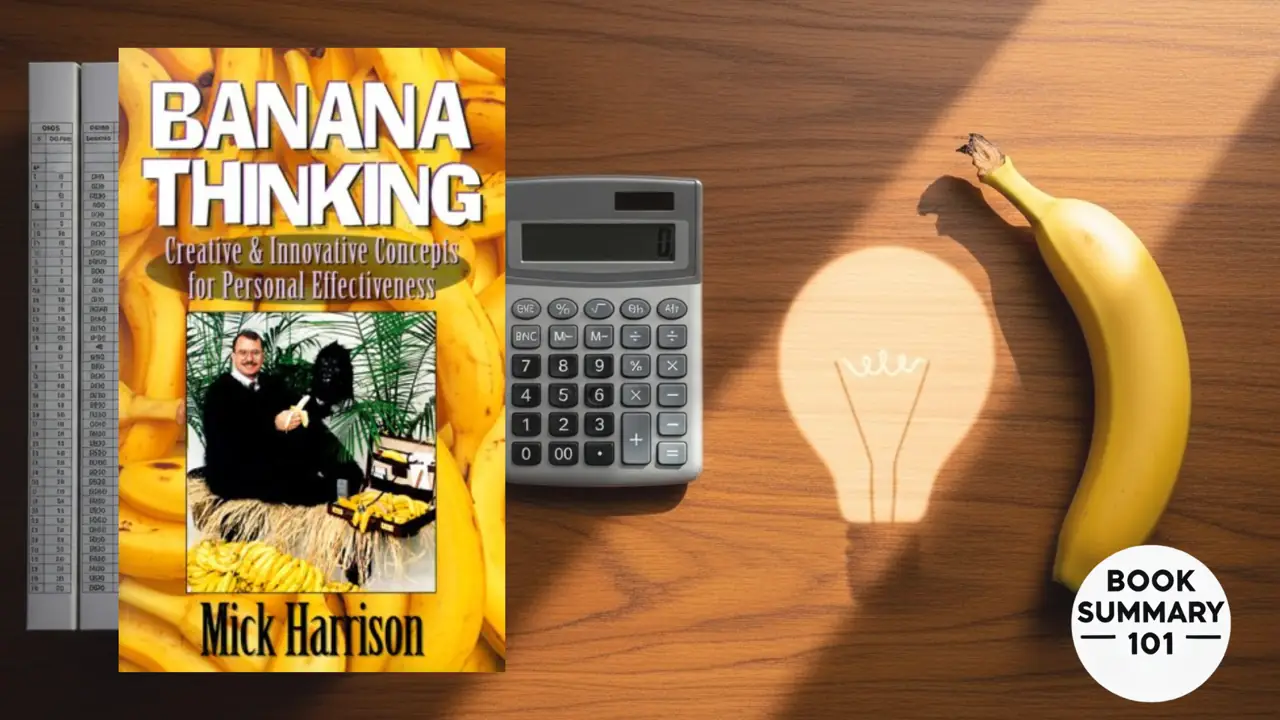
Then I stumbled upon a book with a title so weird I had to pick it up: “Banana Thinking: Creative and Innovation Concepts for Personal Effectiveness” by Mick Harrison.
I expected a dry business manual masquerading as something fun. What I found instead was a conversation that changed how my brain works. It wasn’t about learning to paint or write poetry; it was about the mechanics of how we process information.
It turns out, I wasn’t uncreative. I was just thinking too “straight.”
Why Should You Even Bother Reading It?
If you are a professional who feels stuck in a rut, a manager trying to wake up a tired team, or just someone who feels like they’re on autopilot, this book is for you.
You don’t need to be an artist or a designer to get value here. In fact, this book is arguably more important for accountants, engineers, and administrators.
Why? Because in a world where AI and algorithms can handle the logical, linear tasks, the ability to think differently—to think in curves rather than straight lines—is the only competitive advantage we have left. Banana Thinking is the manual for reclaiming that human edge.
- Why Should You Even Bother Reading It?
- The Curveball Concepts That Reshaped My Brain
- 1. Vertical vs. Lateral Thinking (The Hole in the Ground)
- 2. Suspending Judgment (The Greenhouse Effect)
- 3. The Power of Random Association (The Kaleidoscope)
- 4. Challenging Assumptions (The Elephant and the Rope)
- 5. From Idea to Innovation (The 1% Inspiration)
- My Final Thoughts
- Join the Conversation!
- What is the biggest “imaginary rule” holding you back at work right now?
- Frequently Asked Questions (The stuff you’re probably wondering)
The Curveball Concepts That Reshaped My Brain
Here is the core philosophy: Most of us are trained in logic. A leads to B, which leads to C. This is “straight-line” thinking. It’s efficient, but it rarely leads to breakthroughs.
To innovate, you need to bend your thought process. You need to take the curved path—the banana shape—to get around the wall of logic and find the solution hiding behind it.
Here are the five most transformative concepts from the book that helped me unpeel my potential.
1. Vertical vs. Lateral Thinking (The Hole in the Ground)
Harrison kicks things off by distinguishing between two modes of thought: Vertical Thinking (Logic) and Lateral Thinking (Creativity).
The Analogy:
Imagine you are digging for oil. Vertical thinking is digging the same hole deeper and deeper. You are refining, improving, and optimizing that one specific spot. Lateral thinking, however, is stopping the digging, moving 100 yards to the left, and digging a brand new hole.
We often try to solve problems by digging the same hole deeper. If a product isn’t selling, we try to sell it harder (vertical). Banana Thinking suggests we look at why we are selling it at all, or if we should be selling something else entirely (lateral).
Real-World Example:
Think about Netflix. When DVD rentals started slowing down, “Vertical Thinking” would have been to make cheaper DVDs or faster shipping. Instead, they dug a new hole entirely: Streaming. They abandoned the old logic to embrace a completely new delivery method.
Simple Terms: Vertical thinking improves the old; Lateral thinking creates the new.
The Takeaway: You cannot dig a hole in a different place by digging the same hole deeper. Sometimes you have to move your shovel.
2. Suspending Judgment (The Greenhouse Effect)
One of the biggest killers of innovation is the phrase, “That won’t work,” spoken too early.
The Analogy:
Harrison treats ideas like delicate seedlings in a greenhouse. If you stomp on a seedling the moment it breaks the soil because it doesn’t look like a mighty oak tree yet, you will never have a forest. Logic is the frost that kills the seedling. You need to keep the greenhouse warm (suspend judgment) long enough for the idea to grow roots.
We have a tendency to edit and create at the same time. We brainstorm and critique simultaneously. This is like trying to drive with one foot on the gas and one on the brake. You don’t move forward; you just burn out your engine.
📖 “Creativity is about movement, not judgment. We need to move from one idea to another without the fear of being wrong stopping us in our tracks.”
Real-World Example:
At Amazon, they use the “Yes, and…” technique during initial brainstorming. If someone suggests a crazy idea, like “delivery by drones,” the immediate reaction isn’t “That’s illegal and impossible.” It is “Yes, and how would we charge the drones?” They let the idea live long enough to see if it has merit before applying logical constraints.
Simple Terms: Stop saying “No” or “But” during brainstorming; only say “Yes” until the idea is fully formed.
The Takeaway: You can always critique an idea later, but you can never revive an idea you killed before it took a breath.
3. The Power of Random Association (The Kaleidoscope)
How do you force your brain to get out of a rut? You have to introduce a glitch in the matrix. You have to introduce randomness.
The Analogy:
Think of your brain like a kaleidoscope. If you hold it still, the pattern never changes. The pieces are locked in place. To get a beautiful new pattern, you have to shake the tube. Random Association is the act of shaking the tube.
Harrison suggests picking a random word—something completely unrelated to your problem, like “Soap” or “Frog”—and forcing your brain to connect it to your current challenge. This forces new neural pathways to open up because logic cannot bridge the gap.
Real-World Example:
The invention of Roll-on Deodorant. The challenge was how to apply liquid without a mess. The creators looked for a random association and found the ballpoint pen. They forced a connection between a pen and armpits (which sounds crazy) and created a revolutionary product mechanism.
Simple Terms: Smash two unrelated things together to spark a third, original idea.
The Takeaway: Your brain is lazy and loves patterns; use randomness to shock it into seeing something new.
4. Challenging Assumptions (The Elephant and the Rope)
We all carry invisible rules in our heads about how things “must” be done. Harrison argues that innovation happens when you identify and break these rules.
The Analogy:
There is a famous story of a massive elephant tied to a small plastic chair with a flimsy rope. The elephant could easily snap the rope, but it doesn’t try. Why? Because when it was a baby, the rope was strong enough to hold it. It learned the limitation and stopped testing it.
We are the elephants. We assume “customers won’t pay for that” or “we have to work 9-to-5” because that’s how it was in the past. Banana Thinking demands we tug on the rope to see if it’s still strong.
📖 “The most dangerous phrase in the language is, ‘We’ve always done it this way.’ It is the anchor that keeps the ship from sailing.”
Real-World Example:
Uber challenged the assumption that to be a taxi company, you needed to own cars. Airbnb challenged the assumption that to be a hotelier, you needed to own real estate. They tugged on the rope and realized the old rules didn’t apply anymore.
Simple Terms: List everything you think is “true” about your problem, and then ask “What if the opposite was true?”
The Takeaway: Innovation lies in proving that the “impossible” rules are actually just habits.
5. From Idea to Innovation (The 1% Inspiration)
The final key concept is that having a “Banana Thought” isn’t enough. You have to execute. Creativity is thinking up new things; Innovation is doing new things.
The Analogy:
Think of ideas like raw ingredients in a kitchen. You can have the best truffle oil and the freshest pasta (great ideas), but if you don’t actually turn on the stove and cook them (execution), you starve. Harrison emphasizes that many people love the fun part of brainstorming but hate the messy part of implementation.
He suggests using “Prototypes”—rough, ugly versions of the idea—to bridge the gap between the dream and reality.
Real-World Example:
James Dyson went through 5,127 prototypes for his vacuum cleaner. 5,126 times, he failed. But he didn’t just sit around “thinking” about vacuums; he built them, tested them, and improved them. The innovation wasn’t the idea; it was the persistence of the build.
Simple Terms: An idea without action is just a daydream.
The Takeaway: Don’t wait for the idea to be perfect; build it rough, break it, and fix it.
My Final Thoughts
Banana Thinking was a relief to read. It stripped away the mysticism of creativity and replaced it with a toolkit.
I realized that I don’t need to wait for a muse to whisper in my ear. I just need to pick up my mental shovel and dig a new hole, or shake the kaleidoscope. It empowers you to realize that “being creative” is actually just a behavior, not a personality type.
If you feel like your work or life has become a straight line—predictable, logical, and a little boring—this book is the permission slip you need to go a little bananas.
Join the Conversation!
What is the biggest “imaginary rule” holding you back at work right now?
I’d love to hear from you in the comments. Is there a process or habit in your life that you do just because “that’s how it’s always been done”? Let’s discuss how to break it!
Frequently Asked Questions (The stuff you’re probably wondering)
1. Is this book only for “creative” types like designers?
Not at all. Mick Harrison wrote this specifically for people in personal effectiveness and business roles. It’s actually more useful for managers, admins, and problem-solvers than for artists.
2. Is it a long, heavy read?
No. It is concise, punchy, and very easy to digest. You can get through the core concepts in a weekend.
3. Do I need to be a manager to use these tools?
Nope. These concepts apply to personal organization, planning a family vacation, or just managing your own daily workflow. It’s about personal effectiveness.
4. Why is it called “Banana Thinking”?
It’s a metaphor for lateral thinking. Logic is a straight line; creativity is a curve (like a banana) that helps you get around obstacles that logic can’t penetrate.
5. Does it give practical exercises?
Yes. The book isn’t just theory; it provides specific techniques (like Random Word Association or Reversal) that you can use immediately in your next meeting.