Have you ever stood in front of a mirror, tears streaming down your face, trying to force a smile because some Instagram guru told you that “low vibes” would ruin your life?
I have.
A few years ago, I hit a massive slump. My career felt stagnant, my relationships were rocky, and I felt this immense pressure to be “positive” all the time. I thought that if I admitted I was sad, angry, or scared, I was somehow failing at this whole “manifestation” thing. I was treating my emotions like unwanted houseguests—locking the door and pretending they weren’t knocking.
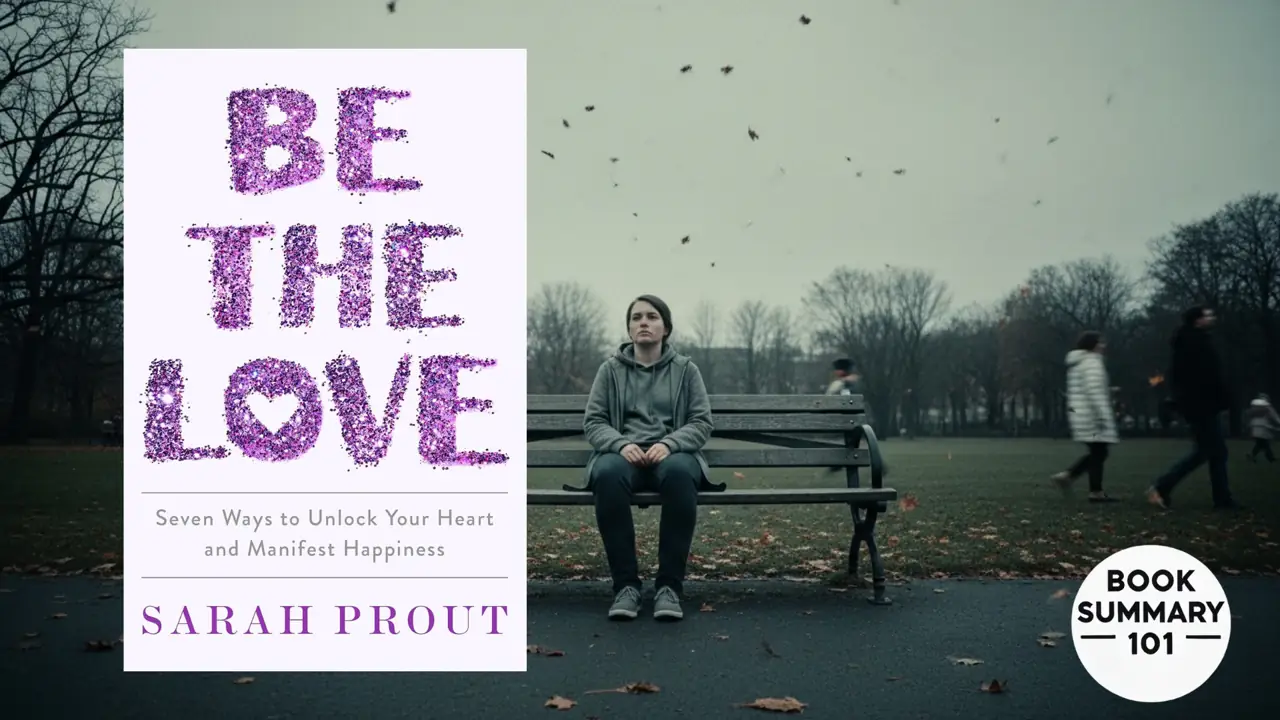
Then I picked up Be the Love by Sarah Prout.
It didn’t feel like reading a textbook or a lecture. It felt like sitting down with a compassionate friend who put a hand on my shoulder and said, “Hey, it’s okay to be a mess. Actually, the mess is where the magic starts.”
If you are tired of toxic positivity and want a roadmap that honors your pain while guiding you toward your dreams, this post is for you.
Let’s dive into the book that taught me that my heart doesn’t need to be perfect to be powerful.
Why Should You Even Bother Reading It?
You might be thinking, “Great, another self-help book about love and happiness. Haven’t we seen them all?”
Here is why Be the Love is different.
This book is for the weary. It’s for the skeptics who want to believe in the Law of Attraction but can’t reconcile it with real-world trauma, grief, or anxiety. It’s for the person who feels like they are doing everything “right” but still feels empty.
Sarah Prout doesn’t speak from an ivory tower; she speaks as a survivor of domestic abuse who once lived on welfare before building a multi-million dollar business. She bridges the gap between the spiritual and the brutally practical.
If you want to understand how to manifest a better life without bypassing your actual feelings, this is the manual you’ve been waiting for.
The Seven Invitations to Transform Your Energy
Sarah Prout structures the book not as a rigid set of rules, but as seven distinct “Ways” or invitations to shift your emotional frequency. These aren’t steps you check off a list; they are states of being that you can step into at any moment to reclaim your power.
1. Be the Mess
The Analogy: The Overstuffed Closet
Imagine your emotional life is a closet in a spare bedroom. For years, every time you felt something inconvenient—shame, jealousy, anger—you shoved it into that closet and leaned your full body weight against the door to keep it shut.
On the outside, the house looks tidy. But you are exhausted because you have to spend all your energy keeping that door closed.
Be the Mess is the invitation to finally open the door.
When you organize a real closet, it always gets worse before it gets better. You have to pull everything out onto the floor. You have to look at that ugly sweater from 1999 and the broken umbrella. It looks chaotic. It looks like a disaster zone.
But this is the only way to actually clean it.
Sarah argues that we cannot manifest our desires if we are terrified of our own darkness. We spend so much energy hiding our “mess” that we have no energy left to create the life we want.
Real-World Example:
Think about a time you tried to suppress a panic attack or a bout of deep sadness. You probably told yourself, “Stop it, get over it, you have to be productive.” The more you fought it, the bigger it got.
Be the Mess suggests a different approach. It’s the difference between fighting a riptide and floating with it.
If you are going through a breakup, be the person eating ice cream in sweatpants. If you are grieving, let the tears flow until you are dehydrated.
By acknowledging the mess, you take away its power to control you from the shadows. You validate your own humanity. And surprisingly, once the mess is acknowledged, it clears up much faster than when you ignore it.
Simple Terms: Stop pretending you are perfect and give yourself permission to feel your “negative” emotions fully.
The Takeaway: You cannot heal what you refuse to feel; accepting your chaos is the first step to finding your peace.
2. Be the Awareness
The Analogy: The Nightclub Bouncer
Your mind is the hottest, most exclusive nightclub in town. But right now, without training, you might have no security at the door.
This means anyone walks in. Anxiety walks in and starts breaking glasses. Fear walks in and starts a fight. Insecurity sneaks in and changes the music to a sad playlist.
Be the Awareness is about hiring a Bouncer.
Becoming “the awareness” means you step back and observe who is trying to get into the club of your mind. You stop being your thoughts and start watching them.
When the Bouncer sees a thought like, “You’ll never get that promotion,” he doesn’t have to let it in. He can look at the ID, see that it’s fake, and say, “Not tonight, pal. You’re not on the list.”
Real-World Example:
Let’s look at “doom scrolling.” You pick up your phone to check the weather, and twenty minutes later, you are deep in a comment section argument, feeling your heart rate spike and your mood crash.
If you are “asleep,” you just let this happen.
If you are practicing Be the Awareness, you catch yourself mid-scroll. You notice the physical sensation of your chest tightening. You become the observer. You say to yourself, “I am noticing that I feel agitated right now.”
That split-second pause is the Bouncer stepping in. It gives you the choice to put the phone down. Without awareness, we are just robots reacting to programming. With awareness, we become the programmers.
📖 “Awareness is the flashlight that illuminates the path. Without it, we are stumbling in the dark, bumping into the same old patterns and wondering why we have bruises.”
Simple Terms: Watch your thoughts like a neutral observer rather than getting swept away by them.
The Takeaway: You are not your thoughts; you are the consciousness observing your thoughts, and that distance gives you control.
3. Be the Intention
The Analogy: The GPS System
Imagine you get into your car—a high-performance vehicle capable of going anywhere. You start the engine, grip the wheel, and… just sit there. Or worse, you start driving in random circles, turning left, then right, hoping you eventually end up somewhere nice.
This is how most of us live our lives. We have the engine (our energy), but we haven’t punched a destination into the GPS.
Be the Intention is the act of typing in the address.
The GPS doesn’t care if you’ve been parked for ten years. It doesn’t care if your car is dirty. It just needs to know: Where do you want to go?
However, Sarah makes a crucial distinction here. A lot of people set intentions from a place of lack (e.g., “I want to be rich because I hate being poor”). This is like telling the GPS where you don’t want to be.
“I don’t want to be in the swamp” isn’t a destination. “I want to go to the beach” is.
Real-World Example:
Consider your morning routine.
Without Intention: You wake up, the alarm blares, you check email immediately, you rush to get coffee, and you react to whatever crises other people throw at you. You are a leaf in the wind.
With Intention: Before your feet hit the floor, you set a micro-goal. “Today, I intend to be calm and focused.”
Now, when you get a stressful email at 10:00 AM, your internal GPS reroutes you back to “calm and focused.” You might take a breath before replying. You have a target.
It’s not about magic; it’s about focus. When you tell your brain what is important, your Reticular Activating System (the part of your brain that filters information) starts looking for evidence to support that goal.
Simple Terms: clearly decide what you want to feel and experience, rather than just drifting through your day.
The Takeaway: The universe (and your brain) can’t help you get what you want if you don’t clearly define what that is.
4. Be the Resilience
The Analogy: Kintsugi (Golden Repair)
There is a Japanese art form called Kintsugi. When a precious bowl breaks, the artist doesn’t throw it in the trash. Instead, they glue the pieces back together using lacquer mixed with powdered gold.
The result is a bowl that is actually more beautiful and valuable because it has been broken. The gold veins tell a story of survival.
Be the Resilience is the understanding that you are the bowl.
Society tells us that trauma damages us permanently. We feel “broken.” Sarah flips the script. She suggests that our breaking points are actually our opening points. The cracks are where the light gets in (and out).
Resilience isn’t about bouncing back to exactly who you were before. You can’t un-break the bowl. It’s about integrating the break into a new, stronger version of yourself. It’s the alchemy of turning pain into power.
Real-World Example:
Sarah Prout shares her own harrowing story of living in poverty with an abusive partner. It was a dark, shattering time in her life.
However, she used the contrast of that experience—knowing exactly what she didn’t want—to fuel her desire for freedom. The resilience wasn’t in forgetting the abuse; it was in using the strength she built during that time to help others.
If you lost a job recently, you have a choice. You can view yourself as a “failed bowl” in the trash. Or, you can apply the gold lacquer. You can say, “This job loss forced me to finally learn that new skill/start that business/realize my worth.”
That is resilience. It’s not just surviving; it’s upgrading because of the struggle.
📖 “Your wounds are not your weakness; they are the womb of your wisdom. Every scar is a testament to a battle you survived.”
Simple Terms: Use your hardships as fuel for growth rather than evidence of your failure.
The Takeaway: You don’t need to be “fixed” because you were never broken; you are simply being reassembled with gold.
5. Be the Magic
The Analogy: Ordering at a Restaurant
This concept is the hardest for control freaks (like me).
Imagine you go to a nice restaurant. You look at the menu and order the Truffle Risotto. The waiter writes it down and walks to the kitchen.
What do you do next?
Do you follow him into the kitchen? Do you scream at the chef, “Are you sure you have rice? Are you cooking it right now? Why isn’t it here yet? I don’t see it!”
No. You sit back. You drink your water. You chat with your friend. You trust that the chef is cooking the risotto and that it will be brought to you when it’s ready.
Be the Magic is about surrendering the “How” and the “When.”
We are great at ordering (setting intentions), but we are terrible at waiting. We try to micromanage the Universe. We assume that if we don’t see results instantly, nothing is happening.
Real-World Example:
Let’s say you are trying to manifest a romantic partner. You’ve done the work, you know what you want (The Order).
But then, you spend every Friday night obsessively swiping on apps, worrying you’ll die alone, and accepting dates with people you don’t like just to “make something happen.” That’s storming the kitchen.
Being the Magic looks like living your best life right now. It means joining a hiking club because you love hiking, not just to hunt for a spouse. It means trusting that the connections are being woven behind the scenes in ways you can’t see yet.
When you let go of the desperate need to control the outcome, you create space for the magic to enter.
Simple Terms: Trust that the universe is working on your behalf, even when you can’t see the results yet.
The Takeaway: Your job is to set the destination; the Universe’s job is to handle the logistics.
My Final Thoughts
When I finished Be the Love, I didn’t feel the usual “high” that comes from motivational books—the one that crashes three days later. I felt something better: Relief.
Sarah Prout gives you permission to be human. She takes the shame out of the spiritual journey.
The core message isn’t that if you think happy thoughts, a Ferrari will appear in your driveway. It’s that by loving yourself through the mess, the boredom, the pain, and the joy, you raise your frequency naturally.
You realize that you are the source of the love you’ve been looking for. And once you really get that? The external stuff—the money, the relationships, the success—tends to follow. But by then, you realize they are just the cherry on top of a sundae you’ve already built.
Join the Conversation!
I’d love to hear from you. Which of the “Seven Ways” do you struggle with the most?
Are you great at “Intention” but terrible at “Magic” (surrendering control)? Or are you stuck trying to hide your “Mess”? Let me know in the comments below – let’s support each other!
Frequently Asked Questions (The stuff you’re probably wondering)
1. Is this book just like “The Secret”?
Not exactly. While it deals with the Law of Attraction, The Secret focuses heavily on thoughts creating things. Be the Love focuses more on emotions and healing. It addresses the trauma and messy feelings that The Secret often overlooks, making it much more practical for real life.
2. Do I need to be religious to read this?
No. Sarah uses the term “Universe,” but you can swap that with God, Source, Nature, or simply your own subconscious mind. The principles work regardless of your spiritual label.
3. Is it too “woo-woo” or mystical?
It definitely has spiritual elements (talking about energy, frequencies, and the Universe), but Sarah grounds everything in her personal, gritty life story. If you are strictly scientific, the “energy” concepts map well to psychological concepts like cognitive reframing and emotional regulation.
4. Can I read this if I’m currently depressed or grieving?
Yes, and it might be perfect for you. Unlike books that tell you to “cheer up,” this book starts with Be the Mess. It honors your grief and doesn’t ask you to bypass it, making it a safe companion for tough times.
5. How is this different from her previous book, Dear Universe?
Dear Universe is more of a reference guide/dictionary for specific emotions (e.g., “I feel anxious, what do I do?”). Be the Love is a narrative journey. It’s a deep dive into the philosophy and “how-to” of living a high-vibration life, rather than a quick-fix reference.