Let’s be honest for a second. Whenever I used to hear the words “Federal Reserve,” “Quantitative Easing,” or “Gold Standard,” my eyes would glaze over.
It felt like a secret language designed to keep regular people like us out of the room. I knew my grocery bill was going up, and I knew the news was always talking about the dollar, but I couldn’t connect the dots. I felt vulnerable, like I was playing a game where everyone else knew the rules except me.
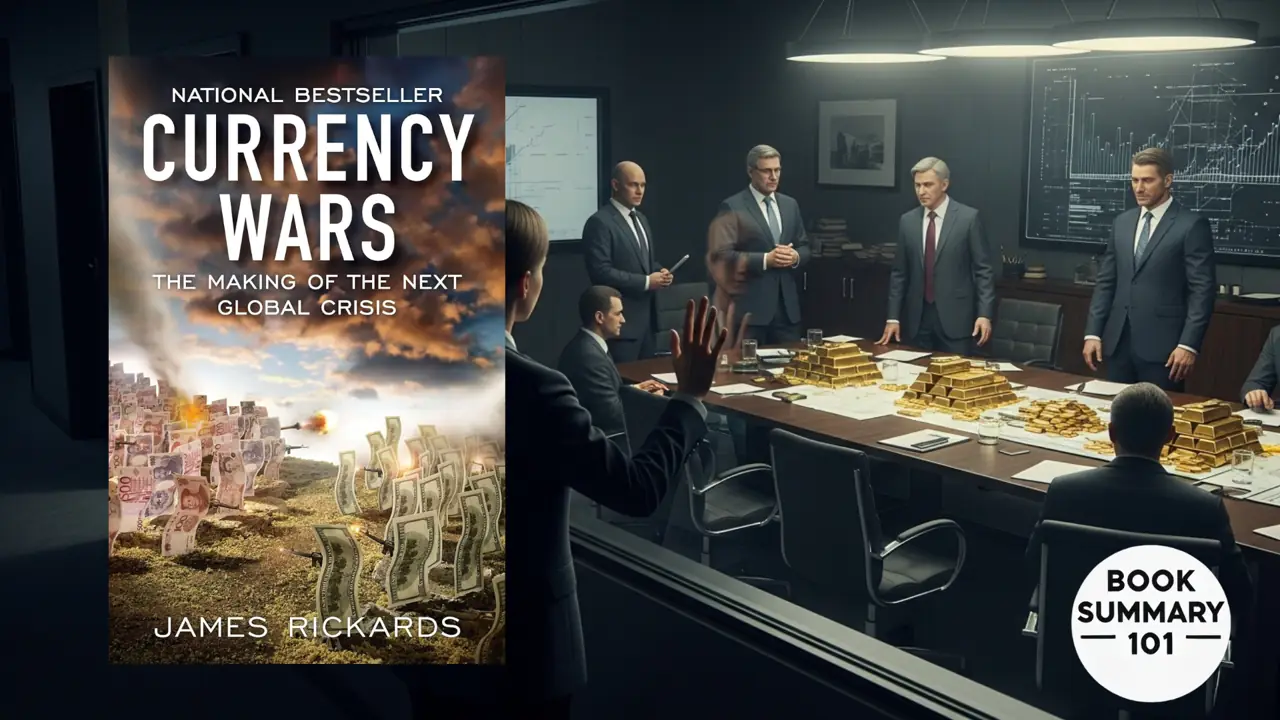
Then I picked up Currency Wars: The Making of the Next Global Crisis by James Rickards.
I expected a dry, dusty textbook. Instead, I got a thriller.
Rickards writes less like an accountant and more like a spy. He takes the confusing world of global finance and explains it like a high-stakes poker game played by superpowers. Reading this book felt like sitting down with a friendly insider who finally whispered, “Okay, here is how the machine actually works.”
If you’ve ever worried about the value of your savings or wondered why countries seem to be fighting over money, you need to read this.
- Why Should You Even Bother Reading It?
- The Hidden Battlefield of Global Finance
- 1. The Financial War Game
- 2. Beggar-Thy-Neighbor (Currency War I)
- 3. The Dollar’s “Exorbitant Privilege” (Currency War II)
- 4. Quantitative Easing: The Nuclear Option (Currency War III)
- 5. Complexity Theory and the Avalanche
- 6. The Endgame: Gold, SDRs, or Chaos
- My Final Thoughts
- Join the Conversation!
- Frequently Asked Questions (The stuff you’re probably wondering)
Why Should You Even Bother Reading It?
You might think, “I’m not a day trader or a politician, so why does this matter?”
It matters because you use money. This book is perfect for the curious observer, the saver, or anyone who senses that the global economy is standing on shaky ground.
Rickards’ core message is urgent: Currency wars are not just about numbers; they are hostile acts. When countries fight over currency, it leads to trade wars, and eventually, it can lead to actual shooting wars. Understanding this helps you protect your own financial future.
The Hidden Battlefield of Global Finance
Usually, we think of war as tanks, drones, and soldiers. But Rickards argues that the most dangerous battles today are fought with interest rates and money printing.
Before we look at the specific tactics, we need to realize that the dollar isn’t just a medium of exchange—it’s a weapon. Here are the core principles from the book that completely reshaped how I view the world.
1. The Financial War Game
The Analogy: Imagine a game of Dungeons & Dragons, but instead of wizards and dragons, the players are bankers and military strategists, and the “magic” is billions of dollars.
The book opens with a fascinating scene: Rickards is invited to a top-secret facility near the Pentagon to participate in a “financial war game.”
Just like the military simulates tank battles, they were simulating an economic attack on the United States. In the game, Russia and China teamed up to stockpile gold and launch a new currency, effectively dumping the US dollar.
The Real-World Example:
In the simulation, the “enemy” team didn’t fire a single shot. They simply refused to buy US debt and launched a gold-backed currency. The result in the game? The US economy froze, and the military couldn’t even pay for fuel. This actually mirrors real concerns about China’s massive holdings of US Treasury bonds today.
Simple Terms:
Nations can destroy each other’s economies without ever declaring a physical war.
The Takeaway:
Financial markets are a matter of national security, not just economics.
2. Beggar-Thy-Neighbor (Currency War I)
The Analogy: Imagine a family dinner where there is only one pie. It’s not getting any bigger. To get a bigger piece for yourself, you have to steal a slice from your brother’s plate.
Rickards takes us back to the 1920s and 30s for “Currency War I.” After World War I, countries were drowning in debt. To boost their own sales, they intentionally devalued their money.
If Germany makes their money “cheaper,” their goods become cheaper for other countries to buy. Their factories get busy. But here’s the catch: they are stealing those sales from France or England. This is called a “beggar-thy-neighbor” policy. You get rich by making your neighbor poor.
The Real-World Example:
The Smoot-Hawley Tariff Act of 1930. The US tried to protect its own industries by slapping taxes on imports. Other countries retaliated. Global trade collapsed, turning a recession into the Great Depression.
📖 “In a currency war, there is no such thing as a win-win scenario. It is a zero-sum game where one country’s gain is necessarily another country’s loss.”
Simple Terms:
When countries try to cheat the system to boost their own economy, everyone eventually crashes together.
The Takeaway:
Devaluing your currency works temporarily, but it usually triggers a global race to the bottom.
3. The Dollar’s “Exorbitant Privilege” (Currency War II)
The Analogy: Imagine you go to a casino where you are the only person allowed to print your own chips. Everyone else has to earn chips, but you can just manifest them out of thin air to pay your bar tab.
This section covers “Currency War II” (1967–1987). For a long time, the US dollar was backed by gold. But in 1971, President Nixon broke that link.
Suddenly, the US could print as much paper money as it wanted without needing the gold to back it up. We could buy cars from Germany and electronics from Japan using paper we printed, while they had to do actual work to earn that paper. The French finance minister called this America’s “exorbitant privilege.”
The Real-World Example:
The “Nixon Shock” of 1971. It led to the massive inflation of the 1970s (where prices for everything skyrocketed) because there was no longer a “brake” on how much money the government could create.
Simple Terms:
Being the country that owns the global reserve currency allows you to run up massive debts that other countries have to pay for.
The Takeaway:
The paper dollar has no intrinsic value; it relies entirely on the world simply trusting the US.
4. Quantitative Easing: The Nuclear Option (Currency War III)
The Analogy: You’re trying to fix a stalled car engine by flooding it with gallons of gasoline. You might get a spark, or you might blow up the whole garage.
Rickards argues we are currently in “Currency War III,” which began around 2010. The main weapon used by the Federal Reserve is Quantitative Easing (QE). This is a fancy term for printing trillions of dollars to buy bonds.
The goal is to lower interest rates and get people spending. But Rickards points out that this flood of money has to go somewhere. It often flows into developing countries, causing their prices to skyrocket, causing chaos abroad.
The Real-World Example:
In 2010, the Brazilian Finance Minister Guido Mantega publicly accused the US of starting a currency war. The US “printed” money to save Wall Street, but that money flooded into Brazil, making the Brazilian currency too expensive and hurting their local farmers and manufacturers.
Simple Terms:
When the US prints money to save its own economy, it exports inflation and chaos to other nations.
The Takeaway:
Money printing isn’t free; the cost is usually paid by savers and foreign countries.
5. Complexity Theory and the Avalanche
The Analogy: The Sandpile. Imagine you are slowly dropping grains of sand onto a table. A pile forms. For a long time, nothing happens. But eventually, the pile reaches a “critical state.” One single, tiny grain of sand causes the whole mountain to collapse in an avalanche.
This is my favorite concept in the book. Rickards uses “Complexity Theory” to explain why economists always get it wrong. Economists treat markets like a machine that seeks balance (equilibrium).
Rickards argues the economy is a complex system, like a weather system or a sandpile. It is naturally unstable. The risks don’t follow a nice, neat bell curve. They have “fat tails”—meaning extreme disasters happen way more often than models predict.
📖 “The system is not in equilibrium; it is in a critical state. A collapse can happen at any time and it will be sudden and irreversible.”
The Real-World Example:
The 2008 Financial Crisis. The risk models used by banks said that a housing crash of that magnitude was mathematically impossible (a “black swan”). But it happened because the system was in a critical state—too much debt (sand) had piled up.
Simple Terms:
The economy is fragile, and standard economic models are useless at predicting when the big crash will come.
The Takeaway:
Don’t trust the experts who say “the system is sound.” They are looking at the wrong map.
6. The Endgame: Gold, SDRs, or Chaos
The Analogy: Rebooting a frozen computer. When the screen goes blue and nothing works, you have to hit the reset button.
So, how does Currency War III end? Rickards offers a few scenarios, but they all involve a “reset” of the global monetary system.
One option is a return to a Gold Standard (tying money to gold again to stop inflation). Another is the rise of SDRs (Special Drawing Rights)—a kind of “super-money” issued by the IMF (International Monetary Fund) to replace the dollar. The third option is simply chaos—social unrest and hyperinflation.
The Real-World Example:
Central banks around the world (especially China and Russia) have been buying gold at record paces over the last decade. They are preparing their “lifeboats” for when the dollar system needs a reboot.
Simple Terms:
The current dollar dominance cannot last forever; something else will eventually replace it.
The Takeaway:
Owning hard assets (like gold or land) is the best insurance policy against a monetary reset.
My Final Thoughts
I’ll admit, reading Currency Wars is a bit like watching a horror movie where the monster is the economy. It’s frightening to realize how fragile our financial system really is.
But strangely, I walked away feeling empowered.
When you understand that inflation isn’t an accident, but a policy choice—and when you understand that the “strong dollar” is just a phase in a larger historical cycle—you stop panicking and start planning. Rickards doesn’t leave you hopeless; he gives you the knowledge to see the storm coming so you can close the windows.
It’s a dense topic, but Rickards makes it feel like a conversation over whiskey. It’s smart, historical, and incredibly relevant.
Join the Conversation!
Here is my question for you: If the US Dollar lost its status as the world reserve currency tomorrow, what would you want to be holding? Gold, Bitcoin, or something else?
Drop a comment below—I’d love to hear your take!
Frequently Asked Questions (The stuff you’re probably wondering)
1. Is this book too technical for me?
Not at all. While the concepts are complex, Rickards is a great storyteller. He uses history and analogies (like the ones above) to make it accessible. If you can read the newspaper, you can read this book.
2. Do I need to be an investor to get value from this?
No. This is actually a book about history and geopolitics disguised as a finance book. It explains why the world looks the way it does today.
3. The book was written a few years ago—is it still relevant?
Yes, perhaps even more so. Rickards predicted the rise of inflation, the weaponization of the dollar (sanctions), and the move by Russia/China to buy gold. We are living in the “Currency War III” he described.
4. Does the book tell me exactly what to invest in?
It is not a “get rich quick” stock picking guide. However, Rickards makes a very strong case for holding physical gold as an insurance policy against government mismanagement of money.
5. Is the author biased?
Rickards definitely leans toward “sound money” (gold standard) and is critical of the Federal Reserve. It’s good to keep that perspective in mind, but his historical analysis is widely respected.