I used to have a graveyard of ideas on my computer.
Seriously. It was a folder called “Projects,” and it was filled with half-finished documents, brilliant-in-the-shower concepts, and book outlines that never saw the light of day. I was always busy, my calendar was packed, but I had this nagging feeling that I wasn’t actually doing anything that mattered. I was spinning my wheels, mistaking motion for progress.
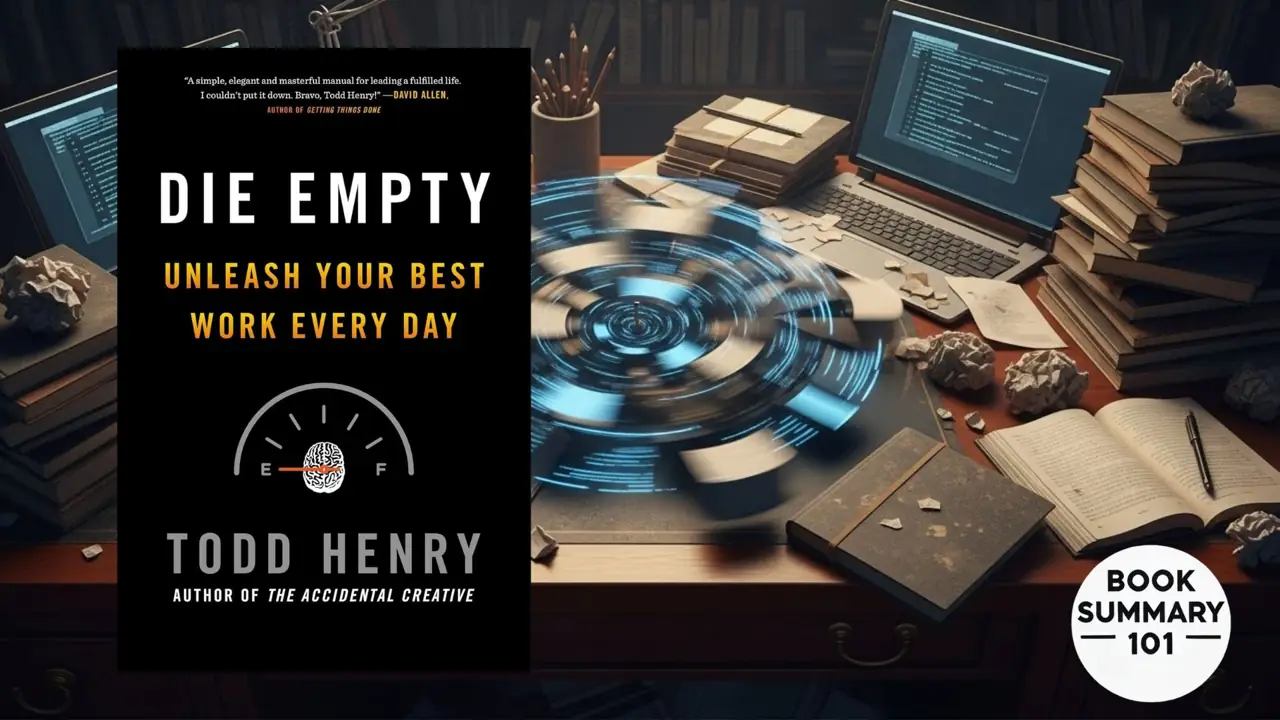
Then I stumbled upon a book with a title that stopped me in my tracks: Die Empty by Todd Henry. It sounded a bit morbid, right? But the subtitle, “Unleash Your Best Work Every Day,” hooked me. I picked it up, and instead of a depressing lecture, I found one of the most encouraging and clarifying conversations I’ve ever had. It felt like a wise friend grabbing me by the shoulders, looking me in the eye, and saying, “Hey, that stuff you’re capable of? The world needs it. Now. Let’s get to work.”
This book didn’t just give me a productivity hack; it gave me a new philosophy for my work and my life.
Why Should You Even Bother Reading It?
This book is for anyone who feels a gap between their potential and their daily reality. It’s for the creative professional who feels their best ideas are stuck in brainstorming sessions, the entrepreneur who is buried in admin instead of innovation, and the student who feels like they’re just checking boxes.
In a world obsessed with distraction and short-term thinking, Die Empty is a powerful call for urgency and purpose. It argues that your most important work—the contribution only you can make—isn’t something you should save for “someday.” It’s something you must pour out, day by day.
- Why Should You Even Bother Reading It?
- The Core Principles That Lit a Fire Under Me
- The Graveyard Analogy: Why You Must “Die Empty”
- The Three Kinds of Work: Mapping, Making, and Meshing
- Battling Aimlessness: Define Your Driving Questions
- Escaping Comfort: The Dangers of the Stable Plateau
- Conquering Fear by Embracing Productive Discomfort
- My Final Thoughts
- Join the Conversation!
- Frequently Asked Questions (The stuff you’re probably wondering)
The Core Principles That Lit a Fire Under Me
Todd Henry doesn’t just give you vague inspiration; he provides a mental toolkit for shifting your entire approach to work. Here are the ideas that completely reshaped my thinking.
The Graveyard Analogy: Why You Must “Die Empty”
Let’s start with the central, gut-punch of an idea. Todd Henry asks you to imagine the wealthiest, most valuable land in the world. It’s not the oil fields of the Middle East or the diamond mines of Africa. It’s the graveyard.
Why? Because the graveyard is filled with potential that was never realized. It’s packed with books that were never written, businesses that were never started, songs that were never sung, and apologies that were never offered. It’s full of brilliant contributions that people carried inside of them their entire lives, only to be buried with them. The goal, Henry argues, is to arrive at the end of your life completely spent, having poured out every last drop of your unique value into the world. You want to “die empty.”
This isn’t about burnout or hustling yourself into exhaustion. It’s about intentionality. It’s about refusing to let fear, procrastination, or comfort be the reasons your best work never sees the light of day. Seeing my “Projects” folder not as a collection of future ideas but as a tiny graveyard of its own was the wake-up call I desperately needed. It reframed my daily work from a series of tasks to a daily opportunity to empty myself of my best ideas.
Simple Terms: Don’t let your best ideas die with you.
The Takeaway: Your life’s mission should be to share your unique gifts and contributions with the world, leaving nothing in the tank.
The Three Kinds of Work: Mapping, Making, and Meshing
Ever feel like you’re driving full-speed but have no idea where you’re going? That’s what happens when you don’t balance your work. Henry breaks down all valuable work into three essential activities: Mapping, Making, and Meshing.
Imagine you’re planning a cross-country road trip.
Mapping is when you’re at the kitchen table with the maps spread out. You’re deciding the destination (your goals), charting the course, and identifying key stops along the way. In work terms, this is strategy, planning, and defining your priorities. It’s the “what” and “why.”
Making is the actual driving. Your hands are on the wheel, you’re on the highway, and you’re covering ground. This is the execution phase—writing the code, designing the logo, making the sales call, creating the product. It’s the “doing.”
Meshing is everything that keeps the car running and makes you a better driver. It’s stopping for gas, checking the oil, and learning how to use that new GPS app. In your work, this is sharpening your skills. It’s reading books, taking courses, seeking feedback, and reflecting on your process.
Most of us get stuck in “Making.” We just drive and drive and drive, proud of how busy we are. But without Mapping, we drive in circles. And without Meshing, our car eventually breaks down. The key is to consciously build time for all three into your weeks.
Simple Terms: All work is either planning it (Mapping), doing it (Making), or getting better at it (Meshing).
The Takeaway: To do great work, you must be intentional about dedicating time not just to execution, but also to strategic planning and personal development.
Battling Aimlessness: Define Your Driving Questions
The first of Henry’s “seven deadly sins” of mediocrity is Aimlessness. It’s the state of drifting through your days, reacting to whatever comes your way instead of proactively steering your own ship.
The analogy that comes to mind is a ship without a rudder. The wind and currents (your email inbox, other people’s requests) are pushing it around, and while it’s definitely moving, it has no control over its destination. Henry’s solution is to define a set of “driving questions” to act as your rudder.
These aren’t goals like “increase sales by 10%.” They are big, open-ended, philosophical questions that guide your work. For example, instead of a vague goal to be a “good leader,” your driving question might be, “How can I create an environment where my team feels safe enough to do their most courageous work?” That single question changes how you approach every meeting, every one-on-one, and every project. It becomes a filter for your decisions. Aimlessness is the default for most people; a powerful driving question is the antidote.
📖 “Vague aspirations lead to vague outcomes. A lack of clarity is the enemy of excellence.”
Simple Terms: Aimlessness is drifting; have a big question that gives you a direction to sail in.
The Takeaway: Stop setting vague goals and instead define a core question that will guide your daily actions and decisions with purpose.
Escaping Comfort: The Dangers of the Stable Plateau
Another “deadly sin” is Comfort. This one is sneaky because it feels so good. You get good at your job, you know the ropes, and you can do it with your eyes closed. You’ve reached a comfortable, stable plateau.
Think of it like a stagnant pond. The water is calm and still. It feels safe and predictable. But because no fresh water is flowing in, it eventually becomes murky and lifeless. To stay fresh and full of life, you need the constant flow of a river—the influx of new challenges, new skills, and new problems.
That stable plateau is dangerous because it’s where growth stops. You’re no longer pushing yourself, which means you’re not generating your best work, just your easiest work. Henry argues that you have to actively and intentionally introduce challenges that push you off this plateau. Volunteer for the project that scares you. Learn the skill you’ve been avoiding. Actively seek out problems that you don’t immediately know how to solve. The comfort zone is where potential goes to die a slow, quiet death.
Simple Terms: Being comfortable means you’re not growing.
The Takeaway: You must intentionally seek out challenges and step outside your comfort zone to continue producing valuable work.
Conquering Fear by Embracing Productive Discomfort
This leads directly to the next big obstacle: Fear. Fear of failure, fear of looking stupid, fear of not being good enough. This fear is what keeps us on that stable plateau. But Henry offers a powerful reframe: learn to embrace “productive discomfort.”
Imagine training at the gym. If you lift a weight that feels easy, you’re not building any muscle. Growth only happens when you push to the point of strain—that slight shake, that burn. That feeling of discomfort is the physical proof that you are getting stronger.
It’s the same with your work. That feeling of nervousness before a presentation, the uncertainty when tackling a new kind of project, the vulnerability of sharing a new idea—that’s not a signal to retreat. That is the feeling of your professional “muscles” tearing down so they can rebuild stronger. It’s productive discomfort. When you feel it, you should lean in and smile, because it’s a sign that you are on the right track. You’re in the growth zone.
📖 “The work that matters most is often the work you’re most afraid to do. Your fear is a compass pointing you to the areas where you need to grow.”
Simple Terms: The nervous, uncertain feeling you get when trying something hard is actually a sign of growth, not weakness.
The Takeaway: Reframe fear and uncertainty as “productive discomfort”—a necessary ingredient for doing your most important work.
My Final Thoughts
Die Empty isn’t a book about working 80 hours a week. It’s the exact opposite. It’s about ensuring the hours you do work are filled with purpose, focus, and a fierce urgency to contribute something meaningful. It’s an antidote to the modern disease of being perpetually busy but deeply unfulfilled.
Reading this book felt like being given permission to take my own ideas seriously. It’s a practical, inspiring, and deeply human guide to sharing your best work with a world that desperately needs it. It’s a kick in the pants, delivered by a wise and encouraging friend.
Join the Conversation!
After reading this, what’s one idea, project, or contribution you’ve been keeping in your own “graveyard” folder that you feel inspired to start working on today? Share it in the comments below!
Frequently Asked Questions (The stuff you’re probably wondering)
1. Is this book just for ‘creatives’ or artists?
Not at all. While Todd Henry has a background in the creative world, the principles apply to anyone who produces value with their mind—managers, developers, marketers, scientists, and entrepreneurs. If you have to solve problems and generate ideas, this book is for you.
2. Is “Die Empty” a morbid or depressing book?
Absolutely not! The title is a jarring call to action, but the book itself is incredibly optimistic and empowering. It’s about living a life of purpose and contribution, which is the opposite of depressing.
3. Does the book give you a step-by-step system to follow?
It’s less of a rigid, step-by-step system and more of a mental framework and a set of guiding principles. It gives you the “what” and the “why,” then provides tools and prompts to help you figure out the “how” for your specific situation.
4. How is this different from other productivity books?
Many productivity books focus on hacks, apps, and time management tricks (the “how”). Die Empty focuses on your mindset, your purpose, and the underlying principles of creating valuable work (the “why”). It’s about effectiveness and impact, not just efficiency.
5. Do I need to be an entrepreneur to get value from this?
No. The book is about owning your work and developing a sense of personal responsibility for your contributions, whether you work for a massive corporation, a small non-profit, or for yourself. It’s about cultivating an owner’s mindset, no matter who signs your paycheck.