Let’s be real for a second.
How many times have you checked your phone in the last hour?
Better yet, how many times did you check it while you were supposed to be doing something “important”?
I used to beat myself up about this constantly. I’d sit down to write, grade papers, or read a report, and five minutes later—without even realizing it—I’d be scrolling through Twitter or staring out the window.
I felt like my brain was broken. I thought I had lost the moral fortitude to just pay attention.
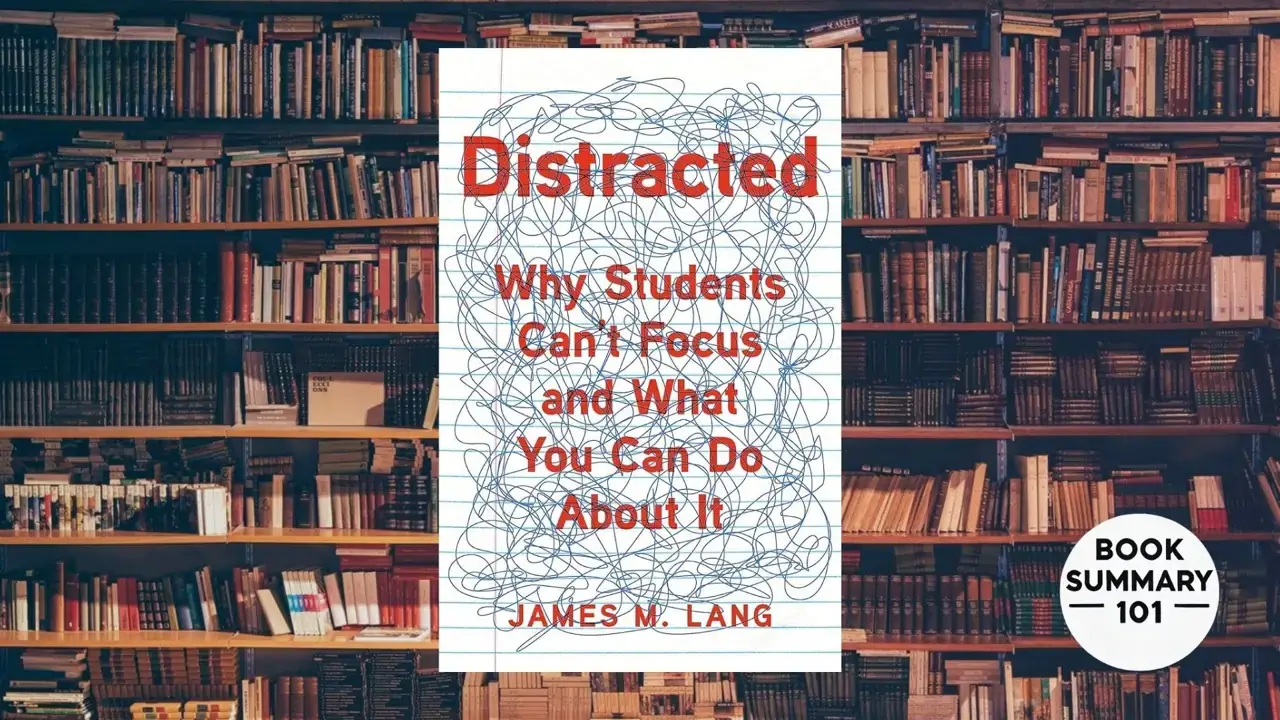
Then I picked up “Distracted: Why Students Can’t Focus and What You Can Do About It” by James M. Lang.
And let me tell you, it felt like a warm hug and a cold splash of water at the same time.
Lang, a veteran educator, argues that we’ve got it all wrong. We treat distraction like a modern disease caused by smartphones, but it’s actually an ancient survival mechanism.
Reading this book didn’t just change how I teach or work; it changed how I forgive myself for zoning out—and gave me the actual tools to tune back in.
Grab a coffee. Let’s talk about attention.
- Why Should You Even Bother Reading It?
- The Core Principles That Reshaped My Thinking
- 1. The “Ancient Brain” Hypothesis (It’s Not the Phone’s Fault)
- 2. The Failure of “Attention Modification Syndromes”
- 3. The Curiosity Gap (The “Itch” You Have to Scratch)
- 4. Modular Learning (The Interval Training Method)
- 5. The Power of Community (The Campfire Effect)
- My Final Thoughts
- Join the Conversation!
- Frequently Asked Questions (The stuff you’re probably wondering)
Why Should You Even Bother Reading It?
You might see “Students” in the title and think, “I’m not a teacher, so this isn’t for me.”
Stop right there.
While Lang writes from the perspective of a college professor, this book is essential reading for:
- Parents trying to understand why their kids can’t look away from screens.
- Managers who want more engaged meetings (zoom or in-person).
- Creatives struggling to find flow in a noisy world.
- Anyone who feels like they are losing the battle for their own mind.
If you are tired of the “just ban the phones” argument and want a compassionate, science-backed approach to focus, this is the book for you.
The Core Principles That Reshaped My Thinking
We tend to think of attention as a switch we can simply flip on. Lang argues that attention is more like a garden—it needs the right soil, climate, and care to grow. Here are the major concepts from the book that completely shifted my perspective.
1. The “Ancient Brain” Hypothesis (It’s Not the Phone’s Fault)
We love to blame Instagram, TikTok, and the “ding” of a text message for our inability to focus. We act like distraction was invented in 2007 when the iPhone came out.
Lang flips this script immediately. He uses the analogy of The Watchtower.
Imagine your ancestors living on the open savanna thousands of years ago. If they had the ability to hyper-focus on one thing—say, carving a tool—to the total exclusion of everything else, they would have been eaten by a predator.
To survive, the human brain evolved to be easily distracted. It evolved to constantly scan the horizon for movement, changes in light, or sudden noises.
The Reality Check:
Distraction is the default setting of the human brain. It is a feature, not a bug. When a student (or you) looks away from a task because a phone buzzes or a bird flies past the window, that isn’t a moral failing. That is a healthy brain doing exactly what evolution designed it to do: keep you safe by noticing change.
Lang points out that throughout history, philosophers have complained about distraction. Medieval monks complained about it. The problem isn’t the technology; it’s that we are asking our “hunter-gatherer brains” to do something unnatural: sit still and stare at one thing for an hour.
Simple Terms: You aren’t distracted because you are lazy; you are distracted because your brain is wired to scan for danger and novelty.
The Takeaway: Stop trying to “cure” distraction. Instead, accept that focus is hard and fragile, and work with your brain’s nature rather than fighting it.
2. The Failure of “Attention Modification Syndromes”
So, if distraction is natural, how do we usually try to fix it?
Lang critiques what he calls the “Attention Modification Syndromes.” This is the “Prohibition” approach.
Think of it like Playing Whack-a-Mole.
Teachers (and bosses) often think the solution to distraction is to ban the distractor.
“Put away your laptops.”
“No phones in the meeting.”
“Block specific websites.”
Lang argues that this is a losing battle. If you ban the laptop, the brain will find a crack in the ceiling to stare at. If you ban the phone, the brain will daydream about lunch.
The “Prohibition” analogy suggests that by removing the object, you create virtue. But you don’t. You just create boredom. And a bored brain will always find a way to distract itself.
A Real-World Example:
Think about a time you were in a boring meeting where phones were prohibited. Did you suddenly become 100% engaged with the speaker? Probably not. You likely started doodling, making a grocery list in your head, or counting the tiles on the floor. Banning the device didn’t create engagement; it just changed the form of your distraction.
📖 “Attention is an achievement, not a given. It is something that we must help students construct, not something that we can demand they simply produce.”
Simple Terms: You can’t force focus by removing fun things; you have to make the task at hand more compelling than the distraction.
The Takeaway: Banning technology is a temporary band-aid. The only long-term solution is to cultivate genuine interest.
3. The Curiosity Gap (The “Itch” You Have to Scratch)
If we can’t force attention, how do we invite it? Lang leans heavily on the science of curiosity.
He uses the analogy of The Mystery Novel.
Why can you read a thriller for three hours straight, but struggle to read a three-page memo? Because the thriller opens a “gap” in your knowledge that you feel a desperate need to close.
The brain hates incomplete loops. When we are presented with a question, a puzzle, or a mystery, our attention naturally zooms in to solve it. This is the “itch” that attention scratches.
Too often, in schools and workplaces, we just hand people answers to questions they never asked.
“Here are the quarterly figures.”
“Here is the date of the Battle of Hastings.”
This is boring because there is no gap to bridge.
A Real-World Example:
Look at how clickbait titles work (like the one I used for this post!). They don’t give you the information immediately. They create a gap: “You won’t believe what happened next.”
Lang suggests starting a lecture or a meeting not with a thesis statement, but with a provoking question, a confusing image, or a problem that seems impossible to solve. You have to “sell” the problem before you sell the solution.
Simple Terms: People pay attention when they want to know the answer.
The Takeaway: Never give an answer until you have first stimulated the question.
4. Modular Learning (The Interval Training Method)
One of the most practical concepts in the book is the idea of Modularity.
Think of this like Interval Training vs. A Marathon.
If I asked you to sprint at full speed for 60 minutes, you’d collapse. But if I asked you to sprint for 2 minutes, walk for 1, and jog for 2, you could keep moving for a long time.
Our attention span works the same way. The neurobiology cited by Lang suggests that sustained attention on a single passive target (like a speaker) creates cognitive fatigue very quickly.
Lang advocates for breaking time into “modules.”
Instead of one 60-minute slog, structure your time (or your class) into distinct chunks:
- 10 minutes of intro/hook.
- 15 minutes of active work.
- 10 minutes of discussion.
- 10 minutes of summary.
A Real-World Example:
Think about Spotify’s “Discover Weekly” or a TikTok feed. The content changes rapidly. Just when your brain starts to drift, the stimulus changes.
In a work context, this is the Pomodoro Technique (25 minutes of work, 5 minutes of break). By changing the “mode” of what you are doing—switching from listening to writing, or from writing to discussing—you “reset” the attention clock.
Simple Terms: Don’t do the same thing for more than 15-20 minutes at a time.
The Takeaway: Variation is the key to sustaining attention over the long haul.
5. The Power of Community (The Campfire Effect)
Finally, Lang touches on something deeply human. We pay attention to things that matter to our “tribe.”
The analogy here is The Campfire.
For thousands of years, humans gathered around fires to share stories. We paid attention to the speaker not just because the story was good, but because we were part of the group.
Lang argues that anonymity is the enemy of attention. If a student feels like a number in a lecture hall, or an employee feels like a faceless name on a Zoom call, they will tune out. Why? Because their attention doesn’t matter. No one notices if they are gone.
However, when we build community—when we learn names, ask for specific opinions, and create a sense of belonging—attention spikes. We are hardwired to care about social standing and connection.
📖 “When we are in the presence of others, our brains perk up. We are social animals, and we have evolved to pay attention to one another.”
A Real-World Example:
Have you ever been in a large audience where the speaker suddenly walked off the stage and into the crowd? The energy in the room changes instantly. The “barrier” is broken. You pay attention because the speaker is suddenly a real person in your space, and you are part of the interaction.
Simple Terms: We pay attention when we feel seen and when we feel connected to the people around us.
The Takeaway: Build relationships first; attention will follow.
My Final Thoughts
Reading Distracted felt like receiving permission to be human.
For years, the narrative around focus has been combative. It’s been a “war on distraction” or a “battle for your mind.” James Lang teaches us that you cannot win a war against your own biology.
Instead of fighting, he teaches us to cultivate.
By understanding that my brain wants to wander, I can gently guide it back without shame. By understanding that I need variety, I can structure my workday better. And by understanding the power of curiosity, I can make my own work more interesting.
This book doesn’t promise you’ll never check your phone again. But it does promise that when you do, you’ll understand why—and you’ll know exactly how to get back on track.
Join the Conversation!
I’d love to hear from you.
What is your “Kryptonite” when it comes to focus? Is it social media, email notifications, or just your own daydreaming brain?
Drop a comment below and let’s share some strategies (or just commiserate)!
Frequently Asked Questions (The stuff you’re probably wondering)
1. Is this book only for teachers and professors?
No, not at all. While the examples are drawn from the classroom (lectures, grading, students), the psychology applies to everyone. If you lead meetings, give presentations, or just want to manage your own focus, you will find it incredibly useful.
2. Does the author hate technology?
Surprisingly, no. James Lang is very pro-technology. He argues against banning laptops and phones. Instead, he focuses on how to use them purposefully so they aid learning rather than distracting from it.
3. Is it a dense, scientific read?
It’s very readable. Lang is an academic, but he writes in a warm, storytelling style. He references neuroscience, but he explains it through stories and easy-to-understand metaphors.
4. Will this help me with my diagnosed ADHD?
While the book isn’t a medical guide for ADHD, many of the strategies—specifically modular learning, frequent breaks, and changing the environment—align perfectly with coping strategies often recommended for ADHD.
5. What is the biggest takeaway in one sentence?
Stop blaming yourself for being distracted and start designing your environment and tasks to invite curiosity and connection.