I have a confession to make, and I have a feeling you might relate to it.
A few months ago, I found myself sitting on the couch on a Sunday afternoon. I had a cup of coffee, the sun was shining, and I had absolutely nothing on my calendar.
It should have been blissful. Instead, my chest felt tight. My brain started screaming, “You should be doing laundry. You should be listening to that educational podcast. You should be starting a side hustle.”
I felt guilty simply for existing without producing something.
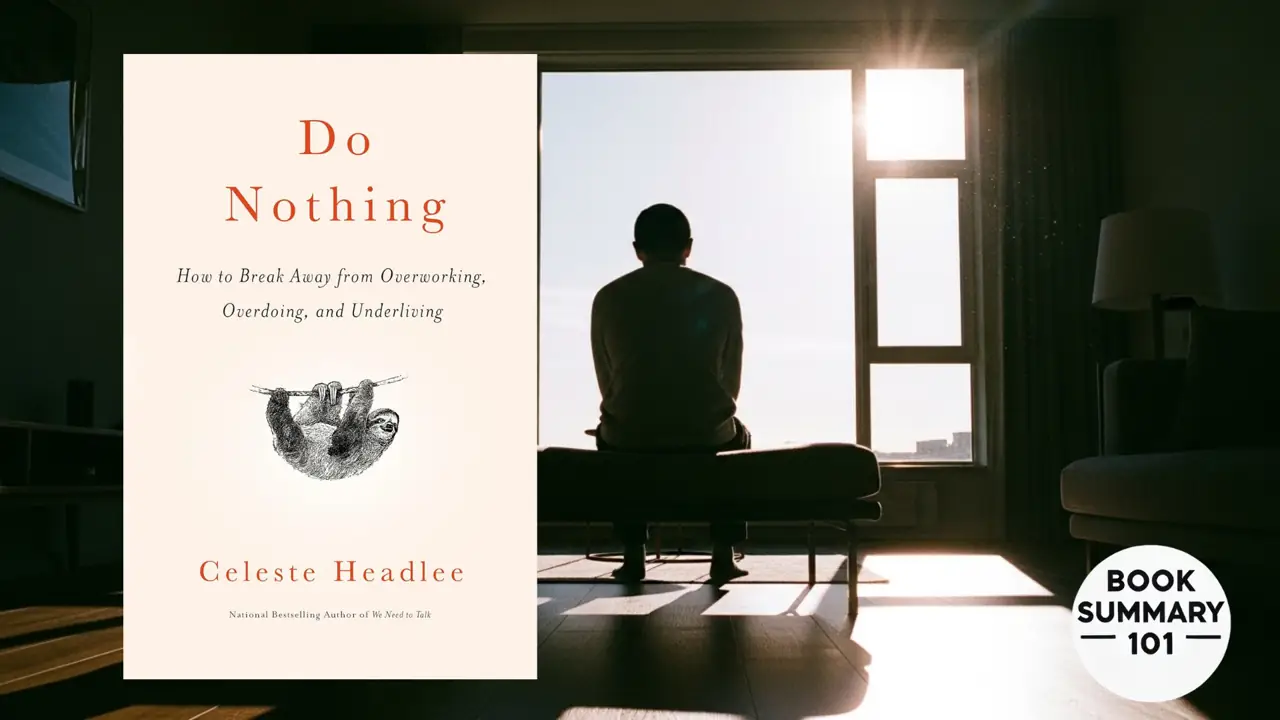
If that sounds like the inside of your head, then Celeste Headlee’s book, Do Nothing: How to Break Away from Overworking, Overdoing, and Underliving, isn’t just a recommendation—it’s an emergency intervention.
I read this book hoping for some time-management tips. What I got instead was a complete dismantling of the way I view my worth as a human being. It felt like sitting down with a wise friend who gently took my to-do list, ripped it up, and told me, “You are enough.”
Here is everything you need to know about this life-changing manifesto.
Why Should You Even Bother Reading It?
This book is for anyone who feels like they are constantly running on a treadmill that keeps speeding up.
If you are a burned-out professional, a student drowning in extracurriculars to “pad your resume,” or just someone who feels a pang of guilt when you sit still for five minutes, this is for you.
Headlee argues that our obsession with efficiency is actually making us sick, sad, and less productive. Reading this book matters because it gives you the historical and scientific permission to stop optimizing every second of your life and actually start living it.
- Why Should You Even Bother Reading It?
- The Lies We’ve Been Sold About Work and Worth
- 1. The Myth of the “Lazy” Past
- 2. The “Time is Money” Trap
- 3. The Cult of Efficiency (Humans as Machines)
- 4. The Tech Leash and the Comparison Game
- 5. The Solution: Untethering and Idleness
- My Final Thoughts
- Join the Conversation!
- Frequently Asked Questions (The stuff you’re probably wondering)
The Lies We’ve Been Sold About Work and Worth
We tend to think that working ourselves to the bone is just “human nature” or how things have always been, but Headlee proves that this is a relatively new, manufactured delusion. Before we look at the specific concepts, here is the roadmap of how we got tricked into trading our humanity for productivity.
1. The Myth of the “Lazy” Past
One of the most mind-blowing concepts in the book is the realization that we work significantly more than our ancestors did. We tend to imagine medieval peasants toiling in the fields from dawn until dusk, every single day, just to survive.
Headlee flips this script entirely. She explains that while life was physically harder back then, the concept of “time” was radically different.
The Analogy: The Task-Based Rhythm vs. The Clock
Imagine a farmer. He milks the cow when the cow needs milking. He harvests when the crops are ready. When the job is done, he stops.
Now, imagine a factory worker. He punches a clock at 8:00 AM and leaves at 5:00 PM. Even if he finishes his work at 2:00 PM, he has to stay and “look busy” until the clock says he can leave.
Headlee points out that pre-industrial workers were task-oriented. They worked hard in bursts (planting, harvest) and then spent months doing very little. They had festivals, long lunches, and naps.
Real-World Example:
Think about the modern “unlimited PTO” trap. In theory, you can take time off whenever. But because we are obsessed with the appearance of hard work (the clock) rather than the actual output (the cow), people actually take less vacation time because they don’t want to look “lazy” compared to their peers. We have less leisure time now than a 13th-century peasant.
📖 “We have become a nation of people who are working hard, not smart. We are working longer hours, but we are not getting more done. We are just getting more tired.”
Simple Terms: We think we work hard because we have to, but history shows we work hard because we’ve been trained to worship the clock.
The Takeaway: Human beings were not designed to work 8+ hours a day, 50 weeks a year.
2. The “Time is Money” Trap
We can thank Benjamin Franklin (and later, the Industrial Revolution) for this one. This is the psychological shift where time ceased to be a natural flow of day and night and became a commodity to be sold.
The Analogy: The Taxi Meter
Headlee suggests that we have turned our lives into a running taxi meter. Every minute that passes where we aren’t earning money, learning a skill, or improving ourselves feels like money falling out of our pockets.
If you are sitting on a park bench staring at the clouds, the taxi meter is still running, and you feel like you are “losing” potential value. This mindset makes true relaxation impossible because “doing nothing” becomes “wasting inventory.”
Real-World Example:
Consider the “Side Hustle” culture. You can’t just enjoy knitting anymore; you have to open an Etsy shop. You can’t just enjoy baking; people ask why you haven’t started a catering business. We have monetized our joy because we believe that time unmonetized is time wasted.
Simple Terms: We view time as currency, which makes spending it on “nothing” feel like burning cash.
The Takeaway: You must separate your time from your monetary value to find peace.
3. The Cult of Efficiency (Humans as Machines)
This is the core of the problem. We are trying to apply the logic of machines to the biology of humans.
The Analogy: The Steam Engine
During the Industrial Revolution, we invented machines that could run 24/7 without getting tired, depressed, or sick. They were efficient.
Headlee argues that we looked at those machines and said, “I want to be like that.” We started optimizing our lives to eliminate “downtime.” But humans aren’t steam engines. We are biological organisms that require rest, play, and idleness to function. When you try to run a biological organism like a steam engine, it doesn’t get more efficient—it breaks down.
Real-World Example:
Think about listening to audiobooks or podcasts at 2x speed. Why do we do this? To “consume” more information faster. We aren’t enjoying the story; we are processing data like a hard drive. We treat our brains like processors that need to be maxed out, rather than gardens that need to grow.
Simple Terms: You are not a robot, so stop trying to optimize your sleep, eating, and relationships for maximum output.
The Takeaway: Efficiency is a great goal for a dishwasher, but a terrible goal for a human life.
4. The Tech Leash and the Comparison Game
Technology was supposed to liberate us. The promise was that computers would do the work, and we would have more leisure time. Instead, we brought the office home in our pockets.
The Analogy: The Slot Machine
Headlee compares our smartphones to slot machines in a casino. We check them constantly not because we need to, but because of “intermittent reinforcement.” Sometimes there’s a fun text (a win!), and sometimes there’s a stressful work email (a loss).
Because we don’t know what we’re going to get, we keep pulling the lever. This keeps us in a state of low-level anxiety and constant alertness, preventing us from ever truly mentally “clocking out.”
Real-World Example:
The “Sunday Scaries.” You are watching a movie with your family, but you instinctively check your email on your phone. You see a message from your boss. You don’t answer it, but your brain has now left the movie and is back at the office. You have physically left work, but digitally, you are still tethered to the desk.
📖 “Ideally, technology should make our lives easier, but in reality, it has made our lives more stressful. We are constantly connected, constantly available, and constantly distracted.”
Simple Terms: Your phone has erased the boundary between “work” and “home,” keeping you on call 24/7.
The Takeaway: To reclaim your life, you have to create physical boundaries with your technology.
5. The Solution: Untethering and Idleness
So, what do we do? Headlee doesn’t suggest we all quit our jobs and move to a commune. Her solution is surprisingly practical: we need to reclaim “idleness.”
The Analogy: The Reboot
Think about when your computer starts acting weird—it’s slow, it’s freezing, it’s overheating. What do you do? You shut it down. You don’t open more tabs to fix it.
Headlee argues that “doing nothing”—staring out a window, sitting on a porch, walking without headphones—is the human equivalent of a reboot. It isn’t laziness; it is necessary maintenance. This isn’t about “mindfulness meditation” (which is often just another thing on our to-do list), but about aimlessness.
Real-World Example:
Instead of scrolling through Instagram while waiting in line at the grocery store, just stand there. Look around. Let your mind wander. Instead of listening to a podcast on your commute, drive in silence. These micro-moments of boredom are where creativity and mental recovery happen.
Simple Terms: Stop filling every empty second with noise; let your brain be bored.
The Takeaway: Idleness is not a vice; it is the fuel for a healthy mind.
My Final Thoughts
Do Nothing is a deceptive title. It sounds passive, but it is actually a rebellious act.
Reading this book felt like a heavy weight being lifted off my shoulders. I realized that my obsession with being “productive” was actually a trauma response to a culture that values output over happiness.
Headlee doesn’t want you to be lazy. She wants you to be human. She wants you to realize that you have value simply because you exist, not because of how many emails you answered today. It empowers you to say “no” to the hustle culture and “yes” to staring at the clouds.
Join the Conversation!
I’d love to hear from you. What is one “unproductive” hobby you used to love that you’ve given up because it felt like a waste of time? Let me know in the comments—maybe we can all agree to start doing them again!
Frequently Asked Questions (The stuff you’re probably wondering)
1. Is this book telling me to quit my job and do nothing?
No! Headlee is very practical. She understands we need to pay bills. The book is about changing your relationship with work and reclaiming your leisure time, not abandoning your responsibilities.
2. Is this just another book on meditation?
Happily, no. Headlee actually critiques the way we use meditation as just another productivity tool. She advocates for “idleness” and “leisure,” which is less about structured breathing and more about just hanging out.
3. I’m a freelancer/business owner. Does this apply to me?
Absolutely. In fact, you probably need it the most. When you are your own boss, you tend to be the worst tyrant. This book helps you set boundaries so you don’t burn out.
4. Is the book heavy on science or just opinion?
It’s a great mix. She cites plenty of historical data, sociological studies, and psychological research, but writes in a way that feels like a story, not a textbook.
5. Will this help me be more productive?
Ironically, yes. By resting properly and stopping the “busy work,” you will likely find that when you do work, you are sharper, more creative, and more efficient. But she would tell you that’s not the point!