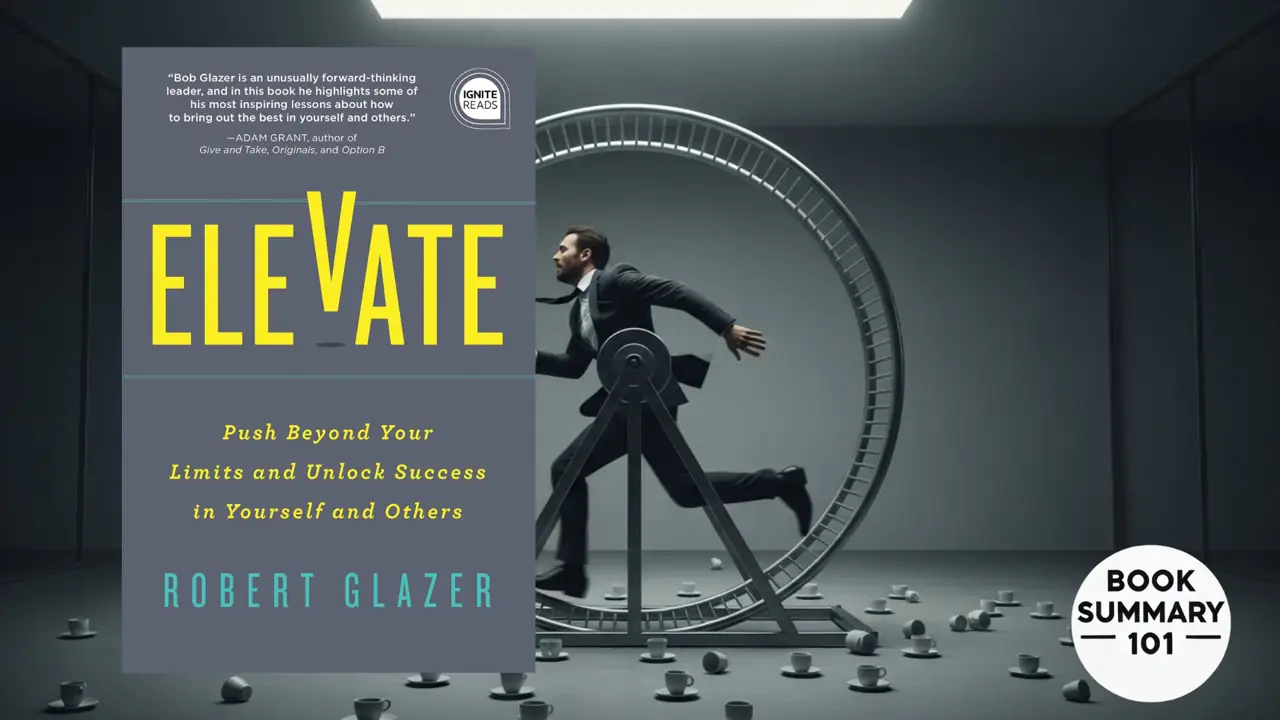
Have you ever felt like you’re running on a hamster wheel? You know the feeling I’m talking about. You’re working harder than ever, waking up earlier, drinking more coffee, and trying to “hustle” your way to success, but you just feel… stuck.
That was me about a year ago. I felt like a smartphone with a battery that wouldn’t charge past 20%. I thought the solution was just to plug myself in for longer—to work more hours.
Then I picked up Elevate: Push Beyond Your Limits and Unlock Success in Yourself and Others by Robert Glazer.
I expected another generic “rah-rah” motivational book telling me to wake up at 4:00 AM. What I got instead was a quiet, friendly conversation that completely shifted my perspective. It wasn’t about doing more; it was about becoming more.
Glazer introduced me to the concept of Capacity Building. He argues that we all have a ceiling on our potential, but that ceiling isn’t fixed. We can raise it. Reading this book felt like having a mentor sit me down and say, “Stop trying to pour from an empty cup. Let’s make your cup bigger.”
Here is everything you need to know about this life-changing framework.
- Why Should You Even Bother Reading It?
- The Four Elements of Capacity Building
- 1. Spiritual Capacity: The Compass and The Rudder
- 2. Intellectual Capacity: Upgrading Your Processor
- 3. Physical Capacity: The Engine of the Machine
- 4. Emotional Capacity: Being the Thermostat, Not the Thermometer
- 5. The “Lift”: Using Your Capacity to Elevate Others
- My Final Thoughts
- Join the Conversation!
- Frequently Asked Questions (The stuff you’re probably wondering)
Why Should You Even Bother Reading It?
If you are a high-achiever who feels plateaued, a parent trying to juggle family and self-care, or a leader trying to get the best out of your team, this book is essential.
We live in a culture that glorifies “the grind.” Elevate is the antidote to burnout culture. It matters today because it shifts the focus from output (what you produce) to input (how you fuel yourself). It’s perfect for non-tech professionals, managers, and anyone who feels like they have hit a wall in their personal or professional growth.
The Four Elements of Capacity Building
Glazer doesn’t just throw the word “capacity” around loosely; he breaks it down into a specific, actionable framework. He posits that our ability to succeed isn’t one giant fuel tank—it’s actually four distinct, interconnected batteries. If one is dead, the whole system fails.
Before we dive into the specific elements, understand this: Capacity building is the method by which individuals seek, acquire, and practice the skills necessary to perform at a higher level.
1. Spiritual Capacity: The Compass and The Rudder
When Glazer talks about “Spiritual Capacity,” don’t panic—he isn’t necessarily talking about religion, chanting, or incense (though if that’s your thing, great!). He is talking about something much more fundamental: Alignment.
Think of your life as a ship sailing across the ocean. Most of us are obsessed with the sails (how fast we are going) or the cargo (how much money we are making). But Spiritual Capacity is your Compass and your Rudder.
If you have a massive engine but no rudder, you’re just going to drive in circles very, very fast.
Spiritual capacity is about understanding who you are and what you want. It’s about defining your core values. Glazer argues that burnout rarely comes from working too hard; it comes from working hard on things that don’t align with your values. When there is a disconnect between what you do every day and who you believe you are, you experience a “spiritual” drain.
Real-World Example:
Consider the story of a high-powered attorney. On paper, she is successful—great salary, prestige, big office. But every Sunday night, she feels a pit in her stomach. Why? Because her core value is “Family” and “Creativity,” yet she spends 80 hours a week arguing technicalities in a windowless room. She has high intellectual capacity, but her spiritual capacity is empty.
To fix this, she doesn’t necessarily need to quit. She needs to align her actions with her values. Maybe she shifts to family law, or she sets a boundary to be home for dinner every night. Once she aligns her compass, the “work” feels less like a drain and more like a mission.
📖 “When you know what you stand for and where you are going, you can make decisions that align with your long-term goals rather than short-term gratification.”
Simple Terms: Knowing exactly who you are and what you stand for so you don’t waste energy faking it.
The Takeaway: You cannot outperform your own self-image or values; you must define your “Why” before you can effectively improve your “How.”
2. Intellectual Capacity: Upgrading Your Processor
If Spiritual Capacity is the compass, Intellectual Capacity is the operating system of your brain. It’s about how you think, plan, and execute.
Imagine your brain is a computer. Most of us are trying to run the latest, most demanding software (modern life, complex careers) on a computer with the processing power of a generic laptop from 1998. We crash. We freeze up.
Glazer suggests that we need to upgrade our RAM. This isn’t just about being “smart” or having a high IQ. It is about discipline, routine, and intentional learning. It’s about how you manage your time, how you set goals, and the systems you use to achieve them.
It involves a concept Glazer is famous for: The Morning Routine. He argues that you cannot have high intellectual capacity if you live your life in “reactive mode”—waking up and immediately checking email or social media. That’s letting the world dictate your processing power.
Real-World Example:
Think about the difference between a reactive worker and a proactive planner. The reactive worker (Low Intellectual Capacity) arrives at work, opens their inbox, and spends 8 hours putting out fires. They are busy, but they aren’t moving forward.
The proactive planner (High Intellectual Capacity) creates a “Stop Doing” list. This is a real tool Glazer recommends. Instead of just a To-Do list, they explicitly list things they will not waste bandwidth on—like checking news sites before noon or attending meetings without agendas. By rigorously guarding their mental energy and dedicating time to deep learning (like reading 20 minutes a day), they upgrade their processor to handle complex tasks with ease.
Simple Terms: The discipline to control your schedule, habits, and learning so you run your day instead of your day running you.
The Takeaway: Success requires a strict operating system; you must swap bad habits for good ones and ruthlessly eliminate distractions.
3. Physical Capacity: The Engine of the Machine
This section is often the hardest pill to swallow for high achievers. Physical Capacity is exactly what it sounds like: your health, well-being, and physical performance.
Here is the analogy: You have a Ferrari (your mind/ambition). You have a destination (Spiritual Capacity) and a great GPS (Intellectual Capacity). But if you put sludge in the gas tank and never change the tires, that Ferrari isn’t going anywhere. It’s going to break down on the side of the highway.
Glazer emphasizes that your brain is a biological organ. It needs sleep, nutrition, and movement to function. You cannot “hack” your way out of sleep deprivation.
When we are stressed, physical capacity is usually the first thing we sacrifice. We skip the gym to finish a report. We eat fast food to save time. We sleep 5 hours to “get ahead.” Glazer argues this is mathematically impossible. When your physical capacity drops, your intellectual and emotional capacity plummet with it. You become dumber and crankier when you are tired.
Real-World Example:
Let’s look at a CEO of a startup. She thinks she is being a hero by sleeping 4 hours a night and living on Red Bull. However, her decision-making ability has degraded to that of someone who is legally drunk (which is what happens with chronic sleep deprivation).
She starts snapping at employees (Emotional failure) and making bad strategic calls (Intellectual failure). By reclaiming her Physical Capacity—committing to 7 hours of sleep and a 30-minute walk daily—she actually works fewer hours but produces better results. She sharpened the saw instead of just hacking away with a dull blade.
Simple Terms: Treating your body like a high-performance vehicle rather than a rental car you don’t care about.
The Takeaway: Your physical health is the foundation of your execution; without energy, your best plans are worthless.
4. Emotional Capacity: Being the Thermostat, Not the Thermometer
This is perhaps the most challenging capacity to build, but also the most rewarding. Emotional Capacity is your ability to manage your emotional response to difficult situations and the quality of your relationships.
Here is the analogy Glazer inspires: Are you a Thermometer or a Thermostat?
A thermometer is reactive. If the room is hot, the thermometer goes up. If the room is cold, it goes down. It has no control; it just reflects the environment. People with low emotional capacity are thermometers. If their boss is angry, they get angry or scared. If traffic is bad, their day is ruined.
A thermostat, on the other hand, sets the temperature. If the room gets too hot, the thermostat kicks in to cool it down. It regulates the environment. People with high emotional capacity regulate the energy in the room. They handle stress without cracking. They don’t take things personally.
Real-World Example:
Imagine a customer service team leader. A client calls in screaming about a mistake. A “thermometer” leader would take it personally, yell back, or hang up and spend the rest of the day in a bad mood, complaining to colleagues.
A “thermostat” leader pauses. They recognize the client is frustrated, but they don’t let that frustration enter their own system. They respond with calm empathy. They de-escalate the situation. Furthermore, they have the resilience to hang up the phone and not let that one negative interaction poison their dinner with their family later that night. That is high emotional capacity.
📖 “It’s not the load that breaks you down, it’s the way you carry it.”
Simple Terms: Mastering your reactions to stress and challenges so you control your feelings rather than letting them control you.
The Takeaway: Your ability to succeed is capped by your ability to handle stress and maintain healthy relationships during the storms.
5. The “Lift”: Using Your Capacity to Elevate Others
This final concept explains the title of the book. Why do we build all this capacity? Is it just to be super-humans who make a lot of money?
No. The ultimate goal of building capacity is to Elevate others.
Think of the oxygen mask on an airplane. The flight attendants always tell you: “Secure your own mask before assisting others.” This isn’t selfishness; it’s physics. If you pass out from lack of oxygen, you can’t help your child, your neighbor, or your spouse.
Glazer argues that once you have built your capacity—once your cup is overflowing—you have a moral obligation to pour into others. This is the definition of true leadership. You build your capacity so you can mentor, support, and lift the people around you.
Real-World Example:
Consider a manager named David. David spent a year working on his four capacities. He is healthy, focused, aligned with his values, and emotionally regulated. Because he isn’t drowning in his own chaos, he notices that one of his junior employees, Sarah, is struggling.
Because David has “excess capacity,” he has the time and patience to mentor Sarah. He helps her build her own intellectual routine. He supports her through a mistake without losing his temper. He is elevating her. If David were still burnt out and reactive, Sarah would be on her own.
Simple Terms: Filling your tank so high that the overflow naturally helps everyone around you grow.
The Takeaway: Self-improvement is actually the first step to community improvement; you cannot lead others to a place you haven’t been yourself.
My Final Thoughts
Reading Elevate felt like taking a deep breath after holding it for a long time. It gave me permission to stop obsessing over “productivity hacks” and start focusing on the foundations of my life.
The most empowering part of Glazer’s message is that capacity is not fixed. You aren’t born with a set amount of patience, energy, or focus. These are muscles. If you train them, they grow. It made me realize that my current limitations aren’t permanent walls; they are just the current boundaries of my capacity, and boundaries can be pushed.
Join the Conversation!
I’d love to hear from you. Looking at the four elements—Spiritual, Intellectual, Physical, and Emotional—which one is currently your “flat tire”? Which one is dragging the others down? Let me know in the comments below!
Frequently Asked Questions (The stuff you’re probably wondering)
1. Is this book just for business leaders and CEOs?
Not at all. While Robert Glazer is a CEO, the principles apply to everyone. Whether you are a stay-at-home parent, a student, or an artist, “capacity building” is about human performance, not just corporate profits.
2. Do I need to be “spiritual” or religious to get the Spiritual Capacity section?
No. Glazer uses the word “Spiritual” to describe your core values and purpose. It’s about knowing what matters to you, whether that comes from religion, philosophy, or just your personal code of ethics.
3. Is this a long, heavy read?
It is actually very accessible. It’s a medium-length book, but it reads fast because the chapters are short, punchy, and filled with stories. You could easily finish it on a weekend.
4. Does the book give practical steps, or is it just theory?
It is highly practical. Glazer provides specific exercises, like the “Whole Life Dashboard” and strategies for morning routines, to help you actually implement the ideas immediately.
5. How is this different from Atomic Habits?
Great question. Atomic Habits is about the mechanics of habit formation (the how). Elevate is about the holistic fuel required to sustain those habits (the who and the why). They actually complement each other perfectly!