I remember sitting in a gray-walled conference room about seven years ago, my heart hammering against my ribs. I had prepared a bulletproof portfolio, calculated the ROI I brought to the company, and researched industry standards. I asked for a 15% raise. My manager sighed, slid a single piece of paper across the table, and pointed to a graph.
“I’d love to,” he said, feigning empathy. “But the data says you’re already at the 75th percentile of the market rate. My hands are tied.”
I felt defeated. Who was I to argue with “The Data”? It felt scientific. It felt final.
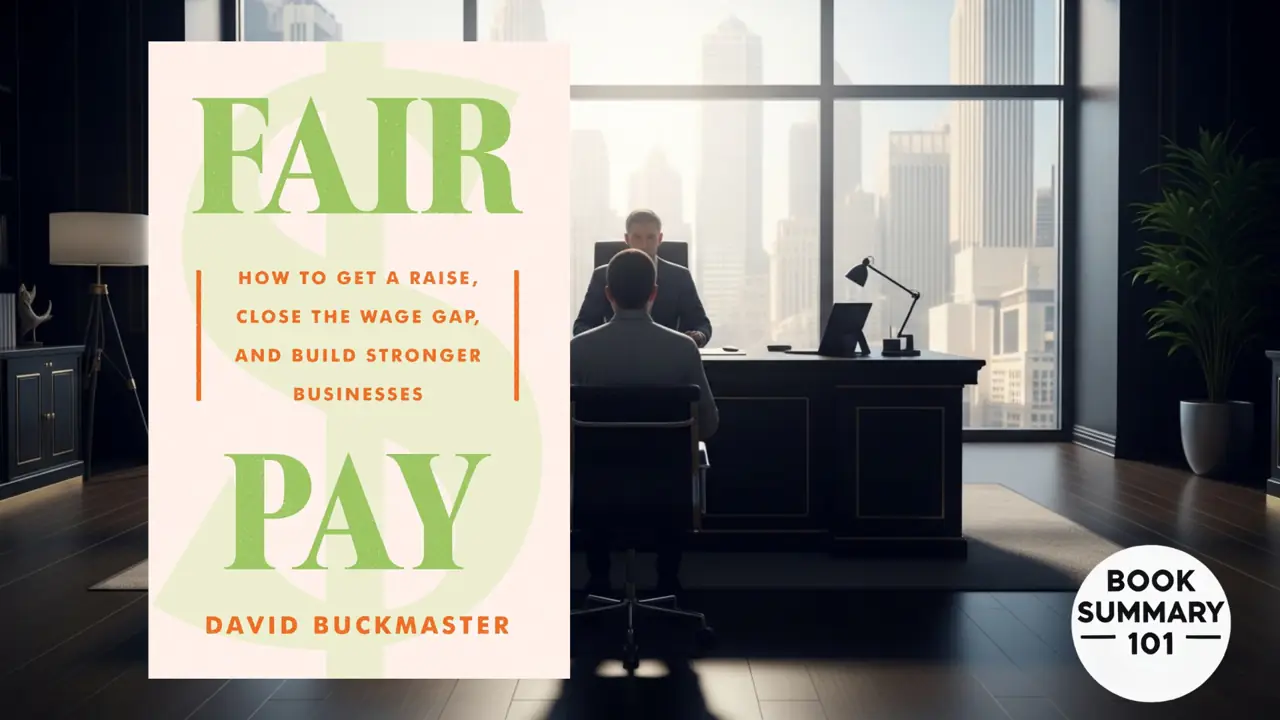
Reading Fair Pay by David Buckmaster was a visceral experience because it retroactively validated the anger I felt in that room. It turns out, that graph wasn’t science. It was a hallucination. Buckmaster, a former insider who managed compensation for giants like Nike and Starbucks, pulls back the curtain on the “black box” of corporate payroll. He reveals that what companies call “market rate” is often just a circular echo chamber of bad data used to suppress wages.
This wasn’t just a business book for me; it was an explanation of why the modern contract between employer and employee feels so broken.
The Hallucination of the “Market Rate”
The most startling revelation Buckmaster offers—and the one that completely dismantles standard corporate rhetoric—is that the “Market Rate” doesn’t actually exist. We tend to think of salary data like stock prices: a hard number determined by supply and demand in real-time.
Buckmaster argues it’s more like a group of students cheating on a test where no one studied.
Imagine a room full of artists trying to draw a perfect circle. The first artist draws a wobbly, imperfect circle. The second artist traces that drawing. The third traces the tracing. By the time you get to the hundredth artist, the shape is a distorted mess, yet everyone claims it is the “standard.”
This is how salary surveys work. Companies buy data from third-party aggregators to see what other companies pay. Those other companies are doing the exact same thing. If one major player suppresses wages or creates a low “band” for a job title, the data feeds back into the system, dragging down the average for everyone.
The “Peer Group” Trick
The book exposes a specific dirty trick regarding “peer groups.” When determining your pay, a tech company might not compare themselves to other high-paying tech giants. Instead, they might dilute the data by including “general industry” companies—like retail chains or manufacturing plants—in their comparison set.
By widening the pool to include lower-margin businesses, they mathematically justify paying a software engineer or a marketing director significantly less, all while claiming they are “competitive.” When a boss says, “This is the market rate,” they are really saying, “This is the average of what we and our carefully selected competitors are getting away with paying.”
The Double Standard: “Cost” vs. “Value”
One section of the book that struck a particular nerve was the distinction between how executives are paid versus how the rest of us are paid. Buckmaster highlights a hypocritical divide in corporate philosophy.
When a Board of Directors negotiates a CEO’s salary, they look at value creation. They ask, “How much value will this leader bring to the stock price?” The potential upside is the driving metric, leading to massive, uncapped compensation packages.
However, when that same company calculates your salary, they switch the metric to cost of labor. They don’t ask what you produce; they ask, “What is the absolute minimum we can pay to keep a body in this seat?”
This shift from value to cost is why you can generate millions in revenue for your department but still be capped at a 3% raise. You are viewed as a utility bill—an expense to be minimized—while the executive suite is viewed as an investment portfolio.
The “Total Rewards” Trap
One of the most insidious concepts Buckmaster attacks is the corporate obsession with “Total Rewards.” You have likely heard this term during onboarding. It’s the pie chart HR shows you that combines your actual salary with health insurance, 401k matches, gym memberships, and—I’m not kidding—the “culture” of the office.
Fair Pay argues that this is a linguistic sleight of hand designed to distract you from the cash column.
Buckmaster points out that you cannot pay your rent with “culture.” You cannot buy groceries with a subsidized gym membership you don’t use. Yet, companies spend millions on “perks” rather than payroll because perks are cheaper and tax-advantaged for them, while salary compounds year over year.
I found this section particularly vindicating. It highlights how employers monetize the “privilege” of working for a cool brand (like Nike or Apple) to justify sub-par wages. They are essentially charging you an “employment tax” for the prestige of having their logo on your resume.
The Tyranny of the Bell Curve
Perhaps the most damaging tool in the HR toolkit described in the book is the “Forced Distribution” model, often represented as a bell curve.
Here is the nightmare scenario: You have a team of ten high-performers. They all crushed their goals. But the compensation model dictates that only two people can be rated “Exceeds Expectations” (getting the big bonus), six must be “Meets Expectations,” and two must be rated “Needs Improvement” (getting zero raise).
Buckmaster exposes this as a morale-killing absurdity. It forces managers to artificially deflate the ratings of good employees just to satisfy a mathematical model created by a consultant 20 years ago. It turns colleagues into competitors. If I know there is a finite amount of “Exceeds” ratings available, I am statistically incentivized not to help my teammate succeed.
Why Your 3% “Merit Increase” is Actually a Fine
There was a specific chapter that made me want to throw the book across the room—not because it was bad, but because it was painfully true. Buckmaster tears apart the concept of the annual “merit increase.”
For decades, we’ve been conditioned to view a 3% raise as a reward for a job well done. We high-five over it. We thank our managers.
Fair Pay frames this differently: In an economy where inflation exists (even low inflation), a flat salary is a decaying asset. If the cost of living rises by 2% and your “merit” raise is 3%, your actual reward for busting your back all year is a 1% gain. If inflation hits 4% or 5%—as we have seen recently—you have effectively paid the company for the privilege of working there.
Buckmaster challenges the corporate laziness that buckets “cost of living” adjustments with “performance rewards.” By conflating the two, companies manage to keep payrolls stagnant while making employees feel grateful for barely breaking even. It’s a psychological trick that stops us from demanding real growth.
How to Weaponize This Knowledge Tomorrow
So, how do you use this without getting fired? You can’t just walk into your boss’s office and scream, “The market is a lie!”
Here is how you apply Buckmaster’s insights practically. Next time you are in a review, stop arguing about your performance. If the system is rigged by data, you need to attack the data quality. When they quote the “market rate,” ask specific, uncomfortable questions about their “compensation philosophy.”
Ask these questions to disrupt the script:
- “Which specific peer group of companies are included in this salary band? Are we comparing ourselves to industry leaders or general averages?”
- “What is my Compa-Ratio?” (This is the HR term for where you sit in the salary range. 1.0 is the midpoint. If you are a high performer sitting at 0.85, you are empirically underpaid based on their own math).
- “How old is this salary survey data?” (It is often 1-2 years old, meaning it lags behind inflation significantly).
By moving the conversation from “I deserve more” to “Your calculator is broken,” you force the company to verify their math. Often, they can’t. That hesitation is your leverage.
My Final Thoughts on Fair Pay
I finished Fair Pay feeling less like an employee and more like an informed investor. The book strips away the fear that comes with salary negotiation because it shows you that the person across the table isn’t holding a royal flush; they’re holding a handful of Uno cards and hoping you don’t notice.
It changed how I view the exchange of labor for money. It is not a benevolence granted by a corporation; it is a business deal that requires rigorous auditing. If we stop accepting “that’s just the rate” as a valid argument, we force the market to actually become a market.
If you work for a living, or if you hire people who work for a living, you are currently operating on a map drawn by people who were lost. This book is the compass you didn’t know you needed.
Here is the question that lingers for me, and I’d love to know your stance:
Buckmaster suggests that total radical transparency (everyone knowing everyone’s salary) is the only way to fix the wage gap. Is that a price you are willing to pay for fairness, or is your privacy worth the inequality?