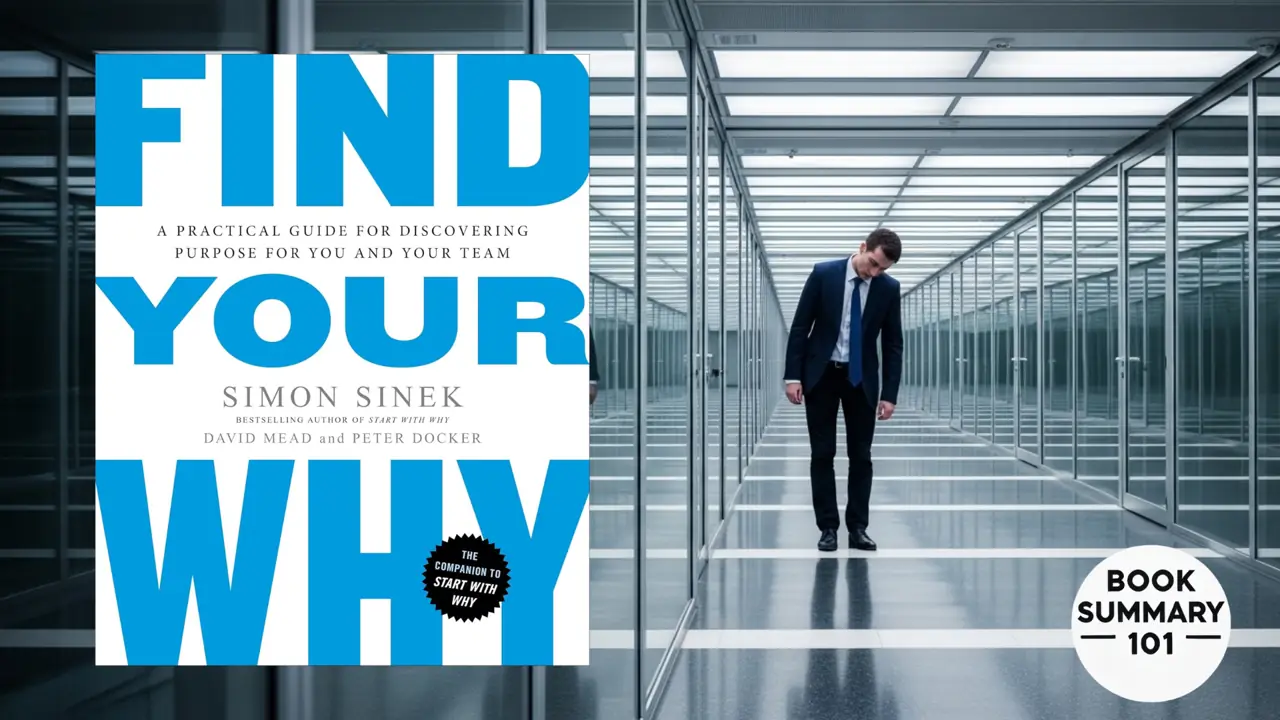
Have you ever woken up on a Tuesday morning, stared at the ceiling, and thought, “What am I actually doing with my life?”
I definitely have.
For a long time, I felt like I was drifting. I had a job, I had hobbies, and on paper, everything looked fine. But deep down, it felt like I was just going through the motions – like a hamster on a wheel that was well-oiled but going nowhere.
I had watched Simon Sinek’s famous TED Talk. I had even read his first book, Start With Why. I understood the concept intellectually. I knew I needed a purpose. But I had a massive problem:
I had no idea how to actually find it.
I was waiting for a lightning bolt of inspiration that never came.
That’s when I picked up Find Your Why by Simon Sinek, David Mead, and Peter Docker. If Sinek’s first book was the philosophy, this book is the manual. It felt like sitting down with a patient friend who said, “Okay, stop overthinking. Here are the exact steps to figure this out.”
It wasn’t magic; it was a process. And it changed how I look at everything.
Why Should You Even Bother Reading It?
This book isn’t just for CEOs or startup founders trying to write a mission statement.
This is for you if:
- You feel unfulfilled at work and can’t pinpoint why.
- You are a team leader trying to get everyone pulling in the same direction.
- You are going through a transition in life and need a “North Star” to guide your next move.
In a world where we are obsessed with the “What” (our job titles, our salaries, our to-do lists), this book forces you to stop and define the “Why.” It is the antidote to burnout.
- Why Should You Even Bother Reading It?
- The Roadmap to Discovering Your Purpose
- 1. The Golden Circle (The Target)
- 2. The Partner (The Mirror Analogy)
- 3. Mining for Gold (Gathering Stories)
- 4. Connecting the Dots (Pattern Recognition)
- 5. The Why Statement (The Formula)
- 6. The “Hows” (Your Values in Action)
- My Final Thoughts
- Join the Conversation!
- Frequently Asked Questions (The stuff you’re probably wondering)
The Roadmap to Discovering Your Purpose
Finding your purpose isn’t about inventing something new or aspiring to be someone you aren’t; it’s about looking backward to discover who you’ve always been. To make this easier to digest, I’ve broken down the book’s actionable framework into the core concepts that reshaped my thinking.
1. The Golden Circle (The Target)
Before we start digging, we have to look at the map. Sinek bases everything on “The Golden Circle.” Imagine a target or a bullseye with three rings.
- The Outer Ring (WHAT): Every person and company knows What they do. These are the products you sell or the job tasks you perform.
- The Middle Ring (HOW): Some people know How they do it. These are your unique values, your “secret sauce,” or your strengths.
- The Center (WHY): Very few people know Why they do what they do. This is the purpose, cause, or belief that drives you.
The Biology of It:
Sinek explains that this isn’t just fluffy marketing talk; it matches how our brains are built. The outer “What” corresponds to our Neocortex (responsible for rational thought and language). The inner “Why” corresponds to the Limbic brain (responsible for feelings like trust and loyalty, but no language).
This is why “gut feelings” are so hard to explain. Your gut knows the “Why,” but your brain struggles to put it into words.
Specific Example:
Think about Apple. If they were like everyone else, their marketing (The What) would sound like: “We make great computers. They are beautifully designed and user-friendly. Want to buy one?”
But Apple starts with the Why: “Everything we do, we believe in challenging the status quo. We believe in thinking differently (Why). The way we challenge the status quo is by making our products beautifully designed and user-friendly (How). And we happen to make great computers (What).”
Simple Terms:
Your “Why” is the emotional core of who you are; your “What” is just the tangible proof of that belief.
The Takeaway:
People don’t buy what you do; they buy why you do it.
2. The Partner (The Mirror Analogy)
Here is the hardest rule in the book: You cannot find your Why alone.
It is physically impossible. Sinek uses a brilliant analogy here: You can’t see your own eyebrows.
No matter how hard you try, you cannot see your own face without a reflection. In the same way, you are too close to your own life to see the patterns. You need a mirror. In this process, the mirror is a partner—someone who can listen objectively.
This shouldn’t be your spouse or your best friend who knows you too well. It needs to be someone curious, observant, and willing to ask, “Tell me more,” without trying to “fix” you or give advice.
Specific Example:
Imagine you are telling a story about a time you helped a stranger. You might think the point of the story is that you are “nice.” A good partner will dig deeper and realize the point of the story is actually that you “love to solve complex problems for people who are stuck.” You can’t see that distinction; they can.
Simple Terms:
You need an objective observer to spot the themes in your life that you are blind to.
The Takeaway:
Don’t try to DIY this in isolation; find a partner who will listen to your stories and reflect back what they hear.
3. Mining for Gold (Gathering Stories)
So, what do you and your partner actually do? You go mining.
The “Why” discovery process is essentially a memory excavation. You aren’t looking for what you want to be in the future; you are looking for who you were at your best.
You need to come up with specific stories from your life. Sinek advises gathering about 10 stories that had a significant impact on you. These should be:
- Specific (a specific moment in time, not a general pattern).
- Emotional (happy memories where you felt alive, or sad memories where you learned a hard lesson).
The Analogy:
Think of your memory as a riverbed. You are reaching into the dirt and pulling out rocks. Most are just rocks, but some are gold nuggets. Your job is to pull out the nuggets (the specific, emotional memories) and lay them on the bank.
📖 “Our Why is not what we aspire to be. It is who we are at our natural best.”
Specific Example:
Don’t say, “I really liked my old boss.” That’s vague.
Instead, tell the story: “I remember it was a rainy Tuesday, and I messed up a huge report. I was terrified. But my boss sat me down, didn’t yell, and spent two hours teaching me how to fix it. I felt safe and empowered.”
Simple Terms:
Your purpose is hidden in your past memories, specifically the moments where you felt the most fulfilled.
The Takeaway:
Generalities hide the truth; specific stories reveal the data you need to find your Why.
4. Connecting the Dots (Pattern Recognition)
Once you have told your stories to your partner, the partner’s job begins. They are looking for the “Golden Thread” that ties everything together.
As you share your stories, your partner should be taking notes, looking for recurring themes. Maybe in every story, you are the one protecting the underdog. Or maybe in every story, you are taking something chaotic and making it organized.
The Analogy:
It’s like looking at a scattering of stars in the sky. Individually, they are just points of light. But if you draw lines between them, you see the constellation. Your partner is the astronomer connecting the stars.
Specific Example:
Let’s say you tell a story about coaching a little league team, helping a sibling with homework, and training a new hire. On the surface, these are different activities. But your partner notices the theme: in all three, you are taking complex information and simplifying it so others can succeed. That is a major clue to your Why.
Simple Terms:
Your “Why” is the single recurring theme that shows up in all the happy moments of your life.
The Takeaway:
We often think our lives are random, but when an outsider looks at the data, a clear pattern of behavior always emerges.
5. The Why Statement (The Formula)
This is the part I loved the most because I’m a sucker for a good template.
The authors don’t want you to write a three-page essay about your purpose. They want one sentence. A single, sharp, actionable sentence that you can memorize and use as a filter for every decision you make.
The Formula:
TO [Contribution] SO THAT [Impact].
- The Contribution: What you actually do for others.
- The Impact: The result of that action.
Specific Example:
Here is Simon Sinek’s actual Why Statement:
“To inspire people to do the things that inspire them so that, together, we can change our world.”
Notice it doesn’t say “To write books” or “To give speeches.” Those are just the What. His Why is inspiring people.
Simple Terms:
Draft a single sentence that clearly states what you give to the world and the effect it has on others.
The Takeaway:
If you can’t articulate your purpose in one sentence, it’s not simple enough to be actionable.
6. The “Hows” (Your Values in Action)
Once you have your Why statement, you aren’t done. You need to know how to bring it to life.
In the book, the authors explain that while you only have one Why, you have multiple “Hows.” These are your core values or your strengths. These are the actions you take to ensure your Why actually happens.
The Analogy:
If your Why is the destination, your Hows are the vehicle and the route you take to get there. They keep you on track.
📖 “Discipline is doing it the way you said you would. Consistency is doing it that way every single time.”
Specific Example:
If your Why is “To challenge the status quo so that we can move society forward,” your “Hows” might be:
- Speak with candor. (Don’t sugarcoat things).
- Look at the problem from a new angle. (Don’t just copy others).
- Take the road less traveled. (Be brave).
These become your code of conduct. If you are about to make a decision that isn’t candid or brave, you know you are violating your Hows, and you will likely feel unfulfilled.
Simple Terms:
Your “Hows” are the daily habits and behaviors that make your “Why” a reality.
The Takeaway:
Your Why is your purpose, but your Hows are your accountability metrics.
My Final Thoughts
Reading Find Your Why felt a bit like cleaning a messy closet. At first, it’s overwhelming. You’re pulling everything out (all those memories), and it looks chaotic. But once you start sorting things into piles, you realize you actually have a wardrobe that makes sense.
The most empowering part of this book is the realization that you don’t need to change who you are. You just need to articulate it. Once you have that “To… So That…” statement, decision-making becomes so much easier. You can look at a job offer or a project and ask, “Does this fit my Why?”
If the answer is no, you have the permission to walk away. And that freedom? That is worth the price of the book alone.
Join the Conversation!
I’d love to hear from you. If you had to guess your “Why” right now without doing the full exercise, what do you think it is? Drop a comment below—let’s see if we can help each other refine them!
Frequently Asked Questions (The stuff you’re probably wondering)
1. Do I need to read Start With Why before reading this book?
Honestly? No. It helps to have the background, but Find Your Why does a great job of recapping the core “Golden Circle” concept in the first chapter. If you are impatient and just want the “how-to” steps, you can start here.
2. Can I really not do this alone? I’m an introvert.
Trust me, I tried. You really can’t. You will inevitably spin your wheels or create a Why that sounds good but isn’t true. Grab a friend, buy them a coffee (or a beer), and ask them to help. It’s actually a great bonding experience.
3. Is this book for individuals or for businesses?
Both! The book is split into sections. There is a specific track for individuals and a specific track for teams/tribes. The exercises differ slightly, but the core logic is exactly the same.
4. How long does the process take?
The book suggests setting aside about 4 to 6 hours for the individual discovery process. It’s not a 10-minute worksheet. It’s a deep dive. For teams, it’s usually a full-day workshop.
5. What if I come up with a Why and I don’t like it?
That usually means it’s not your true Why, or you haven’t refined the words yet. The book emphasizes that the first draft is just a draft. You “try on” your Why statement for a few days. If it doesn’t make you emotional or excited, you go back to the data (your stories) and refine it.