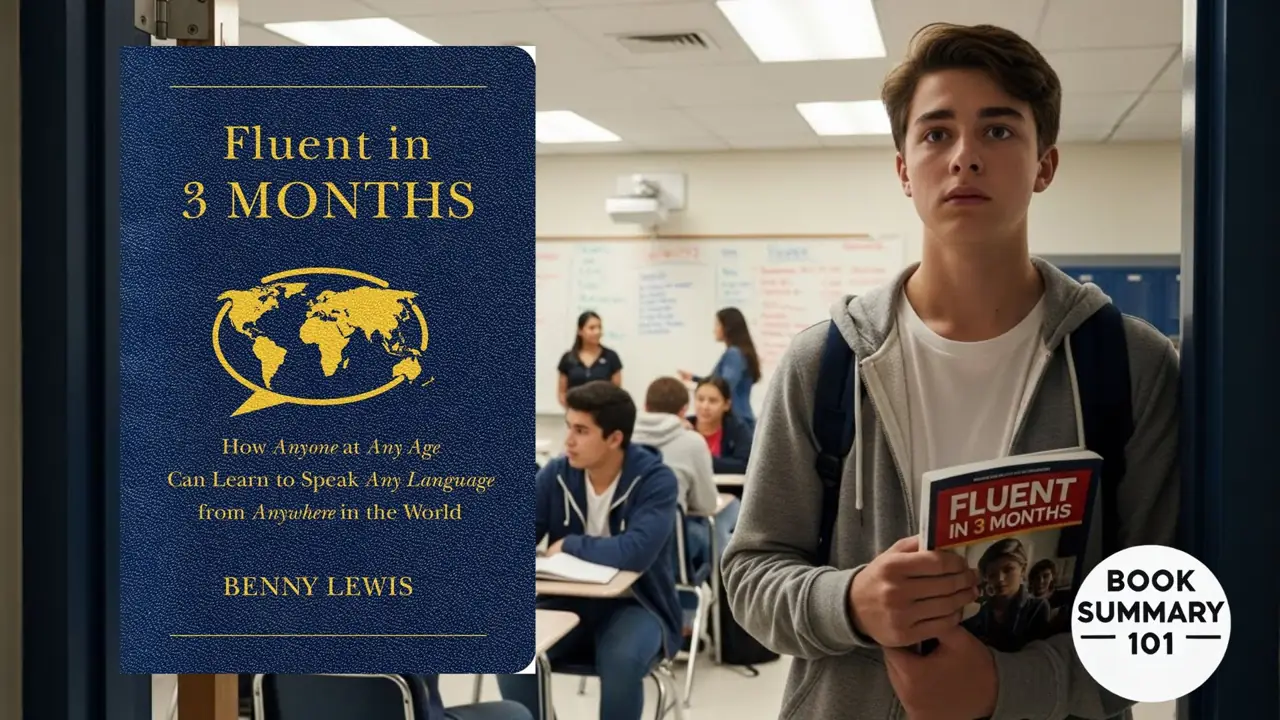
I still remember the feeling of absolute dread walking into my high school Spanish class.
I spent four years—four long years—staring at conjugation tables, memorizing lists of vegetables, and taking multiple-choice tests. By the end of it, on paper, I was an “intermediate” student.
But then I took a trip to Mexico. I walked up to a taco stand, confident I was ready to order. The vendor looked at me, smiled, and asked a simple question.
I froze. My mind went blank. I panicked, mumbled something incoherent, and walked away hungry and humiliated.
For years, I told myself, “I just don’t have the language gene. I’m too old. My brain isn’t wired for this.”
Then I picked up “Fluent in 3 Months” by Benny Lewis. Within the first chapter, I realized something that changed everything: The problem wasn’t my brain. The problem was that I was trying to study a language like it was history or math.
Reading this book felt less like a lecture and more like a pep talk from a friend who knows the secret code. If you’ve ever felt stupid trying to learn a new language, this post is for you.
- Why Should You Even Bother Reading It?
- The Mindset Shifts That Broke My Silence
- 1. Speak From Day One (The “Tarzan” Phase)
- 2. The “Fail Fast” Philosophy
- 3. Build an “Immersion Bubble” at Home
- 4. Hacking Memory with Mnemonics
- 5. Conversational Connectors (The Illusion of Fluency)
- My Final Thoughts
- Join the Conversation!
- Frequently Asked Questions (The stuff you’re probably wondering)
Why Should You Even Bother Reading It?
This book isn’t just for globetrotters or linguistic geniuses. In fact, Benny Lewis (the author) actually failed German in school. He is the self-proclaimed “worst language learner.”
This book is for anyone who has ever given up. Whether you want to reconnect with your heritage, boost your career, or just order that taco without having a panic attack, this book tears down the myth of “talent.” It argues that connection—not perfection—is the point. In our increasingly globalized world, the ability to communicate, even imperfectly, is a superpower.
The Mindset Shifts That Broke My Silence
Before we get into the tactical “how-to,” we have to talk about the “how-to-think.” Benny Lewis doesn’t just give you a list of flashcards; he fundamentally rewires your approach to learning.
These aren’t just study tips; they are the core principles that took Benny from a monolingual struggle-bus to a polyglot who speaks over a dozen languages.
1. Speak From Day One (The “Tarzan” Phase)
Most of us approach language learning like we’re building a house. We think we need to pour the foundation (grammar), build the frame (vocabulary), and put on the roof (perfect pronunciation) before we invite anyone over. We wait months, or even years, before we open our mouths because we’re terrified of looking foolish.
Benny Lewis suggests a totally different approach: The Bike Analogy.
You cannot learn to ride a bike by reading a textbook about physics. You can study balance and velocity all day, but until you get on the seat and wobble around, you aren’t riding.
Lewis argues you must speak from Day One. Not day 100. Day One.
He champions what he calls “Tarzan Speak.” When you start, you won’t sound like a poet. You will sound like a caveman. You might say, “Me… hungry… want… food.”
Is the grammar terrible? Yes.
Did you successfully communicate? Absolutely.
Real-World Example:
Imagine you are learning Italian. Instead of spending two weeks studying the future tense, you go to a local Italian bakery (or hop on a Zoom call with a tutor). You simply point and say, “Pizza. Please.” You have just spoken the language. You have used the tool. That small win creates momentum that a textbook never could.
📖 “There are seven days in a week and ‘someday’ isn’t one of them.”
Simple Terms: Stop preparing to speak and just start speaking, even if you sound silly.
The Takeaway: Communication is the goal, not perfect grammar. If you get your point across, you succeeded.
2. The “Fail Fast” Philosophy
We are conditioned by the school system to view mistakes as “red marks” on a test. An error means a lower grade. In language learning, this fear of mistakes is paralyzed. We stay silent because we don’t want to be wrong.
Lewis flips this on its head. He uses the Toddler Analogy.
Watch a toddler learn to walk. They stand up, take a step, and fall on their face. Do they think, “Wow, I’m really bad at walking, I should probably give up”? No. They laugh, get up, and do it again.
Lewis argues that you should aim to make 200 mistakes a day. If you aren’t making mistakes, you aren’t using the language enough. Mistakes aren’t failures; they are the data points your brain needs to calibrate.
Real-World Example:
Benny tells a hilarious story about his time in Spain. He wanted to tell a group of people he was embarrassed (which is avergonzado in Spanish). Instead, he used the “false friend” word embarazada.
He loudly announced to a room full of people that he was pregnant.
Did everyone laugh? Yes. Did he die of shame? No. In fact, that moment of shock ensured he never, ever forgot that word again. The mistake cemented the lesson better than a flashcard ever could.
Simple Terms: Go out of your way to make mistakes as quickly as possible.
The Takeaway: Perfectionism is the enemy of fluency; embrace the awkward moments because they help you remember.
3. Build an “Immersion Bubble” at Home
A common excuse is, “I can’t learn French because I don’t live in Paris.” We assume that crossing a border magically uploads the language into our brains through osmosis.
But we’ve all met expats who have lived in a foreign country for years and still can’t speak a word of the local language. Being there isn’t enough. Conversely, you don’t need to be there to immerse yourself.
Think of it like The Fish Tank.
You don’t need to throw yourself into the ocean to get wet; you just need to fill your own tank. You can create a virtual immersion environment right in your living room.
Real-World Example:
You can do this today without spending a dime.
- Change your phone’s interface language to the target language. Now, every time you check Instagram, you’re learning navigation vocabulary.
- TuneIn Radio: Listen to live radio stations from the country you’re studying while you wash dishes.
- Netflix: Watch shows with the audio in the target language and subtitles in the target language (no English allowed!).
You aren’t “studying”; you are living your normal life, just with a different soundtrack.
Simple Terms: You don’t need a plane ticket; you just need to change your environment to force contact with the language.
The Takeaway: Immersion is a choice you make, not a location you visit.
4. Hacking Memory with Mnemonics
Rote memorization (repeating a word 50 times) is boring and ineffective. It’s like trying to hold water in your hands; it eventually slips through.
Benny suggests using Mental Glue, otherwise known as mnemonics. The crazier, more violent, or more sexual the image, the stickier the glue. Our brains are wired to remember vivid imagery, not abstract sounds.
Real-World Example:
Let’s say you are learning Spanish and want to remember the word caber (which means “to fit”).
Repeating “caber = to fit” is dull.
Instead, imagine a massive cab (taxi) trying to fit inside a tiny bear. Picture the bear grunting, the taxi tires screeching, the metal crunching as the cab tries to squeeze into the bear.
Cab + Bear = Caber.
The next time you need to say “to fit,” that ridiculous image of the taxi and the bear will pop into your head instantly.
📖 “Language learning is not about being smart; it’s about being imaginative.”
Simple Terms: Connect new words to funny or weird mental images to make them unforgettable.
The Takeaway: Your imagination is a more powerful tool for memory than repetition ever will be.
5. Conversational Connectors (The Illusion of Fluency)
This is my absolute favorite “hack” from the book. When we listen to native speakers, we think they are speaking in a constant stream of complex thoughts. But if you listen closely, a huge percentage of what they say is just “fluff.”
Words like “um,” “well,” “actually,” “you know,” and “in my opinion” are the Mortar between the Bricks.
They hold the conversation together and, crucially, they buy you thinking time.
When you pause in a foreign language to think of a word, the silence can feel awkward. It screams, “I am a beginner!” But if you fill that silence with a native-sounding filler word, you sound thoughtful, not lost.
Real-World Example:
If you are learning French, instead of standing there silently panicking while you search for a verb, learn to say “Alors…” (So…) or “Franchement…” (Frankly…).
If someone asks you a hard question, starting your sentence with, “That is an interesting question, let me think…” in the target language gives you five precious seconds to formulate your answer, all while sounding completely fluent.
Simple Terms: Learn the filler words first so you can keep the conversation flowing while you think.
The Takeaway: Sounding fluent is often just about avoiding awkward silences.
My Final Thoughts
Reading Fluent in 3 Months was a relief. It took the pressure off. I realized that I didn’t need to be a genius; I just needed to be brave enough to sound like a toddler for a few weeks.
This book empowers you to take control of your learning. It moves you from the passive “student” role to the active “speaker” role. It reminds us that language is a messy, human, beautiful thing, and the only way to fail is to keep your mouth shut.
Join the Conversation!
What is the one language you’ve always wanted to learn, and what has stopped you from starting until now? Drop a comment below—I’d love to hear your story!
Frequently Asked Questions (The stuff you’re probably wondering)
1. Can I really become fluent in just 3 months?
“Fluent” is a tricky word. Will you be debating philosophy or writing legal contracts in 3 months? Probably not. But can you reach “social equivalency”—where you can navigate daily life, have drinks with friends, and travel confidently? Absolutely. The title is about reaching conversational fluency, not native-level perfection.
2. Is this book only for European languages?
No! While Benny often uses European languages as examples, the methods (mnemonics, speak from day one, immersion) apply to any language, whether it’s Japanese, Arabic, or Swahili.
3. Do I need to be an extrovert to use this method?
It helps, but it’s not required. If you are shy about speaking to strangers, Benny suggests using online tutors (like iTalki) where you are in a safe, paid environment to practice without the social anxiety of approaching random people.
4. Is this method expensive?
Not at all. One of the core tenets of the book is that you don’t need expensive software like Rosetta Stone. Most of the resources he recommends (Anki for flashcards, free language exchanges, online radio) are free or very cheap.
5. What if I’m “too old” to learn?
Benny dedicates a whole section to debunking this. Adults are actually better learners than kids in many ways because we have discipline, we understand how grammar works conceptually, and we have better vocabularies in our native tongues to use as hooks. Age is just a number; it’s not a barrier.