Let’s be honest for a second. We have all been there.
You walk into a room—maybe it’s a networking mixer, a friend’s birthday party, or a new office. You scan the crowd. Everyone seems to be laughing, clinking glasses, and having the time of their lives.
And then there’s you.
You clutch your drink like a life preserver. You frantically check your phone, pretending you have a very important email to answer, just to avoid making eye contact.
The thought of walking up to a stranger and saying “Hello” feels about as appealing as walking onto a battlefield without armor.
I used to be exactly like that. I thought “charisma” was something you were born with, like blue eyes or being tall. I thought I was just destined to be the quiet observer.
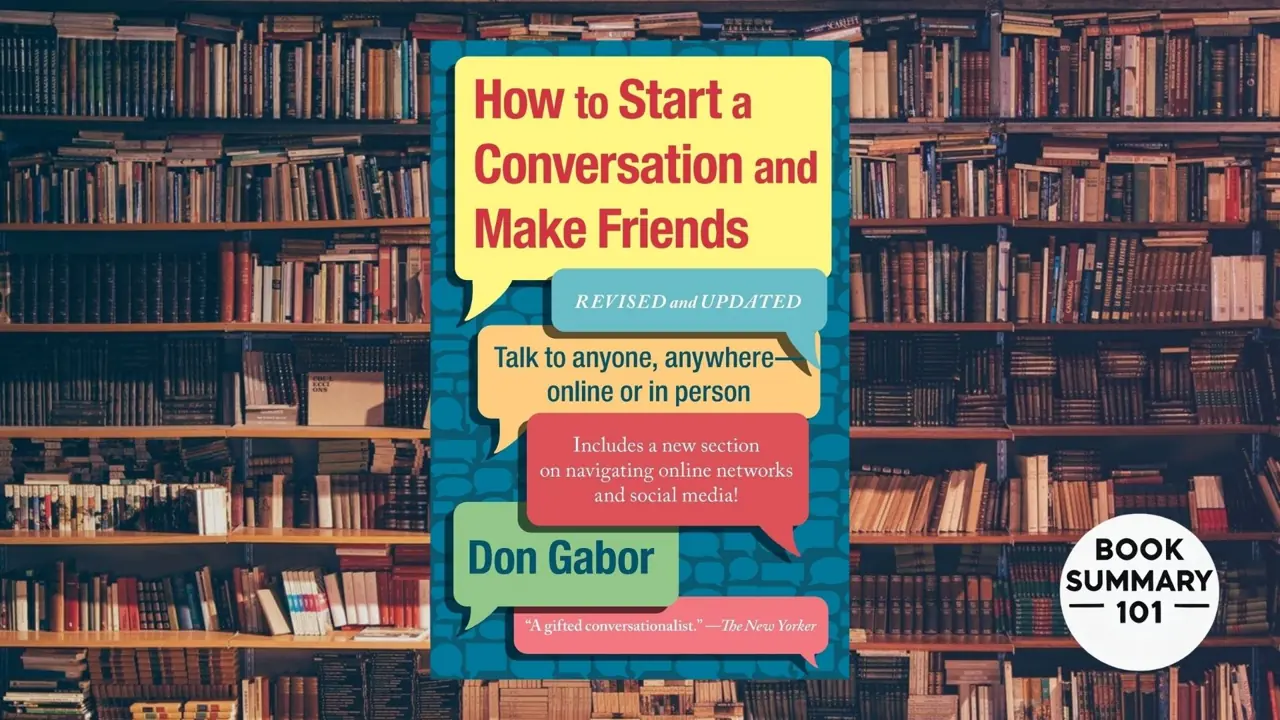
Then I stumbled upon How To Start A Conversation And Make Friends by Don Gabor.
I expected a dry textbook. What I got instead felt like a pep talk from a wise, socially savvy uncle. It wasn’t about changing who I was; it was about learning a set of tools.
This book taught me that conversation isn’t magic. It’s a skill, just like driving a car or cooking a steak. And if it’s a skill, it can be learned.
Ready to delete “awkward silence” from your vocabulary? Let’s dive in.
- Why Should You Even Bother Reading It?
- The Mechanics of Connection: Transforming Strangers into Friends
- 1. Sending the “Green Light” Signals
- 2. The “Low-Hanging Fruit” Opening Lines
- 3. Playing “Catch” (Closed vs. Open Questions)
- 4. The Detective’s Ear (Active Listening)
- 5. The Drawbridge (Self-Disclosure)
- 6. Landing the Plane (Ending the Conversation)
- My Final Thoughts
- Join the Conversation!
- Frequently Asked Questions (The stuff you’re probably wondering)
Why Should You Even Bother Reading It?
You might think, “I know how to talk, I do it every day.” But there is a massive difference between talking and connecting.
This book is a must-read for:
- The Introvert: Who wants to make friends but feels drained by the idea of “small talk.”
- The Professional: Who needs to network but feels fake doing it.
- The Newcomer: Anyone who just moved to a new city and needs to build a social circle from scratch.
In a world where we spend more time staring at screens than faces, Gabor’s core message is more relevant than ever: Human connection is the biggest predictor of happiness, and it all starts with a simple conversation.
The Mechanics of Connection: Transforming Strangers into Friends
Don Gabor breaks down social interaction into manageable, bite-sized pieces. It’s not about memorizing pickup lines; it’s about understanding the psychology of engagement.
Here are the 6 core concepts that will turn you into a conversational pro.
1. Sending the “Green Light” Signals
Imagine you are driving down a dark road. You see a house with all the lights off and the shades drawn. Do you knock on the door? Absolutely not. It looks uninviting.
Now imagine a house with the porch light on, the door cracked open, and music playing. That’s approachable.
Gabor teaches that before you ever say a word, your body is screaming a message. Many of us unknowingly walk around with our “lights off”—arms crossed, looking at the floor, frowning in concentration. We are signaling: Stay away.
To start conversations, you must become the house with the porch light on. Gabor uses the acronym SOFTEN:
- Smile
- Open Posture (no crossed arms)
- Forward Lean (shows interest)
- Touch (a handshake)
- Eye Contact
- Nod
Real-World Example:
Think about the last time you were at a coffee shop. You likely avoided the barista who was scowling at the espresso machine, but you happily chatted with the one who looked up, smiled, and made eye contact as you approached the register. Be the second barista.
📖 “Body language is a conversation that goes on even when you aren’t speaking.”
Simple Terms: Look approachable and happy before you even open your mouth.
The Takeaway: Your non-verbal cues act as a traffic light; make sure yours is set to “Green” so people feel safe approaching you.
2. The “Low-Hanging Fruit” Opening Lines
The biggest fear most people have is, “What do I say first?” We agonize over trying to be clever or funny.
Gabor suggests a much simpler approach: Pick the low-hanging fruit.
Imagine you are standing under an apple tree. You don’t need a ladder to get the apples at the very top; you just grab the ones right in front of your face.
In conversation, the “low-hanging fruit” is the shared reality between you and the other person. Gabor suggests using the Situation, the Other Person, or Yourself to break the ice.
Real-World Example:
You are standing in a long line at a concert.
- The Situation: “I can’t believe how long this line is! Have you seen this band before?”
- The Other Person: “That is a cool vintage t-shirt. Where did you find it?”
- Yourself: “I’m so glad I brought a jacket; it’s freezing out here.”
Simple Terms: Comment on what is happening right now, right where you are.
The Takeaway: You don’t need a brilliant opening line; you just need to observe your environment and voice a thought about it.
3. Playing “Catch” (Closed vs. Open Questions)
Conversation is exactly like a game of catch.
If you throw a ball to someone and they just let it hit their chest and drop to the floor, the game is over. That is what happens when you ask Closed Questions (questions that can be answered with a simple “Yes” or “No”).
- You: “Did you have a good weekend?”
- Them: “Yes.”
- You: (Panic sets in).
To keep the game of catch going, you need Open-Ended Questions. These are balls that the other person has to catch and throw back. These questions usually start with Who, What, Where, When, How, or Why.
Real-World Example:
Instead of asking, “Did you like the movie?” (Closed), try asking, “What was your favorite scene in the movie and why?” (Open). The second question forces them to tell a mini-story, giving you more “hooks” to keep the conversation alive.
Simple Terms: Ask questions that require an explanation, not just a one-word answer.
The Takeaway: Be a journalist; use the “W” words to encourage the other person to share details and feelings.
4. The Detective’s Ear (Active Listening)
Most people don’t listen; they just wait for their turn to speak.
Gabor suggests you need to listen like a Detective. A detective isn’t just hearing the words; they are looking for clues, keywords, and emotional undertones. They are hunting for “free information.”
When someone speaks, they often drop little breadcrumbs about what they really want to talk about. Your job is to spot those breadcrumbs and pick them up.
Real-World Example:
- Them: “I just got back from a trip to Chicago, and I’m exhausted because the flight was delayed.”
- Bad Listener: “I hate flying. One time I…” (Hijacking the topic).
- Detective Listener: “Oh no, delays are the worst! But aside from the flight, how was Chicago? Did you go for business or fun?”
By picking up on the keyword “Chicago,” you show you value their experience.
📖 “The most interesting person in the room is usually the one who is most interested in others.”
Simple Terms: Listen intently to find the “hooks” or topics the other person is excited about.
The Takeaway: Make the other person feel like the most important person in the room by focusing entirely on their story, not your rebuttal.
5. The Drawbridge (Self-Disclosure)
Imagine a castle with a moat. If you keep the drawbridge up, you are safe, but no one can visit you. If you lower it, you are vulnerable, but you can make allies.
Self-disclosure is lowering the drawbridge.
If you only ask questions, you are an interrogator. If you only talk about yourself, you are a narcissist. Gabor argues for a healthy balance. To move from “acquaintance” to “friend,” you must reveal things about yourself—your opinions, your history, your feelings.
However, you don’t drop the bridge all at once. You lower it inch by inch. Start with facts, move to opinions, and eventually share feelings.
Real-World Example:
- Level 1 (Fact): “I work in marketing.”
- Level 2 (Opinion): “I think marketing is fascinating, but it can be stressful.”
- Level 3 (Feeling): ” honestly, I’ve been feeling a bit burnt out lately and I’m thinking of making a change.”
Simple Terms: You have to share a little bit of your true self to get the other person to trust you.
The Takeaway: Vulnerability creates intimacy; don’t be afraid to share your personal thoughts once rapport is established.
6. Landing the Plane (Ending the Conversation)
We have all been trapped in a conversation that has run its course. It gets awkward. You start shifting your weight. You look for an escape route.
Gabor compares ending a conversation to landing a plane. You don’t just cut the engines and nose-dive (walking away abruptly). You need a smooth descent.
The goal is to leave the person feeling good, not rejected. To do this, you need a three-step exit:
- Signal the end (check watch, mention a task).
- Summarize/Validate (“It was great hearing about your new puppy”).
- Future Action (“Let’s catch up next week”).
Real-World Example:
“I promised I’d say hi to the host before I leave, but I really enjoyed talking to you about your travels. I hope you have a great time in Italy!”
Simple Terms: wrap up the chat politely while the energy is still high.
The Takeaway: Always exit a conversation before it becomes boring, and leave the other person with a compliment.
My Final Thoughts
Reading How To Start A Conversation And Make Friends felt like someone finally handed me the manual for being a human being.
The most empowering realization I had was that everyone else is just as nervous as I am. That person standing alone by the buffet isn’t “aloof” or “too cool”—they are likely terrified and waiting for someone like you to save them.
By taking the initiative, you aren’t annoying people; you are rescuing them. You are the hero of the party.
This book strips away the mystery of charisma. It’s not about being the funniest person in the room. It’s about being the most interested person in the room.
Join the Conversation!
I’d love to hear from you. What is your absolute favorite “go-to” question to break the ice at a party? Do you ask about their job, their hobbies, or something totally random? Let me know in the comments below!
Frequently Asked Questions (The stuff you’re probably wondering)
1. Is this book only for shy people?
Not at all. While it’s a lifesaver for the shy, it’s also great for extroverts who talk too much and need to learn how to listen and build deeper connections rather than just surface-level chatter.
2. Is the advice dated?
The book was originally written a few decades ago, but human psychology hasn’t changed. The examples might reference older technology, but the principles of eye contact, empathy, and open-ended questions are timeless.
3. Do I need to be funny to make friends?
Nope! Gabor actually warns against trying too hard to be a comedian. Being authentic, kind, and a good listener is far more attractive to potential friends than being a “performer.”
4. What if I try these tips and get rejected?
It happens! Gabor addresses this. Sometimes people are just having a bad day. The key is not to take it personally. If you get a “Red Light,” just smile and move on to someone with a “Green Light.”
5. Can I use these techniques for dating?
100%. The foundation of a romantic relationship is friendship and conversation. The “SOFTen” technique and the art of self-disclosure are critical for dates.