I have a confession to make. For years, I struggled with “analysis paralysis.”
Whether it was launching a new project, making a career move, or even just deciding what to write about next, I would freeze. I was obsessed with getting it perfect. I thought that if I just gathered enough data, the “right” answer would magically appear.
Spoiler alert: It never did. I just wasted time.
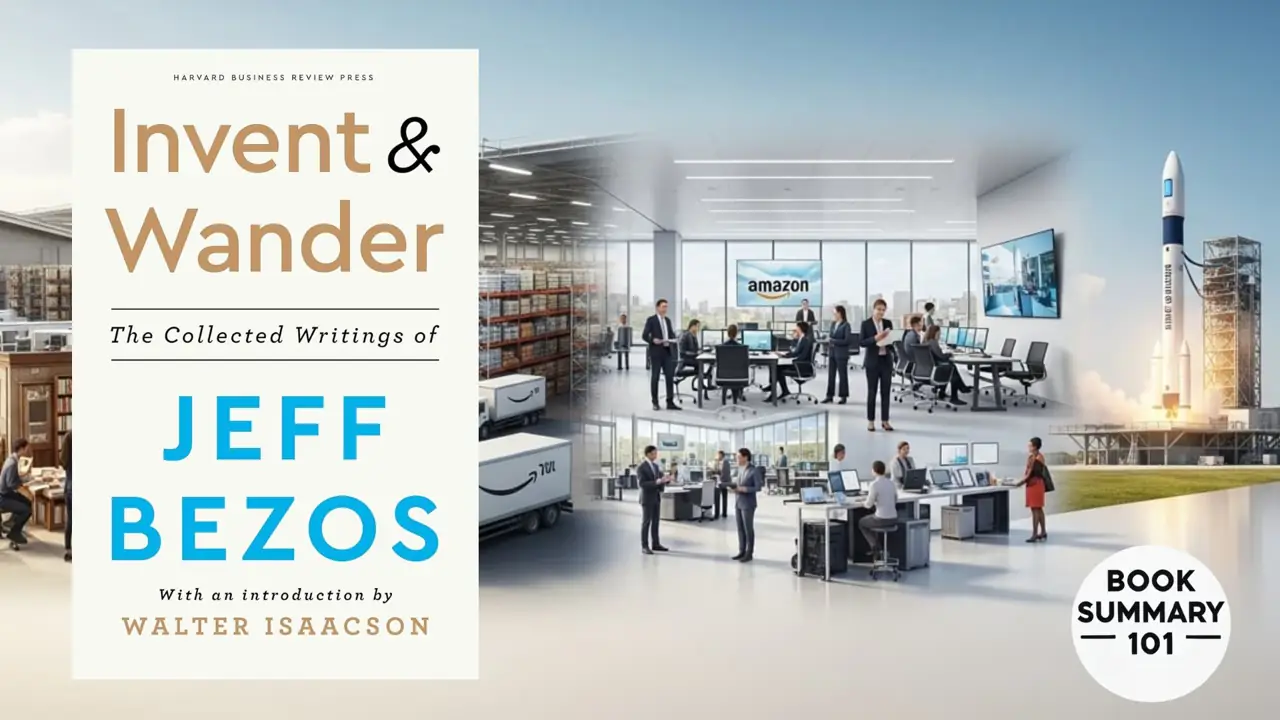
Then, I picked up Invent and Wander: The Collected Writings of Jeff Bezos.
I honestly expected a dry business manual full of jargon about supply chains and stock prices. What I found instead was a surprisingly personal, deeply philosophical guide on how to think clearly.
Reading this book felt less like a lecture and more like sitting down for a coffee with a mentor who has already made every mistake in the book—and learned how to turn them into gold. It completely shifted how I view failure, time, and decision-making.
If you’ve ever felt stuck in the weeds or afraid to take a risk, this summary is for you.
- Why Should You Even Bother Reading It?
- The “Day 1” Philosophy and the Art of High-Velocity Living
- 1. Day 1 vs. Day 2 (Staving Off Death)
- 2. The “One-Way” vs. “Two-Way” Door Decisions
- 3. Customer Obsession (Looking Out, Not In)
- 4. The Virtue of Wandering (Efficiency isn’t Everything)
- 5. Missionaries vs. Mercenaries
- 6. Focus on What Doesn’t Change
- My Final Thoughts
- Join the Conversation!
- Frequently Asked Questions (The stuff you’re probably wondering)
Why Should You Even Bother Reading It?
You might be thinking, “I’m not a tech CEO, and I don’t plan on building a rocket ship. Why does this matter to me?”
Here’s the thing: this book isn’t really about Amazon.
It’s about a mindset. It is perfect for entrepreneurs, creatives, managers, or anyone who wants to operate at a higher level.
If you want to understand how to prioritize what actually matters, how to speed up your decision-making without being reckless, and how to stay innovative even when you’re successful, the core message of this book is indispensable in today’s fast-paced world.
The “Day 1” Philosophy and the Art of High-Velocity Living
Jeff Bezos doesn’t just get lucky; he operates on a specific internal operating system that drives everything he does. Before we dive into the specific tactics, you need to understand the framework that holds them all together—a relentless focus on keeping the energy of a startup alive, no matter how big you get.
1. Day 1 vs. Day 2 (Staving Off Death)
The most famous concept in the book is the idea of “Day 1.”
Imagine a scrappy startup. Everyone is excited. Speed is critical. You take risks because you have nothing to lose. You are obsessed with the customer because one bad review could kill you. That is Day 1.
Now, imagine a massive, old corporation. People are more worried about following procedures than solving problems. Innovation is slow because no one wants to rock the boat. Meetings take weeks to schedule. That is Day 2.
Bezos uses a stark analogy here: Day 2 is stasis. Followed by irrelevance. Followed by excruciating, painful decline. Followed by death.
It sounds dramatic, but it’s true. Entropy (disorder) is the natural state of the universe. If you stop pushing, your energy dissipates. To survive, you must fight to stay in Day 1, even if you are a massive company.
Real-World Example:
Think about Kodak or Blockbuster. They entered Day 2. They focused on protecting their existing profits (film and late fees) rather than obsessing over what the customer actually wanted (digital photos and streaming). They stopped wandering and started managing. Amazon fights this by maintaining a startup culture even with thousands of employees.
Simple Terms:
Never get comfortable; act like a hungry startup every single day.
The Takeaway:
Success is not a destination where you get to relax. Success is a constant battle against slowing down.
2. The “One-Way” vs. “Two-Way” Door Decisions
This was the biggest “lightbulb moment” for me regarding my analysis paralysis.
Bezos explains that we treat all decisions as if they are catastrophic if we get them wrong. But they aren’t.
He categorizes decisions into two types of doors:
- Type 1 (One-way doors): These are consequential and irreversible. If you walk through, you can’t go back. (e.g., selling your company, quitting your job without savings). These require deep analysis.
- Type 2 (Two-way doors): These are reversible. If you walk through and don’t like what you see, you can just walk back out. (e.g., trying a new pricing tier, changing the color of a button on your website).
The problem is that most large organizations—and most anxious people—use the heavy, slow Type 1 process for every decision, including the Type 2 ones.
📖 “Most decisions should probably be made with somewhere around 70 percent of the information you wish you had. If you wait for 90 percent, in most cases, you’re probably being slow.”
Real-World Example:
Launching “Amazon Auctions” was a failure. But it was a two-way door. Bezos could close it down easily. Because they weren’t afraid to walk through that door, they learned lessons that eventually led to Amazon Marketplace, which is a massive success.
Simple Terms:
If you can undo a decision, make it fast; if you can’t undo it, take your time.
The Takeaway:
Stop agonizing over reversible choices. Make the decision, see what happens, and pivot if necessary.
3. Customer Obsession (Looking Out, Not In)
Most companies are competitor-obsessed. They look at what the other guy is doing and try to do it slightly better or cheaper.
Bezos argues that this is a trap. If you are focused on competitors, you are waiting for them to do something so you can react. You are a follower.
Instead, Bezos practices “Customer Obsession.”
Think of it like driving a car. If you are constantly looking in the rearview mirror (competitors) or looking at the dashboard (your own internal metrics), you’re going to crash. You need to look out the windshield at the road (the customer).
Customers are famously “divinely discontent.” Even when they say they are happy, they want things better, faster, and cheaper. If you focus on them, they will pull you toward the future.
Real-World Example:
No customer ever asked Amazon for “Prime.” No one said, “I want to pay a flat yearly fee for two-day shipping.” But Bezos knew customers wanted fast and cheap delivery. By working backward from that desire, Amazon invented Prime, which seemed crazy at the time but revolutionized e-commerce.
Simple Terms:
Don’t worry about what your rivals are doing; worry about what your customers are dreaming of.
The Takeaway:
Invent on behalf of the customer before they even know what to ask for.
4. The Virtue of Wandering (Efficiency isn’t Everything)
In business, “efficiency” is usually the holy grail. We want to get from Point A to Point B in a straight line.
But Bezos argues that efficiency is the enemy of invention. You cannot invent something new if you are only focused on optimizing what you already have.
To invent, you must wander.
Imagine searching for a needle in a haystack. If you grid the haystack and search systematically, that’s efficient. But invention is like exploring a new city. You have to go down side streets, get lost, and stumble upon things by accident.
Wandering looks inefficient. It looks like a waste of time. But it is the only way to find “non-linear” discoveries—the big breakthroughs that change everything.
Real-World Example:
AWS (Amazon Web Services) didn’t come from a direct order to “make more money.” It came from the internal engineering teams wandering and realizing they needed better infrastructure for themselves. They eventually realized they could sell this infrastructure to others. Now, AWS is the backbone of the internet.
Simple Terms:
Give yourself permission to explore ideas that don’t have an immediate payoff.
The Takeaway:
If you want to discover something truly new, you have to be willing to get lost for a while.
5. Missionaries vs. Mercenaries
When building a team or assessing your own career, Bezos draws a sharp line between two types of people.
- Mercenaries: They are in it for the money. They want to flip the stock, get the bonus, and get out.
- Missionaries: They love the product. They love the customer. They are trying to build something that lasts.
Bezos believes that, paradoxically, the missionaries usually end up making more money than the mercenaries. Why? because they have the grit to stick through the hard times.
Think of it like building a house. A mercenary is a flipper trying to slap on a coat of paint and sell it next week. A missionary is building their “forever home.” Who is going to do a better job with the foundation?
📖 “I’d take a missionary over a mercenary any day. Mercenaries want to flip the company and get rich, missionaries want to build a great product or service—and one of those paradoxes is that the missionaries usually end up making more money anyway.”
Real-World Example:
Wikipedia is built by missionaries. There is no money in it for the contributors, yet they built the largest repository of human knowledge in history, far surpassing “professional” encyclopedias built by paid mercenaries.
Simple Terms:
Do it because you care about the result, not just the paycheck.
The Takeaway:
Passion creates resilience, and resilience creates long-term value.
6. Focus on What Doesn’t Change
We are often obsessed with trends. “What’s the next big thing?” “What will the world look like in 10 years?”
Bezos flips this. He asks: “What will NOT change in the next 10 years?”
He argues that you can only build a sustainable business strategy around things that are stable.
- Customers will always want lower prices.
- Customers will always want faster delivery.
- Customers will always want vast selection.
It is impossible to imagine a future 10 years from now where a customer says, “I love Amazon, I just wish the prices were a little higher and the shipping was a little slower.”
Because these things won’t change, Amazon can pour billions of dollars into them today, knowing that investment will still pay off a decade from now.
Real-World Example:
This is why Amazon invests heavily in robotics and warehouses. Even if technology changes, the desire for speed (the result of the robotics) will remain constant.
Simple Terms:
Don’t chase trends; double down on the timeless human needs.
The Takeaway:
Build your foundation on the things that will still be true ten years from now.
My Final Thoughts
Reading Invent and Wander gave me a strange sense of calm.
We live in a world that demands instant gratification. We want success now. We want to optimize every second of our day. Bezos’s writings are a reminder that the biggest wins come from the opposite approach.
They come from thinking in 7-year timeframes, not 7-day timeframes. They come from being willing to look foolish while you “wander” through a new idea. They come from understanding that failure isn’t a sign of incompetence—it’s the price of admission for invention.
If you are feeling pressured to have it all figured out, this book gives you permission to experiment, to fail, and to focus on the long game.
Join the Conversation!
I’d love to hear how you handle decision-making. Do you suffer from “analysis paralysis” like I did? Are you stuck at a “one-way door” right now? Drop a comment below and let’s chat about it!
Frequently Asked Questions (The stuff you’re probably wondering)
1. Is this book just a biography of Jeff Bezos?
No. While it contains autobiographical elements, it is primarily a collection of his shareholder letters, speeches, and interviews. It’s more of a “blueprint of his brain” than a story of his life.
2. Do I need to be a techie or know how to code to understand it?
Absolutely not. The concepts are about leadership, psychology, and decision-making. Whether you run a bakery or a software company, the advice applies.
3. Is it repetitive?
Since it collects letters from over 20 years, there is some repetition of core themes (like “Day 1”). However, seeing how he repeats and refines these ideas over decades actually helps drive the points home.
4. What is Walter Isaacson’s role in the book?
Walter Isaacson (who wrote the famous biographies of Steve Jobs and Einstein) writes a lengthy introduction. He frames Bezos’s genius by comparing him to other great innovators, setting the stage for the letters.
5. If I only read one part, what should it be?
Read the 1997 Shareholder Letter (included in the book). It lays out the entire philosophy of Amazon before they were huge. It is shocking how consistent Bezos has remained to that original vision.