We’ve all been there.
You spend three hours designing the perfect graphic. You agonize over the caption, trying to be witty yet professional. You research the perfect hashtags. You finally hit “Post,” sit back, and wait for the dopamine hit of likes and comments to roll in.
And then… nothing.
Maybe your mom likes it. Maybe a bot comments “Great pic! DM for promo!” But mostly, it’s just crickets. It feels like you’re screaming into a void, right?
I used to feel the same way. I thought social media success was reserved for celebrities, lucky teenagers on TikTok, or brands with million-dollar budgets. I thought I just wasn’t “cool” enough for the algorithm.
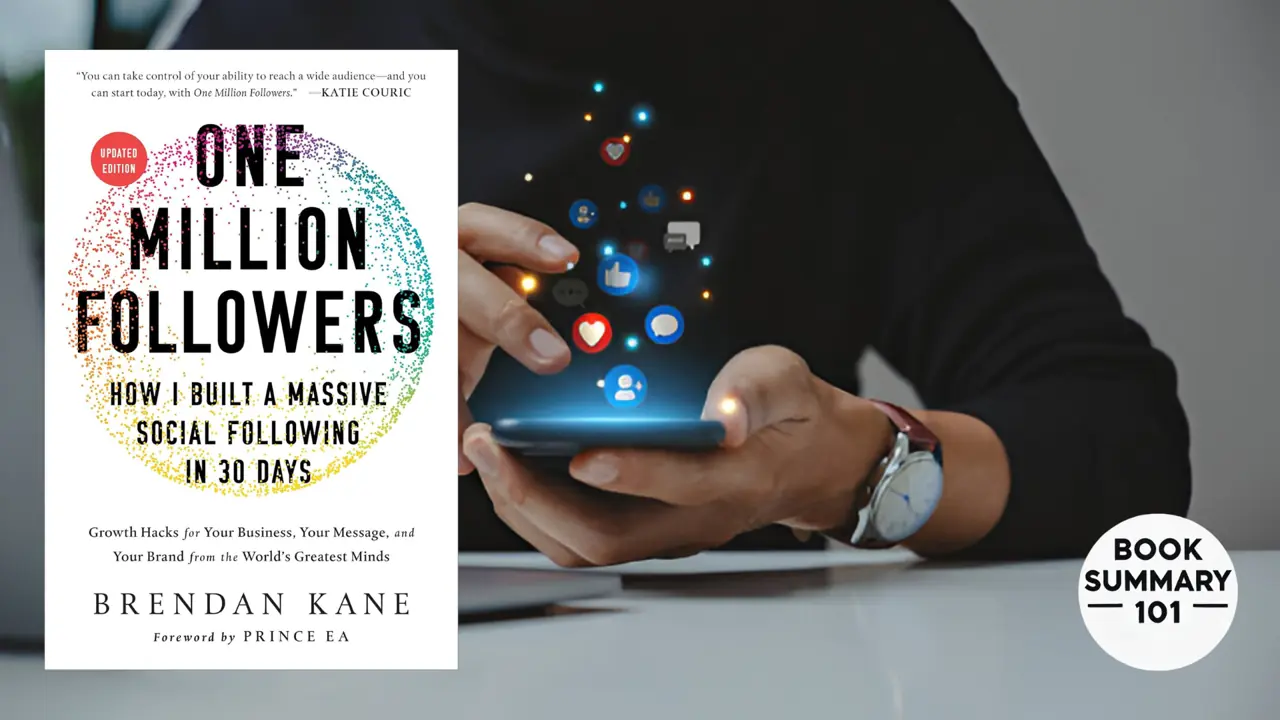
Then I picked up One Million Followers by Brendan Kane.
Reading this book wasn’t like reading a marketing textbook; it felt like sitting down with a mad scientist who handed me the keys to a secret lab. Kane isn’t just a theorist; he built over a million followers for himself in just 30 days to prove a point. He’s worked with Taylor Swift, Rihanna, and MTV.
The book stripped away the “magic” and replaced it with a system. It turns out, going viral isn’t about luck. It’s about engineering.
Here is the breakdown of how he did it, and how you can apply it to your life.
- Why Should You Even Bother Reading It?
- The Scientific Formula for Social Domination
- 1. The Process of Hypothesis Testing (The Comedian’s Notebook)
- 2. The 3-Second Rule (The Highway Billboard)
- 3. Shareability vs. Likeability (The Social Currency)
- 4. Facebook as the Testing Lab (The Petri Dish)
- 5. Strategic Alliances (The Trojan Horse)
- My Final Thoughts
- Join the Conversation!
- What is the one thing that frustrates you the most about social media right now?
- Frequently Asked Questions (The stuff you’re probably wondering)
Why Should You Even Bother Reading It?
If you are a content creator, a small business owner, or just someone who wants their voice heard in a crowded room, this book is your survival guide.
The digital landscape has changed. The days of “organic reach” (posting something and assuming your followers will see it) are practically dead. The algorithms are stingy.
Kane’s book is essential because it stops you from playing the guessing game. It is perfect for:
- The Frustrated Creative: Who is tired of low engagement.
- The Entrepreneur: Who needs to validate a product idea quickly.
- The Data Nerd: Who wants to understand the math behind the memes.
This isn’t about vanity metrics; it’s about building an audience that actually cares about what you have to say.
The Scientific Formula for Social Domination
Most people treat social media like a slot machine—they pull the lever and hope for a jackpot. Brendan Kane treats it like a chemistry lab. Before we dive into the specific tactics, you need to understand that this entire book revolves around a shift in mindset: moving from “artist” to “analyst.”
Here are the core principles that will reshape how you view your feed.
1. The Process of Hypothesis Testing (The Comedian’s Notebook)
Imagine your favorite stand-up comedian. When you see them on a Netflix special, every joke lands perfectly. The timing is impeccable. You laugh until it hurts. You might think, “Wow, they are naturally hilarious.”
But you didn’t see the year they spent in dingy basement clubs.
In those clubs, they tested 50 variations of that one joke. They changed the setup. They changed the punchline. They watched the audience’s faces to see if they smirked or roared. They kept the version that worked and threw away the other 49.
Kane argues that social media requires the exact same process. This is the concept of Hypothesis Testing.
Most of us post one version of a photo with one caption. If it flops, we blame the algorithm. Kane suggests that you have no idea what the market wants until you test it aggressively. He advocates creating dozens, sometimes hundreds, of variations of content (different headlines, different background colors, different formats) and testing them against each other with small ad budgets.
You aren’t trying to create a masterpiece on the first try. You are throwing spaghetti at the wall, but you are meticulously measuring exactly which noodle sticks and why.
📖 Quote: “You don’t have to be a creative genius to create viral content; you just have to be willing to test until you find what works.”
Simple Terms: Don’t guess what people like; test many different versions of your post to prove what they like.
The Takeaway: Use low-budget ads to test different headlines and images before you commit to a major campaign.
2. The 3-Second Rule (The Highway Billboard)
Picture yourself driving down a highway at 70 miles per hour. You are whizzing past trees, exit signs, and guardrails. Suddenly, a massive, bright yellow billboard with a bizarre image catches your eye. You turn your head.
That billboard did its job. It broke your pattern.
Social media feeds are the digital highway. We scroll at a breakneck speed. Our thumbs are on autopilot. Kane emphasizes that you are not competing with other brands in your niche; you are competing with the user’s boredom and attention span.
This is the 3-Second Rule (and honestly, it’s getting closer to one second).
If your content doesn’t stop the scroll immediately, it doesn’t matter how good your caption is or how valuable your advice is. No one will see it. Kane explains that you need a “hook point.” This is often a visual disruption.
It could be a high-contrast color. It could be a headline that asks a provocative question. It could be a video that starts in the middle of the action rather than having a slow intro.
Real-World Example: Think about those “Satisfying Video” compilations. They don’t start with a host saying, “Hello, today we will crush soap.” No, the video starts instantly with a hydraulic press crushing a bar of glittery soap. It hooks you viscerally before your brain can tell your thumb to move on.
Simple Terms: You must grab the viewer’s attention instantly with something visually or mentally striking, or they will scroll past you.
The Takeaway: Audit your content. If the first 3 seconds aren’t gripping, delete the intro and start in the middle of the action.
3. Shareability vs. Likeability (The Social Currency)
Here is a trap many of us fall into: we create content that people “Like.”
A “Like” is a passive nod. It’s someone saying, “That’s nice.” But a “Like” doesn’t help you grow exponentially. To get a million followers, you need Shares.
Kane uses the analogy of Social Currency. When someone shares a post, they are using your content to say something about themselves to their friends. They are spending your content to buy social status.
People share things for specific reasons:
- To look smart: “Look at this interesting fact I found.”
- To look funny: “This meme gets me.”
- To look empathetic: “This story made me cry.”
- To define their identity: “This is so me.”
If you post a picture of your oatmeal, people might “Like” it because it looks tasty. But they won’t share it, because sharing a picture of your breakfast does nothing for their ego.
However, if you post a quote that says, “Success is 5% inspiration and 95% coffee,” a coffee lover shares that because it reinforces their identity as a hard-working coffee addict.
📖 Quote: “If you want to go viral, you have to ask yourself: ‘Why would someone share this?’ If the answer is ‘because it’s about me,’ start over. It has to be about them.”
Simple Terms: Create content that makes the person sharing it look good to their friends.
The Takeaway: Shift your focus from “Look at me” content to “This helps you express yourself” content.
4. Facebook as the Testing Lab (The Petri Dish)
Many people think Facebook is for Boomers and that all the cool kids are on TikTok or Instagram. While that may be true for trends, Kane argues that Facebook is the ultimate scientific laboratory.
Think of Facebook as a Petri Dish. It has the most robust, granular data targeting system in the world.
Kane’s strategy often involves using Facebook’s advertising platform not just to sell things, but to learn. Because Facebook allows you to target people by incredibly specific interests (e.g., “People who like Star Wars AND knitting”), you can run cheap tests to see who your audience actually is.
You might think your audience is teenage boys who like skateboarding. But after running a $50 test campaign on Facebook, the data might show that 45-year-old moms are actually clicking on your content more.
Once you identify the winning content and the winning audience in the “Facebook Lab,” you can then take that proven content and scale it on Instagram, LinkedIn, or YouTube. You don’t waste money guessing on other platforms; you use Facebook to find the truth first.
Real-World Example: Imagine a movie studio. They don’t just release a movie globally. They do “test screenings” with small audiences. They measure every laugh and scream. If the ending falls flat, they reshoot it. Facebook Ads are your test screening room.
Simple Terms: Use Facebook’s advanced ad tools to cheaply test what content works, then move the winners to other platforms.
The Takeaway: Don’t be afraid to spend small amounts of money ($5-$10) on ads to gather data on what your audience actually clicks.
5. Strategic Alliances (The Trojan Horse)
Building a following from zero is hard. It’s like trying to push a boulder up a hill by yourself. It’s much easier if you can hitch a ride on a truck that’s already going up the hill.
Kane calls this leveraging Strategic Alliances.
In the old days, we called this “networking.” In the digital age, it’s about finding people who already have the audience you want and getting them to feature you. It’s a Trojan Horse strategy. You enter a new community inside the vessel of someone they already trust.
This isn’t just about paying an influencer to hold your product. It’s about creating mutually beneficial content.
If you are a fitness trainer, don’t just post your own workouts. Find a nutritionist who has 100k followers. Create a piece of content together—maybe a video on “How to eat for muscle gain.”
The nutritionist shares it because it’s good content for their audience. You get exposure to their 100k followers, who trust the nutritionist. Since the nutritionist trusts you, the audience trusts you by proxy.
Kane emphasizes that you must lead with value. You don’t ask for a favor; you ask, “How can I help you create content that your audience will love?”
Simple Terms: Grow faster by collaborating with people who already have the audience you want.
The Takeaway: Identify 5 accounts in your niche that are larger than you and pitch a collaboration idea that benefits them first.
My Final Thoughts
Honestly, reading One Million Followers was a relief.
It removed the mystery. I stopped looking at big influencers as “lucky” and started seeing the systems behind their success. It’s empowering to know that you don’t need to be naturally charismatic or famously beautiful to build an audience. You just need to be diligent.
The book shifts the power dynamic. You stop being a victim of the algorithm and start becoming its master. It requires work—lots of testing, analyzing data, and failing small so you can win big—but it’s a roadmap that actually exists.
If you are willing to put on the lab coat and treat your content like a science experiment, the sky is the limit.
Join the Conversation!
What is the one thing that frustrates you the most about social media right now?
Is it the constant algorithm changes? The pressure to be perfect? Or just not knowing what to post? Drop a comment below—I’d love to hear your story and help if I can!
Frequently Asked Questions (The stuff you’re probably wondering)
1. Do I need a huge budget to do what Brendan Kane did?
Not necessarily. While Kane spent significant money to do it in 30 days, the principles of testing (Hypothesis Testing) can be done with very small budgets (like $5 a day) or even organically if you are patient. The money just speeds up the data gathering.
2. Is this book only for people who want to be “Influencers”?
No. It’s for anyone who needs attention on the internet. This applies to brands selling products, authors selling books, or B2B professionals trying to build a reputation on LinkedIn.
3. Isn’t this just about buying fake followers?
Absolutely not. Kane is very clear that buying bots is useless because they don’t engage or buy things. His strategy is about buying data and exposure to reach real humans who actually care about your topic.
4. Do I need to know how to code or be a tech wizard?
No coding is required. However, you do need to be comfortable looking at basic charts and numbers (like Click-Through Rates) inside social media dashboards.
5. Is the advice still relevant in 2024 and beyond?
Yes. While specific features of Instagram or Facebook change, the core psychology—hooking attention, testing variations, and understanding why people share—is timeless.