Let’s be real for a second. Have you ever looked at your business bank account, seen a decent number, and felt a wave of relief?
But then, five minutes later, that sinking feeling hits. You realize that money isn’t actually yours. It belongs to the landlord, the software subscriptions, the vendors, and the tax man.
By the time everyone else gets paid, there are just crumbs left for you.
For the longest time, I thought this was just “paying my dues.” I thought that if I just sold more, eventually there would be enough left over for me to actually turn a profit.
I was wrong. I was running on a hamster wheel, confusing revenue with success.
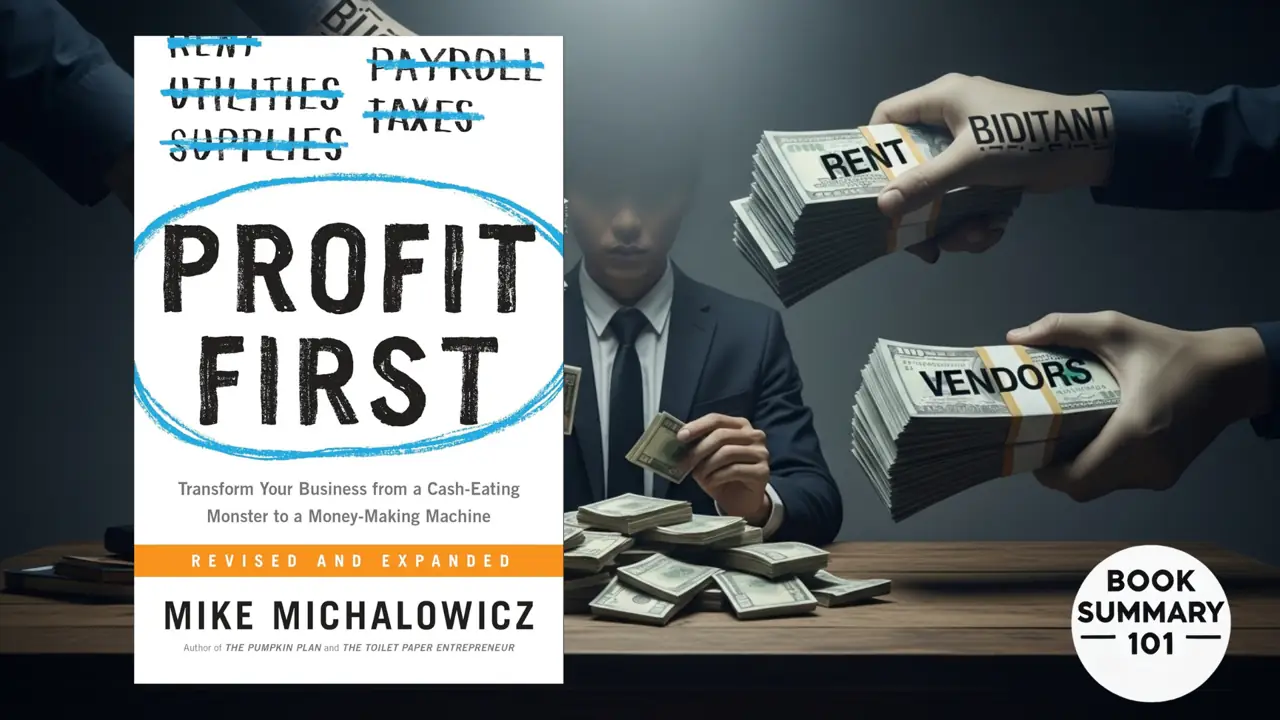
Then I picked up Profit First: Transform Your Business from a Cash-Eating Monster to a Money-Making Machine by Mike Michalowicz. It didn’t feel like reading a dry accounting textbook; it felt like a friend grabbing me by the shoulders and saying, “Hey, stop sabotaging yourself.”
This book completely rewired how I look at money. It turns out, the way we’ve been taught to handle business finances is logically sound, but behaviorally flawed. And that changes everything.
- Why Should You Even Bother Reading It?
- The Core Principles That Reshaped My Thinking
- 1. The Toothpaste Tube Analogy (Parkinson’s Law)
- 2. Flipping the Frankenstein Formula
- 3. The Small Plate Strategy (The 5 Core Accounts)
- 4. Removing Temptation (The Bank Strategy)
- 5. The Rhythm (The 10th and 25th Rule)
- My Final Thoughts
- Join the Conversation!
- Frequently Asked Questions (The stuff you’re probably wondering)
Why Should You Even Bother Reading It?
If you are an entrepreneur, a freelancer, or a small business owner who works incredibly hard but never seems to have cash in the bank, this book is your lifeline.
You don’t need an MBA or a love for spreadsheets to get this. In fact, if you hate accounting, you’re the perfect candidate.
Profit First is vital because it stops the “growth at all costs” madness. It teaches you how to be profitable today, not “someday” in the distant future. It’s for anyone tired of the panic that sets in every time a big bill is due.
The Core Principles That Reshaped My Thinking
Michalowicz doesn’t just suggest you try harder to save money; he completely dismantles the traditional accounting equation we’ve all been taught and rebuilds it to work with human psychology, not against it. Here is how he flips the script to trick your brain into building wealth.
1. The Toothpaste Tube Analogy (Parkinson’s Law)
This is the analogy that made the lightbulb go off in my head instantly.
Think about a tube of toothpaste. When you buy a brand new tube, how do you use it? You put a giant, generous glob on your toothbrush. You don’t think twice about it because the tube feels full. You might even drop some in the sink and just rinse it away.
But what happens when that tube is almost empty? You change your behavior. You roll it up, you flatten it, you squeeze the absolute life out of it to get that tiny little bead of paste. And guess what? That tiny bead is actually enough to brush your teeth.
This is Parkinson’s Law: Demand expands to match the supply.
In business, when you have one big “operating account” with all your money in it, you act like you have a full tube of toothpaste. You spend loosely. You sign up for software you don’t really need. You hire too fast.
Profit First forces you to run your business on a “nearly empty toothpaste tube” by removing the profit first. When less money is available to run your business, you don’t shut down—you just get innovative and frugal.
Simple Terms: We spend whatever money we see available, so we need to make less money available for spending.
The Takeaway: By artificially restricting your operating budget, you force yourself to be efficient and innovative, just like squeezing the last bit of toothpaste.
2. Flipping the Frankenstein Formula
Traditional accounting (GAAP) teaches us a logical formula:
Sales – Expenses = Profit
It makes sense on paper. You sell stuff, you pay your bills, and you keep the leftovers. The problem? Human nature doesn’t care about logic.
When “Profit” is the leftover variable, it becomes an afterthought. It’s the bottom line, literally and figuratively. If you don’t monitor your expenses like a hawk (which most of us don’t), there are never any leftovers.
Michalowicz argues that we need to flip the formula to:
Sales – Profit = Expenses
This sounds radical, but it’s actually how grandma used to budget. When you make a sale, you take your profit first. You take your taxes first. You take your own salary first.
Whatever is left over? That is what you have to run the company. If you can’t pay your expenses with the remainder, it doesn’t mean you need more sales; it means your business model is broken and you need to cut costs.
📖 “Profit is not an event. Profit is a habit.”
Simple Terms: Take your reward off the top before you pay a single bill.
The Takeaway: Treat profit as a non-negotiable expense, not a surprise bonus at the end of the year.
3. The Small Plate Strategy (The 5 Core Accounts)
Imagine you are at an all-you-can-eat buffet. If you grab a massive platter, you are going to pile it high with food and probably overeat.
But what if you force yourself to use a tiny salad plate? You physically cannot fit as much food on it. You consume fewer calories because the container is smaller.
Profit First applies this “small plate” logic to your banking. Most businesses eat off one giant platter: a single checking account where revenue mixes with expense money. It’s a mess.
Michalowicz suggests setting up 5 Core Accounts:
- Income: All revenue goes here first.
- Profit: A percentage for a rainy day fund and debt reduction.
- Owner’s Comp: Your salary (because you shouldn’t work for free!).
- Tax: Saving for the government so you don’t panic in April.
- OpEx (Operating Expenses): The only money available to pay bills.
When you log into your bank, you don’t see one big number. You see exactly what you have for bills in the OpEx account. If that account is low, you can’t “borrow” from your taxes or your salary. You simply can’t afford the expense.
Simple Terms: Divide your money into different buckets so you don’t accidentally spend your tax money on a new office chair.
The Takeaway: Segmenting your cash gives you instant clarity on the health of your business without needing to run a P&L report.
4. Removing Temptation (The Bank Strategy)
This is the part where most people get nervous, but it’s the most crucial step for success.
We are weak. If we see a pile of money sitting in a “Profit” savings account, and we have a cash flow crunch, we will steal from it. We’ll tell ourselves, “I’ll just borrow this for a week.” (Spoiler: You never pay it back).
To combat this, Michalowicz introduces the concept of Banks 1 and 2.
- Bank 1: Your main bank where you operate daily.
- Bank 2: A completely different bank where you hold your Profit and Tax accounts.
Here is the kicker: Bank 2 should be inconvenient. No debit cards. No online transfers connected to Bank 1. If you want to get that money, you should have to physically drive to the bank.
This adds friction. That friction is usually enough to stop you from making an impulsive decision to raid your savings. It keeps your profit “out of sight, out of mind” until it’s time to take a quarterly distribution.
Simple Terms: Hide your profit money at a bank that is annoying to get to so you don’t spend it.
The Takeaway: Use human laziness to your advantage; if it’s hard to access your savings, you’re more likely to keep saving.
5. The Rhythm (The 10th and 25th Rule)
Do you pay bills as they come in? Most of us do. An invoice hits the inbox, and we pay it to get it off our plate.
The problem is that this causes your bank balance to bounce up and down wildly every day. It’s emotional chaos. You never really know where you stand.
Michalowicz suggests a “bi-monthly rhythm.” You enter a batch-processing mode where you pay bills and allocate funds only twice a month: on the 10th and the 25th.
Why these dates? By the 10th, most beginning-of-month bills are in. By the 25th, end-of-month bills are in.
This allows you to see the cash pile up for two weeks. You can look at the total pile and make informed decisions about where to allocate it, rather than reacting frantically to every single email.
📖 “When less money is available to run your business, you will find ways to get the same results with less money.”
Simple Terms: Stop paying bills every day; stack your cash and process everything in two batches a month.
The Takeaway: Batching your finances reduces anxiety and gives you a clearer picture of your cash flow trends.
My Final Thoughts
Implementing the strategies in Profit First was honestly a bit scary at first. Setting up multiple bank accounts felt like overkill, and looking at the reality of my “OpEx” account was a harsh wake-up call.
But the peace of mind that followed was immediate. Knowing that every time I made a sale, a specific percentage was already set aside for me and for taxes changed my relationship with my business. I stopped resenting the work.
It turns your business from a monster that eats all your cash into a machine that actually serves you. It forces you to be honest, and that honesty is the foundation of real growth.
Join the Conversation!
I’d love to hear your take. Do you currently have “one big bucket” for your business banking, or have you tried separating your funds? Drop a comment below and let’s talk about money habits!
Frequently Asked Questions (The stuff you’re probably wondering)
1. Do I need to be good at math to do this?
Not at all. If you can divide a number by two or figure out a percentage (or just use a calculator), you are overqualified. The system is designed to remove the complexity of accounting, not add to it.
2. Can I do this if I have a lot of debt?
Yes! In fact, the book has a specific strategy for freezing debt and using the Profit account to slowly chip away at it. It stops the bleeding so you don’t add new debt while trying to pay off the old stuff.
3. Will my accountant hate me?
Some traditional accountants might roll their eyes because this isn’t “standard” GAAP accounting. However, many modern accountants love it because it helps their clients actually survive. You can use Profit First for cash management and still let your accountant file taxes the traditional way.
4. Is this only for big businesses?
No, it is actually best for small businesses, freelancers, and solopreneurs. These are the people most at risk of “entrepreneurial poverty,” and this system works even if you are only making a few thousand dollars a month.
5. Doesn’t opening 5 bank accounts cost a lot in fees?
It shouldn’t. Many banks offer free business checking accounts, especially for small businesses. Even if there is a small fee, the amount of money you save by not overspending usually outweighs the bank fees by a mile.