I have to be honest with you—about two years ago, I hit a wall.
I remember sitting at my desk, staring at the news headlines. A pandemic, supply chain nightmares, social unrest, economic yo-yoing. It felt like every time I figured out how to navigate one crisis, two more popped up like a twisted game of Whac-A-Mole.
Trying to lead a team (or just manage my own career) felt like trying to build a house of cards inside a wind tunnel. I was exhausted. I was cynical. And I kept thinking, “We just need to wait for things to go back to normal.”
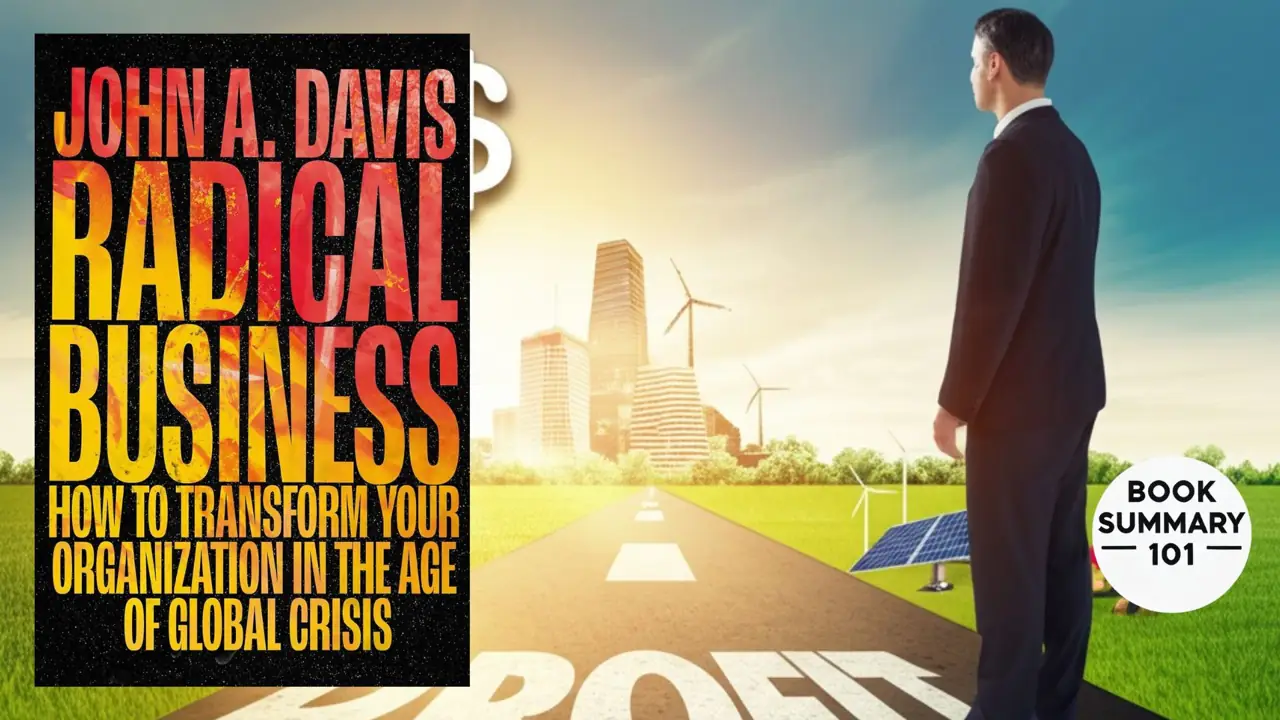
Then I picked up Radical Business: How to Transform Your Organization in the Age of Global Crisis by John A. Davis.
I expected another dry, academic lecture on economics. You know the type—lots of charts, zero soul.
What I got instead was a wake-up call that felt less like a lecture and more like a lifeline. It was a friendly, firm hand on the shoulder saying, “Hey, stop waiting for ‘normal.’ It’s gone. Here is how we build something better.”
If you’ve been feeling like the old rules of work just don’t apply anymore, but you aren’t sure what the new rules are, pull up a chair. We need to talk about this book.
- Why Should You Even Bother Reading It?
- The Pillars of the New Corporate World
- 1. The Shift from Profit to Purpose (The “Fuel vs. Destination” Analogy)
- 2. Radical Agility in a VUCA World (The “Jazz Band” Analogy)
- 3. The Stakeholder Ecosystem (The “Permaculture Garden” Analogy)
- 4. Psychological Safety and Humanity (The “Oxygen Mask” Analogy)
- 5. Technological Humanism (The “Iron Man Suit” Analogy)
- My Final Thoughts
- Join the Conversation!
- Frequently Asked Questions (The stuff you’re probably wondering)
Why Should You Even Bother Reading It?
So, who is this actually for? Is it just for CEOs of Fortune 500 companies?
Absolutely not.
Whether you’re a solopreneur, a middle manager trying to keep your team sane, or just someone wondering why modern corporations feel so soulless, this book is for you.
We are living in an era where consumers and employees are demanding more. We don’t just want a paycheck; we want purpose. We don’t just want a product; we want ethics.
Radical Business is important right now because it bridges the gap between “making money” and “doing good.” It explains why the businesses that cling to the old ways are going to sink, and why the ones that embrace humanity are going to swim.
The Pillars of the New Corporate World
Davis doesn’t just list problems; he builds a framework. He argues that we are shifting from a “Shareholder Economy” (where only money matters) to a human-centric model.
To make this jump, we have to fundamentally rewire how we think about success. Here are the core principles from the book that completely reshaped my thinking.
1. The Shift from Profit to Purpose (The “Fuel vs. Destination” Analogy)
For decades, we’ve been told that the sole purpose of a business is to make a profit. Davis flips this on its head. He argues that profit isn’t the goal; it’s a byproduct of doing something that matters.
Think of your business (or your career) like a car.
In the old way of thinking, we believed the purpose of the car was to buy gas. We drove around just to find more gas stations to fill the tank. That sounds ridiculous, right?
Gas is essential—you can’t drive without it. But the purpose of the car is to get you to a destination.
In this analogy, profit is the gas. You need it to survive. You need it to keep the engine running. But it is not the destination. The destination is your Purpose—the problem you are solving for the world or the joy you are bringing to people.
When an organization focuses entirely on the gas (profit), they cut corners, burn out employees, and eventually, the car breaks down. But when they focus on the destination (purpose), the profit tends to follow naturally because people want to go on that ride with you.
Real-World Example:
Look at Patagonia. Their stated purpose isn’t to sell fleece jackets; it’s to “save our home planet.” They’ve run ads telling people not to buy their clothes if they don’t need them. Paradoxically, this commitment to their “destination” makes people trust them more, leading to massive “gas” (profits) that they then reinvest in their mission.
📖 Quote:
“Profit is the reward you get for creating value for others. It is not the purpose of the business itself.”
Simple Terms: Stop obsessing over money and start obsessing over the problem you solve for people.
The Takeaway: Companies that stand for something bigger than their bottom line are the only ones that will survive the skepticism of the modern world.
2. Radical Agility in a VUCA World (The “Jazz Band” Analogy)
We used to build businesses like huge, slow-moving ocean liners. They were sturdy, heavy, and designed to go in a straight line. If an iceberg appeared, it took five miles to turn the ship.
Davis explains that we live in a “VUCA” world—Volatile, Uncertain, Complex, and Ambiguous. In this environment, the ocean liner is a death trap.
Instead, we need to operate like a Jazz Band.
Think about a classical orchestra. Everyone has a sheet of music. They play exactly what is written. If the conductor sneezes or a page flies away, the music stops. It’s rigid.
Now, think of a jazz quartet. They have a general structure (the key, the tempo), but they are constantly listening to each other and improvising. If the drummer changes the beat, the bassist adapts instantly. If the piano player misses a chord, the saxophonist turns it into a new melody.
Radical Business teaches us that we can’t predict the next global crisis. We can’t write the sheet music for next year. So, we have to train our teams to listen, adapt, and improvise in real-time.
Real-World Example:
Consider how Airbnb handled the pandemic. Their entire business model (travel) evaporated overnight. If they were an “orchestra,” they would have collapsed. Instead, they played jazz. They pivoted to “Online Experiences” (cooking classes, magic shows via Zoom) and then capitalized on local, long-term stays for remote workers. They listened to the changing beat and adapted.
Simple Terms: Stop planning for a predictable future and start building a team that can react fast to an unpredictable one.
The Takeaway: Rigid plans break in a crisis; flexible cultures bend and bounce back stronger.
3. The Stakeholder Ecosystem (The “Permaculture Garden” Analogy)
The old school of business, popularized by economists like Milton Friedman, was all about the shareholders. If the stock went up, nothing else mattered.
Davis argues this is like Monoculture Farming.
Imagine a farmer who plants only corn, year after year. They spray pesticides to kill everything else. They suck the nutrients out of the soil. For a few years, they get a ton of corn. But eventually, the soil turns to dust, the pests become resistant, and the farm dies.
Radical Business advocates for a Permaculture Garden.
In a healthy garden, you have different plants supporting each other. You have worms aerating the soil, bees pollinating, and cover crops protecting the earth.
In business, your “plants” are your stakeholders: employees, customers, suppliers, the community, and the environment. If you squeeze your suppliers (the soil) too hard to please the shareholders (the corn), the whole ecosystem collapses. You have to feed the entire garden for the harvest to be sustainable.
Real-World Example:
Costco is a master of this. Wall Street often criticizes them for paying their employees too much (treating the “soil” too well). But by paying high wages, Costco has incredibly low turnover, happier staff, and better customer service. This creates a loyal customer base, which—surprise, surprise—results in great long-term returns for shareholders.
Simple Terms: You can’t win by screwing over your employees or your community just to make a quick buck.
The Takeaway: A business is an ecosystem; if you poison one part of it, the whole thing eventually dies.
4. Psychological Safety and Humanity (The “Oxygen Mask” Analogy)
This was my favorite section of the book. Davis talks about how fear is the enemy of innovation. When people are scared—of being fired, of being ridiculed, of making a mistake—they shut down.
Think of psychological safety like the Oxygen Mask on an airplane.
If a cabin loses pressure, you can’t help anyone if you pass out. In a toxic work environment, fear sucks the oxygen out of the room. Employees are gasping for air, just trying to survive the day. They aren’t thinking about the next big idea; they are thinking about how to not get yelled at.
Davis argues that “Radical Business” requires pumping oxygen into the room. It means creating a culture where it is safe to say, “I made a mistake,” or “I have a crazy idea.”
When people can breathe, they can think. When they can think, they can solve the crises that threaten the company.
Real-World Example:
Google conducted a massive study called “Project Aristotle” to find out what made their best teams successful. It wasn’t IQ, and it wasn’t experience. The #1 factor was psychological safety. The teams that felt safe taking risks without being shamed were the ones that outperformed everyone else.
📖 Quote:
“Fear is the most expensive hidden cost in any organization. It stifles the very creativity needed to solve our biggest problems.”
Simple Terms: If your team is scared of you, they aren’t helping you win; they’re just hiding their mistakes.
The Takeaway: You must build a culture where truth is valued over comfort.
5. Technological Humanism (The “Iron Man Suit” Analogy)
We often hear that robots are coming for our jobs. There is a lot of anxiety about AI and automation.
Davis offers a more optimistic, nuanced view. He introduces the concept of Technological Humanism. This isn’t about replacing humans with machines; it’s about amplifying humans with machines.
Think of it like Tony Stark’s Iron Man Suit.
Without the suit, Tony is just a smart guy. Without Tony, the suit is just a pile of metal. But when you put the human inside the technology, you get a superhero.
Radical businesses don’t use tech to turn people into robots. They use tech to handle the drudgery—the data entry, the sorting, the scheduling—so that the humans are free to do what humans do best: empathize, create, and connect.
Real-World Example:
Look at Zillow. Their “Zestimate” algorithm processes millions of data points to give a home value (the suit). But they still rely on real estate agents (the human) to understand the nuance of a neighborhood, the emotion of a buyer, and the art of the deal. The tech doesn’t replace the agent; it gives the agent super-powers.
Simple Terms: Don’t use technology to replace people; use it to get rid of the boring stuff so people can be more creative.
The Takeaway: The future belongs to companies that marry high-tech efficiency with high-touch humanity.
My Final Thoughts
Reading Radical Business gave me a strange sense of relief.
For a long time, I felt like the chaos of the world was a sign that things were breaking. John A. Davis helped me see that the chaos is actually the breaking of a shell. We are growing out of an old, outdated way of doing things.
The book doesn’t promise that the road ahead will be easy. Crises will keep coming. But it does promise that if we build our organizations on a foundation of purpose, agility, and humanity, we won’t just survive the storm—we’ll learn to dance in the rain.
It’s an empowering read. It makes you feel like you have agency again.
Join the Conversation!
I’d love to hear your take. Do you feel like your current workplace is operating like an “Ocean Liner” (rigid and slow) or a “Jazz Band” (agile and improvisational)? Drop a comment below and let me know one thing you’d change to make your work more “Radical.”
Frequently Asked Questions (The stuff you’re probably wondering)
1. Is this book too academic or technical?
Not at all. While John A. Davis is a professor, he writes like a human being. The concepts are backed by research, but the delivery is accessible, filled with stories, and easy to digest.
2. I own a small business, not a global corporation. Is this relevant?
100%. In fact, it might be more relevant. Small businesses can pivot and adapt to these “Radical” principles much faster than giant corporations. The “Stakeholder Ecosystem” concept is critical for local businesses.
3. Does the book talk about AI and modern tech?
Yes, but not in a “coding” way. It talks about the strategy of technology—how to use it to empower people rather than replace them. You don’t need to be a tech wizard to understand it.
4. Is this just a book about “woke” capitalism?
It’s a book about effective capitalism. Davis argues that ignoring social and environmental issues is bad for business long-term. It’s a practical guide to sustainability, not a political manifesto.
5. If I only have time to read one chapter, which one should it be?
Go for the section on Agility. In today’s economy, learning how to pivot when things go wrong is the single most valuable skill you can learn.