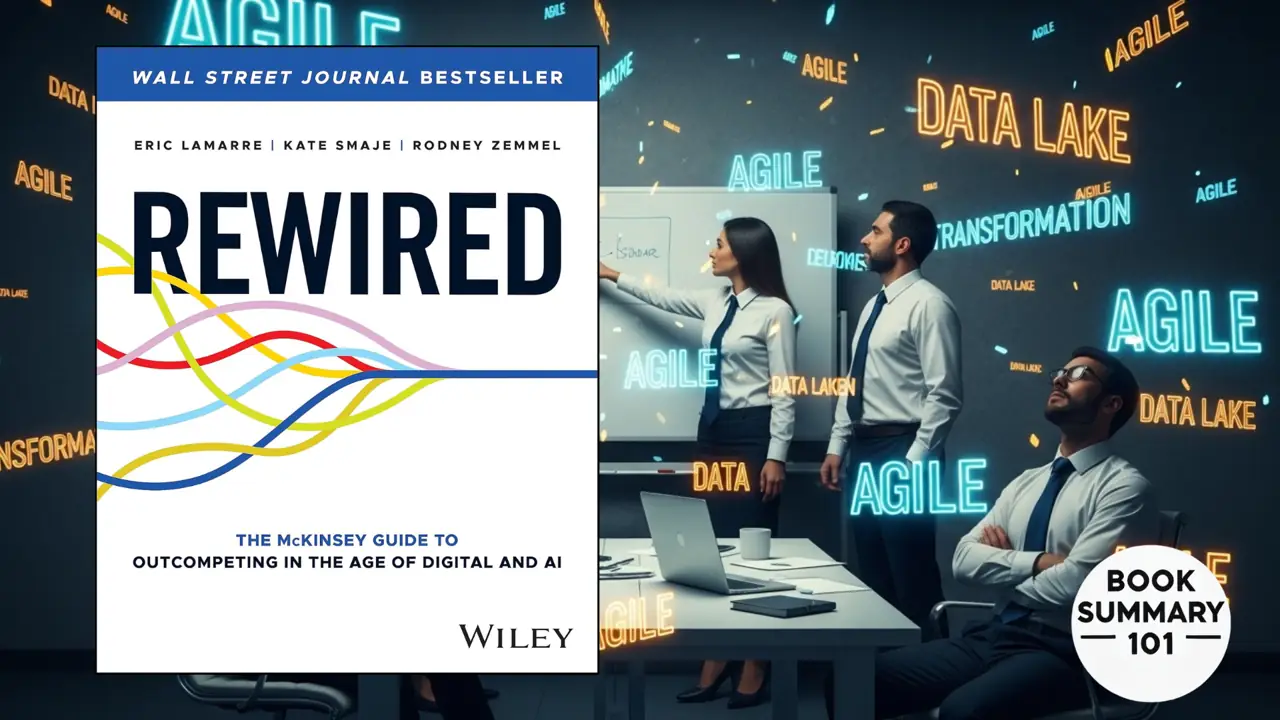
Let me be honest with you. I used to roll my eyes every time I heard the words “Digital Transformation.”
It felt like corporate speak for “let’s spend a billion dollars on new software, change nothing about how we actually work, and hope for the best.” I’ve sat in too many meetings where executives threw around buzzwords like “Agile,” “AI,” and “Data Lake” without knowing what they meant. It felt like watching someone try to fix a Ferrari engine using nothing but a roll of duct tape and positive vibes.
Then I picked up Rewired: The McKinsey Guide to Outcompeting in the Age of Digital and AI by Eric Lamarre, Kate Smaje, and Rodney Zemmel.
I expected another dry, theoretical business book. What I got instead was a mechanic’s manual. It didn’t just tell me what to do; it showed me the messy, greasy reality of how to do it. It was like sitting down with a master architect who finally explained why our renovations kept collapsing.
If you are tired of “digital initiatives” that go nowhere, this post is for you. Let’s dive in.
- Why Should You Even Bother Reading It?
- The Blueprint for Building a Digital Engine
- 1. The Strategy: Don’t Boil the Ocean
- 2. The Talent: The “Translator” is Key
- 3. The Operating Model: From Relay Race to Rugby Squad
- 4. The Technology: Breaking the Spaghetti Ball
- 5. The Data: The Vending Machine
- 6. Adoption: The Organ Transplant
- My Final Thoughts
- Join the Conversation!
- Frequently Asked Questions (The stuff you’re probably wondering)
Why Should You Even Bother Reading It?
You might be thinking, “I’m not a CEO, and I don’t code. Why do I need this?”
Here’s the reality: whether you work in marketing, HR, operations, or finance, your job is being reshaped by digital and AI.
This book is essential for the frustrated manager who can’t get IT to build what they need, the ambitious leader who wants to understand how successful companies like Amazon or Netflix actually operate, and the non-tech professional who wants to stop feeling intimidated by the engineers in the room.
Rewired explains why 70% of digital transformations fail—and gives you the blueprint to be in the 30% that succeed.
The Blueprint for Building a Digital Engine
Most companies treat digital transformation like a fresh coat of paint—it looks nice, but the house is still crumbling. Rewired argues that you have to strip the house down to the studs and rebuild the plumbing and wiring. Here are the six capabilities that act as the structural pillars for a company that can actually compete in the age of AI.
1. The Strategy: Don’t Boil the Ocean
Imagine you want to get fit. If you try to run a marathon, become a powerlifter, and learn yoga all on day one, you will fail. You’ll burn out.
Rewired explains that most companies try to do everything at once. They launch 100 “digital pilots” across the company. They are “boiling the ocean.”
Instead, the authors suggest picking a specific “Customer Journey.” Think of it like a Lighthouse. You pick one domain—say, the mortgage application process in a bank—and you transform that completely, from start to finish. You make it a shining example of what the future looks like.
Once that “Lighthouse” is shining, it proves the value to the rest of the organization and lights the way for the next project.
Real-World Example: Think about Domino’s Pizza. They didn’t just try to upgrade their ovens and their uniforms and their supply chain all at once. They focused obsessively on the “ordering experience.” They built the Pizza Tracker. That one specific focus transformed them from a pizza company into an e-commerce giant that happens to sell pizza.
Simple Terms: Stop trying to fix the whole company at once; pick one important area and fix it perfectly.
The Takeaway: Focus on value, not volume. A hundred mediocre projects are worth less than one completed transformation that actually makes money.
2. The Talent: The “Translator” is Key
Here is a hard truth the book delivers: You cannot outsource your brain.
Many legacy companies hire expensive consultants to build their tech, then wave goodbye when the contract ends. Rewired compares this to a restaurant trying to get a Michelin star by ordering Uber Eats.
You need engineers in-house. But it’s not just about coders. The book introduces a vital concept: The Translator.
Imagine a construction site. You have the Architect (Business Leader) who dreams up the building, and the Builders (Engineers) who lay the bricks. But they speak different languages. The Architect talks about “ROI” and “Customer Joy,” while the Builder talks about “APIs” and “Latency.”
The Translator is the person in the middle. They understand enough business to know why we are building, and enough tech to know what is possible. Without them, you get a beautiful building with no doors.
📖 “Digital talent is not just about hiring coders; it’s about creating an environment where they can thrive and where business and technology leaders work side by side.”
Real-World Example: Look at John Deere. They didn’t just hire software engineers to sit in a basement. They integrated them with the farming equipment teams to build tractors that use AI to distinguish weeds from crops.
Simple Terms: You need people on your team who speak both “Business” and “Geek.”
The Takeaway: Hire your own engineers, but prioritize the people who can bridge the gap between the code and the customer.
3. The Operating Model: From Relay Race to Rugby Squad
In traditional companies, work is a relay race. Marketing writes a brief, passes the baton to Design. Design draws a picture, passes it to Engineering. Engineering builds it (months later) and passes it to Legal.
If Engineering finds a mistake? They have to run all the way back to the start. It’s slow. It’s painful.
Rewired suggests moving to a “Rugby Squad” (or Agile Pod) model.
In rugby, the whole team moves down the field together. The ball (the product) moves back and forth instantly between players. The Marketing person, the Coder, the Designer, and the Data Scientist all sit at the same table (or Zoom room). They make decisions in minutes, not months.
Real-World Example: Spotify is famous for this. They have small “Squads” responsible for specific features (like the “Search” bar). That squad has everyone needed to make changes to Search without asking permission from a VP.
Simple Terms: Stop working in silos; put everyone needed to solve the problem in the same room.
The Takeaway: Speed comes from autonomy. Small, cross-functional teams beat large, bureaucratic departments every time.
4. The Technology: Breaking the Spaghetti Ball
Legacy technology in old companies is often described as “Spaghetti Code.” It’s a tangled mess. If you pull one noodle (change one line of code in the billing system), you might accidentally break the meatball on the other side of the plate (the website crashes).
This makes companies terrified to change anything.
The solution in Rewired is to move toward LEGO blocks (modular architecture).
You want to break your massive, tangled systems into small, interchangeable blocks that connect via APIs (Application Programming Interfaces). If you want to swap out the “Payment” LEGO brick for a better one, you can just snap it off and snap a new one on without destroying the whole castle.
Real-World Example: Netflix moved from a massive, single system to “microservices.” One tiny service handles your login. Another handles the “Continue Watching” list. If the “Continue Watching” service breaks, you can still log in and watch movies. The whole system doesn’t crash.
Simple Terms: Build your tech in small, independent chunks so you can upgrade pieces without breaking the whole thing.
The Takeaway: Modular technology allows you to move fast and experiment without fear of catastrophic failure.
5. The Data: The Vending Machine
Most companies treat data like a hoarder’s attic. They have tons of it—customer records, sales data, sensor logs—but it’s buried in boxes, dusty, and impossible to find when you need it.
Rewired argues you need to treat data like a Product.
Imagine a vending machine. The data should be cleaned, packaged, labeled, and ready for anyone in the company to “purchase” and consume instantly.
If a marketing team wants to know “Who bought red shoes last week?”, they shouldn’t have to submit a ticket to IT and wait three weeks for a report. They should be able to walk up to the “Data Vending Machine,” push a button, and get that list instantly via a trusted data source.
📖 “Data is the fuel for the digital engine, but it’s useless if it’s refined in a refinery that’s disconnected from the gas station.”
Real-World Example: Uber. Their data is instantly available to the app to calculate your price, your arrival time, and the driver’s route simultaneously. If that data were locked in a dusty server, Uber wouldn’t exist.
Simple Terms: Make your data easy to access and ready to use for anyone who needs it.
The Takeaway: Data governance isn’t about locking data away; it’s about making it clean, safe, and accessible for the whole company.
6. Adoption: The Organ Transplant
This is the most critical point in the book. You can build the best AI model in the world, but if your employees don’t use it, it’s worthless.
The authors compare this to an organ transplant. You can put a healthy new heart (new software) into a body (the company), but the body’s immune system (the culture) will try to attack and reject it.
“We’ve always done it this way!” is the immune response.
To fix this, you have to focus on the “last mile.” You don’t just hand a factory worker an iPad and walk away. You have to change their incentives, their daily routines, and show them how this tool makes their life easier, not just the CEO’s life richer.
Real-World Example: A mining company introduced a complex dashboard for truck drivers to optimize routes. The drivers ignored it because it was confusing. The company had to “rewire” by simplifying the screen to just a simple “Green Arrow / Red Arrow” interface. Adoption skyrocketed.
Simple Terms: The best technology fails if humans refuse to change their habits to use it.
The Takeaway: Spend as much money on training and change management as you do on the software itself.
My Final Thoughts
Reading Rewired was a relief. It validated that the confusion I felt in previous jobs wasn’t because I wasn’t smart enough—it was because the organizations were broken.
The book is empowering because it removes the mystery. Digital transformation isn’t magic performed by wizards in hoodies. It’s hard, structural work. It’s plumbing. It’s architecture. It’s people management.
By breaking it down into these specific capabilities, Rewired gives you a checklist. It stops being a scary monster and starts being a project you can actually tackle.
Join the Conversation!
Have you ever worked at a company that tried to “go digital” and failed miserably? What was the biggest hurdle—the old technology or the stubborn people? Let me know in the comments below!
Frequently Asked Questions (The stuff you’re probably wondering)
1. Do I need to know how to code to read this book?
Absolutely not. This is a management book, not a technical manual. It explains concepts like APIs and Cloud, but in the context of business strategy.
2. Is this book only for huge corporations?
While the examples are mostly from Global 2000 companies (it is McKinsey, after all), the principles of “small teams” and “clean data” apply even to small businesses and startups.
3. Is the book mostly about AI?
Surprisingly, no. While “AI” is in the title, the book argues you can’t do AI until you fix the foundation (data, talent, operating model). It’s about building the launchpad for AI.
4. Is it a dry, boring read?
It is dense, but not boring. It’s very structured. It’s best read in chunks, as there are a lot of diagrams and checklists. It’s a reference guide more than a beach read.
5. Who is the ideal reader?
The “Translator.” Someone who sits between the business goals and the technical execution. If you are a Product Manager, a Department Head, or a Strategy Lead, this is your bible.