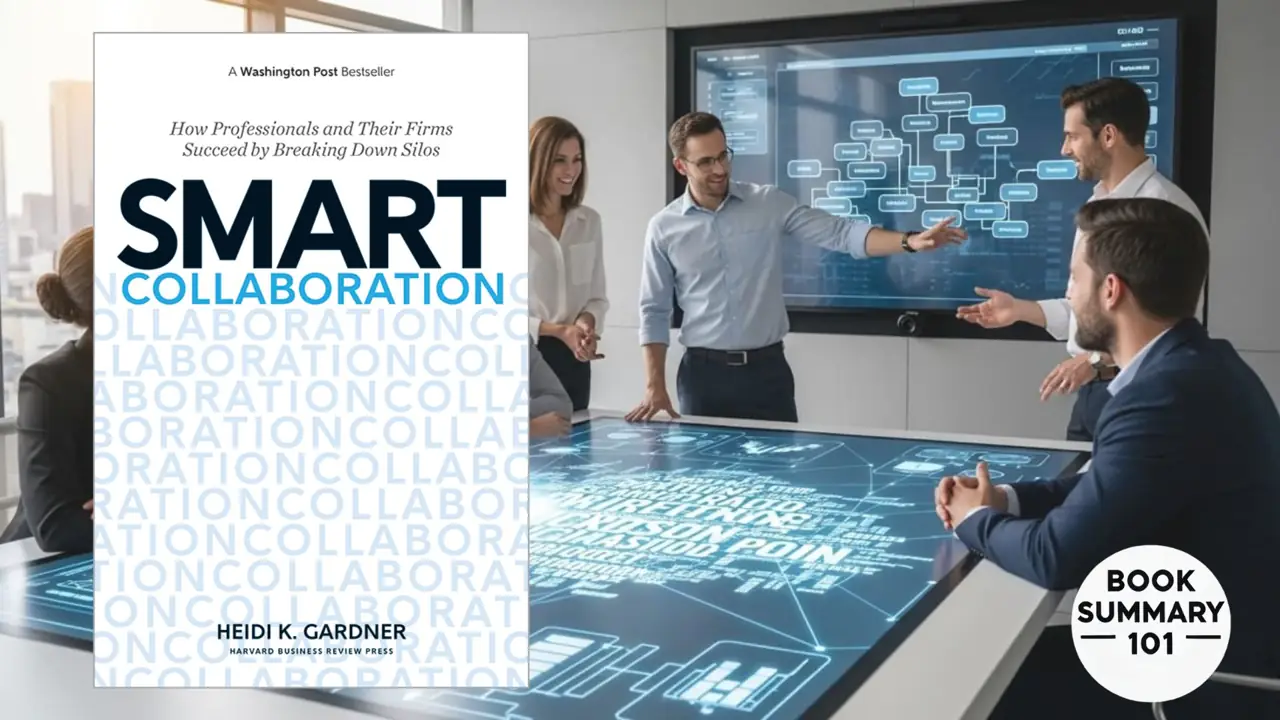
We need to talk about the “hero complex.”
You know the feeling. A massive project lands on your desk. It’s complex, it’s messy, and it involves three different disciplines you barely understand.
But instead of asking for help, you buckle down. You drink too much coffee. You tell yourself, “I can figure this out. If I bring someone else in, they might steal the credit, or worse, mess it up.”
I used to live in that headspace. I thought being a professional meant having all the answers. I treated my knowledge like dragon’s gold—something to be hoarded and protected.
The result? Burnout, sub-par work, and a nagging feeling that I was constantly spinning my plates just to keep them from crashing.
Then I picked up Smart Collaboration: How Professionals and Their Firms Succeed by Breaking Down Silos by Heidi K. Gardner.
I honestly expected another fluffy corporate book about “teamwork making the dream work.” I was wrong.
This book felt like a friendly intervention. Gardner, a Harvard researcher, uses hard data to prove that the “lone wolf” approach isn’t just exhausting—it’s bad for business. It showed me that the most successful people aren’t the ones who know everything; they are the ones who know how to weave different experts together to solve puzzles that are too big for one brain.
- Why Should You Even Bother Reading It?
- The Blueprint for Breaking Down the Walls
- 1. Smart Collaboration vs. The “Cross-Selling” Trap
- 2. The “Sticky” Client (The Economic Argument)
- 3. Overcoming the “Hoarding” Instinct
- 4. Competence Trust vs. Interpersonal Trust
- 5. The T-Shaped Professional
- My Final Thoughts
- Join the Conversation!
- Frequently Asked Questions (The stuff you’re probably wondering)
Why Should You Even Bother Reading It?
You might be thinking, “I’m not a lawyer or a consultant at a Big 4 firm, is this for me?”
Absolutely.
Whether you are a freelancer, a software developer, a marketer, or a CEO, the core problem Gardner addresses is universal: The easy problems have already been solved.
The problems left on our desks today are complex and multifaceted. They require a mix of skills that no single human possesses.
If you are tired of hitting a ceiling in your career because you’re trying to do it all alone, or if you’re frustrated by office politics where departments refuse to talk to each other, this book is your roadmap out of the mess.
The Blueprint for Breaking Down the Walls
Most of us think collaboration just means “getting along” or sitting in meetings together. Gardner flips this idea on its head, showing us that true collaboration is a strategic weapon, not a soft skill. Here are the core principles from the book that completely reshaped how I view my work.
1. Smart Collaboration vs. The “Cross-Selling” Trap
The biggest mistake people make is confusing collaboration with “cross-selling.”
Imagine a potluck dinner. In a cross-selling scenario, I bring the chips, you bring the salsa, and Dave brings the soda. We are all at the same table, but our contributions are separate. I hand off my client to you for a specific task, and then you hand them back.
Smart Collaboration is different. It’s like getting into the kitchen together to cook a complex, Michelin-star stew.
Gardner explains that smart collaboration happens when experts from different “silos” (specialties) integrate their knowledge to create a solution that didn’t exist before. It’s not just passing the baton; it’s running the race together.
The Real-World Example:
Think about a company facing a massive data breach.
- Old Way: The legal team handles the lawsuit. Then, the PR team handles the press release. Then, the IT team patches the server. They don’t talk to each other.
- Smart Collaboration Way: The Lawyer, the PR Specialist, and the IT Forensic Expert sit in a room simultaneously. The Lawyer advises on what can be said legally, which informs the PR strategy, while the IT expert explains the technical reality to both. They create a unified crisis response.
Simple Terms: Don’t just trade tasks; combine your brains to invent new solutions.
The Takeaway: True value comes when you integrate expertise, not just when you pile different services on top of each other.
2. The “Sticky” Client (The Economic Argument)
This is the part that usually convinces the skeptics. Gardner brought the receipts—literally.
Think of your relationship with a client (or your boss) like a spiderweb.
If you are the only person serving that client, there is only one thread connecting them to the firm. If you leave, or if you mess up, that thread snaps. The client is gone.
Gardner’s research at Harvard Law School analyzed millions of data points. She found that as you add more collaboration partners to a client account, the client becomes infinitely “stickier.”
📖 “When a partner brings in just one more person from another practice group to work on a client, revenues from that client triple.”
When a client relies on your firm for tax, and legal, and consulting, and HR strategy, they can’t leave you. The switching costs are too high. They are caught in a web of value.
The Real-World Example:
Consider Apple’s ecosystem. If you just have an iPhone, you might switch to Android. But if you have an iPhone, a Mac, an Apple Watch, and subscribe to iCloud? You aren’t going anywhere. That is the product equivalent of the “sticky” collaboration web.
Simple Terms: The more experts involved with a client, the harder it is for that client to fire you.
The Takeaway: Collaboration isn’t just nice; it is the single most effective way to secure job security and higher profits.
3. Overcoming the “Hoarding” Instinct
Why don’t we collaborate more? Gardner identifies the villain: The Hoarding Instinct.
It’s the toddler mindset of “Mine!”
We hoard our clients and our knowledge because we are afraid.
- We fear losing control.
- We fear that if we bring in a colleague, they might outshine us.
- We fear the “fixed pie”—if I give you a slice of the work, there’s less for me.
Gardner argues that we need to shift from a “fixed pie” mentality to a “growing the pie” mentality. When you bring in others, you don’t lose your slice; the whole pie gets bigger because you can tackle larger, more expensive projects.
The Real-World Example:
Imagine a architect who refuses to work with a landscape designer because she wants the full budget for the building. The result is a nice house on a dirt lot.
If she brings in the landscape designer, they can pitch a comprehensive “indoor-outdoor living experience.” The project budget doubles, the client is happier, and the architect actually makes more money by managing a larger project.
Simple Terms: Stop protecting your small turf and start building a bigger empire together.
The Takeaway: Hoarding work creates a bottleneck (you); sharing work creates an ecosystem of success.
4. Competence Trust vs. Interpersonal Trust
This was a massive “Aha!” moment for me.
We often think we can only collaborate with people we like—people we’d want to grab a beer with. Gardner separates trust into two buckets:
- Interpersonal Trust: Do I like you? Are you kind?
- Competence Trust: Do you know your stuff? Are you reliable?
To succeed in smart collaboration, you do not need to be best friends. You just need high Competence Trust.
You can work with someone who is prickly, quiet, or socially awkward, as long as you trust that they are an absolute wizard at their specific skill.
📖 “You don’t have to like someone to collaborate effectively with them. You just have to trust their competence and their intention to deliver for the client.”
The Real-World Example:
Think of a surgical team. The neurosurgeon and the anesthesiologist might not hang out on weekends. They might not even like each other’s jokes. But the surgeon trusts the anesthesiologist implicitly to keep the patient sedated. That is Competence Trust.
Simple Terms: You don’t need to be friends; you just need to respect each other’s skills.
The Takeaway: Don’t let personality clashes stop you from working with the best people for the job.
5. The T-Shaped Professional
So, who survives in this new world? It’s not the Generalist (who knows a little about everything) and it’s not the pure Specialist (who knows everything about one tiny thing).
It is the T-Shaped Professional.
- The Vertical Bar (|): This is your deep expertise. You still need to be a master of your craft (e.g., you are the best Java coder in the building).
- The Horizontal Bar (-): This is your ability to reach across the aisle. It’s your empathy, your curiosity about other disciplines, and your ability to speak the language of other departments.
Gardner emphasizes that you can’t just rely on the Vertical bar anymore. If you can’t connect your deep knowledge to others, you become an isolated island.
The Real-World Example:
A Data Scientist (Vertical skill) who learns how to explain their algorithms to the Marketing Team (Horizontal skill) becomes invaluable.
A Data Scientist who only talks to other Data Scientists gets stuck in the back room and never gets promoted.
Simple Terms: Be an expert in your field, but learn how to play nice with everyone else.
The Takeaway: Your career growth depends on your ability to bridge the gap between your expertise and others’.
My Final Thoughts
Reading Smart Collaboration: How Professionals and Their Firms Succeed was a genuine relief.
It took the pressure off. I realized I don’t need to be the smartest person in the room. In fact, if I am the smartest person in the room, I’m probably in the wrong room.
The book empowered me to admit what I don’t know and gave me the confidence to reach out to colleagues who do. It turned the scary concept of “dependency” into a strategic advantage. It’s a dense read at times, packed with data, but the message is incredibly human: we are better together.
Join the Conversation!
I’d love to hear from you. Have you ever hoarded a project because you were afraid of losing control, only to regret it later? Drop a comment below and let’s talk about it.
Frequently Asked Questions (The stuff you’re probably wondering)
1. Is this book only for lawyers and consultants?
No. While Gardner uses a lot of examples from law and accounting firms (because that’s where the data is), the principles apply to software engineers, creative agencies, healthcare, and any “knowledge work” field.
2. Is it a difficult read?
It is detailed. It’s a business book based on academic research, so it’s not a breezy beach read. However, it is very well-structured and the case studies make the concepts easy to grasp.
3. Do I need to be a manager to use this?
Not at all. In fact, applying these principles as a junior employee is a great way to get noticed. It shows you are thinking about the “big picture” of the company.
4. What if I work remotely?
The book is even more relevant. Remote work creates digital silos naturally. Smart collaboration requires you to be even more intentional about reaching out across those digital walls.
5. Does the book explain how to get people to trust me?
Yes. It breaks down the psychology of trust and gives practical steps on how to build “competence trust” quickly, even with people you’ve just met.