Let’s be real for a second. Does the word “negotiation” make your stomach do a little flip?
For the longest time, it absolutely terrified me.
I used to think negotiation was reserved for high-powered lawyers in bespoke suits, screaming at each other across mahogany tables. In my own life, whether I was buying a car, discussing a salary, or even just deciding where to go for dinner with a group of friends, I usually took the path of least resistance.
I was a chronic “settler.” I’d pay the sticker price just to avoid awkwardness. I’d say “yes” to deadlines I couldn’t meet just to be nice.
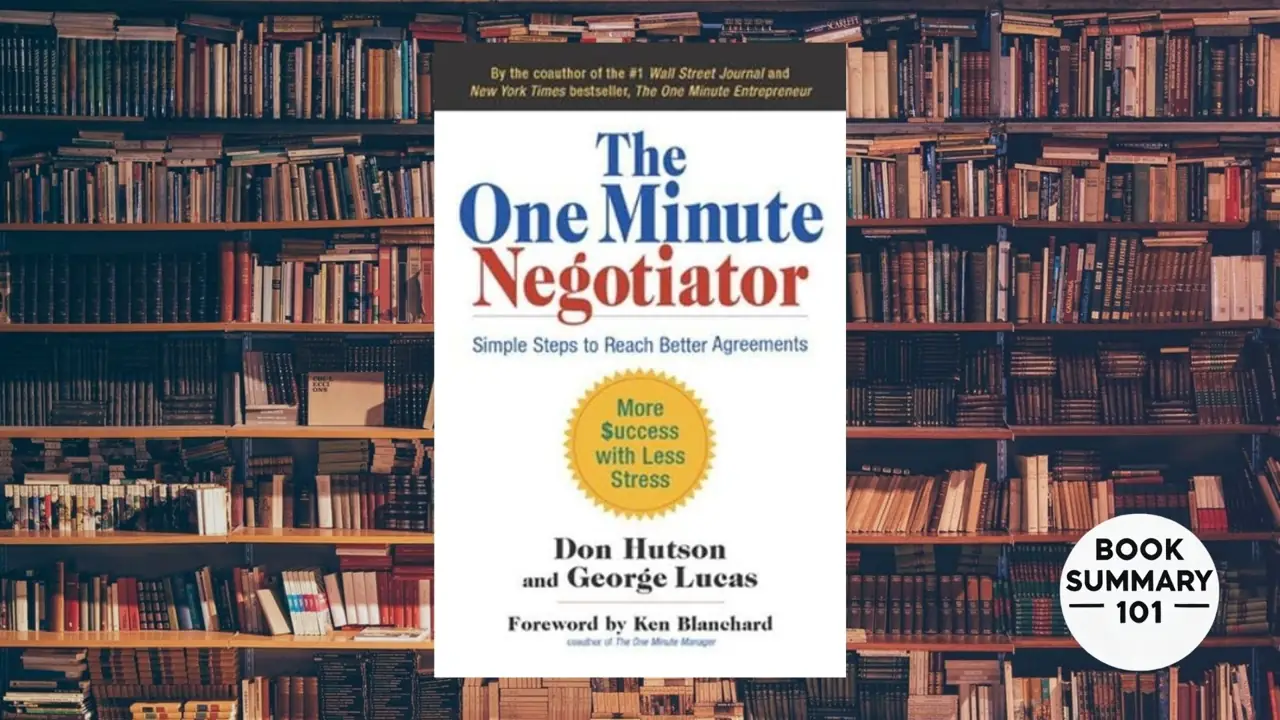
Then I picked up The One Minute Negotiator: Simple Steps to Reach Better Agreements.
I expected a dry, dusty manual on economic theory. Instead, what I found was a story—a relatable business fable that felt like a lifeline. It wasn’t about tricking people or being aggressive. It was about understanding human behavior.
It felt like the authors, Don Hutson and George Lucas, were sitting across from me, explaining that I didn’t need to change who I was to get what I wanted. I just needed to change how I viewed the game.
If you’ve ever felt like you walked away from a deal feeling cheated, or if you simply freeze up when money is mentioned, this summary is for you.
- Why Should You Even Bother Reading It?
- The Blueprint for Stress-Free Agreements
- 1. The Negotiation Matrix (The Compass)
- 2. The Avoidance Trap (The Turtle)
- 3. Accommodation vs. Competition (The Doormat and The Bulldozer)
- 4. Collaboration (The Baking of the Pie)
- 5. The E.A.S.Y. Treatment Process
- My Final Thoughts
- Join the Conversation!
- Frequently Asked Questions (The stuff you’re probably wondering)
Why Should You Even Bother Reading It?
You might be thinking, “I’m not in sales, so why do I need this?”
Here is the truth: You are negotiating all day long.
You negotiate bedtime with your toddler. You negotiate project timelines with your boss. You negotiate with your spouse about who’s doing the dishes.
This book is perfect for the “non-negotiator.” It’s designed for people who hate conflict but want results. Its core message is vital today because we live in a world of constant collaboration. The “my way or the highway” approach doesn’t work anymore.
If you want to protect your interests without burning bridges, you need the tools inside this book.
The Blueprint for Stress-Free Agreements
The genius of this book lies in how it simplifies complex human interactions into a grid that anyone can visualize. The authors don’t just give you a list of tactics; they give you a new pair of glasses to see the world through.
Before we jump into the specific strategies, understand this: successful negotiation isn’t about memorizing scripts. It’s about recognizing the situation you are in and adapting your behavior accordingly. It’s about being a chameleon with a backbone.
Here are the core concepts that reshaped my thinking.
1. The Negotiation Matrix (The Compass)
Imagine you are dropped in the middle of a dense forest. Without a compass, you’re just wandering aimlessly, hoping you don’t get eaten by a bear.
In negotiation, most of us are wandering. We react emotionally rather than strategically.
The authors introduce the “Negotiation Matrix” to act as your compass. It breaks down negotiation behavior into two simple axes: Proactivity (how active or passive you are) and Cooperation (how reactive or cooperative you are).
Depending on where you land on this grid, you fall into one of four categories. Recognizing where you naturally sit—and where your opponent sits—is 90% of the battle.
If you don’t know where you are on the map, you can’t navigate to where you want to go.
Simple Terms: A simple chart that helps you identify your negotiation style and the style of the person across from you.
The Takeaway: You cannot use the same strategy for every person; you must identify the “quadrant” you are in to win.
2. The Avoidance Trap (The Turtle)
We all know the “Turtle.” Maybe you are the Turtle.
This style falls into the “Passive/Uncooperative” quadrant. This is when you physically or mentally withdraw from the negotiation.
Think of it like seeing a “Check Engine” light come on in your car and deciding to just turn up the radio so you can’t hear the noise. You aren’t fixing the problem; you’re just hoping it magically goes away.
In the real world, this looks like a freelancer who is terrified to ask for a deposit, so they just start working without a contract. Or a manager who hates conflict, so they don’t correct an employee’s bad behavior until it’s too late.
The book teaches us that while avoidance feels safe in the moment, it is almost always a Lose/Lose outcome. The problem festers, resentment builds, and eventually, the deal collapses anyway.
📖 “Avoidance is a negotiation style that is characterized by a low commitment to results and a low commitment to relationships. It is a double loss.”
Simple Terms: Ignoring the problem or the negotiation entirely because you are afraid of the tension.
The Takeaway: Hiding never solves the issue; it usually makes the eventual explosion much worse.
3. Accommodation vs. Competition (The Doormat and The Bulldozer)
These are the two extremes where most inexperienced negotiators get stuck.
The Accommodator (The Doormat):
This is the “Passive/Cooperative” style. You care more about being liked than being respected. Imagine a puppy rolling over to show its belly. You give the client a massive discount just because they frowned, hoping they will “owe you one” later. (Spoiler: They usually won’t). This is a Lose/Win for you.
The Competitor (The Bulldozer):
This is the “Active/Uncooperative” style. This is the 1980s Wall Street stereotype. To the Bulldozer, negotiation is war. They want to crush you.
Think of a car salesman who hides the keys to your trade-in so you can’t leave. They might get the sale (Win/Lose), but you will never refer a friend to them.
The book explains that while Competition has its place (like a one-time purchase where you’ll never see the person again), it is poison for long-term business relationships.
Simple Terms: Accommodators give up too much to be nice; Competitors take too much to feel powerful.
The Takeaway: Both styles are imbalanced—one ruins your profit margin, the other ruins your reputation.
4. Collaboration (The Baking of the Pie)
This is the holy grail. The “Active/Cooperative” quadrant.
Most people think negotiation is about slicing a pie. If I get a bigger slice, you get a smaller one.
Collaboration is the mindset of: “Hey, before we cut this, let’s go into the kitchen and bake a bigger pie so we can both get fat.”
This is the Win/Win.
A real-world example of this is a supplier and a retailer. A Competitor would demand the lowest price. A Collaborator says, “If you can lower your price by 10%, I will commit to a two-year contract and put your product in our premium display window.”
Suddenly, the supplier makes more money through volume, and the retailer saves money on unit cost. Both sides walk away happy. The authors stress that this takes more effort and brainpower, but the payoff is exponential.
📖 “Collaboration is the only strategy that builds and strengthens long-term relationships. It is the gold standard of negotiation.”
Simple Terms: Working together to find a creative solution where both parties get more than they expected.
The Takeaway: Don’t just fight over the existing value; create new value by listening to what the other person actually needs.
5. The E.A.S.Y. Treatment Process
So, how do you actually do this? The authors provide a brilliant mnemonic device called the E.A.S.Y. process to guide you through any deal.
It works like a pilot’s pre-flight checklist:
- E – Engage: Recognize the situation. Is this actually a negotiation? Are the stakes high enough to bother?
- A – Assess: Look at the Matrix. Is the other person acting like a Bulldozer or a Doormat? What are their tendencies?
- S – Strategize: Choose your counter-move. If they are being competitive, maybe you need to stand firm initially before pivoting to collaboration.
- Y – Your One Minute Drill: This is the execution phase. Take a minute to mentally rehearse your approach.
Think of it like Spotify’s algorithm. Spotify Engages with you (you open the app), Assesses your taste (you skipped the country song), Strategizes (it queues up more rock music), and executes Your “Discover Weekly” playlist.
It’s a constant loop of reading the data and adjusting the output.
Simple Terms: A four-step checklist to slow down your brain and pick the right strategy before you open your mouth.
The Takeaway: Negotiation isn’t about guessing; it’s about following a deliberate process of assessment and adaptation.
My Final Thoughts
Reading The One Minute Negotiator was genuinely a relief for me. It gave me permission to stop trying to be a “tough guy” and start being a “smart guy.”
The biggest shift was realizing that I don’t have to be afraid of the Bulldozers of the world. Once you can identify them (“Oh, he’s just using the Competition style”), their power over you vanishes. You stop taking it personally and start treating it like a puzzle to be solved.
It’s a quick read, but the feeling of control it gives you lasts a long time.
Join the Conversation!
I’d love to hear from you. Which negotiation style do you default to when you’re under stress? Are you a “Turtle” who hides, or a “Doormat” who gives in too easily? Let me know in the comments below!
Frequently Asked Questions (The stuff you’re probably wondering)
1. Is this book only for business people?
Not at all. While the setting is business, the principles apply to buying a house, discussing chores with your family, or even negotiating with customer service representatives.
2. Is “One Minute” a gimmick?
It’s a metaphor for the speed at which you can assess a situation once you know the framework. The preparation takes time, but the mental switch happens in a minute.
3. Do I have to be aggressive to use this?
No. In fact, the book argues that aggression (Competition) is often a weak strategy for long-term success. Collaboration is the ultimate goal.
4. How is this different from “Getting to Yes”?
Getting to Yes is more academic and theoretical. The One Minute Negotiator is a narrative story (fable) that is easier to digest for beginners.
5. Will this help me ask for a raise?
Absolutely. It helps you move from “I want more money” (Competition) to “Here is how my increased salary reflects the increased value I bring to the company” (Collaboration).