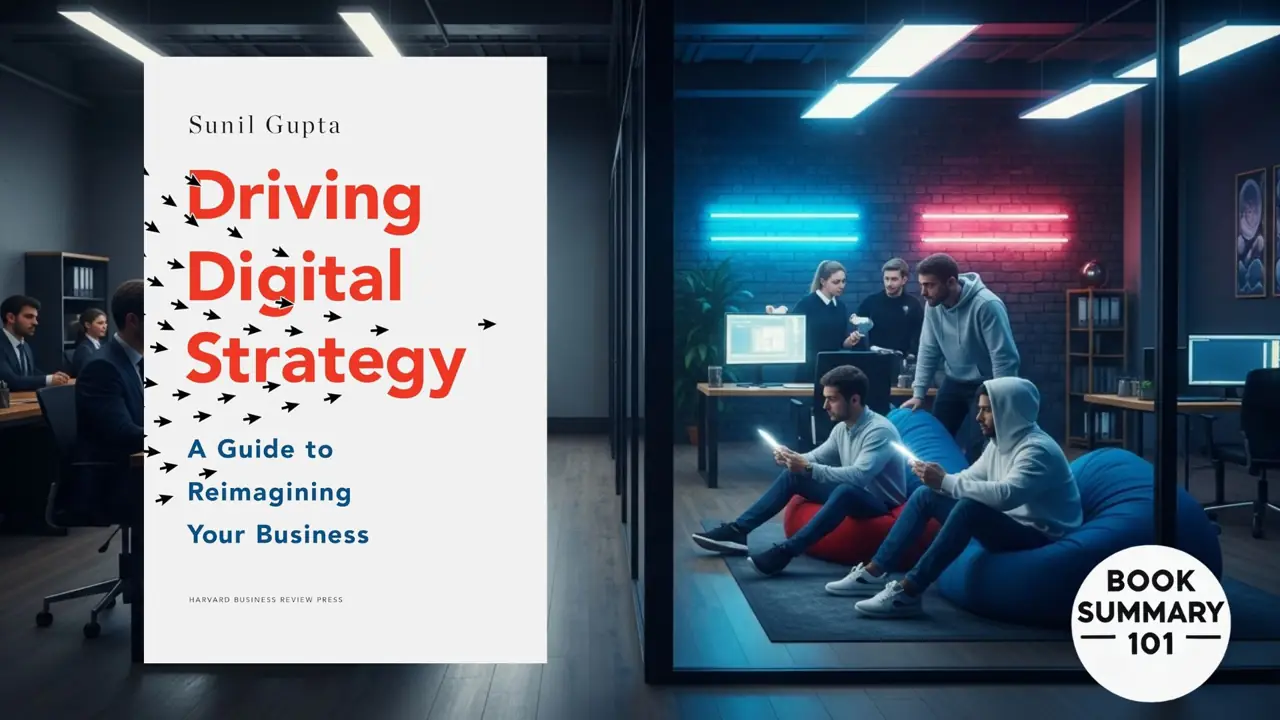
We need to talk about the “Digital Department.”
You know the one I mean.
Maybe in your company, it’s a small team tucked away on the third floor. Or maybe it’s a group of cool kids in hoodies working in a WeWork down the street, completely separated from the “real” business.
For years, I looked at digital strategy the same way I looked at learning a second language: something nice to have, something I should do, but ultimately separate from my day-to-day life.
I thought “going digital” meant launching a slightly better app or throwing some money at Facebook ads. I was drowning in buzzwords—blockchain, AI, IoT—without understanding how they actually fit together to make money.
Then I picked up “Driving Digital Strategy” by Harvard Business School Professor Sunil Gupta.
It felt like sitting down with a mentor who gently took the buzzing smartphone out of my hand, set it on the table, and said, “Forget the tech for a second. Let’s talk about the business.”
Gupta’s message hit me like a ton of bricks: Digital strategy is not a thing. It is just… strategy.
If you are treating digital as a separate initiative, you are already losing.
Why Should You Even Bother Reading It?
This book isn’t for the Silicon Valley start-up founder coding in a garage. They already get it.
This book is for the rest of us.
It is for managers at “legacy” companies—banks, car manufacturers, retailers, and insurance firms—who are terrified of being the next Kodak or Blockbuster.
If you have ever wondered, “How do we pivot this massive, slow-moving ship without sinking it?” or if you are a non-tech professional who feels intimidated by the speed of change, this book is your survival guide. It bridges the gap between the boardroom and the server room.
- Why Should You Even Bother Reading It?
- The Four Pillars of Reimagination
- 1. Reimagine Your Business Scope (The “Drill vs. Hole” Dilemma)
- 2. From Pipelines to Platforms (The Town Square Effect)
- 3. Reimagining Operations (Turning Competitors into Partners)
- 4. The Transition to “As-a-Service” (The Painful Valley)
- 5. Reimagining the Organization (The Talent Gap)
- My Final Thoughts
- Join the Conversation!
- Frequently Asked Questions (The stuff you’re probably wondering)
The Four Pillars of Reimagination
Gupta doesn’t just throw a list of tech trends at you. Instead, he argues that to survive, you don’t just need a new website; you need to fundamentally “reimagine” your business across four specific dimensions.
Think of your business like a house you’re renovating. You can’t just slap a solar panel on a crumbling roof and call it a “smart home.” You have to look at the foundation, the layout, the plumbing, and the people living inside.
Here are the core concepts that define this reimagination.
1. Reimagine Your Business Scope (The “Drill vs. Hole” Dilemma)
We often define our businesses by the products we sell. A car company sells cars. A drill company sells drills.
But Gupta brings up a classic marketing concept and gives it a digital steroids injection: People don’t want a quarter-inch drill; they want a quarter-inch hole.
Digital technology allows you to stop obsessing over the “drill” (your physical product) and start owning the “hole” (the outcome the customer actually wants).
The Analogy:
Imagine you are a doctor. In the old days, you only got paid when you performed surgery (selling the product).
But what if you used wearable data and monitoring to keep the patient healthy so they never needed surgery?
If you define your business as “doing surgery,” digital tech destroys you. If you define your business as “keeping people healthy,” digital tech makes you invincible.
Real-World Example:
Look at John Deere. For a century, they sold tractors. Big, green metal beasts. That was their scope.
But as Gupta details, they reimagined their scope using sensors and data. Now, they don’t just sell tractors; they sell “farm management.” Their machines collect data on soil moisture, crop yield, and planting depth.
They shifted from selling a vehicle to selling the outcome: a better harvest. By expanding their scope, they made themselves indispensable to the farmer in a way a simple tractor manufacturer never could.
Simple Terms: Stop defining yourself by what you make; define yourself by the problem you solve for the customer.
The Takeaway: Digital tools allow you to expand from selling a product to providing a comprehensive service or solution.
2. From Pipelines to Platforms (The Town Square Effect)
Most traditional businesses operate as “pipelines.”
You buy raw materials, you add value in a factory, you push the product out to a customer. It’s a one-way street.
Gupta argues that the biggest winners in the digital age are shifting from pipelines to platforms.
The Analogy:
A pipeline business is like hosting a private dinner party. You cook the food, you serve it, and your guests consume it. It’s limited by how fast you can cook.
A platform business is like owning the Town Square. You don’t cook the food; you just provide the space, the electricity, and the security for other people to set up food stalls and sell to each other. You take a cut of every transaction.
The Town Square scales infinitely faster than the dinner party.
Real-World Example:
Consider AccuWeather.
Originally, they were a pipeline: they analyzed weather and sold reports. But they realized they were sitting on a goldmine of data. They reimagined themselves as a platform.
They allowed other developers and companies to plug into their data API to build their own apps and services. By letting others build on top of their foundation, they grew exponentially faster than they could have on their own. They stopped just selling weather; they became the infrastructure for the weather economy.
📖 Quote from the book:
“In a pipeline business, value is created upstream and consumed downstream… In a platform, value is created and consumed by users on the platform.”
Simple Terms: Don’t just sell your own stuff; build a marketplace where others can create value, too.
The Takeaway: Platforms almost always beat products because they leverage the creativity and resources of outsiders to grow.
3. Reimagining Operations (Turning Competitors into Partners)
When we talk about digital strategy, we usually talk about marketing—fancy apps and viral tweets.
Gupta warns that this is a trap. If your operations (the back end) don’t change, your fancy front end will fail. This often means rethinking your supply chain and even your assets.
The Analogy:
Imagine you are a librarian.
In the old model, if someone wanted a book you didn’t have, you’d say, “Sorry, try the library across town.” That library is your competitor.
In the new digital model, you realize your goal is access, not ownership. You connect your database with the other library. Now, when a user wants a book, you get it from the “competitor” and hand it to the user. You kept the customer, even though you didn’t have the asset.
Real-World Example:
Best Buy was dying. People would come into the store to look at TVs (using Best Buy as a showroom) and then buy them cheaper on Amazon.
Instead of just trying to slash prices, Best Buy reimagined its operations. They realized their biggest liability—thousands of expensive physical stores—was actually their biggest asset.
They turned their stores into mini-warehouses. Because 70% of Americans live within 15 minutes of a Best Buy, they could use the stores to ship online orders faster than Amazon could. They turned a brick-and-mortar anchor into a logistics speedboat.
Simple Terms: Use digital tech to make your boring back-end processes faster, cheaper, and smarter.
The Takeaway: Sometimes your “weakness” (like physical stores) is your greatest strength if you connect it to digital data.
4. The Transition to “As-a-Service” (The Painful Valley)
This is perhaps the scariest concept in the book for financial directors.
Gupta discusses the shift from selling products (one-time revenue) to subscriptions or “products-as-a-service” (recurring revenue).
While Wall Street loves subscription models now, the transition is brutal. When you stop selling $500 software boxes and start selling $10/month subscriptions, your revenue initially falls off a cliff.
The Analogy:
It’s like farming.
The old model is hunting. You go out, kill a mammoth (a big sale), and feast. But then you have to go hunt again immediately.
The new model is planting an apple orchard. You have to work the soil for a long time with no food (the revenue drop). You are hungry and tired. But once the trees grow, they provide fruit every single season with much less effort.
You have to survive the “hungry years” to enjoy the recurring fruit.
Real-World Example:
Adobe.
Remember when Photoshop came in a giant box and cost hundreds of dollars? Adobe realized that model was dead. They switched to the Creative Cloud subscription model.
Gupta details how Adobe had to “burn the boats.” They didn’t just add a subscription option; they eventually removed the option to buy the software outright. Their revenue dipped, and people panicked. But today, Adobe is more profitable than ever because they have a predictable, constant stream of income rather than spiking sales cycles.
📖 Quote from the book:
“Strategy is easy to understand but hard to execute. The transition from product to service is often where companies fail, not because they don’t see the future, but because they can’t survive the journey.”
Simple Terms: It is better to rent your product to customers forever than to sell it to them once.
The Takeaway: Moving to a subscription model requires guts and a willingness to lose money in the short term to win in the long term.
5. Reimagining the Organization (The Talent Gap)
You can have the best strategy in the world, but if your culture is stuck in 1990, you will fail.
Gupta highlights that “Digital Transformation” is usually 10% tech and 90% people. The hardest part isn’t buying the software; it’s getting your employees to use it.
The Analogy:
Think of your company as a professional sports team.
You decide to switch from playing football (a physical, brute-force game) to basketball (a fast-paced, fluid game).
You can buy the best basketballs and build a shiny new court. But if you keep the same 300-pound linemen and tell them to “just play differently,” you will lose. You need to retrain your athletes, change your playbook, and maybe even hire some new players who know how to dribble.
Real-World Example:
The New York Times.
For decades, the “kings” of the NYT were the editors who decided what went on Page One. The digital team was secondary.
To succeed with their digital paywall, they had to change the power structure. They had to bring data analysts and engineers into the newsroom—not to tell journalists how to write, but to help them understand what readers cared about.
They had to break down the “church and state” separation between editorial and business, not to corrupt the news, but to save it. It required a massive cultural shift where a developer was just as important to the mission as a reporter.
Simple Terms: You cannot execute a modern strategy with an outdated org chart.
The Takeaway: You must upskill your current workforce and integrate tech talent into the core business, not isolate them in a silo.
My Final Thoughts
Reading Driving Digital Strategy was a massive relief for me.
It demystified the chaos. It made me realize that I don’t need to learn how to code Python to be a digital leader. I just need to understand the business implications of what that code can do.
Gupta empowers you to look at your company and ask: “Are we just doing digital things? or are we being a digital business?”
If you are feeling left behind, this book is the hand that pulls you up onto the train. It reminds you that the fundamental rules of business—creating value for customers—haven’t changed. We just have better tools to do it now.
Join the Conversation!
I’d love to hear from you. What is the biggest barrier to “going digital” in your current job?
Is it the old-school “this is how we’ve always done it” mindset? Or is it the fear of the revenue drop during the transition? Drop a comment below!
Frequently Asked Questions (The stuff you’re probably wondering)
1. Do I need to be tech-savvy to understand this book?
Not at all. Sunil Gupta is a business professor, not a computer scientist. He explains concepts like AI and platforms using business logic, not code. If you understand how a lemonade stand works, you can understand this book.
2. Is this book only for CEOs?
No. While it talks about high-level strategy, it’s incredibly useful for middle managers, marketers, and product owners. It helps you understand why your bosses are making the decisions they are (or why they should be).
3. Does it cover AI and Machine Learning?
Yes, but briefly and strategically. It focuses on how to use AI to cut costs or improve customer experience (like the John Deere example) rather than explaining how the algorithms actually work.
4. Is the book just a collection of success stories?
Thankfully, no. Gupta includes plenty of failures and cautionary tales (like Kodak and Nokia). He also spends a lot of time on the how, not just the what, offering frameworks you can actually use.
5. Is the content outdated?
The book was published in 2018, so some specific stats might be older, but the principles are evergreen. The shift from product to service, the importance of platforms, and the need for organizational change are even more relevant today than when the book was written.