Have you ever looked at the tech titans of the world—the Mark Zuckerbergs, the Elon Musks, the Bill Gateses—and felt a little… alienated?
I certainly have.
Usually, the narrative goes like this: You need to be a coding prodigy, drop out of an Ivy League school, and possess a brain that functions like a supercomputer. For a long time, I thought that was the only path to building something massive.
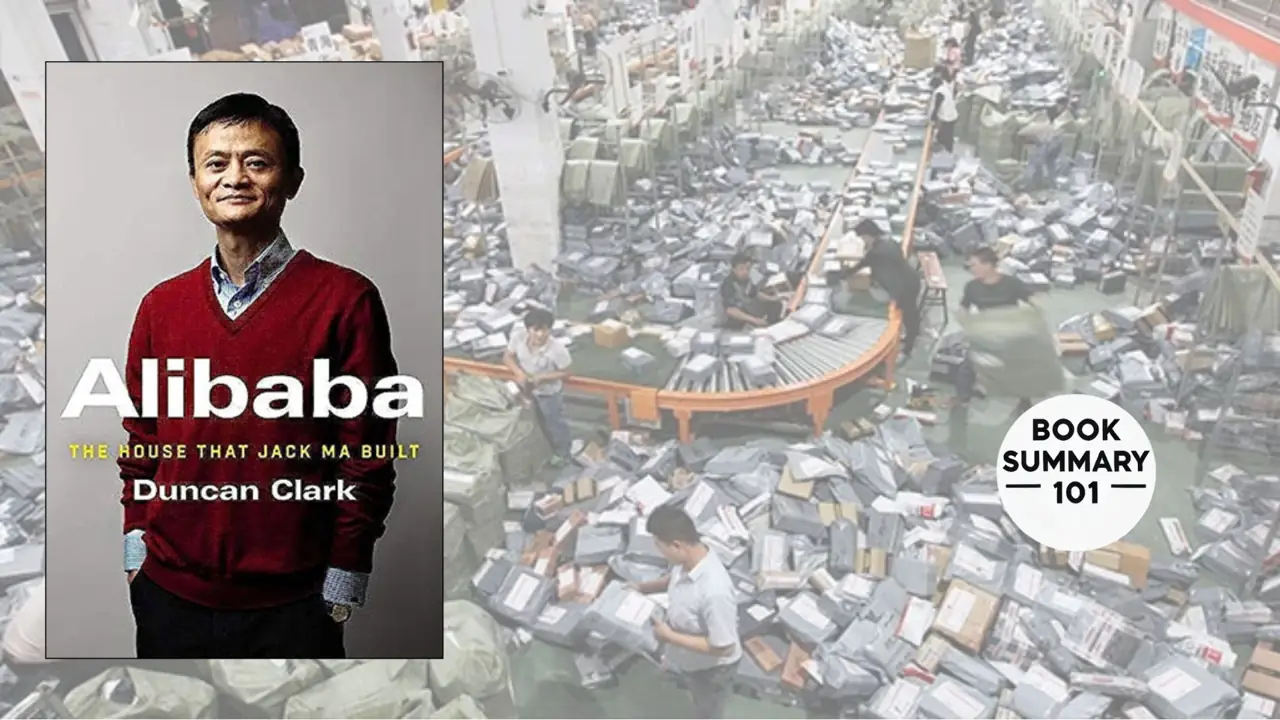
Then I picked up “Alibaba: The House That Jack Ma Built” by Duncan Clark.
It wasn’t just another dry business biography. It felt like sitting down with an old friend who witnessed history and lived to tell the tale. Duncan Clark isn’t just an observer; he was an advisor to Alibaba in the early days. He watched Jack Ma—a former English teacher who failed his college entrance exams twice—build one of the world’s most valuable companies.
Reading this book was a breath of fresh air. It reminded me that “soft skills”—like empathy, teaching, and sheer grit—can sometimes crush raw technical ability.
If you’ve ever felt like an underdog, or if you’re just curious how a company you might never have used became bigger than Amazon and eBay combined, this summary is for you.
Why Should You Even Bother Reading It?
You might be thinking, “I don’t live in China, and I don’t work in e-commerce. Why do I care?”
Here is why: This is the ultimate underdog story. It is perfect for entrepreneurs who feel outgunned by bigger competitors, non-technical founders who worry they can’t build a tech company, and curious minds who want to understand the massive economic shift happening in the East.
Jack Ma’s philosophy flips Western business logic on its head. If you want to learn how to win a war against a giant (like eBay) when you have zero money and zero technology, this book is your playbook.
- Why Should You Even Bother Reading It?
- The Blueprint of the ‘Crocodile in the Yangtze’
- 1. The Iron Triangle: The Ecosystem of Trust
- 2. The Shark vs. The Crocodile: Winning on Home Turf
- 3. The “Love Them, Don’t Marry Them” Strategy
- 4. Customers First, Employees Second, Shareholders Third
- 5. The Teacher Management Style
- My Final Thoughts
- Join the Conversation!
- Frequently Asked Questions (The stuff you’re probably wondering)
The Blueprint of the ‘Crocodile in the Yangtze’
Duncan Clark breaks down the Alibaba phenomenon not as a stroke of luck, but as a carefully constructed architecture. It wasn’t magic; it was a specific set of principles that allowed a small startup in an apartment to dominate the world stage.
Here are the core pillars that hold up the House that Jack Ma built.
1. The Iron Triangle: The Ecosystem of Trust
Imagine you are trying to build a house, but you have no bricks, no cement, and the ground is unstable. That was the internet in China in the late 90s. There was no infrastructure for e-commerce.
People didn’t trust putting their credit cards online. Actually, most people didn’t even have credit cards. And the mail system? It was unreliable at best.
Jack Ma didn’t just build a website; he had to build the entire environment. Clark describes this as the “Iron Triangle.”
Think of a three-legged stool. If you remove one leg, the whole thing falls over. Alibaba needed three specific legs to stand:
- E-commerce (The Marketplace): This is Alibaba.com and Taobao (the sites where people buy stuff).
- Logistics (The Delivery): Cainiao (a network ensuring packages actually arrive).
- Finance (The Money): Alipay (a way to pay without getting scammed).
The genius wasn’t the website; it was Alipay.
In the West, we had trust (credit cards). In China, Ma created an escrow system. The buyer puts money in Alipay, Alibaba holds it, the seller ships the goods, the buyer inspects the goods, and only then does Alibaba release the money to the seller.
Real-World Example:
Think about Uber. Uber didn’t just create an app to hail a taxi. They had to handle the payments invisibly (so you don’t fight with the driver about cash) and create a rating system (Logistics/Trust) so you wouldn’t be afraid to get into a stranger’s car. Uber, like Alibaba, had to build an ecosystem of trust, not just a piece of software.
Simple Terms: You can’t just sell a product; you have to build the roads and the banks that allow the transaction to happen.
The Takeaway: If the infrastructure for your business doesn’t exist, you can’t wait for someone else to build it. You have to build it yourself to unlock the market.
2. The Shark vs. The Crocodile: Winning on Home Turf
One of the most thrilling parts of the book is the war between eBay and Taobao (Alibaba’s consumer site).
In the early 2000s, eBay was the giant shark in the ocean. They came to China with deep pockets, bought a local player, and expected to dominate. Jack Ma, the small underdog, knew he couldn’t fight eBay in the “ocean” (the global market).
He used a famous analogy: “eBay may be a shark in the ocean, but I am a crocodile in the Yangtze River. If we fight in the ocean, we lose—but if we fight in the river, we win.”
What did this mean? It meant knowing the local terrain better than the invader.
eBay tried to apply their US model to China: they charged users listing fees. They tried to make the site look clean and corporate.
Jack Ma went the opposite direction. He made Taobao free for years. He knew the Chinese market was price-sensitive. He also made the website chaotic, colorful, and busy—because Chinese shoppers viewed a busy site as a sign of life and activity, similar to a bustling street market. A clean, white minimalist site looked “empty” and untrustworthy to them.
📖”eBay is a shark in the ocean. We are a crocodile in the Yangtze River. If we fight in the ocean, we lose. But if we fight in the river, we win.”
Real-World Example:
Look at Spotify vs. Apple Music. When Apple launched, they were the giant. But Spotify (the crocodile) focused intensely on one thing: discovery and personalization (like the ‘Discover Weekly’ playlist). They understood the “terrain” of how people felt about finding new music better than Apple, who just treated music like a library. Spotify won the hearts of users by understanding the nuance of the user experience.
Simple Terms: Don’t fight a giant on their terms; drag them into your territory where you know the rules and they don’t.
The Takeaway: Local knowledge and cultural customization will almost always beat a generic, global strategy.
3. The “Love Them, Don’t Marry Them” Strategy
Navigating the government is tricky in any country, but in China, it is an art form.
Many Westerners assume Alibaba is state-owned or a puppet of the government. Clark explains that it’s much more complicated. Jack Ma’s philosophy regarding the government was simple: “Love them, don’t marry them.”
Think of this like dancing with a bear. You have to be close enough to the bear to follow its lead so you don’t get stepped on, but you never want to be hugged so tight that you suffocate.
Ma understood that he had to align Alibaba’s goals with national goals.
- The government wanted to create jobs? Alibaba created millions of merchant jobs.
- The government wanted to develop rural areas? Alibaba launched “Taobao Villages” to help farmers sell online.
By positioning Alibaba as a solution to the government’s problems, Ma secured the political cover he needed to grow without being nationalized or shut down. He didn’t ask for money; he asked for permission to exist.
Real-World Example:
Consider Tesla. Elon Musk aligns his company with government goals regarding green energy and climate change. By helping governments meet their carbon emission targets, Tesla receives subsidies and regulatory support. He is “dancing” with the regulators by making his success their success.
Simple Terms: Align your business goals with the goals of the powers that be (bosses, regulators, governments) to clear the path for growth.
The Takeaway: You don’t have to sell your soul, but you must ensure your success helps the “rulers” look good, too.
4. Customers First, Employees Second, Shareholders Third
This is perhaps the most controversial concept in the book, especially for Wall Street.
In the West, the mantra is “Shareholder Value.” The CEO’s job is to make the stock price go up. Jack Ma openly told investors during his IPO roadshow (where he was asking them for billions of dollars) that they were number three on his priority list.
The Hierarchy:
- Customers: Without them, there is no money.
- Employees: Without happy employees, you can’t serve the customers.
- Shareholders: If the first two are happy, the shareholders will eventually get rich.
Imagine an inverted pyramid. Most companies put the investors at the top, crushing the employees and customers with demands for profit. Ma flipped the pyramid. He believed that if you squeeze employees to please investors, the product suffers, the customers leave, and the investors lose anyway.
It takes guts to tell the people giving you money that they aren’t your favorite, but it worked.
Real-World Example:
Costco operates on a similar philosophy. They pay their employees significantly more than the industry average and keep prices rock-bottom for members, even if Wall Street complains about thin margins. The result? A fanatic customer base and a stock that has performed incredibly well over the long term.
Simple Terms: Take care of the people who pay you (customers) and the people who do the work (employees), and the stock price takes care of itself.
The Takeaway: Short-term profit hunting often kills long-term value. Focus on the product and the people.
5. The Teacher Management Style
Jack Ma was not a coder. He was an English teacher.
Throughout the book, Clark emphasizes how this background defined his leadership. He didn’t lead like a general or an engineer; he led like a coach.
In the early days, Ma couldn’t write a line of code. He couldn’t contribute to the technical product. So, what did he do? He focused on vision, motivation, and culture.
Think of a sports movie. Jack Ma is the coach in the locker room giving the halftime speech. He isn’t the one throwing the ball, but he is the one making the team believe they can win.
He used stories, martial arts metaphors (calling himself a guardian of the “Six Vein Spirit Sword”—the company values), and grandiose visions to keep his team motivated through brutal hours and near-bankruptcy. He hired people who were smarter than him and then cheered them on.
📖”Intelligent people need a fool to lead them. When the team’s all a bunch of scientists, it is best to have a peasant lead the way. His way of thinking is different.”
Real-World Example:
Steve Jobs (in his later years) wasn’t designing the chips inside the iPhone. He was the visionary and the “editor.” He set the standard and pushed his team to achieve what they thought was impossible. He was the conductor of the orchestra, not the violin player.
Simple Terms: You don’t need to be the smartest person in the room to be the leader; you just need to be the one who can unlock everyone else’s potential.
The Takeaway: Soft skills—storytelling, teaching, and motivating—are just as lethal in business as technical skills.
My Final Thoughts
When I finished Alibaba, I didn’t just feel like I understood a Chinese company; I felt empowered.
Duncan Clark does a masterful job of humanizing a figure who is often portrayed as a caricature. Jack Ma was rejected from KFC (24 people applied, 23 got the job—he was the only rejection). He was rejected from Harvard 10 times.
The book strips away the “genius” myth. It shows that Alibaba wasn’t built on a secret algorithm. It was built on understanding human nature, solving a massive trust problem, and having the sheer audacity to play the game by a different set of rules.
It’s a reminder that your background doesn’t dictate your future. If a teacher can build the Amazon of the East, what can you build?
Join the Conversation!
I’d love to hear your take on Jack Ma’s “Inverted Pyramid” philosophy.
Do you agree that shareholders should come third, or is that a recipe for disaster in most companies?
Drop a comment below and let’s chat!
Frequently Asked Questions (The stuff you’re probably wondering)
1. Is this book too technical for me?
Not at all. Duncan Clark writes in a very narrative, storytelling style. You don’t need to know anything about coding, finance, or complex economics to enjoy it. It reads more like a biography and an adventure story than a textbook.
2. Do I need to be interested in China to enjoy it?
No. While it is set in China, the lessons about strategy, competition, and leadership are universal. If you are interested in business, startups, or underdog stories, you will get a lot out of it regardless of the geography.
3. Is the book impartial, or is it just praising Jack Ma?
It is quite balanced. Because Duncan Clark was an early advisor but also an independent investment banker, he gives a fair view. He praises Ma’s vision but also discusses the controversies, the friction with Yahoo!, and the aggressive tactics used against competitors.
4. What is the “Iron Triangle” mentioned in the book?
The Iron Triangle is the combination of E-commerce (selling), Logistics (delivery), and Finance (payment). The book argues that Alibaba succeeded because it didn’t just build the store; it built the delivery network and the bank to support it.
5. How long is the read?
It’s about 300 pages. It flows very quickly because of the conversational writing style. You could easily finish it in a weekend or a few evenings of reading.