Do you remember that old Schoolhouse Rock! cartoon, “I’m Just a Bill”?
Growing up, I honestly thought that was the whole story. I thought Congress wrote all the laws, the President signed them, and the rest of the government just happily carried out those orders. It seemed so clean, so democratic, and so incredibly simple.
But as I got older, I started noticing things that didn’t fit that neat little narrative.
I’d see massive, sweeping changes to environmental policies, healthcare rules, or internet regulations, and I’d think, “Wait a minute, Congress hasn’t passed a law about this in decades. Where did this come from?” It was frustrating. I felt like there was a secret, hidden layer of government pulling the strings, and I didn’t have the security clearance to understand it.
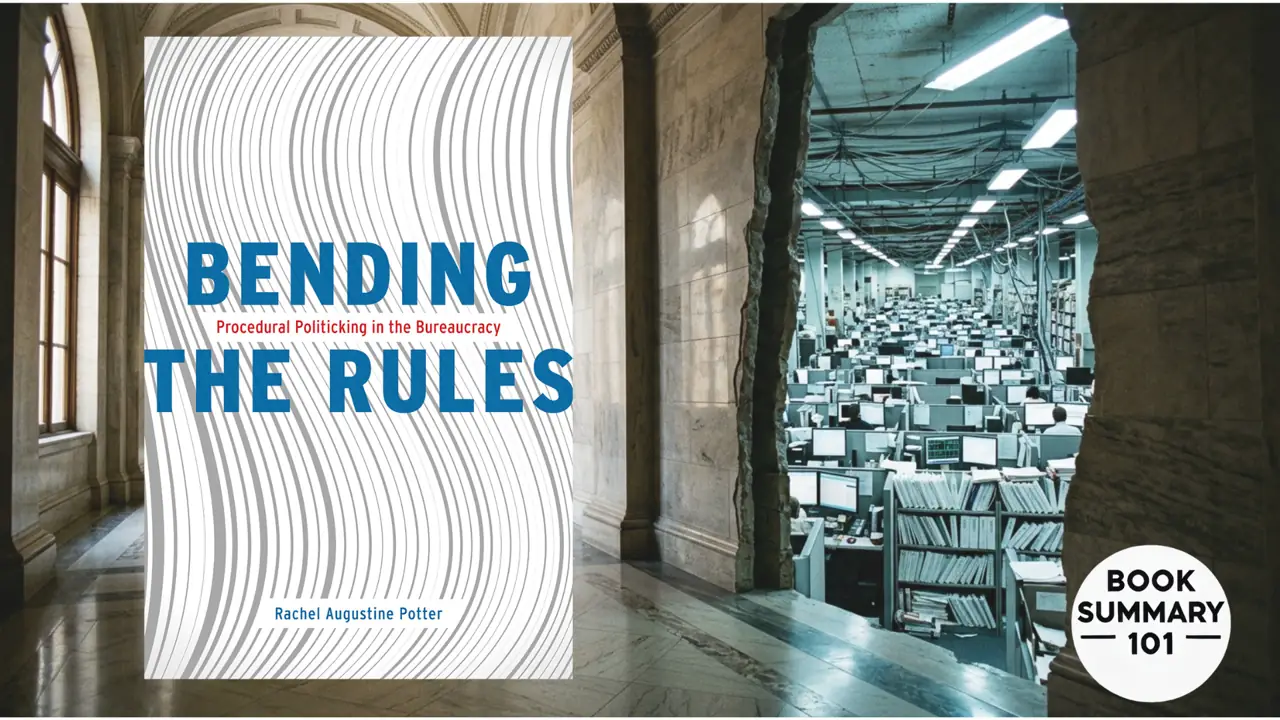
That is, until a friend recommended Bending the Rules: Procedural Politicking in the Bureaucracy by Rachel Augustine Potter.
Reading this book felt like sitting down for coffee with a brilliant insider who was finally ready to spill the tea on how Washington actually operates. It completely shattered my childhood illusions, but in the best way possible. It showed me that the real power doesn’t always sit in the Oval Office. Often, it sits in a cubicle.
Why Should You Even Bother Reading It?
You might be thinking, “A book about bureaucratic procedure? That sounds like a guaranteed cure for insomnia.” I get it! But trust me, this is anything but dry.
If you have ever felt like the system is rigged, if you work in any corporate or government setting, or if you are simply a curious citizen who wants to know how the rules that govern your life are actually made, this is for you. You don’t need a law degree or a background in political science to grasp this.
This book’s core message is incredibly relevant right now: the unelected officials who run government agencies aren’t mindless paper-pushers. They are brilliant political strategists. Understanding their playbook is the only way to truly understand modern politics.
- Why Should You Even Bother Reading It?
- The Bureaucrat’s Secret Playbook for Ruling from the Shadows
- 1. The Myth of the Mindless Paper-Pusher (The Bureaucrat’s True Nature)
- 2. The Notice-and-Comment Game (The Standard Procedure)
- 3. Bypassing the Haters (Interim Final Rules)
- 4. The Art of Strategic Timing (Midnight Rulemaking)
- 5. Weaponized Jargon (Drafting Obscurity)
- My Final Thoughts
- Join the Conversation!
- Frequently Asked Questions (The stuff you’re probably wondering)
The Bureaucrat’s Secret Playbook for Ruling from the Shadows
Let’s open up the hood of the administrative state and take a look at the engine. What follows are five of the most fascinating, brilliant, and slightly sneaky ways unelected officials use boring procedures to outsmart politicians and get their rules passed.
1. The Myth of the Mindless Paper-Pusher (The Bureaucrat’s True Nature)
Imagine a quiet, unassuming chess grandmaster sitting in a park. To the untrained eye, they might look like they’re just mindlessly moving pieces around, maybe even playing a simple game of checkers. But in reality, they are thinking fifteen moves ahead, anticipating every counter-attack, and carefully manipulating their opponent into a trap. (If you want to dive deeper into how strategic play translates to real-world maneuvering, check out our summary of How Life Imitates Chess).
For decades, we have treated government bureaucrats like they are playing checkers. We assume they just take orders from Congress and rubber-stamp documents all day. If you find yourself fascinated by the complexities of modern administrative work, you might also appreciate our summary of Bullshit Jobs.
Rachel Augustine Potter completely flips this script. She argues that bureaucrats are actually the grandmasters of the political chess board. They have their own goals, their own policy dreams, and a deep, driving desire to protect their agency’s mission. When politicians try to interfere with those goals, bureaucrats don’t just roll over. They fight back.
📖 “Bureaucrats are not simply passive administrators of the law. They are strategic actors who use the tools at their disposal – specifically, the procedural rules of rulemaking – to insulate their preferred policies from political interference.”
But here is the brilliant part: they don’t fight back with loud press conferences or flashy campaigns. They fight back using boring, mind-numing administrative procedures.
Think about an experienced scientist working at the Environmental Protection Agency (EPA). They know that if they propose a bold new climate rule, politicians funded by oil companies will try to crush it. So, instead of a direct confrontation, the bureaucrat uses complex procedural rules to quietly shield their policy from attacks. They use the system’s own red tape as a weapon.
Simple Terms: Government workers aren’t mindless robots; they are strategic fighters who use boring procedures to protect their agendas.
The Takeaway: If you want to understand why government does what it does, you have to stop looking at politicians and start looking at the motives of the invisible bureaucrats writing the rules.
2. The Notice-and-Comment Game (The Standard Procedure)
Think about the worst Homeowners Association (HOA) meeting you’ve ever attended. The board wants to pass a rule about what color you can paint your mailbox. Legally, they have to open the floor to the neighborhood for “feedback.” What follows is two hours of chaotic yelling, complaints, and threats of lawsuits.
This is exactly what bureaucrats face, but on a massive, national scale. It’s called the “Notice-and-Comment” process.
Because we live in a democracy, agencies can’t just invent a rule in secret and force it on us. The Administrative Procedure Act (APA) requires them to publish a draft of the rule and invite the public to comment on it. It sounds highly democratic, right? Everyone gets a voice!
But for the bureaucrat trying to get a rule passed, this public comment period is a terrifying minefield. If they don’t respond to the comments properly, a judge can throw their entire rule in the trash.
Take the Federal Communications Commission (FCC) and the battle over Net Neutrality. When the FCC proposed changing the rules, they received millions of public comments. Some were from angry citizens, but many were from massive telecommunications lobbyists with armies of lawyers.
The bureaucrats at the FCC had to carefully navigate this ocean of feedback. They had to figure out how to satisfy the legal requirement of “listening” to the public without actually letting the public destroy the core of their policy. They do this by strategically categorizing comments, bundling them together, and using legal boiler-plate to dismiss the haters while keeping their rule intact.
Simple Terms: Agencies legally have to ask the public for their opinion on new rules, which usually results in a chaotic avalanche of complaints.
The Takeaway: The public comment period is less about true democracy and more about bureaucrats playing a legal game of dodgeball to keep their rules alive.
3. Bypassing the Haters (Interim Final Rules)
Have you ever tried to get a toddler to eat their vegetables? If you put a pile of steamed spinach on their plate, they will scream, cry, and refuse to eat. But if you secretly blend that spinach into a delicious, sweet fruit smoothie, they slurp it right down. By the time they realize they’ve eaten a vegetable, it’s already in their stomach.
In the bureaucratic world, sneaking the spinach into the smoothie is called using an “Interim Final Rule.” It is one of the most powerful and controversial tools in a bureaucrat’s playbook.
Remember that messy Notice-and-Comment HOA meeting we just talked about? Well, bureaucrats have figured out a legal loophole to skip that meeting entirely. If an agency anticipates massive political pushback on a rule, they can claim “good cause.” They declare that going through the normal, slow comment process would be “impracticable, unnecessary, or contrary to the public interest.”
Boom. The rule goes into effect immediately.
A great real-world example of this happens often with the Transportation Security Administration (TSA). If a new security threat emerges, the TSA doesn’t have time to ask the public how they feel about taking off their shoes at the airport. They just issue an Interim Final Rule, citing an emergency, and the rule becomes law overnight.
While this makes sense for national security, Potter points out that agencies often stretch the definition of “good cause” to bypass the haters on policies that aren’t actually emergencies. They just know the rule will be unpopular, so they force it through first and ask for forgiveness later.
Simple Terms: Bureaucrats use a legal loophole to skip public feedback and make a rule effective immediately by claiming it’s an emergency.
The Takeaway: When an agency knows a rule will face heavy resistance, they will often bend the rules of procedure to force it into law before anyone has a chance to fight it.
4. The Art of Strategic Timing (Midnight Rulemaking)
Imagine a public relations firm representing a celebrity who just got caught in a major scandal. They need to release an apology, but they don’t want anyone to actually read it. What do they do? They release the statement on a Friday afternoon at 5:00 PM, right before a long holiday weekend. They know the news cycle is dead, and everyone is logging off.
Timing is everything. And nobody understands the power of strategic timing quite like a seasoned bureaucrat.
In Bending the Rules, Potter explains that agencies carefully manipulate the calendar to insulate their rules. If they have a highly controversial rule, they might delay its release until Congress is on recess, or until the media is distracted by a massive international crisis.
The most famous example of this is called “Midnight Rulemaking.”
When a President is about to leave office – especially if the incoming President is from the opposing political party – agencies go into overdrive. In the final 60 days of an administration, bureaucrats will suddenly finalize dozens of massive, highly impactful rules.
📖 “Timing is not incidental in the rulemaking process; it is a calculated mechanism of control. By strategically burying or rushing rules, bureaucrats can effectively run out the clock on their political opponents.”
Look at the transition between the Obama and Trump administrations, or Trump and Biden. In the final weeks, the outgoing administration’s agencies suddenly dropped massive environmental regulations and business mandates. They rush them out the door at the “midnight” hour, knowing that reversing a finalized rule is legally exhausting and takes years.
Simple Terms: Agencies deliberately release new rules at times when politicians and the media are too distracted to fight back.
The Takeaway: The calendar is a weapon; by rushing rules at the end of a presidency or burying them during busy news cycles, bureaucrats ensure their policies survive.
5. Weaponized Jargon (Drafting Obscurity)
Think about the last time you updated your iPhone and that little box popped up asking you to agree to Apple’s new “Terms and Conditions.” Did you read all 45 pages of that dense, legalistic, incredibly boring text? Of course not. You blindly scrolled to the bottom, clicked “Agree,” and went on with your day.
Apple knows you aren’t going to read it. The sheer boredom and complexity of the document are exactly what protects the company. Bureaucrats use the exact same strategy, a tactic Potter calls “drafting obscurity.”
When an agency is writing a rule that they know politicians will hate, they don’t write it in plain English. They thicken the text. They pack it with so much technical jargon, cross-references, scientific data, and agonizingly dense legal speak that it becomes unreadable to the average person – or the average politician. For a look at how to cut through this kind of organizational complexity, have a look at our summary of The Ministry of Common Sense.
Let’s look at the Dodd-Frank Wall Street Reform Act. When the financial agencies had to write the specific rules to implement this law, they produced thousands of pages of incredibly complex financial regulations.
A member of Congress might want to strike down a specific banking rule, but to do so, they first have to understand it. If the rule is buried on page 842 of a 1,000-page document, hidden behind complex mathematical formulas, the politician’s eyes will glaze over. They won’t have the time or the staff to untangle the mess, so they simply let it slide. The bureaucrat gets exactly what they want by boring their enemies into submission.
Simple Terms: Bureaucrats intentionally write rules using dense, confusing, and incredibly boring language so that no one will bother to challenge them.
The Takeaway: Complexity is a shield; if a rule is too difficult and tedious for politicians to understand, they are much less likely to try and overturn it.
My Final Thoughts
Reading Bending the Rules fundamentally shifted how I view the news.
Before this book, I used to get so worked up over the theatrical arguments happening in Congress. Now? I realize that most of the partisan bickering on television is just a distraction from the real game being played behind the scenes.
It is incredibly empowering to finally see the Matrix. Once you understand that unelected officials are strategically using timing, jargon, and legal loopholes to shape our world, you become a much smarter consumer of political news. You stop getting mad at the puppets and start paying attention to the procedural strings. Rachel Augustine Potter has given us a rare, brilliant look into the true engine room of our government, and I cannot recommend it enough.
Join the Conversation!
Now that you know the secrets of the bureaucratic playbook, I’d love to hear from you! Have you ever noticed a confusing rule – maybe at your job, in your local government, or in the news – and wondered who on earth wrote it and how it got passed?
Drop your stories in the comments below, and let’s decode them together!
Frequently Asked Questions (The stuff you’re probably wondering)
1. Do I need to be a political science major to understand this book?
Not at all! That’s the beauty of it. While the subject matter is deep, Potter writes in a way that is incredibly accessible. If you can understand the basics of office politics, you can absolutely understand the concepts in this book.
2. Is the book super dry and academic?
Honestly, it reads more like a psychological thriller about office workers. Yes, it relies on solid academic research, but the focus is on the human element – the strategy, the sneakiness, and the brilliant maneuvering of the people involved. It is remarkably engaging.
3. Who is this book actually for?
It’s for anyone who works in a corporate bureaucracy, anyone interested in politics, law students, or just the endlessly curious. If you like podcasts that explain “how things actually work,” this book is right up your alley.
4. Does the author think bureaucrats are evil?
No, and that’s a very important point! The book isn’t a hit piece on government workers. It just reveals that they are rational, strategic actors who deeply care about their agency’s mission. They use these tactics because they genuinely believe in the policies they are trying to protect.
5. Will this help me in my everyday corporate job?
Absolutely. The tactics described in this book – like strategic timing, bypassing the haters, and using jargon as a shield – are used in massive corporations every single day. Understanding how government bureaucrats bend the rules will almost certainly make you better at navigating your own company’s internal politics.