Let’s be honest for a second. How many times have you stared at a decision—whether it’s a career pivot, a messy negotiation, or just what to do with your weekend—and felt complete paralysis?
I used to be terrible at this. I would overthink the small stuff, panic over the big stuff, and generally feel like I was guessing my way through adulthood. I treated life like a game of roulette, hoping the ball would land on “Success” if I just got lucky.
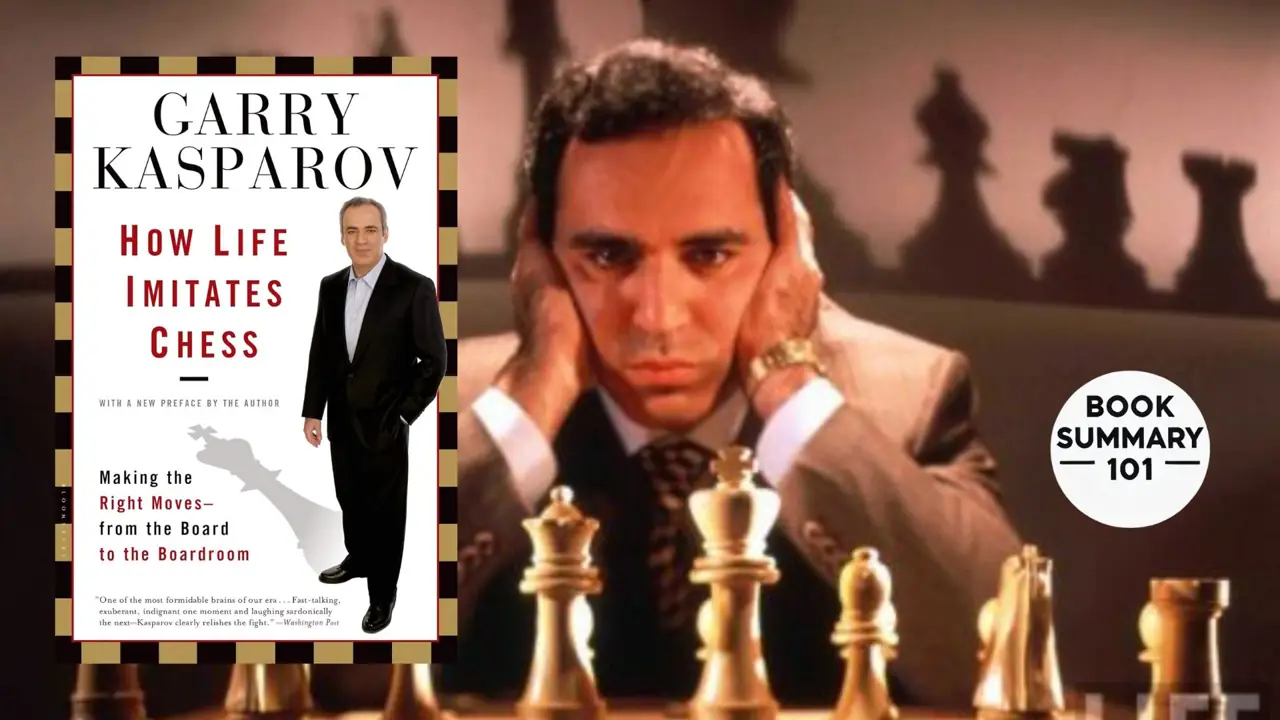
Then I picked up How Life Imitates Chess by Garry Kasparov.
I know what you’re thinking. “I don’t play chess. I don’t want to read a boring textbook on the Sicilian Defense.”
Trust me, neither did I. But this isn’t a book about moving wooden pieces on a 64-square board. It’s a book about how your brain works. It was like sitting down for coffee with the smartest guy in the room while he explained, in plain English, how to organize the chaos in my head.
It turns out, the man who dominated the chess world for twenty years knows a thing or two about making high-pressure decisions. And the best part? You don’t need to know a Rook from a Bishop to understand it.
- Why Should You Even Bother Reading It?
- The Grandmaster’s Toolkit for Success
- 1. Strategy vs. Tactics (The Map vs. The Steering Wheel)
- 2. The Calculation of Evaluation (Material, Time, and Quality)
- 3. Questioning Success (The “Gravity” of Winning)
- 4. Intuition vs. Calculation (Training the Gut)
- 5. The Endgame (Knowing When to Exchange)
- My Final Thoughts
- Join the Conversation!
- Frequently Asked Questions (The stuff you’re probably wondering)
Why Should You Even Bother Reading It?
This book is a goldmine for anyone who feels like they are constantly reacting to life rather than leading it.
If you are a business leader, an entrepreneur, or just someone trying to navigate office politics, Kasparov’s insights are invaluable.
But it’s also for the dreamers. It teaches you that talent isn’t enough; you need a system. The core message is relevant today because we live in an age of information overload. We have too much data and not enough wisdom. Kasparov teaches you how to filter the noise and make the right move, even when the clock is ticking.
The Grandmaster’s Toolkit for Success
Kasparov organizes his philosophy into a few distinct pillars that act like a mental operating system. These aren’t just abstract ideas; they are practical tools you can pick up and use immediately to audit your life and your business.
1. Strategy vs. Tactics (The Map vs. The Steering Wheel)
Most of us use the words “strategy” and “tactics” interchangeably. Kasparov says this is a fatal mistake. He draws a hard line between the two, and understanding the difference is the first step to mastery.
Think of it like a road trip. Strategy is the map. It’s the long-term goal: “We are driving from New York to California to start a new life.” Tactics are the driving skills: merging into traffic, dodging a pothole, or finding gas when the tank is low.
Kasparov argues that most people are obsessed with tactics—solving the immediate problem right in front of them—but have no strategy. They are excellent drivers, but they are driving in circles.
In the business world, a tactic is offering a 20% discount to boost sales this month. A strategy is building a brand loyalty program that ensures you don’t need to offer discounts in five years. If you only focus on the daily fires (tactics), you will eventually lose the war, even if you win every battle.
📖 The Golden Rule: “Strategy is knowing what to do when there is nothing to do. Tactics is knowing what to do when there is something to do.”
Simple Terms: Strategy is the “what” and “why” (long-term); Tactics are the “how” (short-term).
The Takeaway: Stop reacting to immediate problems and check if your daily actions actually align with your long-term goals.
2. The Calculation of Evaluation (Material, Time, and Quality)
How do you know if you’re winning? In life, we often look at the wrong metrics (like just looking at a bank account balance). Kasparov introduces a three-pronged system for evaluating any position: Material, Time, and Quality (MTQ).
Imagine you are renovating a house.
- Material: This is your budget and your raw materials (bricks, wood).
- Time: How long will the renovation take?
- Quality: How good is the craftsmanship?
Kasparov explains that you can usually trade one for another, but you can rarely have all three. In a chess game, you might sacrifice a piece (Material) to get a surprise attack (Time) that ruins the opponent’s defense (Quality).
In the real world, a startup might burn through cash (Material) at an alarming rate. Is that bad? Not if they are using it to capture the market fast (Time) before a competitor creates a better product (Quality). The mistake is focusing on only one factor (like hoarding cash/Material) and ignoring the others until it’s too late.
Simple Terms: Every decision is a trade-off between resources, speed, and position.
The Takeaway: Don’t just look at what you have; look at how much time you have and the quality of your position relative to your competitors.
3. Questioning Success (The “Gravity” of Winning)
This is perhaps the most counter-intuitive lesson in the book. We all know we should learn from our mistakes. But Kasparov insists we must also learn from our wins.
Think of the “Gravity of Success” like wearing a heavy winter coat. It served you perfectly during the blizzard (your past struggle). But now summer has arrived (the market has changed), and you’re still wearing the coat because “it worked before.” Now, that same coat is going to make you pass out from heatstroke.
Kasparov points out that winning makes us conservative. When we win, we stop taking risks. We stop innovating. We assume we won because we are geniuses, when maybe we just got lucky or the competition was weak.
Real-World Example: Look at Blockbuster Video. They were winning. They had the store locations, the cash, the dominance. They assumed their model was perfect because it had always worked. They didn’t analyze their success; they rested on it. Then Netflix changed the rules of the game, and Blockbuster’s “winning strategy” became their tombstone.
📖 The Warning: “Success is the enemy of future success.”
Simple Terms: Just because it worked yesterday doesn’t mean it will work tomorrow.
The Takeaway: brutally analyze your victories to see if you won through skill or luck, and never let success make you complacent.
4. Intuition vs. Calculation (Training the Gut)
We often hear people say, “Trust your gut!” But Kasparov warns that your gut is only as good as the data you’ve fed it.
He compares intuition to a muscle. You can’t trust your muscles to lift 300 pounds if you’ve never been to the gym. Similarly, you can’t trust your “business intuition” if you haven’t put in the hours of study and calculation.
In chess, grandmasters don’t calculate every single move—that’s impossible. They use intuition to narrow down the options to just two or three sensible moves, and then they calculate.
Real-World Example: Consider a seasoned firefighter. They might walk into a burning building and immediately yell, “Get out!” without knowing why. That isn’t magic. It’s their brain subconsciously recognizing heat patterns and sound cues from thousands of previous fires. It is compressed experience. If a rookie tried to use “intuition,” they would likely get burned.
Simple Terms: Intuition is just rapid, subconscious pattern recognition based on experience.
The Takeaway: Do the hard work of calculation and study first; only then have you earned the right to trust your gut.
5. The Endgame (Knowing When to Exchange)
In chess, the “endgame” is when few pieces are left. It requires a totally different mindset than the opening. One key concept here is the “exchange”—giving up a piece to get a better position.
Think of this like cleaning out your closet. You have to get rid of the clutter (exchange old clothes) to make room for the new wardrobe. If you hoard everything, you have no space to operate.
Kasparov applies this to business and personnel. Sometimes, as a leader, you have to realize that the team that got you from $0 to $1 million isn’t the same team that will get you from $1 million to $10 million. You might have to “exchange” pieces—move people to new roles or let them go—to simplify the board and push for the win.
It sounds harsh, but in the endgame, clarity is everything. Complication favors the losing side (who wants to create chaos to survive). Simplicity favors the winning side.
Simple Terms: Simplify your life and business to secure the win, even if it means letting go of things (or people) you like.
The Takeaway: When you are ahead, simplify the game to reduce the chance of a blunder.
My Final Thoughts
Reading How Life Imitates Chess felt less like reading a book and more like upgrading the software in my brain.
What I loved most was the empowerment. Kasparov strips away the excuse of “bad luck.” He forces you to look in the mirror and realize that while you can’t control the pieces your opponent moves, you have absolute control over your own strategy, your preparation, and how you evaluate the board.
It’s a reminder that we are all Grandmasters of our own lives—we just need to stop playing random moves and start playing with purpose.
Join the Conversation!
I’d love to hear from you. Do you tend to focus more on Tactics (fighting daily fires) or Strategy (planning the long route) in your own life? Drop a comment below and let’s discuss!
Frequently Asked Questions (The stuff you’re probably wondering)
1. Do I need to know how to play chess to enjoy this book?
Absolutely not. Kasparov uses chess as a metaphor, but he explains every concept clearly. If you know that the goal is to checkmate the King, you know enough.
2. Is this a biography of Garry Kasparov?
It’s a hybrid. He uses stories from his famous matches (like against Deep Blue and Karpov) to illustrate points, but the focus is 80% on life/business lessons and 20% on his personal history.
3. Is the writing style dry and technical?
Surprisingly, no. It’s very accessible. Kasparov (with his co-author) writes with passion, humor, and a lot of relatable anecdotes from politics and business history.
4. Who is the ideal reader for this book?
Anyone in a leadership position, entrepreneurs, or people interested in self-improvement and critical thinking. If you liked Thinking, Fast and Slow or The Art of War, you’ll like this.
5. What is the biggest lesson in the book?
For me, it’s the idea that “Mental preparation is a continuous process.” You don’t just prepare for one big meeting; you build a lifestyle of analysis and learning so you are ready for any meeting.