Have you ever tried to learn a completely new, incredibly complex skill, only to feel like you were missing the most basic ingredients to even start?
That was me with machine learning. A few years ago, I decided I was going to build my own AI models. I had the enthusiasm, I had the tutorials queued up, and I was ready to change the world. But I quickly hit a massive, frustrating brick wall: I didn’t have any data.
I felt like an aspiring master chef who had all the best pots and pans, but absolutely no food to cook with. Every tutorial assumed I had access to thousands of perfectly labeled images or spreadsheets to teach my AI. I didn’t.
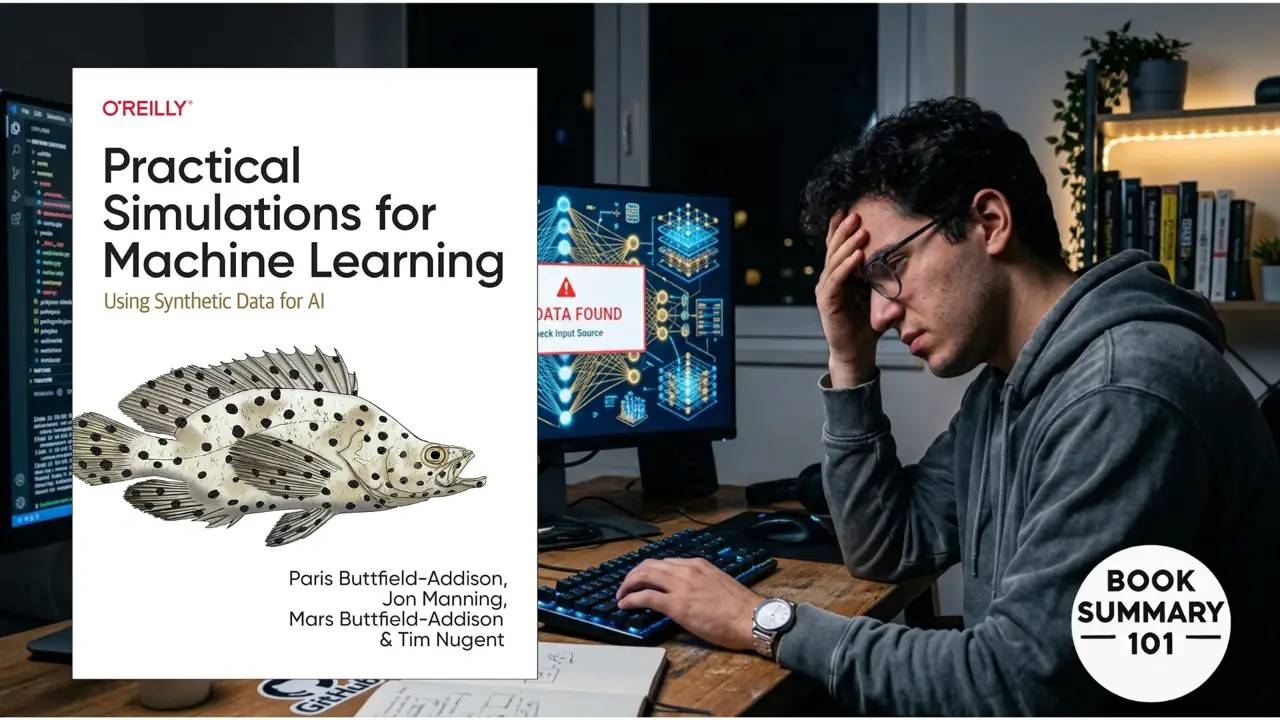
That’s when I stumbled upon a book that completely changed how I view the future of technology: Practical Simulations for Machine Learning: Using Synthetic Data for AI by Mars Buttfield-Addison.
Reading it felt like a tech-savvy friend had pulled me aside at a coffee shop and whispered a massive industry secret. You don’t actually need to hunt down real-world data anymore. You can just fake it.
- Why Should You Even Bother Reading It?
- The Matrix For Machines: Core Principles of Synthetic Data
- 1. The Data Bottleneck (The Hungry Toddler)
- 2. Synthetic Data (The Hollywood Sound Stage)
- 3. Game Engines as Data Factories (The Ultimate Sandbox)
- 4. Domain Randomization (The Distracted Student)
- 5. Reinforcement Learning in Simulation (The Video Game Respawn)
- 6. Sim-to-Real Transfer (Graduation Day)
- My Final Thoughts
- Join the Conversation!
- Frequently Asked Questions (The stuff you’re probably wondering)
Why Should You Even Bother Reading It?
You’ve probably heard the phrase, “Data is the new oil.” It powers everything from the facial recognition on your phone to the algorithms dictating your social media feeds.
But here is the scary truth: we are actually running out of high-quality human data to train AI.
Whether you are a seasoned software developer looking to level up your AI skills, a business leader trying to understand where tech is heading, or just a curious person who wants to know how robots learn to walk, this book is essential. It explains the “hack” that massive companies are using to bypass the data shortage. They are building video games for artificial intelligence to live in.
The Matrix For Machines: Core Principles of Synthetic Data
Let’s dive into the fascinating concepts that make building virtual training grounds for artificial intelligence possible. Here are the core ideas that completely changed how I view machine learning, and how you can use them too.
1. The Data Bottleneck (The Hungry Toddler)
Imagine trying to teach a stubborn toddler what a “dog” is. You can’t just explain the dictionary definition of a canine. You have to show them a picture of a poodle, a golden retriever, a chihuahua, and a husky.
You have to point out dogs in the park, dogs on television, and dogs in books. Only after seeing thousands of variations does the toddler’s brain finally click and understand the concept.
Artificial intelligence is exactly like a very hungry, very literal toddler. To learn anything, an AI needs massive, mind-boggling amounts of data. And not just any data—it needs labeled data.
If you want an AI to recognize a dog, a human being literally has to sit at a computer and draw digital boxes around dogs in millions of photos. It is incredibly tedious, eye-wateringly expensive, and terribly slow. This is what experts call the “Data Bottleneck.”
But it gets worse. What if you need data for something rare or dangerous? Think about self-driving cars.
Companies like Waymo or Tesla can easily get millions of hours of driving data on a sunny, clear day in California. But what if they need data on how to avoid a moose running across an icy road in the middle of a blizzard?
You can’t intentionally cause thousands of car crashes just to collect that data. The data bottleneck halts progress because real-world data is messy, biased, and sometimes downright dangerous to collect.
Simple Terms: AI needs an absurd amount of labeled examples to learn anything, and gathering those examples in the real world is incredibly hard.
The Takeaway: The biggest roadblock in AI development today isn’t a lack of computing power; it’s a desperate lack of high-quality, safe, and diverse data.
2. Synthetic Data (The Hollywood Sound Stage)
If you are a movie director and you want to film a scene on the surface of Mars, you don’t actually build a rocket and fly your actors to space. That would be insane.
Instead, you rent a Hollywood sound stage, set up a massive green screen, and use computers to create the Martian landscape. You fake it, and the audience can’t tell the difference.
Synthetic data is the exact same concept, applied to machine learning. Instead of sending cameras out into the real world to take millions of pictures, we use computer graphics to simply generate the pictures we need.
We construct a virtual reality. If an AI needs to see a million pictures of a stop sign covered in snow, we just tell the computer to render them.
The absolute best part about this process? It solves the tedious labeling problem automatically. Because the computer generated the virtual stop sign, it already knows exactly what it is and where it is located on the screen.
A great real-world example of this is happening in healthcare. Real medical records, like X-rays or MRI scans, are protected by strict privacy laws (like HIPAA). You can’t just share patient data with AI researchers.
So, companies are now generating “synthetic” X-rays. These images look 100% real to the AI, but they belong to a digital ghost. They contain zero private information.
📖 “Instead of collecting data from the real world, we can simulate the real world to generate the data we need, precisely when and how we need it.”
Simple Terms: Synthetic data is perfectly labeled, artificially generated information that mimics reality without the mess or privacy concerns.
The Takeaway: By creating our own data using computer graphics, we can bypass the expense and danger of real-world data collection entirely.
3. Game Engines as Data Factories (The Ultimate Sandbox)
Have you ever played a video game like The Sims or Minecraft? If so, you know how incredibly addictive it is to build a house, arrange the furniture, and watch the digital world come to life.
Now, imagine using that exact same video game software, not for entertainment, but to design an actual, physical warehouse before you spend millions of dollars building it.
This is where tools like Unity and Unreal Engine come into play. Historically, these software programs were used strictly to make blockbuster video games.
But over the last decade, these engines have become incredibly sophisticated. They have built-in physics engines. Gravity works like real gravity. Light bounces correctly off of shiny surfaces. Shadows fall exactly where they should.
Because they mimic the laws of physics so perfectly, they have become the ultimate simulators for reality. They aren’t just for making games anymore; they are now massive “data factories” for AI.
For example, look at Amazon’s robotic fulfillment centers. Before they deploy a new robotic arm to sort packages, they don’t test it blindly on the factory floor.
They build an exact digital replica of the warehouse inside a game engine. They let the AI control a virtual robotic arm to practice grabbing virtual boxes. The AI learns how the boxes slip, how heavy they are, and how to stack them, all within a video game.
Simple Terms: Video game creation software is incredibly realistic, making it the perfect tool to build virtual worlds for AI to practice in.
The Takeaway: The tools originally designed to entertain us with virtual worlds are now the exact same tools we use to educate artificial intelligence.
4. Domain Randomization (The Distracted Student)
Imagine you are studying for a massive, life-altering final exam. If you study in a perfectly quiet room with perfect lighting, you might panic on test day if someone coughs or the lights flicker.
But, what if you study while a radio is blaring, the room is freezing cold, and your chair is wobbling? If you can master the material under those chaotic conditions, the actual, quiet exam will feel like an absolute breeze.
When we train an AI inside a video game, we run into a major problem: the AI is lazy. It might just memorize the specific lighting, colors, or textures of the video game rather than learning the actual task.
To prevent this, engineers use a brilliant trick called Domain Randomization. They purposefully make the virtual world chaotic and weird.
If they are teaching a drone to recognize a red ball, they don’t just show it a red ball in a normal room. They change the background to neon plaid. They make the ball glowing green for a split second. They move the virtual sun around sporadically.
By constantly changing the superficial details, the AI is forced to learn the underlying shape and physics of the ball, rather than just memorizing the color pixels.
A famous real-world example comes from OpenAI. They trained a robotic hand to solve a Rubik’s Cube.
They trained the AI entirely in a simulator, but they constantly randomized the gravity, the friction of the cube, and the lighting. When they finally put the AI into a physical robotic hand, it could solve the cube even if researchers poked it with a stuffed giraffe!
Simple Terms: Purposefully making the virtual training environment chaotic and randomized so the AI learns the actual task, not just the simulation’s specific look.
The Takeaway: If you train an AI in a wildly unpredictable virtual world, it becomes incredibly robust and resilient to the surprises of the real world.
5. Reinforcement Learning in Simulation (The Video Game Respawn)
Think about the first time you played a difficult video game like Super Mario Bros. You probably ran right into the first Goomba enemy and died instantly.
But you didn’t quit playing forever. You just hit the “respawn” button, started over, and remembered to jump the next time. You learned through a process of safe trial and error.
This is exactly how “Reinforcement Learning” works for AI. We give the AI a goal, and we let it try to achieve it. If it does something right, it gets a digital point (a reward). If it makes a mistake, it loses a point (a penalty).
Doing this in the real world is a nightmare. If you want to teach a million-dollar physical robot how to walk, it’s going to fall over and shatter its expensive parts thousands of times before it figures it out.
But inside a simulation? Failure is completely free.
We can let a virtual robot slip, trip, and tumble down digital stairs ten thousand times in a single afternoon. We just hit the respawn button.
Take those creepy, dog-like robots made by Boston Dynamics, for example. Those robots learn to keep their balance on slippery ice by letting their digital twins fall over endlessly in a simulator first. They learn everything about balance through virtual trial and error before they ever take a physical step.
Simple Terms: Letting an AI learn by making millions of mistakes in a virtual world where failure is cheap and completely safe.
The Takeaway: Simulations provide an infinite sandbox where AI can learn through brutal trial and error without breaking any expensive real-world equipment.
6. Sim-to-Real Transfer (Graduation Day)
Imagine a pilot who has spent thousands of hours sitting inside a fully enclosed, hydraulic flight simulator. They have practiced taking off, landing, and dealing with virtual engine failures.
Then comes the ultimate test: graduation day. They finally step out of the simulator and into the cockpit of a real, physical Boeing 747. Because the simulator was so incredibly accurate, their brain automatically maps their virtual skills onto the real plane.
In machine learning, this magical moment is called “Sim-to-Real Transfer.” This is the ultimate goal of the entire process.
You take the digital “brain” (the neural network) that you have painstakingly trained inside your game engine, and you essentially copy-paste it into a physical piece of hardware.
If you did everything right—if your simulation was physically accurate and you used domain randomization—the AI doesn’t even realize it left the matrix! It just views our physical reality as another variation of the video game it has already mastered.
Look at your trusty Roomba vacuum cleaner. Companies like iRobot do not have the time to build thousands of physical obstacle courses with different couches and rugs to test their software.
Instead, they train the vacuum’s AI in millions of digitally generated living rooms. By the time you buy that vacuum and turn it on in your messy apartment, its AI has already “graduated.” It navigates around your shoes and chair legs as if it has been there a thousand times.
📖 “The true magic of synthetic data isn’t creating a perfect simulation; it’s creating a simulation just good enough that the AI’s skills perfectly bridge the gap to physical reality.”
Simple Terms: Taking the AI brain that was trained inside a video game and successfully putting it into a real-world robot or computer system.
The Takeaway: The ultimate proof of a good simulation is when an AI steps into the real world and performs flawlessly on its very first try.
My Final Thoughts
When I finished Practical Simulations for Machine Learning: Using Synthetic Data for AI, I didn’t feel overwhelmed by the technology. I actually felt incredibly empowered.
For the longest time, I thought the only people who could build truly incredible artificial intelligence were massive corporations with billions of dollars and endless oceans of data. I thought the little guy was locked out of the AI revolution.
This book proves that isn’t true. You don’t need a massive data center or a fleet of self-driving cars to teach a machine. You just need a good simulation. You can literally use the exact same software designed to make indie video games to train a neural network right on your laptop.
By understanding how to generate our own synthetic data, we can democratize AI. We can build smarter, safer, and less biased machines, all from the comfort of our own digital sound stages.
Join the Conversation!
I’d love to hear your thoughts on this wild intersection of video games and AI. If you could create a perfectly safe virtual simulation to teach an AI to do one annoying physical chore around your house, what would it be? Drop your answers in the comments below!
Frequently Asked Questions (The stuff you’re probably wondering)
Do I need to be a hardcore programmer to understand this book?
Not necessarily! While the book does have code snippets and practical tutorials (especially using the Unity game engine), the core concepts are explained beautifully. Even if you skip the code blocks, you will walk away with a deep understanding of how and why synthetic data works.
Is synthetic data actually as good as real data?
It sounds crazy, but often, yes! In many cases, it’s actually better. Real data is full of human bias and errors in labeling. Synthetic data is mathematically perfect. When blended together, a mix of mostly synthetic data with a little bit of real data often creates the smartest AI models.
Who is this book genuinely for?
It’s perfect for data scientists, game developers looking to pivot into AI, and software engineers. But honestly, any tech enthusiast who wants to understand the “behind the scenes” magic of how robots are currently being trained will find it fascinating.
What tools does the book actually talk about?
The book leans heavily into the Unity game engine. Unity has a specific toolset called Unity ML-Agents (Machine Learning Agents) that is designed exactly for this purpose. It bridges the gap between the video game world and Python (the language of AI).
Will this make human data entry and labeling jobs obsolete?
In the long run, very likely. As simulations become cheaper and more realistic, the need for giant rooms full of people drawing boxes around pictures of stop signs will drastically decrease. The new jobs will be for the people who build the simulations!