I still remember the exact moment my stomach dropped. I was staring at a beautifully written, perfectly punctuated essay submitted by a student who, just a week prior, had struggled to string together a coherent thesis statement. My first thought wasn’t pride; it was a sinking, dreadful realization. They used AI.
Suddenly, I felt completely obsolete. If a free website could generate a high-level analysis in five seconds, what was the point of my job? I spent the next few weeks trying to play “AI police,” running papers through clunky detection software, interrogating students, and feeling utterly exhausted. I was fighting a losing battle against the future.
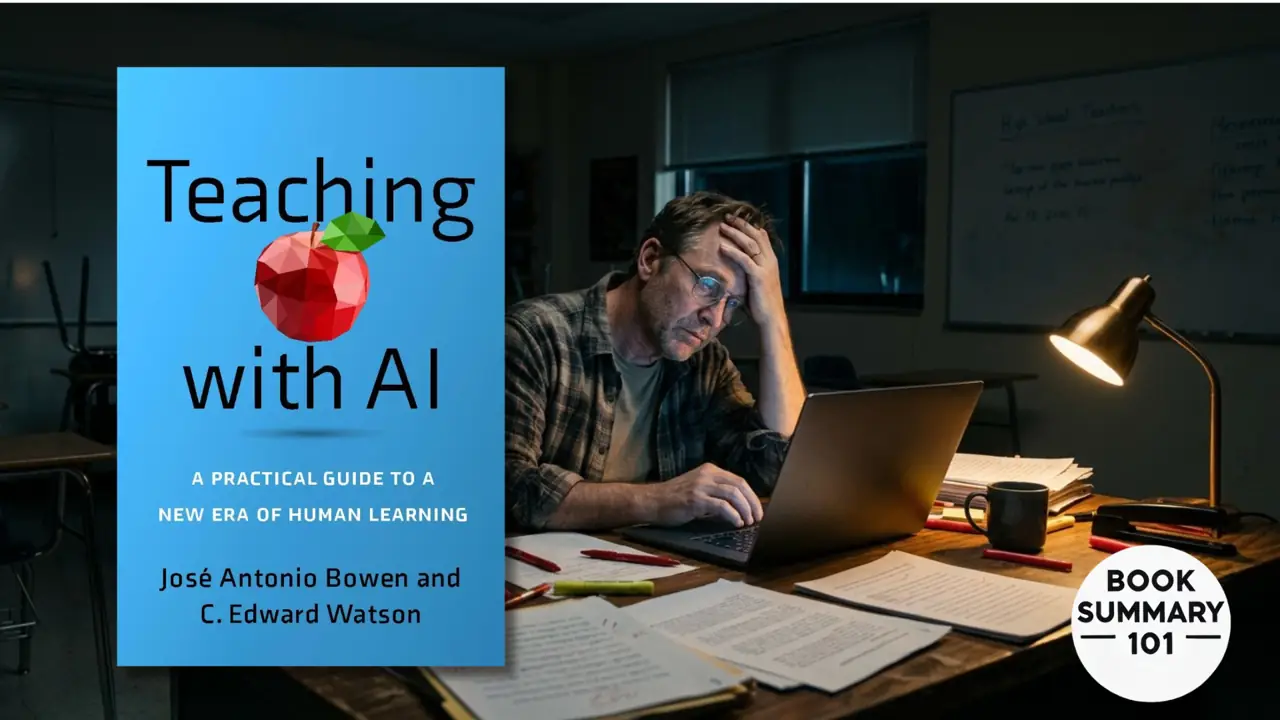
Then, a colleague handed me a copy of Teaching with AI: A Practical Guide To a New Era of Human Learning by José Antonio Bowen.
Reading it felt like sitting down for coffee with a wise, incredibly patient mentor who was gently talking me off a ledge. Instead of preaching doom and gloom, Bowen offered a refreshing, wildly optimistic perspective. He didn’t just tell me to stop fighting the technology; he showed me exactly how to harness it. It completely transformed my anxiety into excitement.
Why Should You Even Bother Reading It?
If you are a teacher, professor, corporate trainer, or even a parent trying to navigate this brave new world, this book is your survival guide. It is written specifically for non-tech professionals who feel overwhelmed by the sudden explosion of ChatGPT and other generative AI tools.
You should read this if you want to stop feeling threatened by technology and start reclaiming your time. Bowen’s core message is crucial right now: AI isn’t going to replace educators, but educators who use AI will absolutely replace those who don’t. We have to adapt, not just to save our own sanity, but to prepare our learners for a workforce where these tools are the new normal.
- Why Should You Even Bother Reading It?
- The Core Principles Reshaping the Modern Classroom
- AI as Your Eager, Naive Summer Intern
- The “AI Sandwich” Workflow
- Process Over Product: The Math Calculator Evolution
- Prompting Like Sorting Legos
- Reclaiming Your Time (The Washing Machine Effect)
- My Final Thoughts
- Join the Conversation!
- Frequently Asked Questions (The stuff you’re probably wondering)
The Core Principles Reshaping the Modern Classroom
Changing our approach to AI isn’t about throwing away everything we know about education; it’s about shifting our perspective to see this technology as a collaborative tool rather than a cheating device. Here are the foundational ideas that will completely change how you view learning in the age of algorithms.
AI as Your Eager, Naive Summer Intern
Think of AI as an incredibly enthusiastic, wildly fast, but somewhat naive summer intern. If you hire a brilliant college freshman to work in your office, you wouldn’t just say, “Hey, write our annual report,” and then publish whatever they hand you without reading it. You know they are prone to making rookie mistakes, misunderstanding context, or just making things up to sound impressive.
However, you also wouldn’t ignore the intern and do all the tedious research yourself. You would give them clear instructions, let them do the heavy lifting, and then you would review, refine, and polish their work. This is exactly how we need to start treating artificial intelligence. It is a cognitive partner, a sidekick that thrives on direction but lacks human wisdom and lived experience. It hallucinates facts and misses the emotional nuances of a topic, but it can brainstorm at the speed of light.
For example, imagine you are trying to design a new, engaging lesson plan on the causes of the American Civil War, and you are staring at a blank screen. Instead of agonizing for hours, you ask your “AI intern” to generate ten different interactive hook ideas for a room full of distracted 8th graders.
Most of the ideas might be mediocre, but two of them will spark your imagination. You take those two, combine them, and add your own pedagogical expertise. The AI didn’t do your job; it just got you past the blank page.
Simple Terms: AI is a tireless assistant that can do the heavy lifting of brainstorming and drafting, provided you supervise it closely.
The Takeaway: Stop viewing AI as an oracle that gives perfect answers, and start treating it as a flawed but helpful intern that accelerates your creative process.
The “AI Sandwich” Workflow
Have you ever watched a master chef at a high-end restaurant? The head chef doesn’t usually stand in the back chopping onions for three hours. They rely on their sous-chefs to prep the ingredients, create the foundational bases, and get everything ready. But the master chef always does the conceptualizing at the beginning, and the tasting, seasoning, and final plating at the end.
This is what Bowen calls the “Human-AI-Human loop,” or what I like to call the AI Sandwich. The top piece of bread is human input: you provide the context, the specific goals, and the creative direction. The meat in the middle is the AI: it processes your input, chops the data, and generates a draft. The bottom piece of bread is human evaluation: you must step back in to edit, fact-check, inject empathy, and finalize the product.
Let’s look at a real-world example like writing a complex, sensitive email to a frustrated parent. You provide the AI with the bullet points: the student is struggling, the student missed three assignments, but we want to be supportive. The AI drafts a professional, polite email in seconds. But you can’t just hit send.
You have to read it, realize the AI sounds a bit too robotic, soften the tone in the second paragraph, and add a personal anecdote about the student’s recent success. You did the thinking, the AI did the typing, and you did the editing.
📖 “We are not outsourcing our thinking to machines; we are outsourcing the friction of the process so we can spend more time on the thinking that actually matters.”
Simple Terms: Always start with human direction, let AI do the messy middle draft, and finish with human editing.
The Takeaway: Never blindly copy and paste an AI output; true productivity happens when you wrap machine generation in human oversight and empathy.
Process Over Product: The Math Calculator Evolution
Remember the great calculator panic? Decades ago, math teachers were terrified that if students had calculators, they would never learn how to do math, and the subject would be ruined forever. But math didn’t die. We simply stopped grading students solely on their ability to do long division by hand, and started grading them on their ability to set up the problem and understand the formulas.
We are facing the exact same evolution with writing and critical thinking. For a century, educators have graded the product—the final essay, the finished report, the completed worksheet. But now, AI can generate an A-grade product in seconds. To adapt, we have to start grading the process. We have to care less about the final document and more about the journey the student took to get there.
A brilliant real-world example of this is the “critique assignment.” Instead of asking students to write an essay on climate change, a teacher asks the students to have an AI write an essay on climate change. The student’s actual homework is to take that AI-generated essay, turn on “Track Changes” in Word or Google Docs, and aggressively fact-check, edit, and improve the AI’s work.
They have to highlight where the AI was biased, where its arguments were weak, and rewrite the conclusion to be more persuasive. You aren’t grading a pristine essay; you are grading their critical thinking and editing skills.
Simple Terms: Because AI can instantly create a finished product, educators must shift to grading the steps, rough drafts, and critical thinking that go into an assignment.
The Takeaway: Stop trying to ban the cognitive calculator; instead, redesign your assignments so that critical thinking and evaluation are the actual tasks being measured.
Prompting Like Sorting Legos
Imagine walking into a child’s incredibly messy playroom. If you stand in the doorway and just yell, “Clean this room!” you are going to get a terrible result. The kid might shove everything under the bed or just sit there crying because they are overwhelmed. But, if you say, “Please pick up all the red Lego bricks and put them in this blue plastic bin, and then put all the stuffed animals on the top shelf,” you get exactly what you want.
This is the secret to prompt engineering with AI. Most people get frustrated with ChatGPT because they treat it like a Google search. They type in, “Write a lesson plan on cells,” and they get a boring, generic, useless response. The AI is like the overwhelmed kid; it needs you to be wildly specific. You have to give it a role, a clear task, a specific format, and constraints.
For example, instead of a vague request, try prompting like this: “Act as an engaging 5th-grade science teacher. Create a 15-minute introductory activity about plant and animal cells. Use a fun analogy involving a bustling city. The output should be formatted as a bulleted list, and keep the language simple enough for a 10-year-old.”
By giving the AI the exact parameters—the colored Legos and the specific bins—you suddenly get a magical, highly usable result. The quality of your prompt dictates the quality of your output.
Simple Terms: Talking to AI requires giving hyper-specific instructions, including the role it should play, the format you want, and the audience it is speaking to.
The Takeaway: If you get a bad, boring, or generic answer from an AI, it is almost always because your initial prompt was too vague or lacked context.
Reclaiming Your Time (The Washing Machine Effect)
Before the washing machine was invented, doing laundry took an entire day of backbreaking labor. You had to fetch water, boil it, scrub clothes against a washboard, ring them out, and hang them up. When the washing machine arrived, it didn’t make humans lazy; it liberated them. It gave people their weekends back. It allowed them to spend time with their families, pursue hobbies, or do more meaningful work.
Right now, the education system is suffering from an epidemic of burnout. Teachers and trainers spend entirely too much time doing the “laundry” of their profession: drafting administrative emails, creating grading rubrics, writing letters of recommendation, and agonizing over the phrasing of syllabus policies. AI is the washing machine for your administrative burdens. It is here to wash away the drudgery so you can get back to the human part of your job.
Think about grading rubrics. Building a comprehensive, 5-point scale rubric for a massive project can take a teacher three hours of tedious formatting and word-smithing. By feeding the assignment parameters into AI and asking for a table format rubric, that three-hour task becomes a three-minute task. You still review it and tweak the criteria, but the machine did the heavy lifting.
📖 “Technology should not distance us from our students; when used correctly, it should automate the mundane so we have the time and energy to be profoundly human.”
Simple Terms: AI can automate tedious administrative tasks, giving educators their time and energy back.
The Takeaway: Use AI to handle the paperwork, planning, and drafting so that you can spend your actual working hours mentoring, connecting with, and inspiring your learners.
My Final Thoughts
Reading Teaching with AI: A Practical Guide To a New Era of Human Learning was a massive sigh of relief. It took a topic that felt scary, foreign, and deeply threatening to my profession and turned it into an exciting frontier.
José Antonio Bowen proves that the core of teaching—mentorship, empathy, curiosity, and human connection—cannot be replicated by a microchip. AI isn’t here to replace the magic that happens in a classroom or a training seminar. It is here to clear the brush out of our way so we can actually focus on that magic.
If you’ve been burying your head in the sand hoping ChatGPT will just go away, it’s time to pull it out, read this book, and meet your new favorite teaching assistant.
Join the Conversation!
I’d love to hear how you are navigating this crazy transition. If you could instantly hand over one annoying, tedious, or time-consuming task to your “AI Intern” today, what would it be? Let me know in the comments below!
Frequently Asked Questions (The stuff you’re probably wondering)
1. Do I need to be a tech genius or know how to code to understand this book?
Absolutely not. This book is written specifically for everyday educators, parents, and professionals. There is zero coding involved. If you know how to type a question into Google, you have all the technical skills required to understand and implement the ideas in this book.
2. Does the book just tell students it’s okay to cheat?
Not at all. In fact, it tackles academic integrity head-on. It redefines what “cheating” means in a world where AI exists, and helps educators design assignments that make traditional cheating nearly impossible by focusing on the student’s thought process rather than just the final output.
3. Who is this book actually for?
While it is primarily aimed at K-12 teachers and higher education faculty, the concepts are universally applicable. Corporate trainers, managers, curriculum designers, and even parents trying to help their kids with homework will find massive value in learning how to partner with AI.
4. Will AI eventually replace teachers?
The book emphatically says no. AI lacks empathy, human connection, physical presence, and the ability to inspire—which are the true hallmarks of a great educator. AI will replace the administrative tasks of teaching, but it will never replace the human mentor.
5. How long does it take to implement these ideas?
You can start using these ideas in five minutes. The prompt engineering tricks (like the Lego analogy) can be used the very next time you open ChatGPT. You don’t need to redesign your entire curriculum overnight; you can start by just having AI draft a single email or brainstorm a single lesson hook.